Why Is Project Management Important? 10 Reasons Explained

Project management provides a structured approach to achieving your project goals within time, budget, and scope. Here, we’ll provide the answer to the question, why is project management important, with a detailed exploration of benefits across multiple project phases, core components, methodologies, and more using PM platforms.
Key Takeaways
- By following defined phases (initiation, planning, execution, monitoring, and closure), your team brings structure to its workflows and improves clarity.
- Tools like Gantt charts, time tracking, and performance analysis methods help monitor progress and manage costs, enabling teams to stay within project scope and avoid costly delays.
- Shared workspaces, automated updates, and workload management through tools like resource planning ensure alignment, reduce silos, and keep teams focused.
- It supports better decision-making, risk mitigation, and client satisfaction, while also enabling businesses to adapt to change and continuously improve.
Why Is Project Management Important?
Project management is important because it gives your work structure, helps projects stay on time and within budget, helps predict and minimize risks, helps teams communicate, increases accountability, optimizes how people work, aligns strategic and organizational goals, promotes reliable decision-making, creates better client relationships, and helps businesses think about the future.

We’ll take a closer look at each.
1. It Gives Your Work Structure
Project management gives your work structure by breaking the delivery into defined phases, with a named owner for each. In practice, that means:
- Outlining clear phases (also known as process groups): initiating, planning, executing, monitoring and controlling, and closing
- Giving teams a roadmap to follow while completing tasks
- Clarifying key elements, including objectives, timelines, roles, and responsibilities
Without that structure, work unravels in predictable ways. A task sits in the wrong status for weeks and blocks the one behind it. The same piece of work gets done twice because nobody confirmed who owned it.
A structured approach replaces that with proven templates and repeatable steps, so teams no longer have to rebuild the same process every time they manage projects.
2. It Helps Projects Stay on Time and Within Budget
Project management keeps projects on time and within budget by scheduling work across a timeline and checking progress against it as the work moves. A Gantt chart is a common tool here because it shows how a slip on one task pushes back every task that depends on it.

Manage the entire project lifecycle with Productive’s Gantt charts.
For budgeting, the starting point is tracking time against the project, so billable hours land where the money is. From there, you watch spend as hours come in and cross-reference it with delivered work.
Earned value analysis compares planned work against completed work to assess budget and time variances.
3. It Helps Predict and Minimize Risks
Project management predicts and minimizes risks by naming potential risks before they land and attaching a response to each one. Risks vary by the type of project you are running, but the common ones include:
- Insufficient resources
- Issues between the team and customer
- Poorly defined requirements
- Scope creep
- Project team turnover
Most of these can be caught with a forecast or a scenario plan. A forecast of revenue and resourcing shows how both move over the coming months, so you can adjust while there is still room.
Scenario planning lets you compare different versions of the same project side by side. Learn more about how to create contingency plans and strengthen risk management.
4. It Helps Teams Communicate
Project management helps teams communicate by putting all updates in one shared place instead of relaying them person to person. Drift starts when updates travel by relay: the project manager tells one person, who tells another, and the versions move apart.
A shared project workspace fixes the basics, and automating routine updates takes it further, so nobody has to chase a status.

Managing all project activities through your task supports project progress
5. It Increases Accountability
Project management increases accountability by assigning a single named owner to every task. In practice, that means:
- Everyone understands who to contact if delays happen on a task.
- Progress has an owner, so a stalled task has someone to ask.
- There’s no overlap so that teams can focus on execution rather than administration.
- Nothing should fall through the cracks, as one person follows execution from start to finish.
RACI is a useful matrix here: every task names who is responsible, accountable, consulted, and informed. It also pays off at the retrospective, because documented ownership and tracked progress show what worked and what did not.
6. It Optimizes How People Work
Project management optimizes how people work by matching each task to the right seniority and to capacity that is genuinely free. A senior shouldn’t be doing work a mid-level can handle, unless the timeline demands it. Inefficient planning leaves some people overloaded while others sit underutilized, and a skilled project manager is the one who catches it.
Booking work against real capacity, with project work and time off both accounted for, keeps those calls grounded in hours rather than instinct.
7. It Aligns Strategic & Organizational Goals
Project management aligns strategic and organizational goals by evaluating each project against its contribution to the business, not just whether it shipped. The value of project management in an organization shows up here rather than in delivery alone. That starts at selection and pricing, where the quote has to cover project costs and overhead or the work eats margin before it begins.
It continues during execution, where every scope change is reviewed against what the original plan was meant to deliver. When a resource conflict comes up, profitability by project tells you which one keeps its people.
8. It Promotes Reliable Decision-Making
Project management promotes reliable decision-making by putting current delivery and financial data in front of the person making the call. Reporting, progress updates, and analytics turn a guess about where a project stands into an informed decision backed by a number.
Project managers track progress against KPIs, monitor budgets, and report on risk, which surfaces trends and bottlenecks early.
Live dashboards of delivery and spend keep that picture current, so leaders reallocate people or re-prioritize tasks instead of reacting after the deadline has passed. A clear change control process gives those shifts a route to follow.
The catch is that a report nobody builds is a report nobody reads. Productive’s Report Intelligence answers questions about your business data directly. Hence, an insight like profitability per project comes back already interpreted rather than as a table you still have to read.
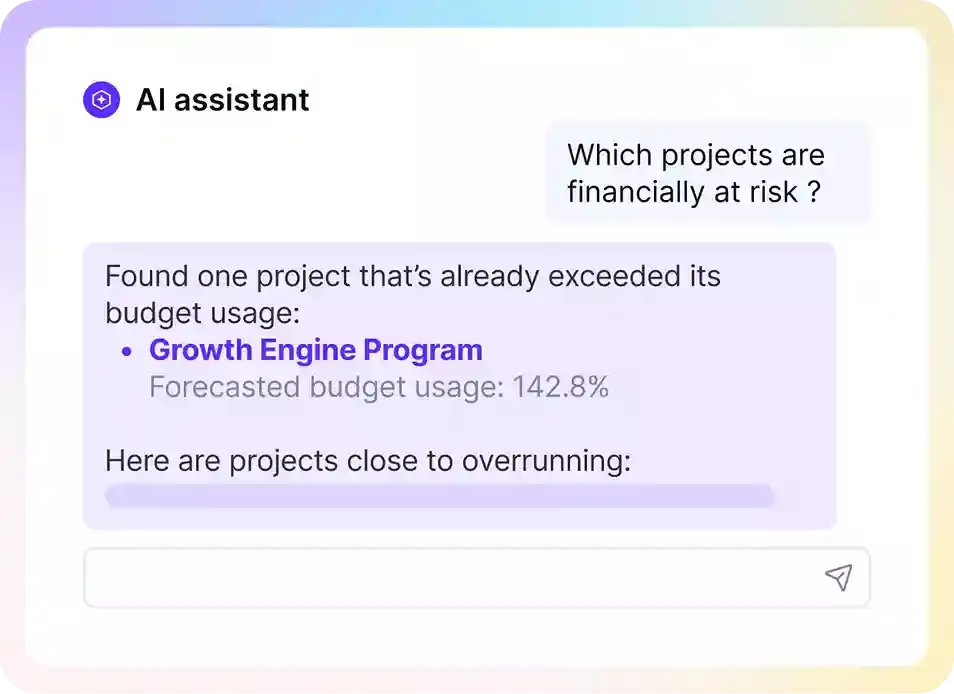
Ask AI for insights in plain language in Productive.
9. It Creates Better Client Relationships
Project management builds better client relationships by setting expectations at the start and reporting against them throughout the engagement.
Clients get regular updates on progress and spend, in language that leaves little room for misinterpretation, so decisions don’t stall due to a missing status. That predictability is what earns the next project and the retainer after it.
10. It Helps Businesses Think About the Future
Project management helps businesses think about the future by turning what happened on one project into the plan for the next.
Post-mortems record what went right and wrong, and performance data show where the estimates were off; both feed the next scope and quote. Continuous improvement runs on that. Each finished project leaves behind data the next quote can be built on.
What Is Project Management?
Project management is the practice of planning, executing, and closing work so it lands on time, on budget, and at the agreed quality. The purpose of project management is to make that outcome repeatable rather than accidental.
In professional services, it covers capacity planning, task and timeline management, client communication, budgeting, and billing.
What Are the Phases of the Project Management Process?
The project management process follows five phases across the project lifecycle: initiation, planning, execution, monitoring and control, and closure.

We’ll take a closer look at each.
Initiation
Initiation is when you decide whether the project is worth pursuing and obtain formal approval to start. It covers:
- Developing a business case: Involves analyzing the benefits, costs, risks, and alternatives to justify why a project should be undertaken.
- Conducting feasibility studies: Assesses whether the project is viable technically, financially, and operationally before committing resources.
- Creating a project charter: Formalizes the project’s objectives, scope, stakeholders, and authority, serving as an official go-ahead for execution.
Before the charter is signed, check team capacity, name the people and skills the work will need, book them, and agree the main project goals with the client.
Planning
Project planning turns the approved charter into a plan with scope, task assignments, milestones, and resource allocation.
It sets dates and budgets you can defend and flags the risks that could move either. A risk register is the usual home for that:
each risk described, categorized by type, with an owner and an action plan attached.
Execution
Execution is where the plan becomes delivered work, run through whichever approach the team has chosen. This is the phase where project management software carries the most weight:
- Tracking progress on work and timelines
- Preventing miscommunication
- Updating plans on time
- Monitoring budgets and controlling project costs
- Generating real-time reports for performance analysis
Monitoring and Control
Monitoring and control means comparing what the plan promised against what the work is actually doing. It runs the whole length of the project rather than sitting as a stage between execution and closure.
The basic setup is a visualization of the plan plus planned vs actual analysis across the metrics you care about. Watch spend against delivered work. If half the budget is gone and 20% of the deliverables are done, you have something to raise this week, not at invoicing.
The problem is that nobody checks on a quiet week. A budget can be 70% spent before anyone opens it, and by then the options are worse.
With Productive’s Budgeting, logged time and expenses track budget spend as the work happens, and custom alerts fire at a threshold you set, so the budget comes to you instead of waiting to be checked.

Track your project budgets in Productive.
Track budgets before they overrun in Productive.
Closure
The closing phase is when you’ll ship your product or project deliverables to the client. For some projects, closure concludes the entire engagement, but for others, it is followed by additional activities.
For a software development project, launching an app might be followed by user testing and bug fixes. A marketing campaign might be followed by gathering insights and reporting on results. Closure itself usually breaks down as follows:
- Formal sign-off mitigates risks by guaranteeing all stakeholders acknowledge project completion, preventing future disputes and establishing clear accountability.
- Resource reallocation optimizes organizational efficiency by releasing team members and equipment for deployment to new priorities.
- Knowledge management transforms experience into organizational know-how through documented lessons learned, strengthening your organization’s project management maturity.
How Do Teams Organize Project Work?
Teams organize project work using Agile, Waterfall, Scrum, Kanban, and Lean, and these five do not all describe the same thing. Agile and Waterfall describe how you sequence work; Scrum and Kanban describe how a team runs day-to-day; and Lean is a way of thinking that both the Scrum Guide and the Kanban Guide cite as an influence.
- Agile: the name commonly used for iterative, change-friendly ways of working. The Agile Manifesto, which named it, sets out four values and twelve principles rather than a step-by-step method.
- Waterfall: a predictive way of working, where each phase is completed before the next begins. It suits projects with well-defined requirements and fixed scopes.
- Scrum: a lightweight framework for delivering work in fixed-length Sprints, with five events and three artifacts defined in the Scrum Guide.
- Kanban: a strategy for optimizing the flow of value through a process, built on three practices and made visible on a board.
- Lean: a way of thinking about creating value with fewer resources and less waste, and a practice of continuous experimentation alongside that.
Our guide to what project management is covers all five in depth, along with the techniques you apply inside them.
How Is Project Management Changing?
Two trends in project management are visible right now: AI tools taking over parts of the admin, and a wider mix of predictive, adaptive, and hybrid ways of working.
AI now covers work that used to sit with the project manager by hand: transcribing meetings, summarizing them, and turning what was agreed into tasks.
Productive’s AI Notetaker records a meeting, produces a transcript, and converts action items into tasks and to-dos inside Productive, so a decision made in a call does not have to be typed up again afterward.
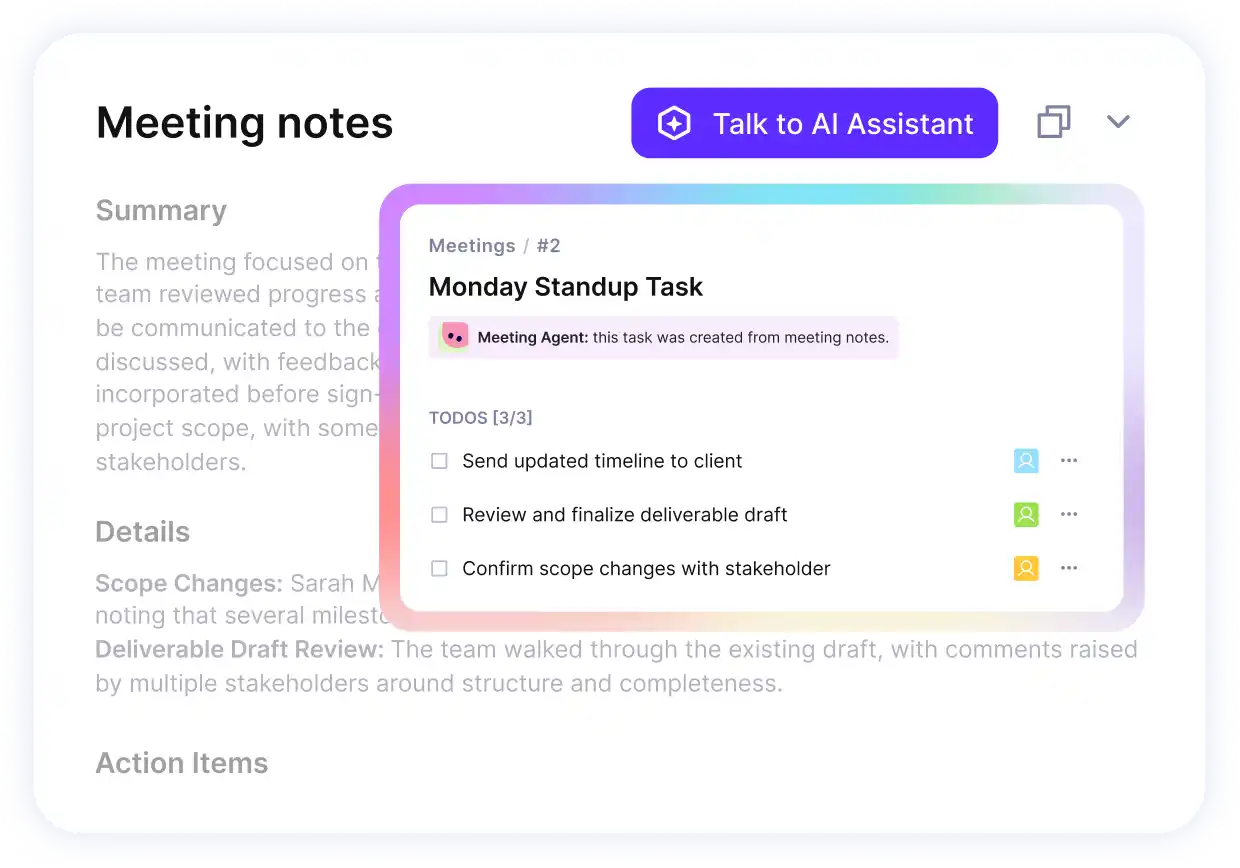
Turn meeting notes into actionable tasks.
What Are the Characteristics of Project Management?
Project management is goal-oriented and time-bound, follows a structured process, runs on cross-functional collaboration, demands adaptability and problem-solving, and depends on quality control. Those six are also what project management needs to work. We’ll take a closer look at each.
Goal-Oriented
Project management is goal-oriented because every task, resource, and timeline points back to one defined project objective. That objective might be launching a new product or completing a system upgrade, but it is agreed before any work starts.
Time-Bound
Projects are time-bound, with a fixed start and end date. One of the key responsibilities of a project manager is to ensure deliverables are completed within that window, often under tight deadlines.
Structured Process
Project management follows a systematic process, broken into phases such as initiation, planning, execution, monitoring, and closure. Each phase has its own tasks and deliverables, so the handoff between them is explicit rather than assumed.
Cross-Functional Collaboration
Cross-functional collaboration means the project draws input from multiple departments and stakeholders simultaneously. Project managers keep that communication moving, so teams are not working from different versions of the same plan.
Adaptability and Problem-Solving
Adaptability and problem-solving mean absorbing unexpected challenges without losing the timeline. Even with careful planning, they still come up, and an effective project manager pivots quickly rather than waiting for the plan to catch up.
Quality Control
Quality control means checking outputs against the agreed standards and stakeholder expectations before they reach the client. Those checks are built into the process, so work is verified as it is delivered rather than questioned after sign-off.
Six Sigma formalizes this as a methodology, using the DMAIC cycle: define, measure, analyze, improve, and control.
What Does a Career in Project Management Look Like?
A career in project management starts with a degree, runs on delivery, and communication skills. Earnings follow experience, role, and industry. We’ll take a closer look at each.
Degrees
A common degree in project management is a business degree, which teaches soft skills such as leadership, communication, and problem-solving. For specific industries, knowledge of the field is often preferred. In construction, for example, understanding engineering principles, safety regulations, and site logistics carries real weight.
Skills
Some of the main skills for project managers include: communication, management, leadership, planning and coordination, customer service, operations, and problem-solving. Experience with project management, CRM, and other types of industry-specific software is also usually required.
Salaries
Built In puts the average US project manager base salary at $97,395, with average additional cash compensation of $12,040 and total compensation of $109,435. The median sits lower, at $90,000.
Those figures come from employees’ anonymously reported salaries, so treat them as a reference point rather than a benchmark. What an individual earns still depends on experience, role, industry, and location.
Keep Track of Your Projects in One Place
The case for project management comes down to visibility: knowing where a project stands on time, budget, and scope while there is still room to change the outcome. Structure, ownership, and reporting are the means to get there.
It gets harder when the data lives in three places. A project tool holds the tasks, a timesheet holds the hours, and a spreadsheet holds the budget, and the three only line up when someone sits down to reconcile them. Productive runs projects, time tracking, budgets, and resourcing in one platform, so budget spend tracks the hours as they are logged.
Book a demo with Productive to see how it can support your professional services business.
Deliver Profitable Projects With Productive
Switch from multiple tools and spreadsheets to an all-in-one software for professional services businesses.
