Project Charter: Definition, Purpose, and How To Write One

A project charter is a document that lays the foundation for any successful project. It’s a roadmap that aligns the project with business goals and is often created and managed using project management tools.
This article will teach you all about project charters, their purpose, best practices, and how to write one.
Key Takeaways
- A project charter is an essential project management document that outlines a project’s scope, objectives, required resources, deliverables, and key decision-makers.
- It serves as a roadmap for project execution and helps align the project with company goals.
- Effective project charters engage stakeholders, establish measurable success criteria, and specify resource and budget constraints.
What Is a Project Charter?
A project charter is a formal document that defines a project’s vision, purpose, scope, objectives, and key stakeholders. It is the formal approval to start work, not the plan for doing it. The detailed project plan comes afterward.
It is typically the first formal document created in the project lifecycle, drafted in the project initiation phase and approved by the sponsor before planning begins. It centralizes the project objectives and budget in one place and identifies the key stakeholders who can approve changes, so decisions don’t stall while the team works out who can sign.
The same format scales. A program charter authorizes a group of related projects under a single sponsor. A charter for business change, such as a tooling migration, ties internal work to a strategic goal in the same way a client project’s charter does.
For an agency, that means agreeing on the goal, the budget, and the client-side approver before a single task is assigned, rather than starting work based on an email thread and an unsigned proposal.
The next section covers what the charter is for.
What Is the Purpose of a Project Charter?
The purpose of a project charter is to provide project alignment, facilitate stakeholder communication, and serve as a decision-making foundation.
We’ll take a closer look at each.
Project Alignment
The document guarantees the project contributes to organizational goals, justifying the resources committed to it. It should articulate how project outcomes support specific business objectives, so that stakeholders understand its relevance.
When project and strategic goals are clearly aligned and documented, it’s easier to gain buy-in from key decision-makers, like the project’s steering committee. That increases the likelihood of positive project outcomes.
Stakeholder Communication
Everyone involved in the project lifecycle needs to be on the same page. This formal document serves as a reference point for all communication, consolidating the goals, scope, deliverables, timeline, requirements, and resources in one place.
It serves steering committee members, project managers, and the project team alike. When someone asks whether a request is included, they can check it against the charter rather than reopen the debate.
Decision-Making Foundation
Beyond aligning goals and fostering communication, the document defines the authority levels of project decision-makers: who reports to whom and who has the authority to make significant project decisions.
Those three purposes are served by a fixed set of elements, covered next.
What Are the Key Elements of a Project Charter?
The key elements of a project charter are the project objectives and benefits, the scope, the timeline and milestones, the stakeholders, the roles and responsibilities, the budget and resources, and the risks and assumptions.

We’ll take a closer look at each.
Project Charter Objectives and Benefits
The document must include a detailed breakdown of high-level objectives. They should be specific, measurable, achievable, relevant, and time-bound (SMART objectives). Each project objective needs a success criterion someone can check without asking you, which usually means a number and a date. Benefits should align with business goals.
Scope
This element, often written up as the project scope statement, outlines the boundaries and deliverables of the project. It defines what is included and excluded, so nobody assumes a deliverable that was never quoted. Specify the objectives, the deliverables behind each milestone, and any constraints or assumptions.
Timeline and Milestones
A charter carries a high-level overview of the schedule, not a task-level plan. Your project timeline should outline the key phases, activities, and deliverables, while the milestone schedule marks each major milestone in the project’s progress. The date beside each one is what a sponsor checks first.
Project Charter Stakeholders
One essential aspect of developing a thorough charter is identifying and engaging key stakeholders. You’ll need to determine who will be impacted by the project, who can influence its success, and who has a vested interest in the outcome.
This includes project sponsors, the project team, end-users, and external parties. Anyone you miss here is a risk to the first decision that needs their sign-off.
Roles and Responsibilities
Sometimes, people involved in the project step on each other’s authority zones. This often hampers the project execution; in some cases, it can spell disaster. The root of this problem is miscommunication, and the charter addresses it by clearly defining managerial roles and responsibilities. Key roles typically include:
- Project sponsor championing the initiative
- Project manager overseeing day-to-day activities
- Subject matter experts providing specialized knowledge
- Team members executing tasks
- Stakeholders providing input and feedback
Documenting responsibilities guarantees accountability by removing the risk of two people claiming the same decision. Regularly review and update roles as the project evolves to maintain alignment.
Budget and Resources
The document needs a high-level overview of the resources required to reach each milestone. This key element defines the budget parameters in project initiation, so specify the financial side first: the high-level budget, the funding sources, and any constraint that puts the ceiling at risk.
Then outline the personnel, equipment, materials, and tools the project needs so that resources can be allocated against the objectives and deliverables. The ceiling you write into the charter is only useful if someone is watching it.
With Productive’s Budgeting, each project budget carries the estimated hours, and Time Warnings email the budget owner once a set percentage of billable time has been tracked against the estimate.
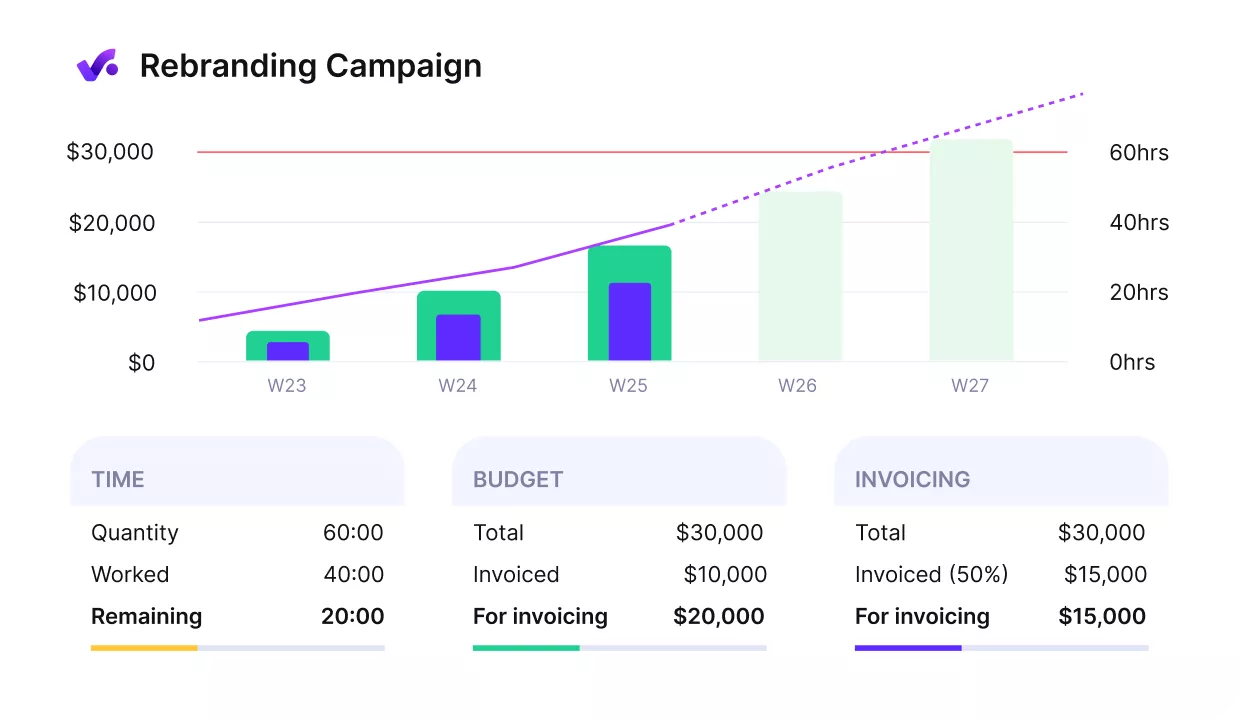
Receive a warning when budgets reach their threshold in Productive.
That turns the spending limit into an alert rather than a figure someone has to remember.

Integrated budget control is a major differentiator: tracked time is automatically reflected in budget consumption, so project profitability is visible in real time.

Read the full customer story on how DonQ grew in complexity with full operational control with Productive.
Risks and Assumptions
Identifying potential risks and clarifying assumptions are the essential elements that close the charter. Every project plan needs a risk register that lists all potential risks and their mitigation strategies. Think about the following:
- Are there any budget constraints that could hinder progress?
- What are the technological gaps or dependencies?
- Do stakeholders have disagreements or misaligned expectations?
- Are there any external factors like market shifts or regulatory changes that might impact the project?
- Are enough resources available, or are there any allocation challenges?
Write down the assumption sitting behind each risk as well. Assumptions are easy to skip, and an assumption that turns out to be wrong can trigger the first change request.
With the elements clear, the next question is timing.
When Should You Create a Project Charter?
You’ll typically create the charter during the project initiation stage, before planning starts, and send it for approval as strategic planning begins. Project chartering at this point pinpoints the goals and constraints before scope creep can appear. That happens during the initiation and strategic planning stages.
We’ll take a closer look at each.
Initiation Stage
The initiation stage is where the charter’s essential elements get drafted, not signed. Nothing is approved yet, so treat every figure here as a first estimate you will have to defend. Work through the following:
- Define the project’s purpose, objectives, and overall extent.
- Identify key stakeholders and their roles.
- Establish a preliminary budget and timeline.
- Assess potential risks and constraints.
- Obtain approval and commitment from the project sponsor.
Strategic Planning Stage
The charter gets its formal approval during strategic planning, which is why you draft it early. Review it once more before sending, so any disagreements surface in writing rather than in a meeting. That sign-off releases the resources behind the work and confirms the project manager’s authority to spend them. Sign-off usually comes from:
- Executive sponsors
- Key stakeholders
- Functional managers
- Financial controllers
- Regulatory bodies
A charter written for a sponsor rarely reads well for everyone on that list. If the charter lives in Productive Docs, AI can summarize it for an approver who only needs the decisions, translate it for a client team, or shorten it before a review.

Easily translate, edit, or summarize project charter documents with Productive’s AI features
Once you know when the charter is due, the next section walks through writing it.
How Do You Write a Project Charter?
You write a project charter in five steps: define the project goals, establish the scope, identify stakeholders, create an implementation plan, and develop budget estimates.

We’ll take a closer look at each.
Step 1: Define and Write Down Project Goals
Clearly defined project goals are what the rest of the charter hangs on. Write each one as an outcome someone can check against later, not as an intention. Make sure the goals are:
- Specific
- Measurable
- Achievable
- Relevant
- Time-bound
- Define Project Purpose
Then define the project purpose. The purpose statement explains why the work is being funded and what it aims to achieve. Tie it back to the strategic goal it supports and keep it to a few lines, since this is the part stakeholders quote back to you months later.
Step 2: Establish Scope
With the purpose set, write the project scope statement. Scope is the element you will be asked about most during delivery because it determines which deliverables are included and which are excluded. Clear exclusions are what keep scope creep out of the build phase. Consider the following when defining the scope:
- Deliverables and key milestones
- Resources and budget
- Timelines and deadlines
- Assumptions and constraints
- Stakeholders and their expectations
Step 3: Identify Stakeholders
A key stakeholder is anyone affected by the project’s outcome or able to influence it, including the project team, sponsors, customers, and end-users. Engage each one early, together with the project team, to gather their input and expectations while the charter is still a draft. Our guide to project stakeholders covers how to map them.
Step 4: Create an Implementation Plan
The implementation plan sets out how the work will be executed across the project lifecycle. It breaks the charter’s high-level overview into phases, with each milestone and key deliverable assigned a date.
It is often developed as part of the broader project management plan, so the detail stays aligned with the objectives the charter fixed. Outline each phase, and include:
- The resource allocation plan with detailed project team responsibilities
- Timeline with key milestones and dependencies
- Risk assessment and a risk management plan with mitigation strategies
- Quality assurance and control measures
- Communication plan with reporting protocols
A well-defined implementation plan coordinates key participants and the resources behind them once delivery begins.
Step 5: Develop Budget Estimates
Budget estimates come last, once the goals, scope, stakeholders, and phases are set. Include every actual cost you can name (labor, materials, equipment, contingency) and validate the assumptions with the project team who will do the work.
Check the total against past projects of a similar size, since the figure is a claim on resources someone has to approve. Break the figures down by category and record the reasoning behind each one, because those are what you will be asked to justify.
Pulling those past projects together takes time. The numbers exist, but they could be spread across closed budgets and old reports.
AI Reports in Productive take that step off your plate: describe the report you want in plain language, and it’s built for you.
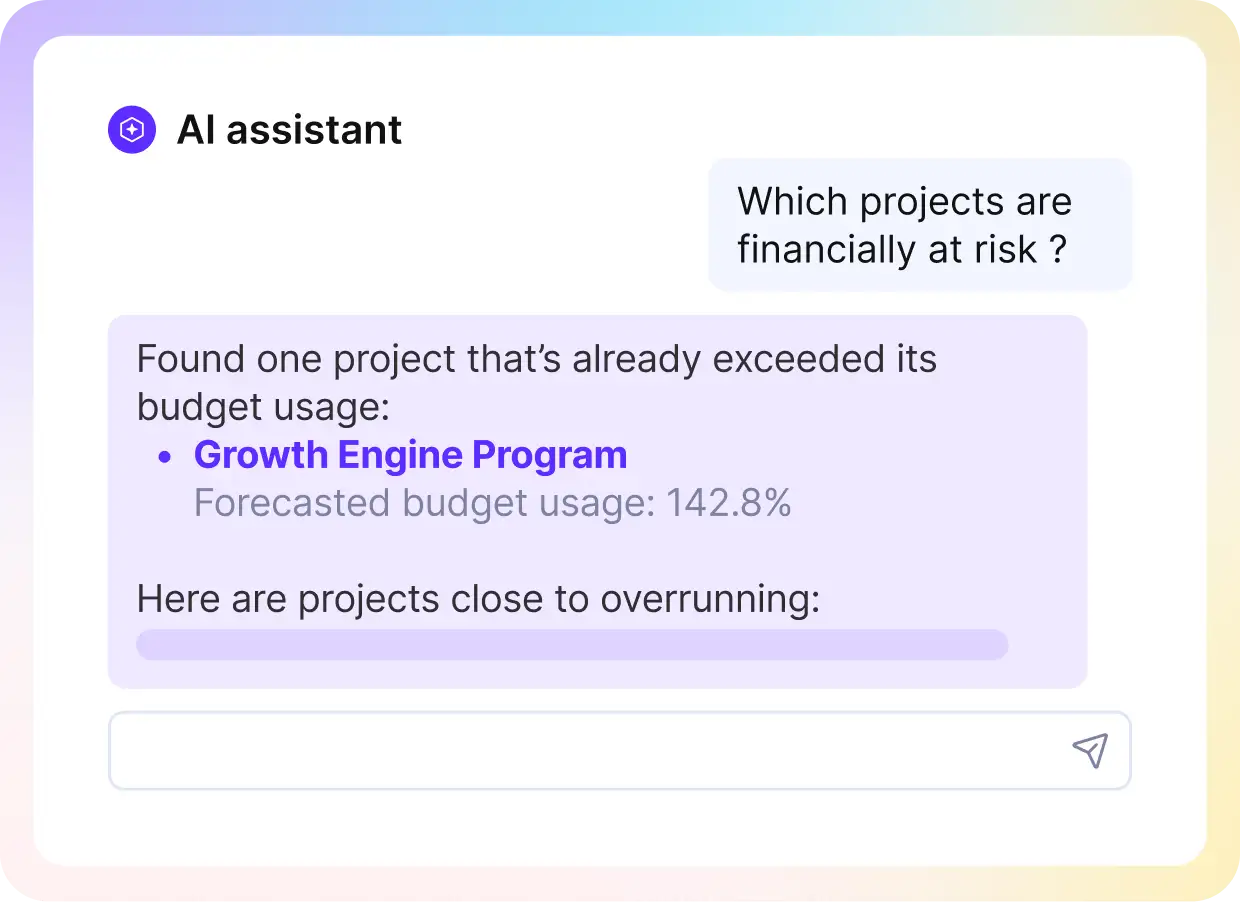
Ask AI for insights in plain language with Productive.
Ask for the cost of last year’s website builds, for example, and you have the comparison in front of you, so you can provide a solid estimate.
Build AI reports in Productive
With the charter written, it helps to be clear on how it differs from the documents around it.
What Are the Differences Between a Project Charter and Other Documents?
The core difference between a project charter and other documents is what each one decides: the charter authorizes the work, the project plan details how it runs, and the business case argues whether it should happen at all. Below are the project plan differences and the business case differences. We’ll take a closer look at each.
Project Plan Differences
The charter authorizes the work and records its essential elements at a high level, while the project plan is the detailed roadmap for executing it once delivery starts. The project plan typically includes:
- Scope statement
- Work breakdown structure
- Thorough resource allocation plan
- Timeline and milestones
- Risk management strategies
Business Case Differences
Both are formal documents from the project initiation phase, but they answer different questions. The business case assesses whether the project is viable by weighing costs, benefits, and risks against the strategic goal it serves. The charter assumes that the answer is yes and records the scope, objectives, and key deliverables the sponsor is authorizing.
Knowing where the charter stops makes the best practices below easier to apply.
What Are the Best Practices for Project Charters?
The best practices for project charters are to write goals as measurable outcomes, state a budget ceiling, list what is out of scope, name one approver per decision type, and focus on the risks that carry a cost. We’ll take a closer look at each.
- Write project goals as measurable outcomes with a date, each tied to an organizational goal. For example, replacing “improve client reporting” with “deliver a weekly automated dashboard by week six” gives the project team a success criterion to point to later.
- State a budget ceiling, not a range. Name the estimated hours, the blended rate, and the figure past which work stops until someone approves more.
- List what is out of scope beside what is in the project scope statement. The exclusions are the first thing you check when a new request comes in.
- Name one approver per decision type, so a change to budget, timeline, or scope has a single person who can say yes in writing.
- Focus on the risks that carry a cost, each with a mitigation and a named owner.
The next section shows how these elements look in a real charter.
What Does a Project Charter Example Look Like?
One example of a well-structured charter comes from Harvard Library. Harvard Library Technology Services published the charter for DRS Futures, a multi-year project to modernize the university’s Digital Repository Service, the system that preserves Harvard’s digital collections. It is a public document so that you can read the DRS Futures project charter alongside this summary.
The charter opens with a problem and value statement: after more than 20 years of incremental enhancement, the existing repository has reached the limits of its original design.
The vision that follows commits to the sustainable, long-term preservation of and access to university digital content, and the approach emphasizes transparency, stakeholder engagement, and consideration of both open-source and commercial solutions.
Scope is split explicitly into what is in and what is out:
- In scope: four phases: Preparation, Discovery, Planning, and Implementation.
- Out of scope: digital content production, cataloging, discovery, dissemination, and reuse.
Deliverables are listed per phase:
- Preparation: the project charter itself, a timeline, a communication plan, governance reporting, and hiring.
- Discovery: a literature review, requirements, stakeholder consultation, and use cases.
- Planning: a solution landscape survey, an RFP, migration plans, and specifications.
- Implementation: repository deployment, data migration, testing, training, and decommissioning of the old system.
Stakeholders are named by role rather than by person:
- Business owner: Digital Preservation Services.
- Technical owner: Library Technology Services.
- Collection managers and large-scale content producers, as the people whose material the system holds.
- Project Executive Committee and ITCRB oversight, as the governance and funding bodies.
The schedule is set at the phase level, with dates rather than tasks:
- Discovery: July 2022 to summer 2023.
- Planning: summer 2023 to June 2024.
- Implementation: July 2024 to summer 2026.
Constraints, assumptions, and risks close the document: three-year ITCRB funding and finite staffing as constraints, product availability and stakeholder participation as assumptions, and staffing turnover and solution underperformance as the two named risks.
Against the key elements from earlier in this article, the charter covers objectives, scope, timeline and milestones, stakeholders, and risks and assumptions in full. Roles appear only as owner units and budget only as a funding constraint, which is where a client-facing version would add named people, a figure, and a cost on each risk.
Keep the Project on Track in One Place
A project charter is the formal approval to start work. It records the goals, scope, stakeholders, budget, and risks in a single document, so the people delivering the project and the people paying for it can check requests against the same reference. Written during initiation and referenced across the project lifecycle, it is the document that answers “what did we agree?” months later.
That reference only holds if the numbers behind it stay current. Once delivery starts, the scope, the approved hours, and the risk log tend to end up in different tools. Productive keeps tasks, budgets, time tracking, and docs in one system, so the charter’s figures can be checked against actual hours instead of memory.
Book a demo or start a free trial to see how Productive keeps your charter and your project data in one place.
Manage Project Documentation and Reports With Productive
Keep every aspect of project management in one place. Switch from multiple tools and spreadsheets to an all-in-one solution for project, financial, and resource management.
