Lean Project Management: Principles, Tools & Implementation

Lean project management is a method for optimizing project processes. It applies lean principles to maximize value and cut waste, usually with support from a PM platform.
By the end of this article, you’ll know the five principles of lean project management, its benefits, the tools that support it, the challenges you can hit on the way, and how to implement it.
Key Takeaways:
- Lean project management focuses on maximizing customer value while minimizing waste.
- The five core principles are identify value, map the value stream, create flow, establish pull, and pursue perfection.
- The main tools are the Deming Cycle (PDCA), Kanban, and Lean Six Sigma.
- Successful implementation requires cultural change and ongoing training, plus openness to experimentation.
What Is Lean Project Management?
Lean project management is a methodology that identifies and delivers value from the customer’s perspective while eliminating waste from the delivery process.
Waste is work the client would not consider worth paying for. In a professional services business, that often looks like waiting on approvals, reworking files after feedback, or building past what the brief asked for.
The test is simple. If a task doesn’t move a deliverable closer to what was agreed, it’s a candidate for removal.
Lean program management applies the same test one level up. It covers a portfolio of related projects rather than a single engagement.
What Is the History of the Lean Project Management Methodology?
The history of the lean project management methodology starts at Toyota and reaches project work decades later.
According to the Lean Enterprise Institute, “Kiichiro Toyoda, Taiichi Ohno, and others at Toyota” began developing these ideas “in the 1930s, and more intensely just after World War II,” inventing the Toyota Production System.
The thinking reached a wider audience through The Machine That Changed the World (1990), by James P. Womack, Daniel Roos, and Daniel T. Jones. In Lean Thinking (1996), Womack and Jones “distilled these lean principles even further to five.”
Lean has since spread well beyond car factories. The same source lists “logistics and distribution, services, retail, healthcare, construction, maintenance, and even government” among the fields now using it.
Now that you know what lean is and where it came from, let’s talk about its five principles.
What Are the Five Principles of Lean Methodology?
The five principles of lean methodology are identifying value from the customer’s perspective, mapping the value stream, creating continuous flow, establishing pull systems, and pursuing perfection. These are the five principles that Womack and Jones set out in Lean Thinking.
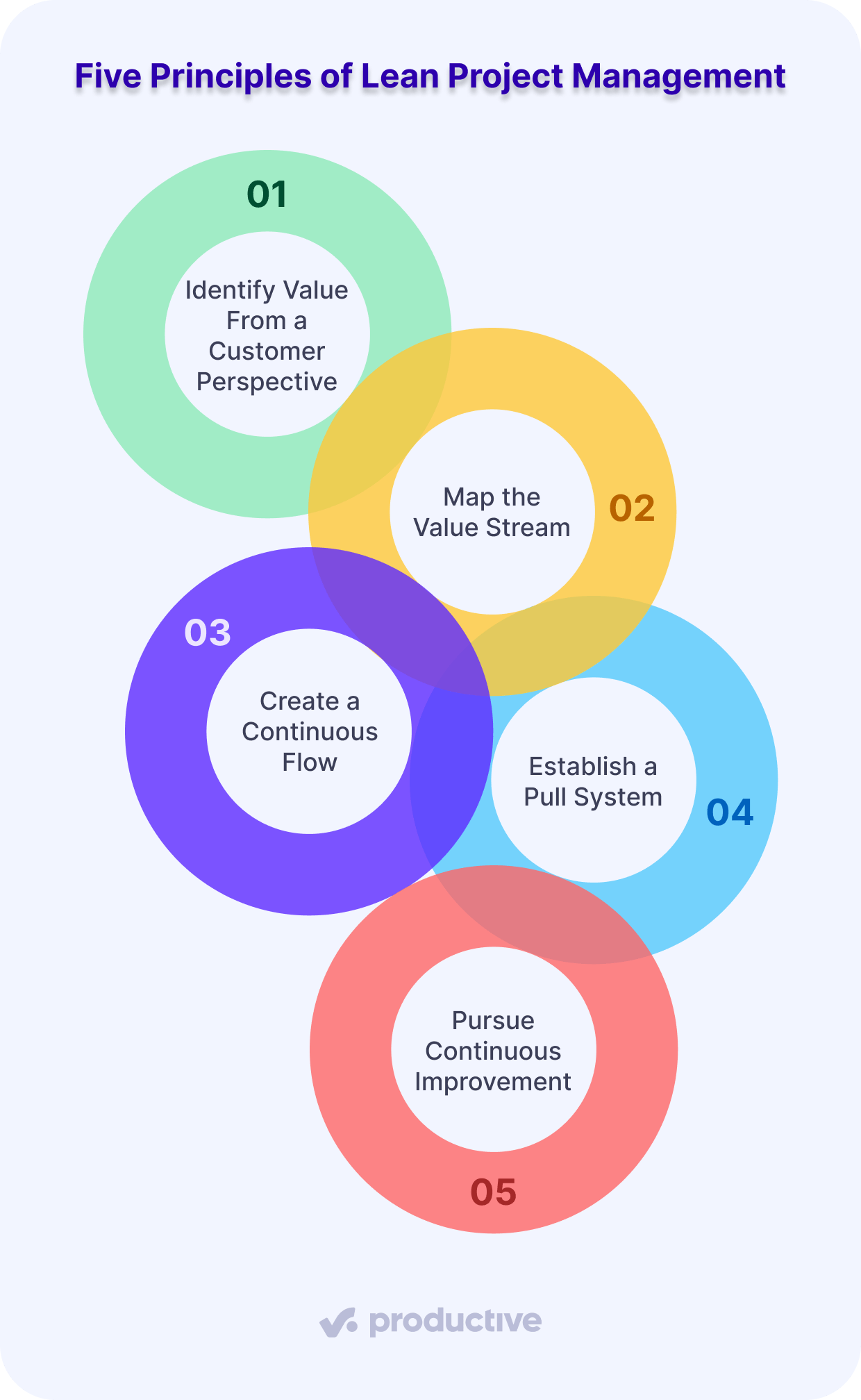
First Principle: Identify Value From a Customer Perspective
The starting point is understanding what customers actually need. When project teams focus on customer value, they can:
- Prioritize tasks and resources effectively, reducing waste and lowering the risk of project failure.
- Align with customer expectations so clients get what they were promised.
- Create pull systems that start work only when there’s real customer demand, preventing tasks and resources from piling up.
- Cultivate direct customer communication to clarify objectives, requirements, and acceptance criteria.
The goal is a customer-centric approach to project management. It translates to better outcomes and higher customer satisfaction.
Second Principle: Map the Value Stream
Mapping the value stream means documenting every step between a client request and a delivered result.
This involves examining each stage of the project lifecycle, from initiation to completion. Teams document the actions taken, the resources used, and the time spent.
Analyzing Current Workflow
A value stream map (VSM) is a visual representation of all actions and processes in your project. It helps you separate value-adding activities from non-value-adding ones.
A VSM helps you:
- Highlight the types of waste in your current workflow.
- Pinpoint areas for process improvement.
- Establish a baseline for efficiency.
- Set targets for improving continuous flow.
- Update the map regularly to reflect changes.
Third Principle: Create a Continuous Flow
Continuous flow means work moves through your pipeline without stalling in queues, handoffs, or approval gaps.
By tightening critical activities, you reduce bottlenecks and keep transitions between tasks smooth. That removes unnecessary handoffs and delays, and productivity and capacity go up.
Implementing Pull Systems and Streamlining Process
The idea behind a pull system is to start work only when there’s real customer demand. That way you keep a steady flow of tasks and reduce excess inventory waste.
More on pull systems in the next principle.
Reducing Bottlenecks
Bottlenecks disrupt the flow of work and cause delays that hit the entire project timeline.
Consider using Kanban boards to visualize processes, manage tasks, and limit work in progress. To sum up, the benefits of tighter processes are:
- Elimination of waste and bottlenecks
- Smooth, uninterrupted work
- More efficient project teams, through better communication and coordination
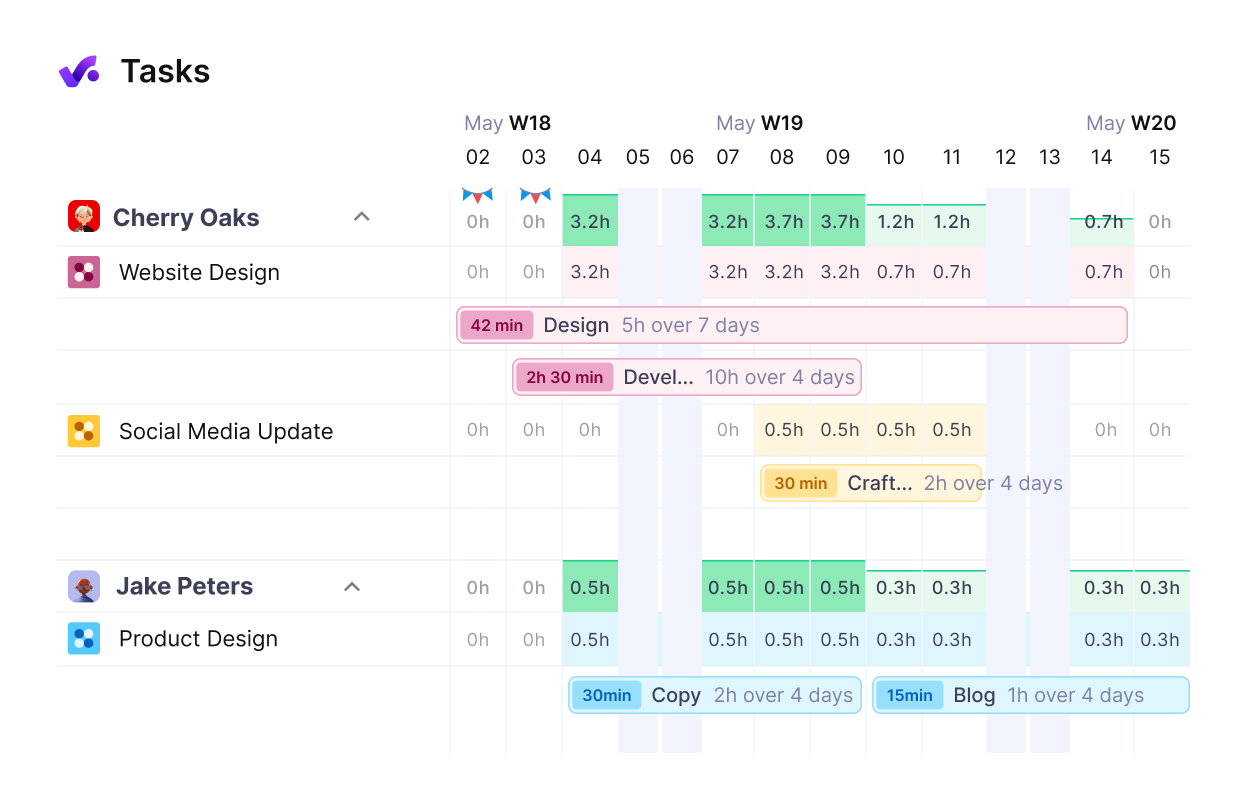
Keep your team aligned and your projects on schedule. Productive’s project management tools ensure every phase runs smoothly.
Fourth Principle: Establish a Pull System
In a pull system, you start work only when there’s real customer demand. That means just-in-time delivery and less excess inventory.
This demand-driven approach contrasts with traditional push systems. There, production runs on forecasts, and forecasts often aren’t right. Wrong input data leads to overproduction and wasted resources.
Just-in-Time Delivery
Just-in-time delivery (JIT) means the product is ready only when it’s needed. The pull system is a key component, because it starts work only when demand exists.
Excess inventory is reduced from the start, and project waste drops. Here’s how teams benefit:
- It’s easier to respond to changing demands
- Improved efficiency of the entire project management process
- Considerable reduction of lead times
- Utilize Kanban for visual workflow management
- Foster continuous improvement
Fifth Principle: Pursue Continuous Improvement
Pursuing perfection means making small, constant changes to how work runs, rather than chasing one big fix. Lean calls this practice Kaizen.
Lean project managers should reassess processes regularly and adapt to changing demands. Small changes, made consistently, add up to better outcomes.
This principle treats work systems as dynamic, so new opportunities for optimization keep appearing. Pursuing perfection through Kaizen leads to:
- Enhanced operational efficiency through small, incremental changes
- Reduced project waste
- A healthier collaborative culture
- An ongoing process that keeps pace with evolving demands
- Positive customer feedback from consistent, high-quality results
What Are the Benefits of Lean Project Management?
The benefits of lean project management are increased efficiency, reduced waste, higher customer satisfaction, and better team collaboration.
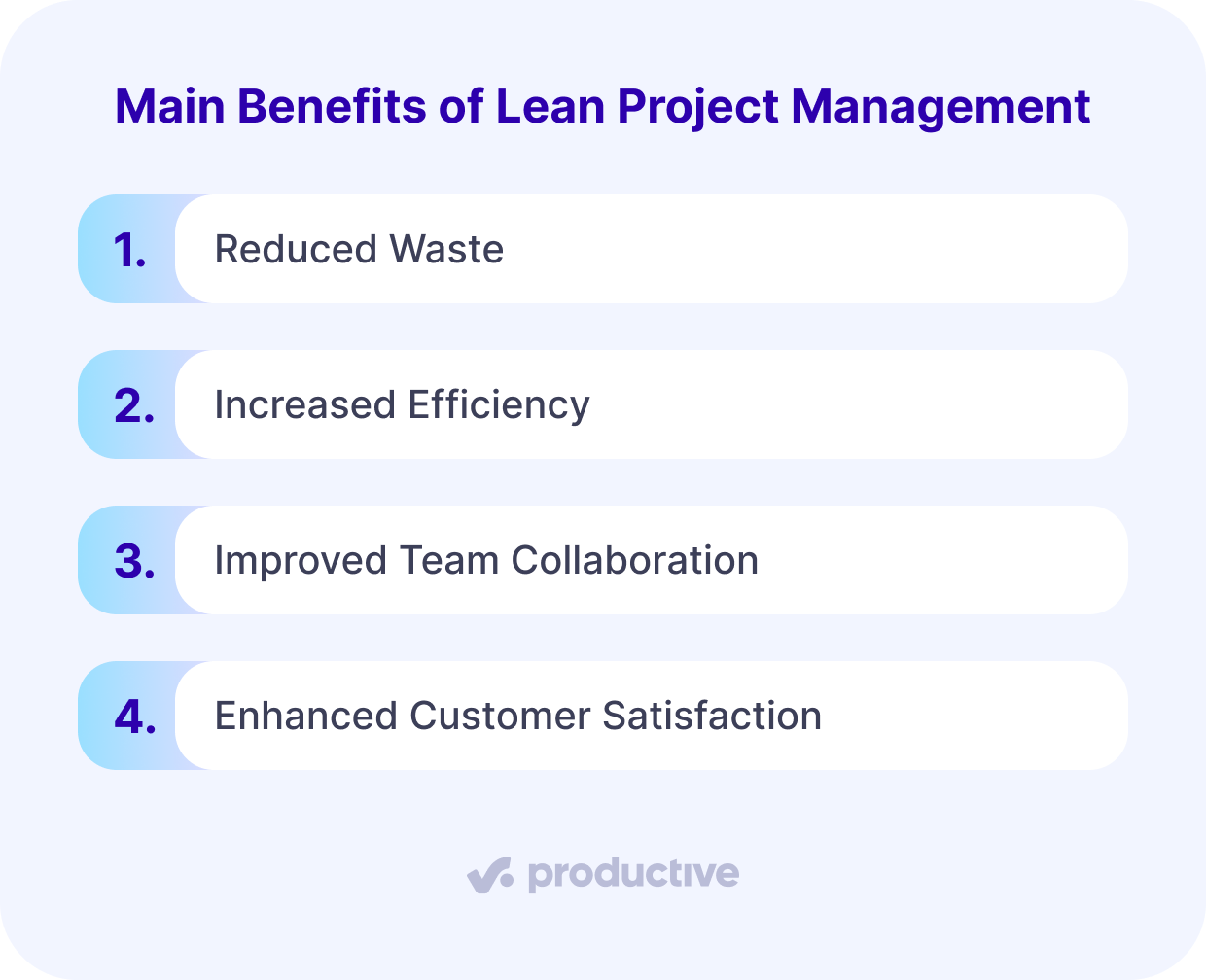
Let’s expand on each one.
Increased Efficiency
Efficiency gains show up quickly once lean principles are in play. The approach is used across industries, from construction and manufacturing to IT development and creative project management
.
Working to a structured method measurably improves outcomes. In its 2026 Pulse of the Profession, published 12 May 2026, the Project Management Institute reported that projects using frameworks succeed at a rate of 72% versus 61% without them.
The same research found that 35% of project professionals used no framework at all on their most recent complex project.
Reduced Waste
A waste-minimization focus systematically removes non-value-adding activities. As a result, you deliver more value with the same resources and reduce project costs.
Enhanced Customer Satisfaction
Because lean focuses on customer-defined value, project outcomes line up closely with what clients asked for. Happy customers are loyal customers.
Removing defects through continuous improvement also raises product quality.
Improved Team Collaboration
Collaborative tools like Kanban and value stream mapping help teams see their workflows. That leads to better coordination and more effective task management.
When team members are part of the planning process, they take more ownership and accountability. Continuous improvement initiatives also build teamwork by encouraging regular feedback and collaborative problem-solving.
Excess meetings and unclear roles are a waste too. Lean lets teams focus on value-adding work, so the clutter of extra meetings and back-and-forth debate gets cut.
Some of that waste can sit around the meeting rather than inside it as well. Productive’s AI Notetaker transcribes, summarizes, and turns action items into tasks, so you can go from meeting to work right away.
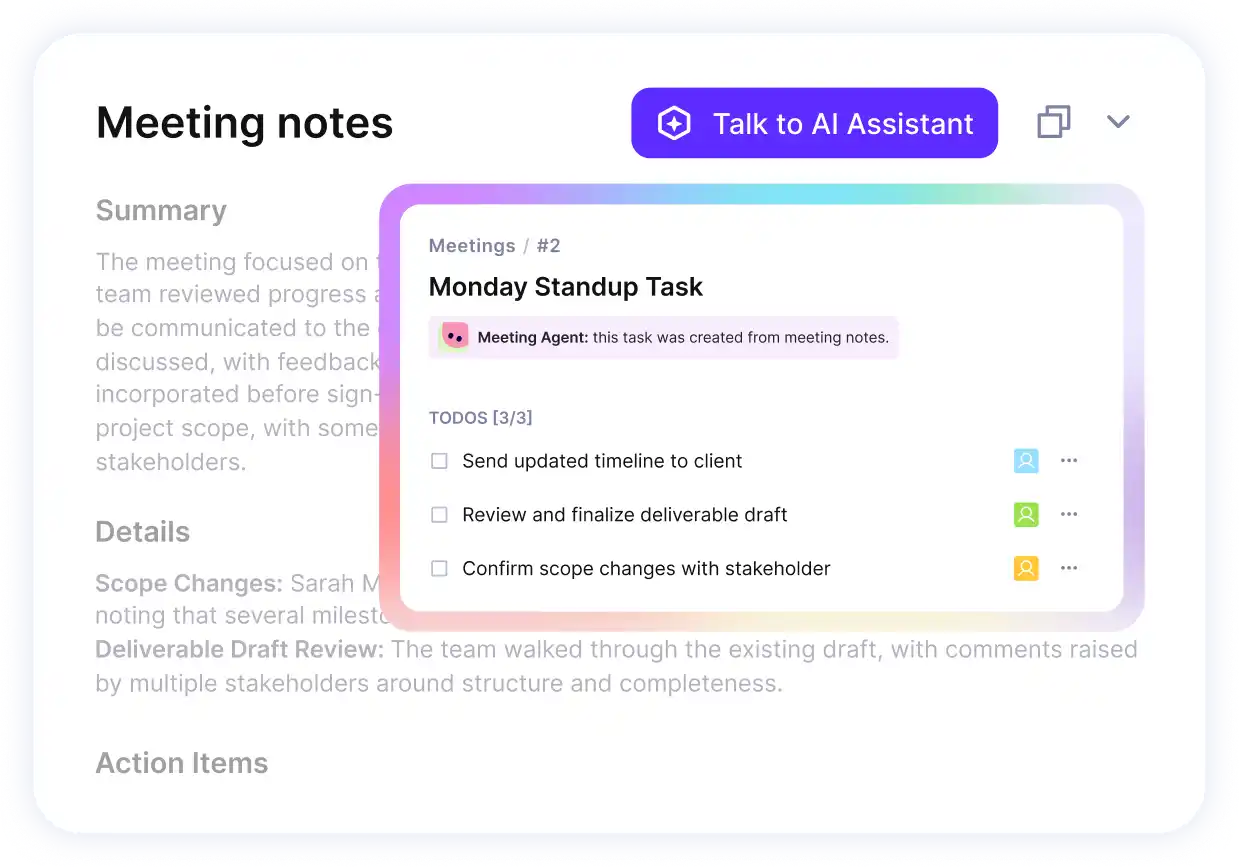
See AI Notetaker in Productive.
That removes the write-up afterward and stops decisions getting lost between the call and the board.
Turn the talk into next steps in Productive.
What Are Lean Project Management Tools?
Lean project management tools are the Deming Cycle, Kanban, and Lean Six Sigma, which includes the DMEDI framework.
All of them give you a structured way to implement changes, evaluate whether they worked, and refine them based on results. Most teams now run them inside lean project management software rather than on paper. Let’s take a better look at each.
Deming Cycle (PDCA)
The Deming Cycle, or PDCA (Plan-Do-Check-Act), is a tool for continuous process improvement. It gives you a structured framework for ongoing learning and adaptation.
The iterative approach lets you plan, implement, assess, and standardize changes systematically. It keeps projects aligned with evolving business needs.
Follow the four phases of the cycle so you can:
- Set clear objectives and develop a strategy based on data analysis.
- Implement planned changes on a small scale to test their impact.
- Evaluate results against expected outcomes to identify what worked.
- Standardize successful changes and revise unsuccessful ones.
Kanban Methodology
The Kanban methodology is a visual tool that supports lean practices. You visualize work on boards that track tasks through stages organized in columns, for example, to-do, doing, and done.
Teams get real-time visibility into project status and bottlenecks.
Kanban’s core principles are limiting work in progress (WIP), managing flow, and making process policies explicit. This pull-based system aligns work with real customer demand, reducing cycle times and improving lead times.
Teams can use physical or digital Kanban boards, which gives flexibility in how tasks get tracked. In Productive’s Project Management, the board layout does this, and the same tasks can also be viewed as a List, Table, Gantt, Calendar, or Timeline.
If you’re comparing options, see our roundup of Kanban project management software.
Lean Six Sigma Techniques
Alongside DMAIC, Lean Six Sigma uses the DMEDI framework (Define, Measure, Explore, Develop, Implement) for new process design or product development.
It guides teams through identifying customer needs, generating solutions, and implementing the most promising ones.
DMEDI Framework
The DMEDI framework is a structured approach with five phases:
- Define clear project goals and customer needs.
- Measure relevant data to assess current processes.
- Explore potential solutions to address issues.
- Develop refined solutions.
- Implement changes while monitoring outcomes.
How To Implement Lean Principles?
You implement lean principles through cultural transformation and ongoing training and development.
Let’s look at each one.
Cultural Transformation
A successful change involves more than adopting new tools and techniques. It needs a cultural transformation, where teams embrace continuous improvement as a core value.
This shift emphasizes collaboration and communication, which lifts productivity and creates shared goals. Senior management support is critical for building the right mindset and motivating teams.
Key aspects of this cultural transformation include:
- Creating an environment that encourages experimentation and learning from failure
- Providing regular training on key principles to overcome resistance to change
- Establishing clear metrics for success and evaluating project performance regularly
- Encouraging open communication among team members
- Enabling people to identify and eliminate waste in processes
Training and Development
Cultural change relies heavily on training and development programs. Ongoing education makes sure team members understand and apply the concepts correctly.
Value stream mapping (VSM) helps teams visualize workflows, identify waste, and build targeted improvement plans.
Regular training on lean methods like the 5S framework and Kanban systems improves workplace organization and workflow management.
Lean Six Sigma certification programs, available at various belt levels, provide structured learning paths that validate your team’s expertise.
Setting measurable goals during training lets you track progress in waste reduction and reinforces lean principles in daily operations.
What Are the Challenges of Implementing Lean Principles?
The challenges of implementing lean principles are resistance to change, difficulty measuring progress, and balancing lean practices with existing organizational culture.
These obstacles are common. Here’s what each one looks like in practice.
Common Implementation Obstacles
Resistance to change usually stems from a lack of understanding of lean principles, which is why ongoing training matters.
Measuring progress is genuinely hard. Without clear metrics and goals set from the outset, teams can’t tell whether a lean initiative is working.
Misalignment with existing culture can stall adoption entirely, which is why leadership commitment matters so much.
Key obstacles to watch for:
- Resistance to change, from unfamiliarity with lean principles
- Difficulty measuring progress and success
- Misalignment of lean practices with existing organizational culture
- Complexity when integrating lean with traditional project management methodologies
- Poor communication about customer value and project goals
What Helps Lean Adoption Succeed?
Lean adoption succeeds when senior management backs it, teams are trained in value stream mapping, and progress is measured against agreed waste-reduction targets.
Senior management support drives organization-wide acceptance. Without it, teams treat lean as an optional extra rather than as how work gets done.
Training in value stream mapping gives your team a shared way to spot waste. People also accept changes more readily when they can see the reasoning behind them.
Measuring against waste-reduction targets keeps the improvement honest. Review the same numbers on a regular cadence, or the initiative quietly stops.
Run Your Projects in One Place
Lean practices tighten processes, cut waste, and deliver value to customers more efficiently. Implementation brings challenges, but the gains in productivity, quality, and customer satisfaction make it worthwhile. If you want to succeed with lean projects, focus on continuous improvement, collaboration, and a willingness to adapt.
The right software makes that easier to sustain. Productive brings tasks, time, budgets, and reporting into one place, so you can see keep track of everything while there’s still time to fix it.
Book a demo with Productive and start today.
See Every Project in One Platform
Productive brings tasks, time tracking, and budgets together, so you spot a project going off track while you can still do something about it.
