Agile Values and Principles: Manifesto & Methodologies

Agile values and principles were created to help software development teams manage the dynamic project lifecycle.
In this article, we’ll go through the history of the Agile Manifesto, its key values, and its most popular practical uses across project management methodologies using PM platforms built for agile teams.
Key Takeaways
- The four Agile values include a focus on: individuals and project team collaboration, incremental progress, customer collaboration, and the ability to quickly respond to change.
- The 12 Agile principles focus on flexibility, cross-team collaboration, frequent delivery, motivated teams, simplicity, technical excellence, and continuous improvement.
- Some popular Agile project management methodologies and frameworks include: Scrum, Kanban, Extreme Programming (XP), Lean, and the Scaled Agile Framework.
What Is the Agile Manifesto?
The Agile Manifesto is a short declaration of four values for software development, written in February 2001 by 17 developers who met at Snowbird, Utah. You can read it in full at the Agile Manifesto’s official site.
One detail is worth getting right, because most articles blur it. The Manifesto itself is only the four values. The 12 Agile principles are a companion document, published separately as “Principles behind the Agile Manifesto.”
The group met to find common ground between the lightweight development methods each of them already practiced. Their shared target was rigidity. Waterfall project management, the traditional methodology, was built on the principle of everything being done in sequence. Design, then development, then testing. That order made late changes costly and time-consuming.
What Are the 4 Agile Values?
The 4 Agile values are individuals and interactions over processes and tools, working software over comprehensive documentation, customer collaboration over contract negotiation, and responding to change over following a plan. Each one names a trade-off rather than a rule.

Let’s examine each agile value in more detail:
1. Individuals and interactions over processes and tools
This value puts a focus on cross-functional teamwork and communication. Well-developed processes and tools matter, but a motivated team that works effectively matters more.
In practice, that means your software development team has balanced workloads, knows what needs to be done, and knows who owns each initiative. An open workspace to collaborate helps too. This is seen as the basis for long-term success and customer loyalty.
2. Working software over comprehensive documentation
Comprehensive documentation has real value in product development, but it can also become a trap. If a product changes rapidly, the technical specification is constantly going out of date. Keeping everything in sync can become a burden on your project scope.
This value asks teams to demonstrate progress through working software and frequent feedback loops instead. Only the most essential information gets documented, so the documentation can keep pace with development.
3. Customer collaboration over contract negotiation
This value imagines a project as a constant collaboration between a customer and the Agile team. In Waterfall, the project specification is written before design or development starts. Agile projects are expected to evolve instead.
Contracts are still part of Agile, naturally. But this approach treats the working relationship between stakeholders as the more useful mechanism. It’s a way to gather feedback during development, and to build a product that fits what the customer actually needs.
4. Responding to change over following a plan
This value treats plans as baselines that are certain to change, not commitments to defend. Agile teams still plan. They just plan at different levels of firmness:
- High-level plans (for programs and projects) act as flexible guidelines that can change over time.
- Mid-level plans (for stages and releases) provide more detail but are still expected to adapt.
- Detailed sprint or iteration plans are firm commitments to a specific goal, like delivering a product increment.
Only the shortest horizon is treated as fixed. Everything above it is a working hypothesis.
What Are the 12 Agile Principles?
The 12 Agile principles are customer satisfaction through early and continuous delivery, welcoming changing requirements, frequent delivery, daily business and developer collaboration, motivated individuals, face-to-face conversation, working software as the measure of progress, sustainable pace, technical excellence, simplicity, self-organizing teams, and regular reflection.
They expand the 4 core values into working guidance. Below, they’re grouped into three categories so they’re easier to learn: quality principles, development principles, and collaboration principles. The numbering follows those groups rather than the order in the original document.
Quality Principles
Quality principles are focused on delivering a high-quality product through the process, teamwork, and engineering practices involved in development. They include:
1. Customer Satisfaction Through Continuous Delivery: The highest priority is satisfying the customer through early and continuous delivery of valuable software. Updates should include project progress reports that both technical teams and business stakeholders can understand.
2. Building Projects Around Motivated Individuals: Give teams the environment and support they need, then trust them to get the job done. In practice, that means recognition for good work, growth opportunities, and decent working conditions.
3. Technical Excellence and Good Design: Continuous attention to technical excellence and good design enhances agility. Regular refactoring and code reviews keep software maintainable, scalable, and adaptable.
4. Simplicity: Defined in the source as “the art of maximizing the amount of work not done.” The goal is not minimal effort but minimal unnecessary output, so teams build only what carries value.
Agile Development Principles
Agile development principles provide a framework for how to organize the scope and the stages of development. These include:
1. Welcoming Changing Requirements: Change is welcome even late in development, because Agile processes harness change for the customer’s competitive advantage. Client sessions become an opportunity to improve the product, not a setback.
2. Frequent Delivery: Deliver working software frequently, from a couple of weeks to a couple of months, with a preference for the shorter timescale. Short cycles enable frequent quality checks and rapid feedback.
3. Working Software as Progress Measure: Working software is the primary measure of progress. Not documentation, not hours logged, not percentage complete.
4. Sustainable Development Pace: Sponsors, developers, and users should be able to maintain a constant pace indefinitely. Correct estimation and good leadership are what make that pace realistic.
Collaboration Principles
Finally, collaboration principles are focused on improving how team members work with each other and their clients. They include:
1. Daily Business and Developer Collaboration: Business people and developers must work together daily throughout the project. The source is specific about the frequency, which is what separates this from generic stakeholder engagement.
2. Face-to-Face Conversation: The most efficient and effective method of conveying information to and within a team is face-to-face conversation. Remote teams use video calling and collaboration platforms to approximate it.
3. Self-Organizing Teams: The best architectures, requirements, and designs emerge from self-organizing teams. The claim is about design quality, not just morale or autonomy.
4. Regular Reflection and Improvement: At regular intervals, the team reflects on how to become more effective, then tunes its behavior accordingly.

What Are the Benefits of Agile Project Management?
The benefits of Agile project management are faster feedback from clients, clearer visibility of progress, easier adaptation to change, closer customer alignment, and better team morale. Each one traces back to one of the 12 principles above.
Short delivery cycles are what produce most of them. When a team ships something usable every few weeks, problems surface while they are still cheap to fix, and stakeholders can see real progress instead of a status percentage.
That visibility depends on reporting, and reporting is often still manual work. In Digital.ai’s 18th State of Agile Report, 44% said spreadsheets and status reports supply half or more of their delivery insights. The survey ran in mid-2025 and covered 349 practitioners.
To gain those insights without building the report yourself, you can ask Productive’s AI Assistant for the project insights you need in plain language.
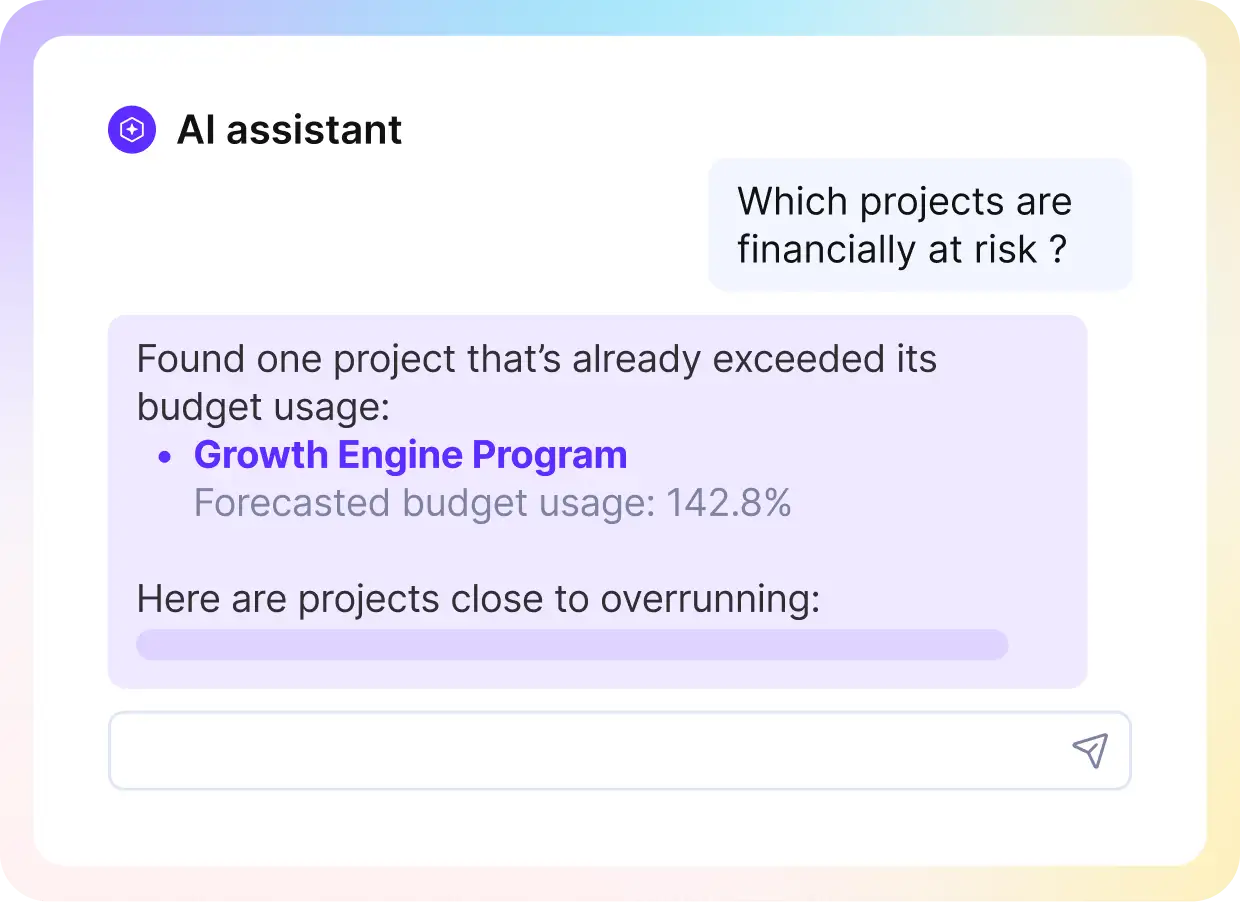
Create reports in seconds by describing what you want to see in Productive.
For more specific updates, AI can also provide a concise summary of a task’s progress, including its current status and any open blockers.
Pull up insights with AI in Productive
If you’re looking to implement Agile in your own workflows, here’s a quick overview of some methodologies within Agile and how they work in practice.
What Are Common Agile Methodologies?
The most common Agile methodologies are Scrum, Kanban, Extreme Programming (XP), Lean, and the Scaled Agile Framework (SAFe). Each has its own characteristics and practices, but they share a common goal of promoting iterative development, flexibility, and collaboration.
Here’s a more detailed exploration of popular Agile methodologies:
Scrum
If you’re looking for a structured yet flexible Agile framework, Scrum might be the right fit for your team. The Scrum framework facilitates collaboration and project management through well-defined accountabilities, events, and artifacts:
- Scrum Team: Includes the Scrum Master, Product Owner, and Developers, each with specific responsibilities. The Scrum Guide describes a Scrum Team as “typically 10 or fewer people.”
- Sprints: Fixed-length iterations of one month or less. A Scrum team aims to produce a potentially releasable increment by the end of each Sprint.
- Collaboration: A daily stand-up, or Daily Scrum, is a 15-minute event that keeps the team aligned, focused, and informed about progress.
By adhering to Scrum’s practices, your team can improve productivity, adaptability, and customer satisfaction.
Kanban
Kanban project management, from a Japanese term meaning “visual signal” or “card,” is a popular Agile methodology that helps project teams visualize work items on a board.
A Kanban board provides an open workspace for team collaboration and visualizing project progress. This supports self-organization and continuous delivery, because teams can see which tasks come next and at what priority. The basic elements of a Kanban board include:
- Columns: stages of the project workflow, such as “To Do” or “In Progress”
- Cards: individual work items, or tasks within a project
- Tags: a way to categorize work items, for example by priority or deadline
The main reported benefits include increased visibility, improved delivery speed, and better alignment between business objectives.
Managing project boards is easier with software built for it. In Productive’s customizable Kanban boards, you can rename each column to match your real stages, from Specification through Design, Development, QA, and Release.
Extreme Programming (XP)
Extreme Programming (XP) is an Agile methodology that prioritizes customer satisfaction and rapid delivery. XP enables teams to:
- Deliver frequent releases in short development cycles, typically lasting one to three weeks.
- Gather valuable user feedback and adapt quickly to changing requirements.
- Foster innovation and continuously improve the final product.
XP uses specific practices such as:
- Pair Programming: Code is written by two programmers at a single workstation, one writing and one reviewing for defects.
- Acceptance Tests: Developers write tests that verify business requirements are implemented as intended, and run them as scripts several times per day.
- Continuous Integration: The codebase is integrated and tested automatically on each check-in, so conflicts surface early.
These practices improve code quality, catch defects early, and support technical excellence in the development process.
Lean
Lean project management focuses on maximizing value by eliminating waste and improving efficiency. The Lean ideas that carry over most directly into Agile work include:
- Effective prioritization of tasks and resources, through value streams
- Alignment with customer expectations through direct communication
- Pull systems that initiate work only when there’s customer demand.
Lean draws on the customer-oriented elements of the Agile Manifesto. The Agile value it promotes most is understanding customer needs and ensuring every step in a process adds value from the customer’s perspective.
Six Sigma is a related approach that focuses on improving business processes with statistical analysis. You can learn more in our article on Six Sigma in project management.
Scaled Agile Framework (SAFe)
The Scaled Agile Framework (SAFe) is an enterprise-level approach designed to help large organizations implement Agile practices across multiple teams and projects. SAFe integrates Lean-Agile principles, emphasizing alignment, collaboration, and delivery to enable the following:
1. Coordination and synchronization among multiple development teams working towards shared objectives
2. Continuous improvement and delivery of value through incremental development cycles
3. Enhanced technical excellence and customer collaboration at scale
Another framework used for scaling Agile across an enterprise is Large Scale Scrum (LeSS).
Keep Every Project in One System
Whatever methodology you choose, Agile is best described as a state of mind, built on the Agile principles and values you adopt during development. An Agile mindset means prioritizing collaboration, adaptability, customer satisfaction, and individual interactions. Kanban, XP, Lean, and Scrum are simply different ways of putting those values into practice.
Those values get harder to hold when the work is spread across five tools. Productive keeps projects, time tracking, budgets, and resource planning in one system, so your team can run sprints and still see what a project is costing while it’s in flight.
Book a demo to see how Productive fits your delivery process.
Get Project Visibility Without Building the Report
Productive tracks time, budgets, and task progress in one place, so you can ask its AI Assistant where a project stands – instead of rebuilding a status report every week.
