Agency Time Tracking Software – Top 8 Tools Reviewed (2026)

If you are looking for the best agency time tracking software, you are right where you need to be.
Most lists compare different tools with the same feature bullets and no guidance on which fits your billing model or team setup. Here, we take a different approach. This guide compares 8 tools, each matched to a different agency situation.
Every tool includes user-based pros and cons, key time tracking features, and a clear skip signal. You also get a comparison table, a step-by-step process for choosing the right tool, and a rollout checklist.
What’s the Best Agency Time Tracking Software?
The best agency time tracking tools are Productive, Harvest, Toggl Track, Clockify, Everhour, TimeCamp, Hubstaff, and Wrike.
Which one fits depends on how you bill clients, how large your team is, and what your stack looks like. Some need a standalone timer. Others need time tracking connected to budgets, resources, and invoicing.
The Best Agency Time Tracking Tools for 2026
How We Chose These Tools
We reviewed official product documentation, help centers, and repeated user feedback patterns across G2 and Capterra for each tool. Every tool on this list earned its spot by serving a distinct agency buyer situation that no other tool on the list covers better.
Comparison Table
| Tool | Category | Best For | Free Tier | Invoicing | Automatic Tracking | AI Features | Resource Planning | Who Should Skip |
|---|---|---|---|---|---|---|---|---|
| Productive | All-in-one platform | Agencies that need time, budgets, and resources connected | 14-day trial | Yes | Yes (from resource bookings) | AI reporting, AI scheduling agents | Yes | Teams that only need a simple timer |
| Harvest | Standalone tracker + invoicing | Hourly-billing agencies under 50 people | 1 user, 2 projects | Yes (native) | No | None native (via Forecast integration) | No | Agencies needing resource planning or PM |
| Toggl Track | Standalone tracker | Teams where adoption is the main problem | Up to 5 users | No (requires integration) | Yes (desktop activity detection) | None | No | Agencies that need invoicing or budgeting built in |
| Clockify | Standalone tracker | Budget-conscious and growing firms | Unlimited users | Yes (paid plans) | Yes (paid plans) | None | No | Teams that need polished reporting or deep integrations |
| Everhour | Integrated tracker | Agencies already using Asana, Jira, or ClickUp | Up to 5 users | Yes | No | None | No | Teams not using a supported PM tool |
| TimeCamp | Standalone tracker + auto-tracking | Creative and dev teams that forget timers | Unlimited users (limited features) | Yes | Yes (AI auto-categorization) | AI time categorization from app/website activity | No | Agencies that want PM and tracking in one place |
| Hubstaff | Monitoring + tracker | Distributed, remote, or field-based teams | 14-day trial | No (payroll only) | Yes (background monitoring) | None | No | In-house creative firms where trust matters |
| Wrike | PM-first with tracking | Large agencies with complex workflows | Free plan (limited) | No | No | AI risk prediction, AI task creation | Yes | Small agencies or anyone needing invoicing |
1. Productive – Best for All-in-One Agency Time Tracking
Most time tracking tools stop at the timer. Productive keeps time tracking, budgets, invoicing, and resource planning in one platform. This means that whenever your team logs time the changes are passed on budgets and resource plans instantly.
Try the best agency time tracker
Track Hours Without Chasing Timesheets
People forget to start the timer. They fill in last week’s hours from memory on Friday, and the data is half fiction. Productive gives the team multiple ways to log time so compliance stops being a fight. Run a timer from the platform or the desktop widget.
Enter hours manually in day, timesheet, or calendar view.
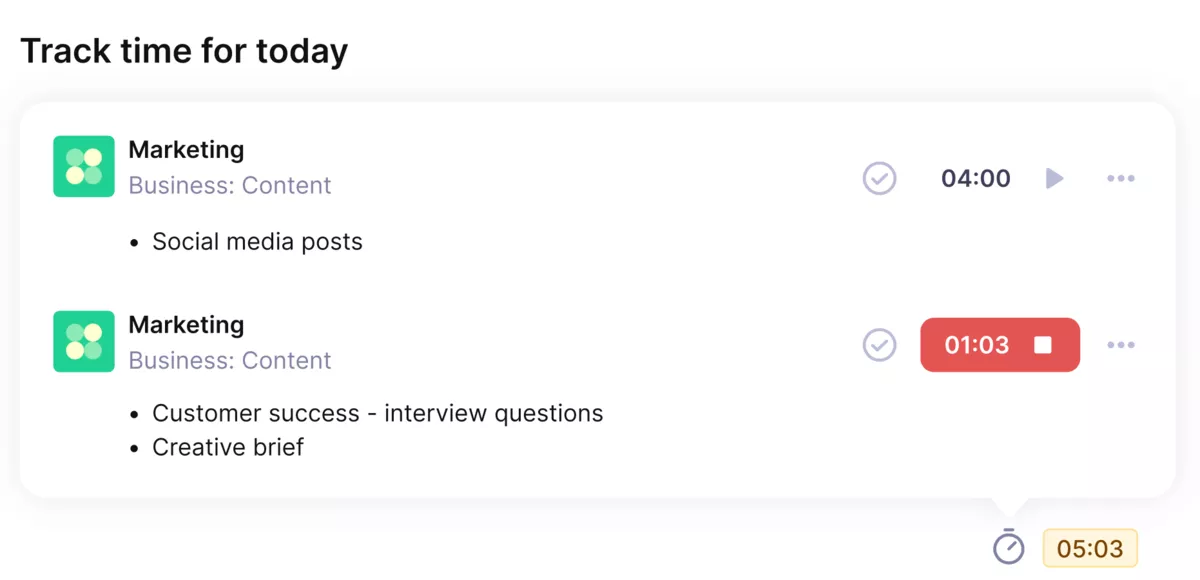
Track time where the work happens.
Enable automatic time logging, which creates entries directly from Resource Planner bookings. Or use AI Time Tracking, which converts calendar events into time entries in one click and matches them to the right service based on past tracking patterns.
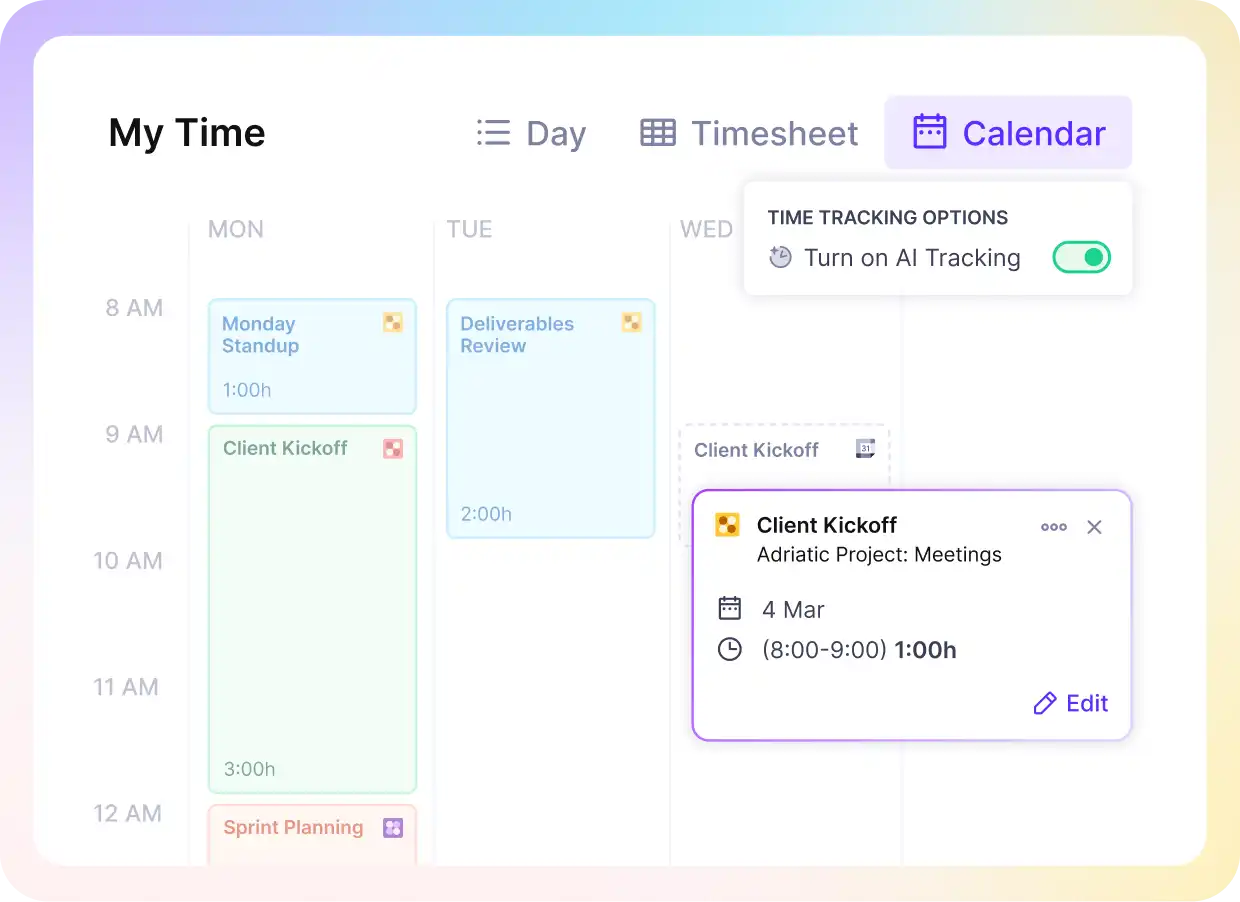
Convert calendar events into time entries in one click.
Your staff picks the method that fits how they work. Learn more about Productive’s time tracking.
See Billable vs. Non-Billable Hours as They Are Logged
When billable and non-billable time is sorted after the fact, hours get miscategorized and revenue leaks. In Productive, the billing type is set at the service level (fixed, time and materials, non-billable, or percentage).
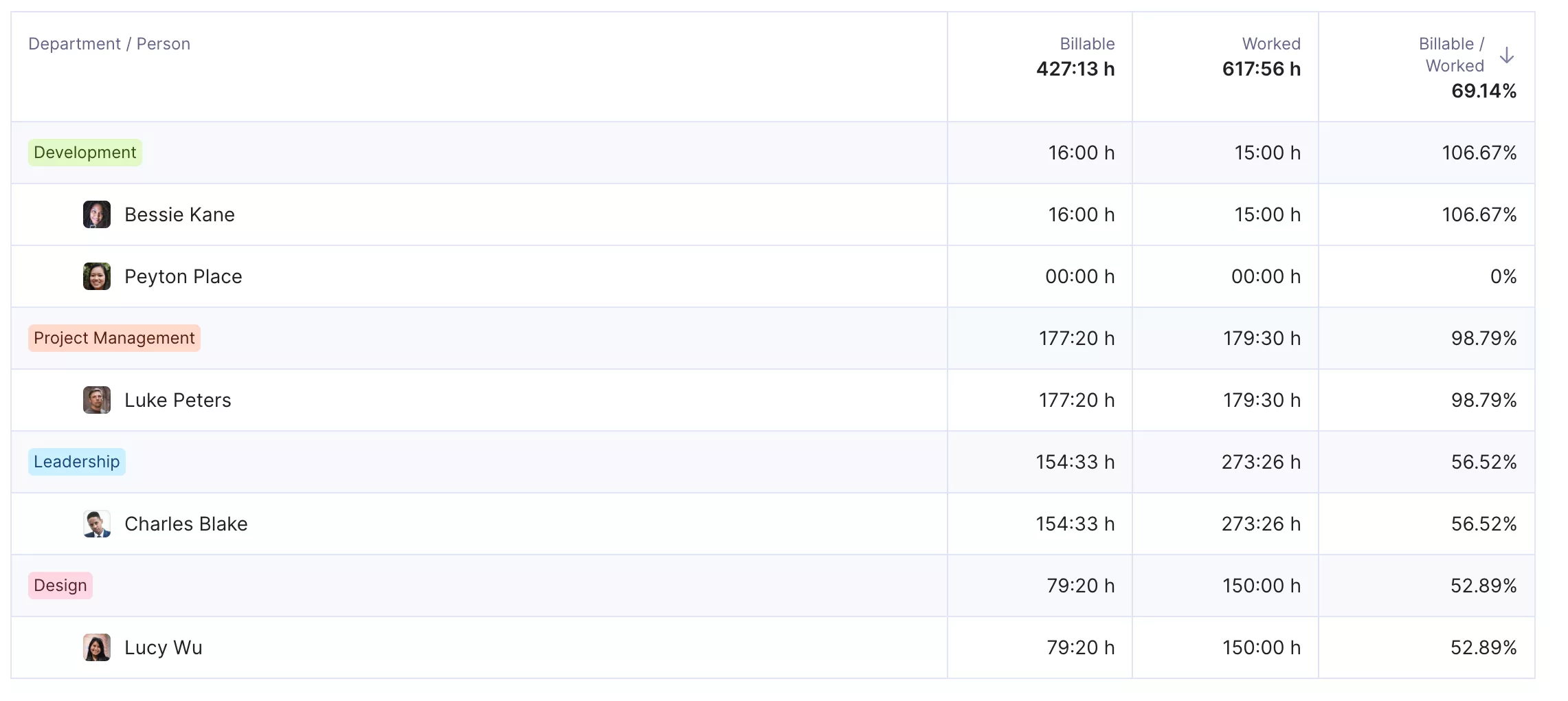
Get instant utilization overviews and prevent idle hours or overbooking.
Every entry inherits that billing type the moment it is created. If a service bills time and materials, tracked hours are billable by default and show values on invoices once time is logged.
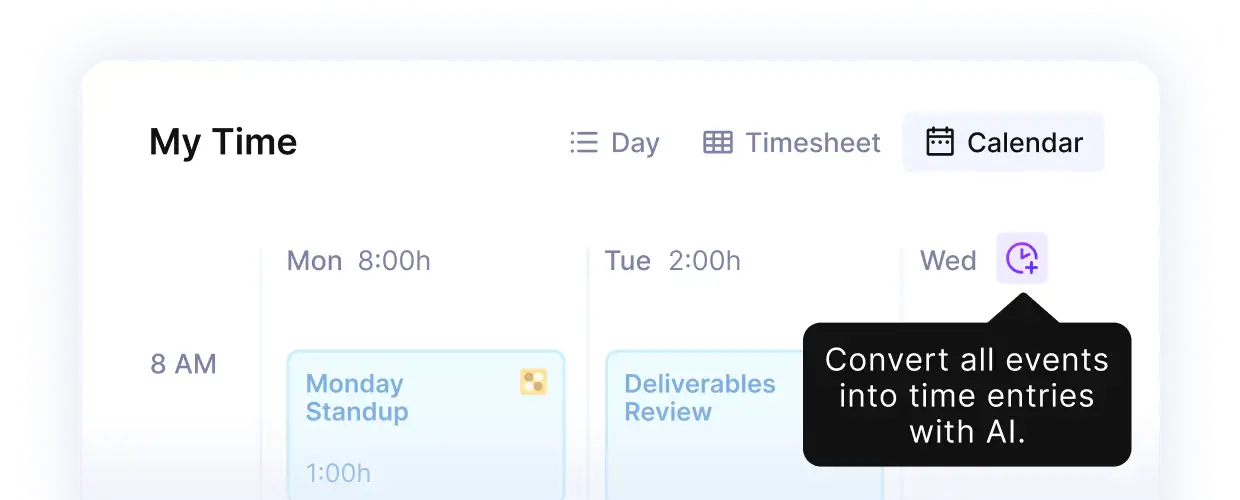
Track time without friction or extra admin effort.
The split is live, not reconstructed at the end of the month. See how this connects to Productive’s budgeting.
Turn Tracked Time Into Budgets, Reports, and Invoices
In most setups, tracked hours sit in one tool and billing happens in another. Productive pulls billable entries directly into invoice drafts. Tracked hours also feed project budgets in real time.
You see budget burn and margin as work happens, not after delivery. Reports cover utilization, profitability by client, and time breakdowns by project or contributor, all from the same data.
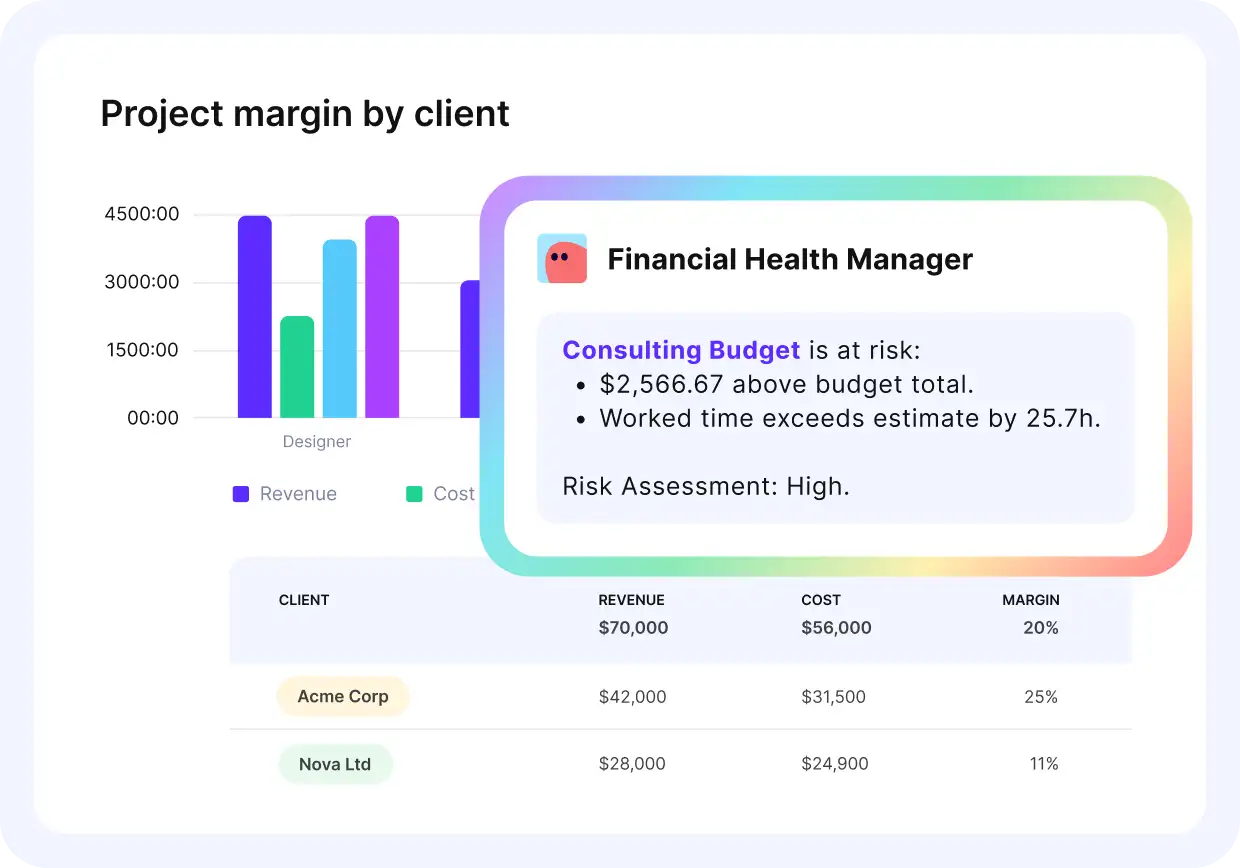
Turn the tracked time into remaining budgets and profitability reports.
You can also describe the report you need in plain language and the AI Assistant builds it from 60+ templates. Set up an AI Agent to generate report summaries and send them to Slack or email on a schedule.
If you’d like to learn more, here’s a link to a roundup of Productive’s AI features.
Pricing
- Plans start with the Essential plan at $10 per user per month, which includes essential features such as budgeting, project & task management, docs, time tracking, expense management, reporting, and time off management.
- The Professional plan includes custom fields, recurring budgets, advanced reports, billable time approvals, and much more for $25 per user per month.
- The Ultimate plan has everything that the Essential plan and Professional plan offer, along with the HubSpot integration, advanced forecasting, advanced custom fields, overhead calculations, and more. Book a demo or reach out to our team for the monthly price per user.
One Platform for Time, Budgets, Resources, and Billing
Productive replaces the disconnected stack most agencies run. Track time, plan resources, monitor project budgets, and invoice clients from one place.

2. Harvest – Best for Time Tracking Built Around Invoicing
Harvest connects hour logging directly to client invoicing, so agencies that bill by the hour can go from logged time to a sent invoice without exporting data or switching tools. It has been in the agency space since 2006, and its core loop (track, review, invoice) is still the tightest billing-first workflow in this list.
Key Features
- Time tracking across devices. Start a timer or enter hours manually from the desktop app, mobile app, browser extension, or directly inside Asana, Jira, Trello, and GitHub tasks via a Chrome button.
- Billing from tracked time. Turn billable hours and expenses into invoices with Stripe or PayPal payments, plus native QuickBooks Online and Xero sync for accounting.
- Project budget monitoring. Set budgets in hours or dollars per project and get alerts when a project approaches its limit so you catch overruns early.
- Expense tracking. Log expenses against projects with receipt photos from the mobile app so they flow into invoices alongside billable time.
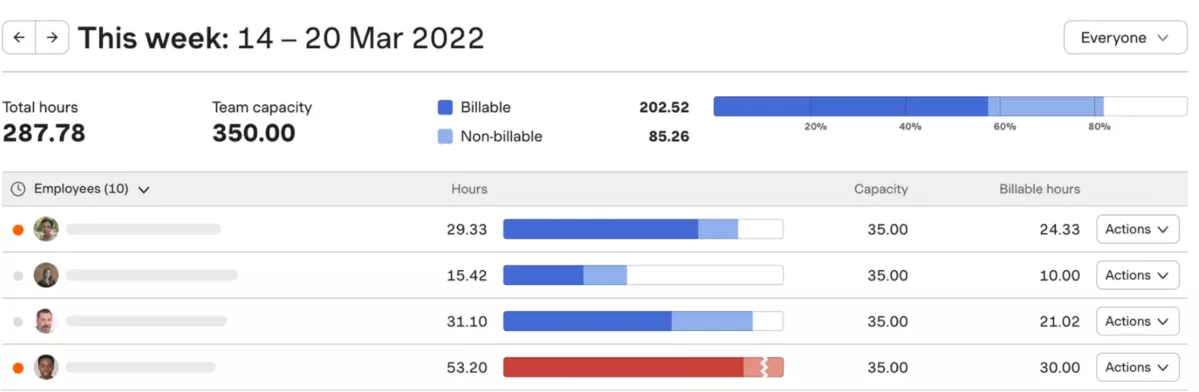
SOurce: harvest
Pros
- Fastest path from hours to invoice. Select tracked entries, generate the invoice, and send it with payment options attached in fewer clicks than any other tool on this list.
- Teams adopt it quickly. The interface has so few moving parts that most shops skip formal training and figure out the workflow by using it.
- Budget alerts prevent surprises. Real-time burn-up charts show exactly where a project stands against its budget so you spot trouble before it becomes a write-off.
- Accounting sync is reliable. The QuickBooks and Xero integrations pull billable data cleanly and cut manual reconciliation at month-end.
Cons
- No automatic hour capture. Every entry requires a manual start or manual input, so if your team forgets to hit the timer, that time is gone.
- Reporting stays surface-level. You get time breakdowns by project, client, and team member but no custom report builder or cross-project profitability analysis.
- Free plan is nearly unusable. It caps at one user and two projects, so any real agency use requires a paid plan from day one.
- Pricing instability after acquisition. After Bending Spoons acquired the company in 2025, users reported steep and unexpected Harvest price increases at renewal across multiple review platforms.
Who Should Use Harvest?
If you need resource planning, automatic time capture, or project management beyond basic task lists, Harvest is not the right fit. It works best for hourly-billing firms under 50 people that want the shortest path from tracked hours to a paid invoice.
Note that many long-time users are leaving after the 2025 Bending Spoons acquisition repriced their plans. If you are exploring options, see our Harvest alternatives comparison.
3. Toggl Track – Best for Simple Time Tracking With Strong Reporting
Most time logging tools fail not because the software is bad, but because the team stops using them after two weeks. Toggl Track solves the adoption problem first: its one-click timer, browser extension, and clean interface make logging time so low-friction that even timer-averse team members stick with it.
Key Features
- One-click timer everywhere you work. Hit start from the desktop app, mobile app, or a browser extension that embeds directly into Notion, ClickUp, Todoist, and GitHub without switching tabs.
- Project profitability dashboards. See billable vs. non-billable breakdowns, team utilization rates, and project-level profitability in visual reports you can share with clients or stakeholders.
- 100+ integrations. Connects to project management, calendar, and communication tools you already use, with Zapier extending the list for anything not natively supported.
- Background time tracking. The desktop client detects idle time and suggests entries based on calendar events to fill gaps when someone forgets to start the timer.

SOurce: toggl track
Pros
- Lowest barrier to adoption. The daily workflow is just “click start, click stop,” so most firms hit full compliance within the first week without configuration or onboarding.
- Reporting turns time data into decisions. Dashboards show where hours go across clients and projects so you can spot overloaded team members or unprofitable work.
- Works the same across every device. Desktop, mobile, and web apps all sync in real time so everyone can log from a desk, a meeting, or a commute.
- Wide integration library. With 100+ native connections and Zapier support, Toggl fits into nearly any existing tool stack without replacing anything.
Cons
- No built-in invoicing. You cannot generate invoices from tracked time inside Toggl, so billing requires an integration with FreshBooks, Xero, or another invoicing tool.
- Free plan caps at 5 users. Firms that grow past 5 people must move to a paid plan for everyone with no option to pay only for additional seats.
- Timesheet approvals require Premium. Managers who need to review and approve entries before billing must pay for the higher-tier plan since the Starter plan has no approval workflow.
- Weak on project financials. Toggl tracks time well but does not handle budgeting, forecasting, or cost tracking, so you need another tool for project profitability in real dollars.
Who Should Use Toggl Track?
Skip Toggl if you need invoicing, resource planning, or project budgeting built into your time tracker. It fits agencies of any size where the main problem is getting the team to actually log their hours consistently.
Consulting firms evaluating standalone tools can also check our time tracking tools for consultants review.
4. Clockify – Best Free Time Tracking Tool for Growing Agencies
Not every agency can justify paying per user for time tracking, especially when you are still proving the ROI of tracking at all. Clockify removes that barrier with a free plan that covers unlimited users and unlimited projects.
Key Features
- Unlimited users on the free plan. Add your entire team without hitting a seat cap, with core tracking, reporting, and project organization included at no cost.
- Detailed time reports. Filter tracked hours by project, client, contributor, and date range, then export as PDF, CSV, or Excel for client-facing summaries.
- Kiosk mode. Set up a shared device where people clock in and out with a PIN, which is useful for firms with shared workstations or studio spaces.
- Billable rate management. Set different hourly rates per project, person, or task and the system calculates billable amounts automatically in reports. For a deeper look at managing the gap, see this guide on billable hours vs. actual hours.
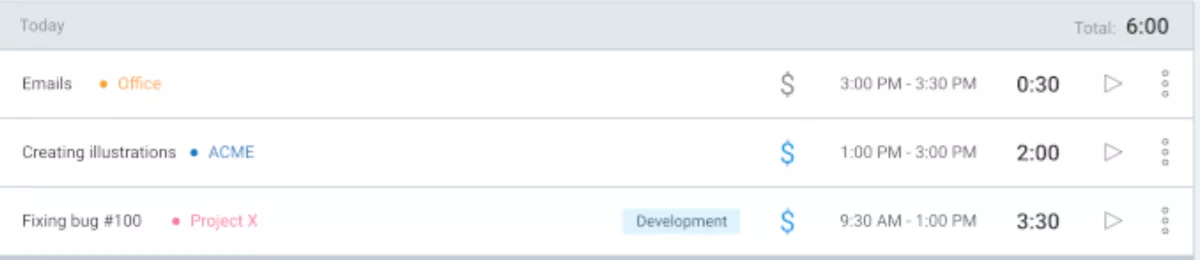
SOurce: clockify
Pros
- Free tier that actually works. You can run a real agency workflow on the free plan without hitting artificial limits on users or projects, unlike most competitors that cap at 1 to 5 seats.
- Setup takes minutes. Most teams go from signup to tracking within a single session because the interface is straightforward enough to skip onboarding.
- Granular client and project reporting. You can drill into who spent time where, on which task, and for which client, making profitability conversations specific instead of guesswork.
- Available everywhere. Web, desktop, mobile, and browser extension all sync in real time so people can log hours regardless of where they work.
Cons
- Invoicing and budgeting are paid-only. The free plan covers logging and reporting, but generating invoices or setting project budgets requires a paid tier that catches teams off guard after they onboard.
- Mobile app is unreliable. Users report frequent crashes, forced logouts, and sync issues that make on-the-go tracking frustrating when entries disappear.
- Interface clutters as you scale. Adding more projects, clients, and team members makes navigation harder without consistent use of search and filters.
- Customer support can be slow. Several users report friction with billing issues and cancellation where response times do not match the urgency.
Who Should Use Clockify?
If you need polished invoicing, deep integrations, or enterprise-grade permissions from day one, Clockify’s free plan will not cover it. It fits budget-conscious agencies under 20 people that need a real tracker without a monthly bill.
5. Everhour – Best for Time Tracking Inside Your PM Tool
Everhour does not replace your project management tool. It embeds directly inside it, adding a timer, budget tracker, and timesheet view to Asana, Jira, Monday, ClickUp, Trello, Basecamp, and Linear without forcing your team to open a separate app.
Key Features
- Native PM tool integration. Track time from inside the task view of Asana, Jira, ClickUp, Monday, Trello, Basecamp, GitHub, and Linear with the timer appearing on the task itself.
- Project budgets tied to tasks. Set budgets in hours or dollars per project and monitor consumption in real time with alerts when a project approaches its limit.
- Timesheet approvals. Managers can review, approve, or reject submitted entries before they flow into billing or reporting to keep invoiced data clean.
- Estimated vs. actual tracking. Compare planned hours against real hours at the task level to spot scope expansion early and price future projects more accurately.
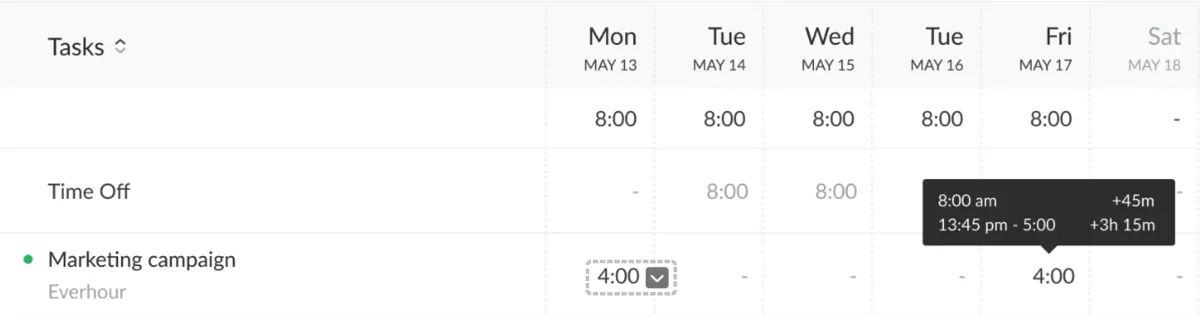
SOurce: Everhour
Pros
- Tracking happens where the work lives. The team never leaves their PM tool to log hours, which removes the biggest friction point in time logging adoption.
- Budget visibility at the task level. You see estimated vs actual hours per task, not just per project, so you spot scope expansion before the project is over budget.
- Minimal learning curve. The interface sits inside tools you already know, so there is almost nothing new to learn beyond starting the timer.
- Works across eight PM platforms. Asana, Jira, ClickUp, Monday, Trello, Basecamp, GitHub, and Linear are all supported natively while most competitors integrate with only two or three.
Cons
- Weak as a standalone tracker. Without a supported PM tool, Everhour loses most of its value because the standalone experience is thin compared to Toggl or Clockify.
- Reporting could be deeper. You can pull reports by user, project, and team, but the filtering options and visual output feel limited compared to dedicated reporting tools.
- 5-seat minimum on the paid plan. A 3-person team pays for 5 seats, which makes the effective per-person cost higher than advertised.
- Invoicing requires manual export. You can log billable hours, but turning them into invoices means exporting data to another tool since there is no native invoice generation.
Who Should Use Everhour?
If your agency does not use Asana, Jira, ClickUp, or another supported PM tool, Everhour is not worth considering. It is the strongest pick for teams that want time logging embedded directly in their existing project workflow without adding another platform to manage.
6. TimeCamp – Best for Automatic Time Tracking for Agencies
Your team forgets to start the timer, fills in timesheets on Friday from memory, and the data is fiction. TimeCamp fixes this by running in the background, detecting which apps and websites you use, and assigning that time to projects automatically.
Key Features
- AI auto-categorization. The desktop app monitors which applications and websites you use, then assigns entries to the correct project using keyword rules that improve over time.
- Billable vs. non-billable separation. Tag any time entry as billable or internal with one click. Reports show the split instantly for invoicing or profitability reviews.
- Invoicing from tracked hours. Generate invoices directly from billable entries with flexible billing rates per project, client, or team member and send them from the platform.
- Attendance and timesheet tracking. Monitor clock-in and clock-out times alongside project-level entries so managers get both a productivity view and a payroll view from the same tool.

SOurce: Timecamp
Pros
- Captures hours you would otherwise lose. Automatic tracking means the team does not need to remember to start a timer because hours are logged in the background based on actual app and website activity.
- Billable tracking simplifies invoicing. The clear split between billable and non-billable time makes it easy to pull invoice-ready data without manual sorting at month-end.
- Free plan covers unlimited users. Small firms can track time on TimeCamp without paying per seat, which is rare among tools with automatic tracking.
- Shows where time actually goes. Activity reports break down hours by task, project, and client, making it easier to spot patterns like scope creep or underestimated work.
Cons
- Manual time entry is clunky. When you do need to enter hours by hand, the browser interface is frustrating because the input jumps to wrong digits and time slots.
- Desktop app sync can lag. The PC app timer sometimes updates only every five minutes, making it unreliable for real-time accuracy checks.
- Reporting filters feel limited. You can generate reports by project and team member, but the filtering and export options fall short of what dedicated analytics tools offer.
- Takes time to learn. Setting up keyword rules, project structures, and automatic categorization has a learning curve that makes initial adoption slower than simpler tools.
Who Should Use TimeCamp?
Agencies that want project management and hour logging in one platform should look elsewhere. TimeCamp fits creative and dev teams where manual tracking has already failed and the priority is capturing hours automatically without relying on anyone to start a timer.
7. Hubstaff – Best for Time Tracking for Distributed Agency Teams
Hubstaff pairs hour logging with GPS location, activity monitoring, and screenshot capture for agencies that manage remote contractors, offshore workers, or field workers. Every logged hour comes with proof of where and how it was spent, which simplifies workforce management for distributed setups.
Key Features
- Activity monitoring with screenshots. Hubstaff captures periodic screenshots and tracks app and URL usage during work hours so managers see activity levels per user in real time.
- GPS and geofencing. Monitor location for field-based or mobile workers. Geofences can auto-start timers when someone arrives at a job site.
- Payroll automation. Set pay rates per user, review timesheets, and trigger payments through integrated payroll via PayPal, Wise, or direct bank transfers.
- Project and task budgets. Assign budgets to projects and measure time against them with alerts when a project approaches its hour or dollar limit.

SOurce: Hubstaff
Pros
- Full visibility into remote work. Managers see who is active, what they are working on, and where they are, which is especially useful for firms with offshore or contract workers.
- Proof of work prevents billing disputes. Automated screenshots and activity logs create a transparent record that holds up when clients question invoiced amounts.
- Clean manager dashboard. The interface organizes time, activity, and project data clearly enough that most managers can navigate it without training.
- Syncs with accounting and PM tools. Native integrations with QuickBooks, Asana, Jira, and Trello reduce manual data entry so logged hours reach your billing workflow without an export step.
Cons
- Screenshots feel invasive. Multiple reviewers describe a sense of being constantly watched, and for in-house creative teams this monitoring style can erode trust.
- Idle detection triggers false alerts. Reading a document or thinking through a problem without moving the mouse can flag you as idle even when you are actively working.
- Advanced features cost more. Payroll, GPS tracking, and detailed reports are locked behind higher-tier plans while the base plan covers only tracking and basic activity monitoring.
- Per-user pricing adds up fast. The cost is manageable for a small team, but firms with 20+ contractors or employees see the monthly bill grow quickly.
Who Should Use Hubstaff?
In-house creative agencies or any team where trust-based culture matters should not use Hubstaff. It fits agencies that manage remote contractors, offshore production teams, or field workers where accountability and location tracking are non-negotiable.
8. Wrike – Best for Complex Project Management With Time Tracking
Wrike is a project management platform first, with time tracking built in. Agencies with 50+ people and complex approval workflows buy it for the workflow engine and get time logging as part of the package.
Key Features
- Custom workflows and automation. Build task statuses, approval chains, and routing rules that match how your agency actually operates, with blueprints to replicate project structures across clients.
- Interactive Gantt charts. Map task dependencies, visualize project timelines, and adjust schedules with drag-and-drop while changes cascade automatically to downstream tasks.
- Resource workload management. See team capacity across projects and spot overloaded or underutilized team members, then reassign work from a single view without switching tools.
- Built-in hour logging on tasks. Log hours directly on any task with a timer or manual entry so entries carry the full project and task context for reporting.

SOurce: Wrike
Pros
- Workflow customization runs deep. Custom statuses, approval workflows, and blueprints let you standardize agency operations across departments without forcing every team into the same structure.
- Cross-team visibility in one place. Dashboards show project health, team workload, and deadlines across the entire agency so you see every department, not just individual projects.
- Time tracking has task-level context. Hours log against specific tasks within projects so you see not just how long a project took but which parts consumed the most time.
- Resource planning is native. Capacity views, workload balancing, and role-based assignment are built in, eliminating the need for a separate resource management tool.
Cons
- Steep learning curve. The interface is dense and feature-heavy, and multiple reviewers report that people still struggle with it weeks after onboarding.
- Hour logging requires the Business plan. It is not available on the Free or Team tiers, so smaller agencies pay enterprise-level prices just to log hours.
- No native invoicing. You can log hours but cannot generate or send invoices from Wrike, so billing requires exporting data to a separate tool.
- Mobile app is limited. Advanced features like workflow editing, automation rules, and dashboard building only work on desktop while the mobile experience handles only comments and basic updates.
Who Should Use Wrike?
Small agencies or any team that needs invoicing alongside time tracking should not pick Wrike. It belongs on the shortlist for agencies with 50+ people and complex, multi-phase projects where the PM capabilities matter more than the time tracking itself.
How to Choose the Right Time Tracking Solution for Your Agency
You can choose the right time tracking tool by identifying your billing model, auditing your current tools, matching to your team size, running a trial on real work, and testing the full data flow from logged hour to paid invoice. Here is how each step works.
Step 1: Identify Your Billing Model
Your billing model determines which features matter. Hourly agencies need billing built into the tracker so billable time converts to client bills without an export step. Retainer agencies need budget tracking that monitors consumption against a monthly hour bank.
Fixed-fee agencies need profitability reports that compare estimated hours to actual hours so the next project is priced more accurately.
Step 2: Audit Your Current Tool Stack
Open your subscriptions and list every app you use for PM, time tracking, billing, and reporting. If you are happy with your PM tool, pick a tool that integrates with it. If you are unhappy with the whole stack, consider a platform that replaces PM and tracking together, as covered in our guide to agency management software. If all you need is a timer and a weekly report, a standalone tool covers it.
Step 3: Match to Your Team Size
Pull your current headcount, including contractors and part-time staff who log hours. Free tiers work for small teams but cap out quickly at 5 to 10 users. Mid-size firms (15 to 50 people) should look for approval workflows, utilization reports, and the ability to set billing rates per person. Management features like granular permissions, audit trails, and SSO become essential above 50.
Step 4: Run a 2-Week Trial With Real Client Work
Pick one active client project, set up the tool with real billing rates and staff, and log for two full weeks. At the end, check two things: did everyone log consistently without daily reminders, and can a manager pull a per-client profitability report in under two minutes?
Step 5: Test the Full Data Flow
Before you commit, trace the path from a logged hour to a paid invoice. Enter test entries, approve them, generate an invoice or export to your accounting tool, and check whether billable amounts, client names, and project labels arrive cleanly. Then pull a profitability report and confirm the numbers match. A tool that tracks hours well but produces messy output downstream creates more work than it saves.
How to Roll Out Agency Time Tracking Software
Rolling out agency time tracking software takes eight steps: define the purpose, set categories, assign champions, pilot on one project, audit early, share results, lock timesheets weekly, and review at day 30.
Most firms skip straight to installation and wonder why compliance drops within a month. Time management is a cultural change, not a software switch. The checklist below covers what to do before, during, and after launch.
Rollout Checklist
1. Write a one-paragraph memo explaining why you are tracking time. Frame it around project pricing and team workload, not monitoring. Send it to the full team at least three days before the tool goes live.
2. Build a billing category guide. List every recurring activity (client calls, design work, internal meetings, admin) and assign each one to billable or non-billable. If your team is new to this split, Productive’s billable hours tracking guide covers the fundamentals.
3. Assign a tracking champion per team. Pick a peer who already tracks consistently, not a manager. Block 30 minutes on their calendar each week to review entries with teammates and fix miscategorized hours.
4. Pilot on one mid-size client project for two weeks. Choose a project with at least three people and both billable and non-billable work. Use the pilot to surface missing categories, broken approval steps, and integration gaps before company-wide rollout.
5. Run a data quality audit at day 7 and day 14. Pull each person’s entries and check for blank days, entries without a project, and gaps between scheduled and logged entries. Follow up in a private message with specific corrections, not a group announcement.
6. Generate the first profitability report and share it with the team. Show which project ran over budget and which came in under. Name the specific hours or categories that drove the result so people see how their entries connect to real outcomes.
7. Set a weekly timesheet lock on Friday or Monday. Configure the tool to prevent edits on entries older than seven days. This stops the end-of-month reconstruction where people guess at an entire week from memory.
8. Hold a 30-minute review meeting at day 30. Walk through the category list and remove anything nobody uses. Add categories the team has been requesting. Identify the one or two steps where friction is still high and simplify them before the process becomes permanent.
Final Thoughts: What’s the Best Tool for Tracking Time in Agencies?
A standalone timer tells you how much time the staff logged, but you still need separate tools for budgets, invoicing, and profitability. The agencies that get the most from time tracking are the ones that consolidate everything into one system so the data stays accurate and everyone only enters it once. If you want to see how that works in practice, book a demo with Productive.
Connect With Agency Peers
Access agency-related Slack channels, exchange business insights, and join in on members-only live sessions.
