Building an Agency Around Quality—for Clients and People, Powered by Productive

Muhlert Digital is a Berlin-based digital marketing agency built around a simple but often overlooked principle: high-quality work starts with sustainable ways of working. Founded in 2022, the agency partners with ambitious brands to deliver senior-led digital marketing, SEO, analytics, and strategy—without overloading teams or sacrificing depth for scale.
We spoke with Quentin Muhlert, Founder and CEO of Muhlert Digital, about how the agency uses Productive to bring structure to its growing operations, gain real-time visibility into projects, resources, and profitability, and scale sustainably—without compromising service quality or the team’s well-being.
We Help Your Agency Reach New Heights
Switch from multiple tools and spreadsheets to one scalable agency management system.
Tell us a bit about Muhlert Digital and your role.
Muhlert Digital is a small digital marketing agency based in Berlin. I’m originally from Canada and spent time in the US doing the Silicon Valley thing before moving to Europe about 12 years ago. Before founding Muhlert Digital in 2022, I worked as an independent consultant for years and had experience both working at agencies and being part of agency growth from very early stages.
The reason I started the agency was simple: I’d seen too many agency models that didn’t work—for clients or for employees. Overloaded teams, junior handoffs that hurt quality, and people working unsustainable hours. We built Muhlert Digital around quality of service and quality of life. Our team is very senior, clients work directly with the people doing the work, and we’re intentional about not overloading anyone.
My role has evolved a lot. In the early days, I did almost everything—client work, strategy, and delivery. As we’ve grown to around 15 people and close to 40 clients, my focus has shifted more toward operations, sales, HR, team management, and overall business oversight. I’m still involved in strategy on key accounts, but my day-to-day is much more about running and scaling the agency.

How was your business overview before switching to Productive?
It was pretty fragmented. We were using Google Sheets heavily, Harvest for time tracking and invoicing, ClickUp for project management, and then more spreadsheets for capacity planning and reporting. A lot of things were manual, stitched together, and honestly pretty rough.
I knew from past experience that this kind of setup doesn’t scale well. You can make it work when you’re small, but as the agency grows, the admin and operational complexity grow exponentially. We were managing with multiple tools, but there was no single source of truth, and getting a clear overview took way too much effort.
What was the final push that made you look for a tool?
It wasn’t a crisis moment—it was more proactive than that. I’ve been part of agencies at different growth stages before, so I knew we’d eventually hit a wall if we didn’t put the right systems in place early.
Rather than waiting until projects were falling apart or profitability was unclear, I started looking for an integrated tool a couple of months before we truly needed it. I wanted something that could support where we were going, not just where we were at the time. That planning mindset was really the final push.

Once everything was set up properly, I could pull reports on profitability, hours per client, utilization per employee, or monthly workload in seconds.
What benefits did you see after switching to Productive?
The biggest benefit was visibility. Once everything was set up properly, I could pull reports on profitability, hours per client, utilization per employee, or monthly workload in seconds.
That’s incredibly important to us because it ties directly to our values. We want to make sure clients are properly serviced and that no one on the team is quietly burning out. If someone is consistently working 60-hour weeks, Productive makes that visible, so we can step in and fix the situation.
It’s also made my job significantly easier as we’ve scaled. We’re running more complex projects now, including detailed financial tracking and managing multiple POs and client budgets. Productive gives us transparency and control that would be nearly impossible to manage manually at our current size.
How was the onboarding?
We didn’t do paid onboarding, mostly because we assumed we’d figure it out ourselves. The Productive team was still very helpful and always available for follow-up questions, which made a big difference.
In hindsight, we probably should have invested in paid onboarding. We relied a bit too much on our SaaS experience and underestimated the importance of fully mapping out workflows, historical data imports, and month-end processes from the start. There was some trial and error, but once everything clicked, it’s been smooth and very effective.
What’s your favorite feature?
Reporting, without a doubt. Being able to quickly pull accurate reports across projects, people, and finances is incredibly powerful.
Budget management is a close second—especially for more complex projects with multiple POs and financial moving parts. Those are the areas where Productive really shines and where it saves us the most time and mental energy.
At our current scale, doing what we do without Productive would mean a huge amount of manual work, spreadsheets, and duct-taped processes. It’s become an enabling force for the agency.
How would you feel if you didn’t have Productive?
Honestly, it would be a nightmare. We’d either have to find another tool with a very similar feature set—probably at a much higher cost—or build a custom solution ourselves.
At our current scale, doing what we do without Productive would mean a huge amount of manual work, spreadsheets, and duct-taped processes. It’s become an enabling force for the agency. I genuinely can’t imagine running the business the way we do now without it.
Achieve Your Agency’s True Potential
Switch from multiple tools and spreadsheets to one scalable agency management system.
More stories


Tracking Time, Boosting Profit: Growth Bite’s Journey with Productive

Growth Bite is a digital marketing agency specializing in SEO, content marketing, and data-driven PR. Founded in 2021, they help businesses of all sizes achieve measurable, ROI-focused growth across digital channels.
We spoke with Rasa Sosnovskytė, the CEO of Growth Bite, who also manages key client accounts, about how the team uses Productive to bring financial clarity to their operations, accurately plan resources, and confidently make profitability-driven decisions as they grow.
We Help Your Agency Reach New Heights
Switch from multiple tools and spreadsheets to one scalable agency management system.
Tell us a bit about Growth Bite and what you do
We founded Growth Bite back in 2021 as a digital marketing agency built on a data-driven approach. Our goal has always been to help businesses of all sizes maximize their digital marketing ROI, and today we work with a wide range of clients, from startups to established enterprises across various industries. Whether they’re looking to strengthen their brand presence or achieve measurable growth, we support them through SEO, content marketing, and data-driven PR.
Our team includes our cofounder, SEO specialists, content strategists, copywriters, and other marketing experts. I serve as both CEO and key account manager, which means I’m deeply involved in both how the business runs and how we deliver results to clients.

What pain points were you experiencing before Productive?
Before we switched to Productive, we used Trello to manage our projects and client work. Trello worked well enough for basic task management, but as we grew, it became evident that it wasn’t built to handle the financial and operational complexity of running an agency. One of our biggest challenges was working with different freelancers across projects. Each freelancer has different rates, which means the cost of delivering work varies significantly from project to project. Trello gave us no way to track this. We couldn’t see the actual cost of delivering work for each client, which made it nearly impossible to understand our actual margins.
Another major issue was that we couldn’t easily determine how many hours each client had remaining on their contract. Pricing appropriately was extremely difficult because we had no clear visibility into the actual effort and costs involved in each project. Without this data, pricing decisions were based more on intuition than on strategy.
In short, Trello showed us tasks, but it didn’t show us the business behind them. We couldn’t connect the dots between hours worked, freelancer costs, remaining contract hours, and project profitability. Everything was siloed, and getting a full picture required manual work we simply didn’t have time for.
What made you look for a new tool?
The main trigger that actually made us look for a new tool was the complete lack of visibility into time, both internally for our team and externally for client reporting. We couldn’t see how much time we were spending on different activities, and we couldn’t give clients clear updates on remaining hours or budget status. On top of that, we were building a new internal tool and allocating some of our expert hours toward its development. We needed much better tracking to understand how time-intensive this initiative was and how many resources we were dedicating to it.
When evaluating tools, we knew we needed something that could help us manage staff time effectively and, crucially, support different cost rates for each individual. Since we work with a mix of in-house team members and freelancers at varying rates, that feature was essential for accurate profitability tracking. A bonus that sealed the deal for us was Productive’s built-in vacation booking system. Having time-off management integrated directly into the same platform where we track projects and resources is incredibly convenient. It also ensures that our capacity planning is always accurate, one less tool, one less source of error.
One of the biggest improvements has come from Productive’s budgeting functionality. It has been an absolute game-changer for us. We can easily track contract changes and monitor profitability rates in real time, which has fundamentally changed how we make resourcing decisions.
What benefits did you see once you started using Productive?
As both CEO and key account manager, Productive has completely transformed how I work. I can now manage clients’ time much more effectively, generate reports without manually gathering data, and see precisely how long tasks actually take. That level of visibility means I can have informed conversations with clients about timelines and budgets and make strategic decisions about resource allocation with confidence.
One of the biggest improvements has come from Productive’s budgeting functionality. It has been an absolute game-changer for us. We can easily track contract changes and monitor profitability rates in real time, which has fundamentally changed how we make resourcing decisions. We’ve even discovered that for some clients, it’s more profitable to hire external freelancers, sometimes even less experienced ones, because their cost of work is lower. Before Productive, we would have defaulted to doing everything in-house without ever realizing the impact on margins. Now we can make far more data-driven decisions about when to use internal resources and when it makes more sense to bring in external talent.
How was your onboarding onto Productive?
The onboarding wasn’t the easiest thing we’ve ever done, but that’s okay; it was very worth it. We had to think through a few workarounds to fit Productive into our specific workflows. However, our account manager was extremely supportive and readily answered our questions, which made a big difference.
We also came up with a clever internal solution: we fed the entire onboarding and documentation content into an AI assistant so we could ask custom questions and receive tailored answers quickly. This significantly accelerated the learning curve and helped the team become comfortable with the platform much faster.
We can set budgets for each project, track time against them in real time, and immediately see when we’re approaching limits or when a project is more profitable than expected. This combination has become the foundation of how we run the agency.
What’s your favorite feature?
My favorite features in Productive are the budgeting option and time tracking. These two capabilities work hand-in-hand to give us the financial visibility we were missing before. We can set budgets for each project, track time against them in real time, and immediately see when we’re approaching limits or when a project is more profitable than expected. This combination has become the foundation of how we run the agency.
How would you feel if you didn’t have Productive?
Honestly, without Productive, we would have to build some kind of Excel formula extravaganza just to attempt to replicate what we have now. I’m afraid to even think about it. The amount of manual work, the room for error, and the lack of real-time visibility would be a nightmare. Productive has become so embedded in how we operate that going back isn’t really an option.
Achieve Your Agency’s True Potential
Switch from multiple tools and spreadsheets to one scalable agency management system.
More stories
From Fragmented Tools to Full Control: How wild Streamlined Operations with Productive

A Vienna-based digital agency, wild has a strong background in design and development. Over the past 12 years, they’ve worked on cutting-edge tech, AI, healthcare, and finance projects, collaborating with enterprise clients to build innovative digital experiences.
Financial reporting and operational efficiency became critical as they scaled and became part of the creative network Residence. Their existing setup—spread across multiple tools—made getting precise insights into profitability, forecasting, and resource planning challenging.
We spoke with Thomas Lichtblau, one of wild’s founders, about their decision to switch to Productive and how it has transformed how they run their agency.
We Help Your Agency Reach New Heights
Switch from multiple tools and spreadsheets to one scalable agency management system.
Can you tell us a bit about wild and your role?
The agency was founded nearly 12 years ago in Vienna, Austria. We’ve been operating entirely remotely for the last four or five years. We have around 30 full-time employees, plus a few freelancers who work with us regularly. We don’t focus on one specific market, but we’ve developed more profound expertise in certain industries over time.
We work a lot in tech, both software and hardware. Given our background in design and development, we’ve been involved in many AI projects, including working with AI companies that develop large language models (LLMs) and building AI-powered internal tools for enterprises. We also do a lot of prototyping.
Beyond tech, we have significant experience in healthcare, wellness, and finance, particularly in the FinTech space. However, we tend to work more with enterprise-level clients rather than startups. We also occasionally collaborate with mid-sized and local businesses.
I’m one of the founders of wild. My background is in design, and I’ve always led on the visual side. However, my role has shifted in the last few years as we’ve grown. I’ve been moving away from client work and focusing more on internal processes and workflows. My main goal is to free up time for our designers and developers so they can focus on creative work rather than administrative tasks.
In 2023, we joined Residence, an interdisciplinary network helping innovative, creative talent grow and thrive across art, business, and culture. That’s been an important factor in how we’ve evolved, including our decision to switch to Productive.

How did your setup look before you switched to Productive?
Before Productive, we had a setup that worked, but it wasn’t as efficient as now. We relied on multiple tools for different tasks:
- Task management: Notion
- Time tracking: Harvest
- Resource planning: Forecast
- Finance and invoicing: Xero
- Documentation: Notion
We had a high-level finance and profitability overview, but it wasn’t as accurate as now. Our data wasn’t as precise, so our reports weren’t as insightful. Things like deal forecasting, budget forecasting, and tracking billable versus non-billable hours weren’t as clear as they are now with Productive.
People no longer have to switch between multiple tools, and we don’t encounter issues where an update in one tool causes a problem in another. Everything is in one place now, which has made a huge difference. I can confidently say that the work required for financial reporting has been significantly reduced.
Why did you decide to switch tools?
The biggest improvement was in the accuracy of our data, especially at the project level. We now have much better insights into project health, billable vs. non-billable hours, expenses, revenue, and profit forecasting. The Scenario Builder has also been a great addition—it helps us plan project teams and determine if a pitch is worth pursuing.
Since switching, our workflows have become more streamlined. People no longer have to switch between multiple tools, and we don’t encounter issues where an update in one tool causes a problem in another. Everything is in one place now, which has made a huge difference. I can confidently say that the work required for financial reporting has been significantly reduced. It’s also been a big help that our finance team can now take over more of this process.
At a glance, the resource planner provides a snapshot of allocated hours across teams, making it simple to spot and prevent resource gaps.
What’s your favorite feature?
My favorite feature is the reporting. It’s flexible and allows me to generate a wide variety of reports. There are some limitations, but I imagine those will be addressed in future updates. For our project managers, the biggest benefit is how well all the project management tools integrate—it makes everything much more effective.
Chantell, one of our Project Management Leads, said she really likes the resourcing part. As the Project Management Lead, she runs the weekly resource meeting with the wild Project Managers. Productive’s resource planner is central to these meetings and incredibly helpful for resourcing projects and ensuring team members are not overloaded with project work. At a glance, the resource planner provides a snapshot of allocated hours across teams, making it simple to spot and prevent resource gaps.

What was the onboarding process like?
The onboarding process was smooth. We started with a demo and were assigned a dedicated manager who helped us through any questions. I spent the first couple of weeks exploring the tool myself, then a couple of months working with our project management team to get everything set up properly. We also created internal handbooks—one for project managers that goes deeper into financials and budgets and a lighter one for the team that covers things like submitting expenses and tracking time.
One of the best aspects of Productive is the support team. They’re incredibly responsive—I get an answer within minutes whenever I have a question.
How would you feel if you didn’t have Productive?
If Productive were to disappear suddenly, I’d probably have a panic attack. We’ve put much effort into setting it up and making it work for our team. Losing it would mean researching and testing new tools, and I doubt we’d find one that works as well as our current setup. It would be incredibly frustrating.
Achieve Your Agency’s True Potential
Switch from multiple tools and spreadsheets to one scalable agency management system.
More stories
How Productive Helped Mitchell & Stones Gain Data Accuracy

Mitchell & Stones is an award-winning, outsourced marketing department committed to helping businesses improve and boost engagement with their target audience.
We spoke with Chris Stones, Strategic and Operations Director at Mitchell & Stones, about how Productive helped them gain data accuracy.
How did you come across Productive?
Before Productive, things were horrible, I’ll tell you. We heavily relied on Asana, Google Sheets, and Clockify. Asana was a good task-tracking tool, but it really lacked data-capturing abilities, and we had to fill that gap with Google Sheets.
Over time, my role primarily became managing this system we had set up. It was pretty much a full-time job since it was the backbone of our organization, and it had to be right 100% of the time. We started looking for a new tool as we figured there must be an easier way to manage our data. We were looking at a few different tools, but they all required a lot of sculpting, and it would take quite a while for us to fully migrate our system. We also figured it would be a massive cost, and the software only did about 15% of what we needed it to do.
There was also the issue of hidden costs with some tools we were looking at. You think you’re getting it all for $5 per user, but then you realize time tracking would add another $5 per user, financial data would be another $10 on top of everything else, and so forth. During our search, we found Productive, which did everything we needed with no hidden costs. I liked how transparent you guys are with your pricing.
We Help Your Agency Reach New Heights
Switch from multiple tools and spreadsheets to one scalable agency management system.

Moving to Productive freed up about 40% of my time, and I was able to concentrate my efforts on other, more important areas of the business.
Which pain points did Productive solve for you?
The issue was that the tools we were using at the time weren’t communicating, so much of the work had to be done manually. Resource planning was done in Sheets, which needed to be updated manually almost every day. When it came to gathering financial utilization data, we took a lot of rough estimates from Asana and Google Sheets, which led to many inaccuracies and distrust of the data. If even one metric was off, it could throw off the entire calculation, essentially making the data completely useless. We really needed an all-in-one tool.
Moving to Productive freed up about 40% of my time, and I was able to concentrate my efforts on other, more important areas of the business. One of the biggest changes has been accuracy. It’s pretty rare to have accuracy in an agency setting since there are a lot of moving parts. I don’t have to rely on someone to input costs, it’s all done pretty much automatically.

I think that the combination of project management and the financial aspects make Productive shine above the rest of the platforms.
What’s your favorite feature in Productive?
I’d say it’s got to be the overhead calculator. I generated all the financial reports for our agency, and no other software out there was able to calculate the overheads and spread them across all our clients. That was so important for us because other tools would show it as profit, and we would have to manually spread them across our clients. If I wanted an accurate report on overhead spread across clients, I would’ve spent hours working on it, but with Productive, we can generate that report automatically.
The ability to produce dashboards for both the team and management is really amazing. We can bring up management dashboards in just a few clicks and check our business performance for the month, without management having to pour hours of work into those reports.
I think the combination of project management and financial aspects makes Productive shine above the rest of the platforms.
How would you feel if you didn’t have Productive?
I think moving to another software would be a step backward for us. We’ve got everything centralized in one place now, and I don’t think we need any other software to run the business.
Before Productive, I felt like my role was updating spreadsheets. With Productive, I’m able to focus more on actually analyzing the data than just putting numbers into spreadsheets.
When it comes to agencies, there are little to no constants in the work we do. Each client is different, and they have different needs. This is why data tracking is extremely important for us. If you’re working things out on the fly, you’re bound to make a mistake at some point—and it might lead you down the wrong path. Productive allows us to have as much accuracy as possible, which is a make-or-break for a lot of agencies.
Achieve Your Agency’s True Potential
Switch from multiple tools and spreadsheets to one scalable agency management system.
More stories
How Reading Room Gained Granular Insights Into Their Profitability With Productive

Reading Room are a full-service digital experience agency, offering services from user experience research and UI design, to website build and cross-platform marketing. Their expert knowledge uncovers unique opportunities tailored to their client’s needs, generating practical actions that produce meaningful future-fit business results.
We spoke to Rick Donohoe, Operations Director at Reading Room, about how Productive gave them granular insights into their profitability.
What led you to Productive?
As the Operations Director, I have a crucial role in reviewing our implemented tools and systems to see what we can optimize. We had a project management tool, Jira, and internal systems that tied in with everything, but we lacked an agency management tool. We had this huge gap where we couldn’t see what projects we had going on, who the assigned project managers were, etc.
It took a while to convince people we needed an agency management system; a project management tool wouldn’t cut it. We couldn’t see our sales pipeline, and all of our invoicing was in a separate system. We couldn’t tell what our margins and profitability were, either. We needed a tool that would centralize all of our data.
I did some searching right away and found Productive. I liked the modern UI, the overall usability, and the intuitiveness. It was easy to understand and work through. We first booked a demo with Productive, and after the first call, we opened a trial account ourselves
We Help Your Agency Reach New Heights
Switch from multiple tools and spreadsheets to one scalable agency management system.

With Productive, I got the information I needed; I can now see tasks, utilization, and our sales pipeline, and I can react more quickly.
What were the challenges you were trying to overcome with Productive?
We had a real lack of granularity, and we couldn’t distinguish finances and profitability per project. The tool we used at the time required a lot of manual work from my side, and I had to transfer a lot of data to spreadsheets to make adjustments. Our client service teams were also working out of spreadsheets. Calculation mistakes weren’t everyday occurrences, but they did happen. We quickly implemented the CRM part of Productive, which we started using immediately in our work. The roll-out and the onboarding were smooth, and we have set up different dashboards and workflows that show our revenue and sales per client, which is excellent.
I also had to find a way to verify the “gut feel” part of my job. I couldn’t rely on just thinking things were okay or being reasonably sure I had to hire someone new; I needed to be sure that I was aware of everything happening. With Productive, I got the information I needed; I can now see tasks, utilization, and our sales pipeline and react more quickly. I don’t have to just trust my gut that we might be over-resourced next month — I can check it immediately. I know what’s going on now that we have Productive.

I also like that I can build dashboards, reports, and pulses that keep all the essential data at your fingertips. Before Productive, I think I spent around a day every month putting together timesheets and utilization reports.
Any features you’re particularly excited about?
This isn’t a feature, but I absolutely love that you guys have a public roadmap. I get monthly updates and know when to expect a feature to drop. It’s just nice to know that things are moving along.
I’m excited about the task automation feature, which looks hugely promising. I know it’s in the early stages of development, but I can see the idea and its potential. You’re always looking at how you can make things easier and more consistent, and removing some of the manual work that’s supposed to be done when deals get updated is a big part of that.
I also like that I can build dashboards, reports, and pulses that keep all the essential data at your fingertips. Before Productive, I think I spent around a day every month putting together timesheets and utilization reports. The reports are now a weekly pulse I’ve set up, and dashboards allow me to see real-time information. The same thing applies to invoicing. I can see that invoices are going out, and I know that every project has been completed. Everything links together, and you can be sure you correctly service everything and haven’t lost any revenue.
How would you feel if you didn’t have Productive?
It would mean not having the necessary data anymore, and I think we’d definitely be in a worse position: we’d know a lot less about what was going on in the business. With Productive, I can see problems before they happen as well as be more proactive around opportunities, and I don’t have to worry about the time it will take me to find information and answer potential questions.
Achieve Your Agency’s True Potential
Switch from multiple tools and spreadsheets to one scalable agency management system.
More stories
How Build in Amsterdam Gained Control Over Projects With Productive

Build in Amsterdam is a digital design agency that operates within the pillars of strategy, branding and e-commerce. As a full service agency, it aims to bridge the gap between on- and offline, and set the industry benchmark with every project.
For an agency that produces a lot of different output, effective project management is crucial. We spoke with Karla Vincheva, Head of Production at Build in Amsterdam about how Productive gave them control over projects and saved them time with invoicing.
Related: 11 Top Project Management Software for Designers in 2023
Can you tell us a bit about your role at Build at Amsterdam and how you found Productive?
I’ve been part of the Build in Amsterdam team for five years now. Currently, as Head of Production, I’m leading a product team with three project managers.
When I started working here, we didn’t really have a project management tool implemented, projects were mostly managed through Excel. That motivated us to do some research and we ended up getting a tool that we really liked. But as we grew, our needs were changing, too.
Through the years we started to work on more and more retainer projects so time tracking became essential. At one point, we reached the cap of the former tool’s possibilities, so we decided to go with a more scalable solution—and that’s how we found Productive.
Achieve Your Agency’s True Potential
Switch from multiple tools and spreadsheets to one scalable agency management system.
We Help Your Agency Reach New Heights
Switch from multiple tools and spreadsheets to one scalable agency management system.
What benefits did you see once you started using Productive?
Well, I’d say the first thing were the budgets. Budget management possibilities were rather limited with our old tool, but Productive is very budget-oriented. It made us more aware of overall productivity and project health.
This ties in well with the invoicing process. We used to work mainly with Excel for creating invoices and then we had to send them separately to our accountants. Now the direct connection between Exact and Productive, and the available invoice template make this process much more automatic and less error-prone.
We’re also very pleased with the time approvals feature. Since we do a lot of retainer work, we have to provide weekly reports to our clients. In the past we had errors due to late time entries or adjusted time entries without project manager’s approval. Having this kind of check is really helpful and removes the risk of such errors.
The team also really enjoys the Google Calendar integration since the calendar bookings makes it easier to track time on projects in Productive.

Everyone in Productive’s Support and Success team is quite responsive and we feel that all of our comments and suggestions are heard, which is great.
Can you tell us a bit about your onboarding process?
I’d say we managed the onboarding quite well. The steps were smooth and for any questions we had, we knew Gabrijela or Luka were there for us.
The whole onboarding was really informative. Everyone in Productive’s Support and Success team is quite responsive and we feel that all of our comments and suggestions are heard, which is great.

Is there a feature that was a game-changer for you?
I’d say it’s a tie between invoicing and collaboration. The invoicing process has become much more automatic and less error-prone since we switched to Productive.
We also collaborate amongst ourselves a lot, so having the option to collaborate in real time and get feedback in a short amount of time is great.
There’s also a few things that we’d like to start using more. We’re using Reports to provide reporting to clients and see if everyone is tracking their time, but we’d really like to get more into the general business reports.
Before using Productive, we had less clarity and control over projects and time tracking.
What would you say Productive brought to your agency?
Clarity. And control. Before using Productive, we had less clarity and control over projects and time tracking. Our collaboration has improved a lot as well, which makes our jobs a lot more pleasant. There are still things within Productive that we want to try out or integrate into our processes more, so I’m sure things will get even easier with time.
Achieve Your Agency’s True Potential
Switch from multiple tools and spreadsheets to one scalable agency management system.
More stories


Scaling Success: Refyne’s Journey with Productive

Refyne is a digital marketing agency based in Denmark with a focus on performance marketing disciplines like SEO, SEM and paid social, and Data Analytics. Refyne wanted to be completely transparent with their operations, but also change the way projects are billed. So they decided to bill clients based on their satisfaction—a pretty unique way of doing things.
We spoke with Jens Lystlund Madsen, Refyne’s Managing Partner to learn how this agency continues to scale using Productive.
Can you tell us a bit about your role at Refyne and the search that led you to Productive?
When we launched the agency in 2020, we knew we wanted to have some kind of infrastructure in place, so we decided to go with Forecast. It wasn’t the most expensive project management tool out there, but we had heard good things about it, so we opted to try it out. It worked pretty well when there were just four of us, but once the specialists started coming in, we soon started to realize that the project management feature was overly complicated for our needs.
We wanted to have a tool that would scale alongside us and we just didn’t see that happening with Forecast. One of our colleagues used to work with Productive so we decided to give it a go—and here we are.
Achieve Your Agency’s True Potential
Switch from multiple tools and spreadsheets to one scalable agency management system.
We Help Your Agency Reach New Heights
Switch from multiple tools and spreadsheets to one scalable agency management system.
We wanted to have a tool that would scale alongside us and we just didn’t see that happening with Forecast. One of our colleagues used to work with Productive so we decided to give it a go—and here we are.
Was the learning curve steep? Would you say Productive is a scalable solution?
Initially, as with everything else, you need to spend some time getting the hang of how things work, but we got great support from the team on making sure that we got onboarded the right way.
There were a lot of times where you guys also just reached out to us to see if we needed anything. It makes you want to use the tool more, once you have the basics in place. I think we got a good introduction to that, so adoption wasn’t a problem at all for us internally.
The pains that we were experiencing were that we just wanted to have something that could accommodate a lot of things, and I think Productive solved that issue really well for us. I don’t see why we wouldn’t be using Productive when we are 50 people or 100, you know? I feel like we can grow with this solution, which is good.

Did you track financials before Productive? How did things change once you made the switch?
We wanted to, but with Forecast it seemed like we skipped a chunk of onboarding and we never really got the hang of it. It seemed like we’d have to pay quite the sum if we wanted to use some of the financial features and at that point we were already unsure whether we wanted to to keep using Forecast. So, no, we didn’t really have a profitability overview before we switched to Productive.
Our setup is a bit different since we don’t have retainers. We only bill the actual work we’ve done, and being able to see that we deliver projects on budget is of essence. We also differentiate billable hours through seniority and there isn’t a lot of tools that can make that work, but we managed to do it with Productive.

I can check our budgets in just a few clicks now and we’re not in a situation where we’re at the end of the month and we still have to deliver 40% of the budget and overwork ourselves relentlessly.
What benefits would you say working in Productive brought to Refyne?
I’d say we saved a lot of time. I can check our budgets in just a few clicks now and we’re not in a situation where we’re at the end of the month and we still have to deliver 40% of the budget and overwork ourselves relentlessly.
This saves time for our specialists and for me, as well, since I don’t have to keep digging for data anymore. Information is easily accessible and we can check it continuously to make sure we’re on track with project budgets.
How would you feel without Productive?
I honestly don’t even know where we’d start if you guys suddenly disappeared. I think that Productive as a whole strikes a good balance between product management, profitability, views, having accessibility in terms of reports at fair price for most agencies.
I’m 100% sure that our cost on tools like these would go up if Productive wasn’t there, because I don’t think we would be able find something that ties so well into our business.
Achieve Your Agency’s True Potential
Switch from multiple tools and spreadsheets to one scalable agency management system.
More stories


Resource Planning For Professionals: Managing 350+ People Using Productive
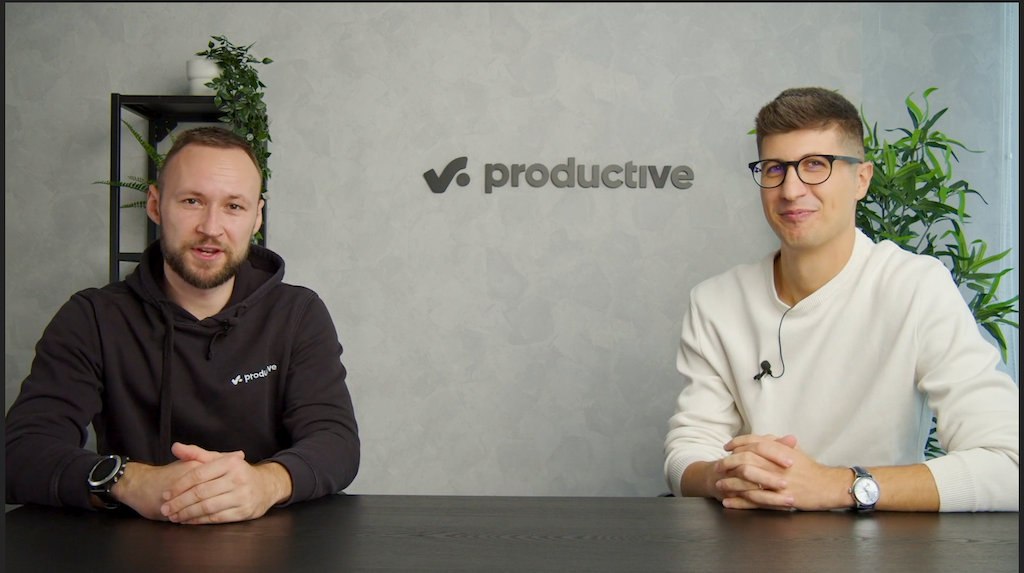
Infinum is a digital agency of 370 people with offices in the USA, UK, Croatia, Montenegro, and North Macedonia. With more than 15 years of experience, numerous awards and clients like Nike, Philips, Samsung and Coca-Cola, they know a thing or two about resource allocation and planning the work for a team on an international scale.
We spoke with Luka Marić, the Head of Operations who gave us a detailed insight on how they use Productive’s powerful resource planning features to track workload, assign people on projects and create reports on utilization.
See also: 12 Best Resource Management Software Solutions
It’s challenging to plan work for 350+ people, so how do you manage a team of that size? Are people divided in teams by their skill, department they belong to, or other parameters?
Luka: I agree, planning work for 350+ people can be challenging, but we’ve developed a system which handles the scale. People are grouped in technical teams (PM, Design, Devops, Android, iOS, Rails, .NET,…) and each member of the planning department is in charge of a certain number of teams. We do have more levels of complexity (seniority, skills, preferences, etc.) which we take into account while scheduling people to projects as well.
We Help Your Agency Reach New Heights
Switch from multiple tools and spreadsheets to one scalable agency management system.
Macro planning seems to be the key here—why do you think it’s important for companies and teams of all sizes?
Luka: I think it’s really important because that’s the only way planning can be in line with a company’s strategic goals. The earlier Planning and Operations are exposed to strategic decisions, the better. We’re the ones allocating the resources on a daily basis, and if macro factors are neglected, we could easily go off track from where we want to be at a certain period.
Scheduling (Resource Planning) in Productive offers us different categories of time off events which helps us a lot. There’s, of course, vacation and sick leave, but we also have separate categories for Maternity or Paternity leaves, Student exams… All of those are requested by people and tracked in Scheduling, which automatically recalculates available time a specific person is able to spend on project-related work.
That way, we can shape expectations from project managers and clients for the delivery and output on a project. In some cases, we are trying to be proactive about this, so we schedule collective vacation leave, exam time off for students, and other types of predictable time off early in the year.
“A single Productive report, Forecast of Production Capacity, is actually very important for us for making hiring decisions.“
Can you name a few reports that are of most value to you, that you got from the data in Scheduling?
Luka: We use more of them on daily basis, but let me give you the most important ones:
Utilization by Teams: We track the ratio of Client / Worked hours on a team level on a monthly, quarterly and yearly basis. For an agency, this data is the bread and butter, and we always need to be aware of these numbers.

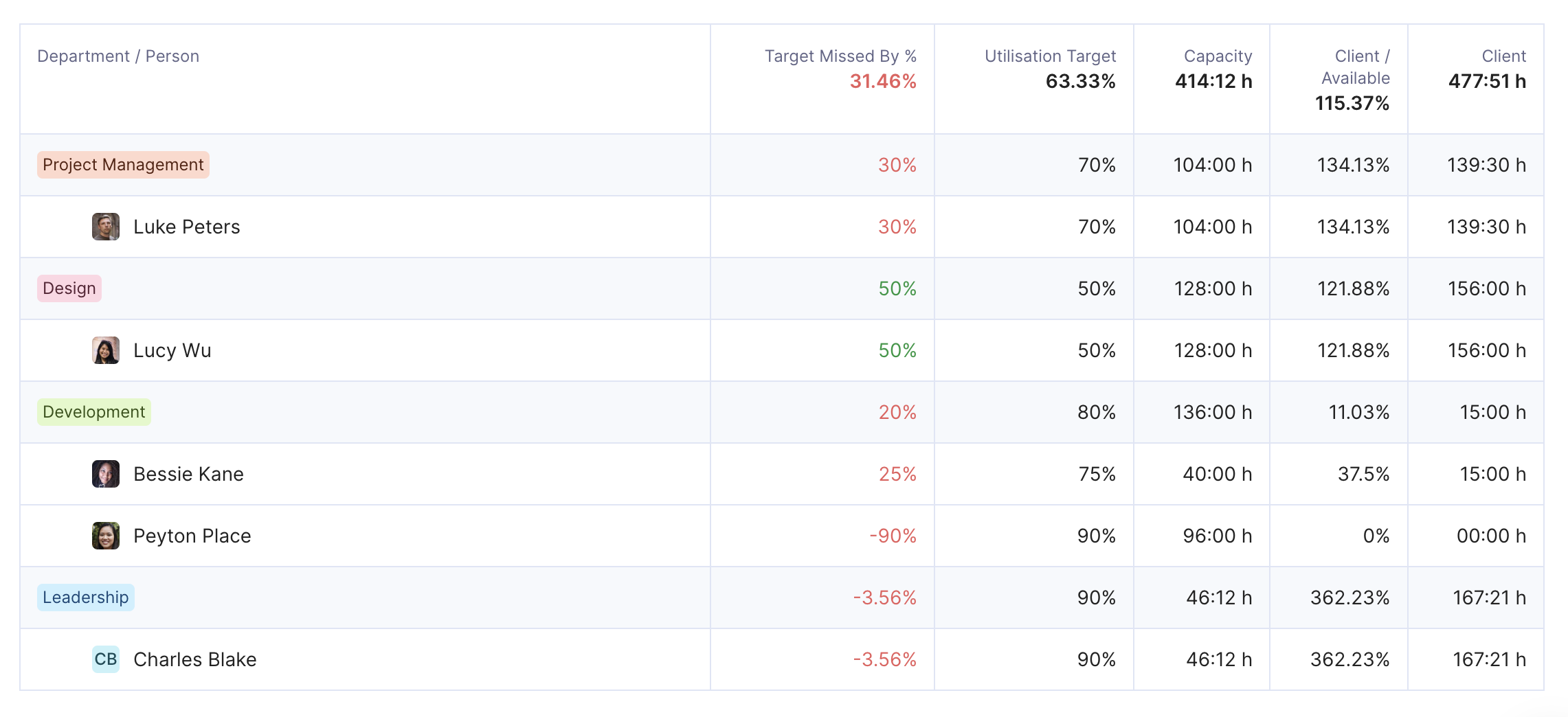
Utilization Target Realization: Built on top of our utilization report, we look into specific team and individual targets and how the reality compares to it.
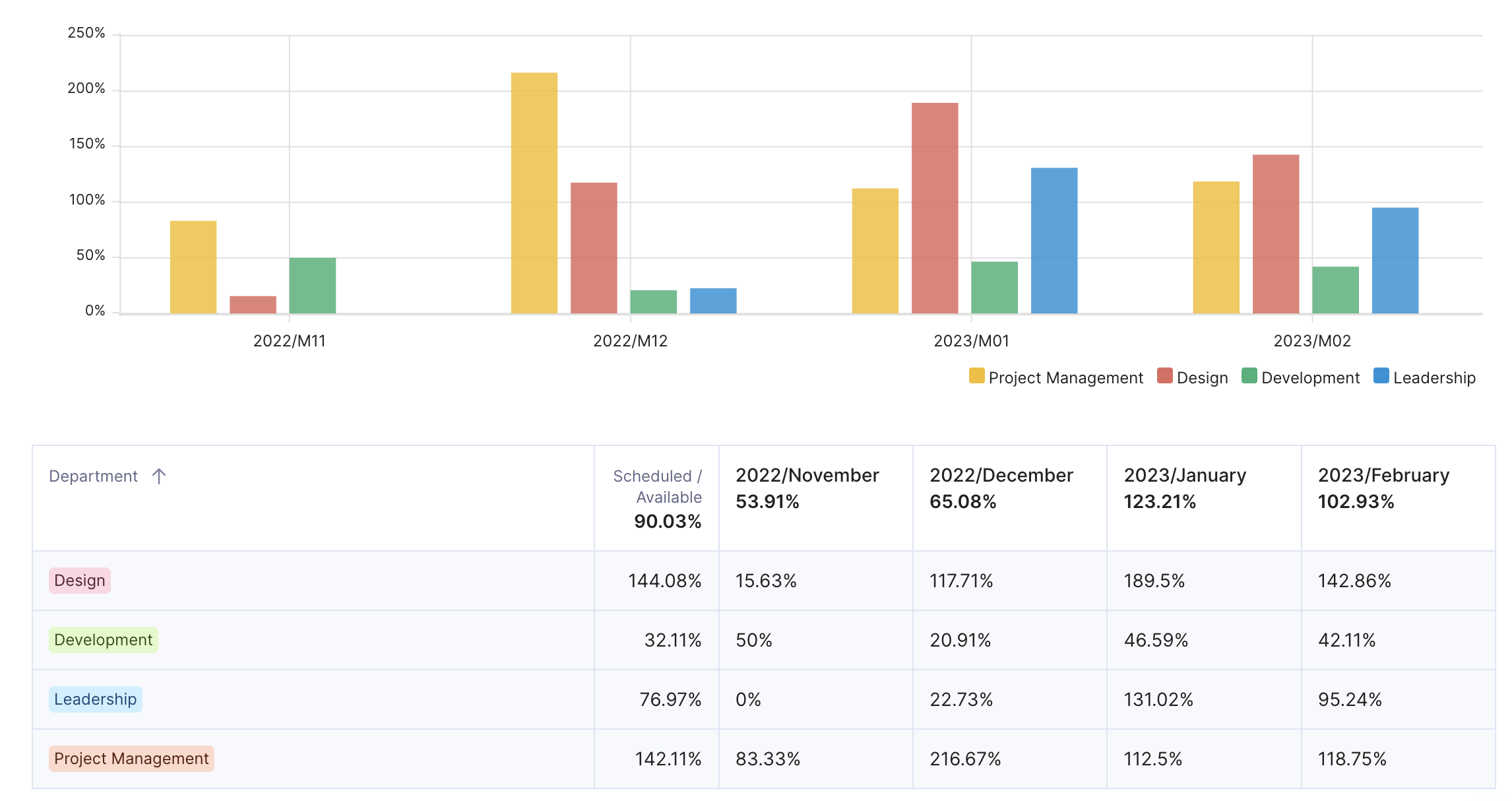
Forecast of Production Capacity: We look into the Scheduled / Available ratio for the upcoming months/quarters, also on the team level. This serves as an indicator of future availability, which is really important while shaping hiring decisions.
What about hiring—can it tell you if you should add new teammates?
Luka: The report I’ve mentioned before, Forecast of Production Capacity, which shows us the Scheduled/Available ratio in the future months, is actually very important for us for making hiring decisions. This way we can see whether we’re over or under capacitated at a certain period of time. We usually look at this for the time period of 7-30 days for our day-to-day activities, but we use the 90-and-more-day forecast to decide whether we need to hire more people in some teams.
One simple example would be: We have team X, whose Scheduled/Available ratio is 110% when looking into the upcoming quarter. This means that we’ll need an extra 10% of our current capacity to be able to do the work we have scheduled. Then we translate those percentages into the numbers of full time employees we actually need and signal this to HR so that they can start with the hiring process.
In reality, it’s a bit more complex because there are some other factors we tend to include, but this would be the essence of it.
Related: The Best ERP for Professional Services
The discussion about the recession is ramping up. How are you preparing for it? What is the data every operations person should be tracking carefully to be ready if everything goes haywire?
Luka: Well, the earlier mentioned data on forecasting production capacity is one of the most important things, I’d say. Hiring decisions are of extreme importance in such scenarios. You definitely don’t want to over-extend and over-hire in such periods, so I advocate for a more conservative approach, especially if we’re anticipating some negative scenarios. The art of running business is finding a balance between the supply and demand. In such volatile times, I believe planning should work especially close with the Sales and HR department to be able to find that sweet spot.
Planning and Operations are usually more focused on so-called lagging metrics, those that assess the current state of the business. Leading indicators, on the other hand, predict future conditions and at uncertain times we need to combine both in a meaningful way to be able to shape our decisions.
Achieve Your Agency’s True Potential
Switch from multiple tools and spreadsheets to one scalable agency management system.
More stories



Saffron Got Clarity on All Aspects of Business

Saffron is a brand consultancy of 90 people with offices in London, Madrid, Vienna, Istanbul, and Mumbai. Founded in 2001, Saffron specializes in creating, growing, adapting and transforming brands that range from the arts and entertainment industry to banking, energy and telcos.
How did Productive become and stay Saffron’s agency management tool of choice? We visited their Madrid office and spoke with Luz Erhardt, Chief Client Officer, Andrew Harb, Program Director, and Matt Atchison, Creative Director to hear all about it.
See also: Best Software for Consultants: The Ultimate Guide to Tools & Features
What did Saffron use as an agency management tool before, and how did you choose Productive?
Andrew: We assessed a number of systems and we came down to probably three that were short-listed and we felt that Productive, as a product, as a system, and based on what it delivered–really helped deliver against what Saffron’s needs were. We felt as though Productive was the best fit, and that’s why we went with it.
Luz: Before we were using a mix of different tools, quite basic—a mix of Excel and other online tools, but not very cohesively. We’ve been working with Productive for a couple of years now.
Matt: I think before, we could get away with things that were a little bit ad hoc, and you could sort of move things around, make decisions on the fly… but as the team has grown, we’ve definitely needed some tool to manage that.
Achieve Your Agency’s True Potential
Switch from multiple tools and spreadsheets to one scalable agency management system.
We Help Your Agency Reach New Heights
Switch from multiple tools and spreadsheets to one scalable agency management system.
Can you tell us about your roles at Saffron and in the context of using Productive?
Luz: I look at client services at Saffron and I also help with reporting. I work very closely with Finance, so we look at things like team utilization, billability, how much time we spent on new business for example. We also look at job performance, how effectively we are managing our resources. We look at future utilization, it allows us to plan a little bit better. Questions like: how tight are we gonna be in the team, do we have capacity? Productive helps us forecast—not only the performance of our jobs today, but of jobs in the future.
Andrew: I’m responsible for ensuring that the projects run to budget and time, working with the teams and essentially being the focal point on the projects, making sure that we deliver what the client’s brief is.
“The main benefit we get from Productive is planning, clarity, everyone working towards one system. It facilitates reporting, hugely. It’s very easy to use. Also, I think one of the biggest things for me is the fact that it’s constantly improving.”
How long did it take to implement Productive at Saffron? How quickly did you see benefits, and which ones?
Andrew: The thing that was seen straight away was that project performance and scheduling data was available for us literally at the click of a finger. I would say that whenever you implement a particular product or a platform, it takes a couple of months. But I think once everyone was using it in the right way, it was super obvious that when we needed project data, we were able to access it instantly.
The most important benefit from Productive, specifically for me, was the ability to be able to access my project performance and scheduling of the team in real-time. That, essentially, allows me and the team to be able to adjust the direction of the project, if need be, much sooner–rather than having to deal with it at a much later stage.
Luz: The main benefit we get from Productive is planning, clarity, everyone working towards one system. There’s a sense of shared ownership also, so it’s not that it only falls on one person. People can take ownership of their jobs and plan the whole thing out, you can collaborate with team members, so there’s also visibility about things. It facilitates reporting, hugely. It’s very easy to use. Also, I think one of the biggest things for me is the fact that it’s constantly improving.

You’ve been using Productive for over three years now. What value did you get out of it after more time went by?
Luz: I think reporting has definitely improved, it’s quicker, it’s faster, it’s more accurate. Forecasting has improved, 100%, because we have more intel about the business. So, for example, in a type of job A, how successful have we been? How many people have we used on that kind of project? Then it helps us plan for a similar situation in the future.
The big benefit we have is that everyone in the company knows what they’re on. Different people have different views, they have different access to different information, but everyone is aware of what they need to be aware of and hence, the planning, the work, the effectiveness is better.
“I felt really supported, I felt the platform itself is continuously evolving in a very positive way. It didn’t feel like just a plug and play and then, you know–we washed our hands of you.”
Can you tell us about your experience with our Support team?
Andrew: For me, what I was surprised with was the ease of use of the platform. What I was really surprised by was the fact that Productive continuously looked to improve the platform, to build out the platform, and they worked really closely with us. So, at the very outset of the project, we worked with the Productive team to set up what the needs of Saffron were. I felt really supported, I felt the platform itself is continuously evolving in a very positive way. It didn’t feel like just a plug and play and then, you know–we washed our hands of you.
Luz: Customer support works really well. There’s a person on the other side who responds immediately and gets onto it.
Any final thoughts you’d like to share?
Luz: Overall, I think Productive is really easy to use, it’s in constant improvement and I think it’s embraced easily by different team members… I would highly recommend it.
Matt: I think quite often, it’s easy to lose touch with the scope of a project and sort of see how long it’s going on and who you’re going to need along that journey. So it’s quite good being able to plan the long term, as well.
Andrew: I definitely think it’s a very close relationship between Saffron and the Productive team. When we need something, they’re very much there for us.
Achieve Your Agency’s True Potential
Switch from multiple tools and spreadsheets to one scalable agency management system.
More stories
With Productive, Brigada Increased Project Profitability

With over a decade of award-winning work under their belt, Brigada successfully bonds different, yet very connected fields of work. This multi-disciplinary spatial design agency joins architecture, spatial and product design, marketing, and psychology to create exciting solutions, mainly for retail purposes. We spoke with Zoja Ivanišević, Head of Development at Brigada to hear what areas of their day-to-day work evolved after they started using Productive.
Tell us a bit about your role and how Brigada is set up as an agency.
I’ve been at Brigada for almost three years now. During that time, my role has shifted from Project Manager to Head of Development. We have three main teams in our agency: business development (I admit that we use Productive the most), our team of architects and product designers.
How did you forecast and manage resource planning before Productive?
We started using Productive about two years ago. Before Productive, we used a number of communication and project management tools, but all our data was spread across multiple platforms. All our internal communication was in Slack.
For resource planning, we had a huge whiteboard in our office, where we’d physically move our people around different color-coordinated projects. In theory, our method was great, but in reality—it wasn’t visually easy to understand.
Related: Top Architecture Project Management Software Solutions
Achieve Your Agency’s True Potential
Switch from multiple tools and spreadsheets to one scalable agency management system.
We Help Your Agency Reach New Heights
Switch from multiple tools and spreadsheets to one scalable agency management system.
Did you track time before?
Somewhat. We used Google Calendar to note which projects we worked on at the end of each day, but we didn’t literally track time in an app, or know which phase of a project people were working on. So we could never get the level of detail we have today.
“Before, we didn’t have precise insight into how profitable a project was until we actually delivered it.”
So how did you know how profitable each project was?
At the end of each project, we’d do an evaluation in Excel to see our profitability. So we could never get the level of accuracy we have today. Before, we didn’t have precise insight into how profitable a project was until we actually delivered it.
Because our profitability evaluation would happen after a project was done, we could never figure out, mid-project, whether we’d see less profit or break a budget until it was in the past.

What pain points did you start experiencing before moving to Productive? Why did you start looking for a tool?
Let’s say that we had all the tools we needed, but they were a mix of analog and digital channels, which gave us much less accuracy and it took us significantly more time to consolidate data.
When we started looking for a tool, we found a lot of solutions that were geared towards tech agencies. We found out about Productive through Infinum, and figured out it had everything that we needed. We wanted a tool that would make our processes easier, for everything to be in one place, and things to be visually easy to use.
What was switching over to Productive like?
It was super easy to import our entire business into the tool, it took us two and a half months to fully migrate our agency. On top of that, we got support whenever we needed it.

“Overall, I’d say we’ve saved 2 hours a week on project management since we started using Productive.”
How has your job evolved over the years?
Productive has helped us with long-term planning. Every six months we do a review of certain project phases. For example, through time, we figured out we had to raise the prices of certain project phases because they weren’t bringing us profit. Actually, those same phases were bringing our profitability down in each similar project. Thanks to the analysis we’re able to do with Productive, we learned which services we needed to raise the prices for and consequently, we’re seeing an increase in profit.
Productive also helps me a ton with resource planning. Now that we have bigger and bigger projects and clients, we’re able to forecast hiring needs using Scheduling. Also, if I see that the scope of a project will increase for a short period of time, I know I need to book contractors in advance. Before, it was a lot more ad hoc and hoping for the best.
Overall, I’d say we’ve saved 2 hours a week on project management since we started using Productive.
What benefits do you think your team members got with Productive?
Our architects and product designers definitely save time on communication and figuring out who’s working on what and when someone’s off or working from home. We’re all on the same page thanks to Productive.

And lastly, how would you feel if you didn’t have Productive in 2021?
I think I’d feel totally handicapped. I’m so used to using Productive and having our whole business in the tool. It’s such an essential part of our daily work routine now. What’s more, we have our entire archive of financial data available within a few clicks.
Achieve Your Agency’s True Potential
Switch from multiple tools and spreadsheets to one scalable agency management system.