Value Stream Management: Definition, Metrics, and Steps

Value Stream Management (VSM) is a Lean method that improves the flow of value from concept to customer. Teams often run it with the help of PM tools. It means identifying, visualizing, and analyzing the activities that create value for your customers. Then you remove the practices that slow them down.
In this article, we’ll cover how to map and manage your value streams. We’ll also look at which metrics to track and how software makes the process easier.
Key Takeaways
- VSM optimizes project management by identifying and eliminating inefficiencies, focusing on delivering customer value quickly and iteratively.
- It bridges Lean principles with software development, utilizing value stream mapping to identify and eliminate waste.
- A clear definition of roles and cross-functional collaboration is vital for the comprehensive mapping of value streams and continuous improvement.
- VSM measures key metrics like lead time, cycle time, flow time, and flow velocity to track efficiency and effectiveness.
What Is Value Stream Management?
Value stream management is a set of Lean practices that improve how you deliver high-quality customer requests, such as new software features. It focuses on the speed of delivery and on customer satisfaction.
The idea is to visualize and analyze the sequence of activities that create value for customers. That reveals workflow bottlenecks, redundancies, and inefficiencies, so value-adding work runs without interruptions or delays.
The practice works at any scale. Enterprise value stream management coordinates flows across teams and portfolios, so a fix in one area does not delay another. Engineering teams use it to track productivity at each delivery stage and remove the bottlenecks that slow releases.
Some value stream management platforms, also called value stream delivery platforms, surface those bottlenecks from connected tools. That cuts the time teams spend building dashboards by hand.

Dependent delivery activities on a timeline, shown in Productive’s Gantt view.
To see why the practice is built the way it is, it helps to know where it came from.
Where Did Value Streams Originate?
Value streams originated in Toyota’s Lean manufacturing principles. According to the Lean Enterprise Institute, Toyota developed the mapping tool as part of the Toyota Production System, where it is called a material and information flow diagram. Software teams later adapted it to digital delivery.
Two ideas explain that shift: From Assembly Line to Lines of Code, and Value Stream Thinking in Agile Product Development. We’ll take a closer look at each.
From Assembly Line to Lines of Code
Lean principles apply to software delivery because code moves through repeatable build and release stages, much like a physical product moving through a factory. However, the assembly line isn’t the act of writing code; it’s the automated path that code takes from a developer’s machine to the end user.
Software teams apply Lean principles through value stream mapping to visualize that journey and eliminate waste, such as manual testing delays or stuck code reviews.
A DevOps value stream runs from code commit to production. Mapping it aligns DevOps teams around shared goals and breaks down silos, so value delivery continues without interruption.
Value Stream Thinking in Agile Product Development
Value stream thinking fits Agile because both aim to deliver value to customers quickly and iteratively. Agile value stream mapping applies the technique to sprints and releases rather than to a factory floor.
That aligns with the Agile principles of continuous improvement and customer-centricity. Just like in Lean, the work involves identifying and eliminating inefficiencies in the software development life cycle. When Agile organizations manage their value streams well, they can:
- Visualize digital value streams to identify inefficiencies and bottlenecks
- Align cross-functional teams around customer-centric goals
- Make data-driven decisions to optimize complex processes
- Respond more effectively to market changes and customer needs
Before you can manage a value stream, you need a precise definition of what one is.
What Is a Value Stream?
By definition, a value stream is the sequence of activities needed to deliver a product, service, or experience to a customer. The customer can be internal or external. An organization can run several value streams at once. Each customer-facing service, from onboarding to billing, follows its own delivery sequence.
In the software delivery life cycle, a value stream carries a continuous flow of information, work items, and software artifacts. That flow includes everything from feature requests and user stories to code changes, tests, builds, and deployments. The input flowing through the value stream can be:
- User stories, features, and bug reports
- Code changes, tests, and documentation
- Builds, packages, and deployments
- Feedback, data, and insights
Not every value stream carries the same kind of work, which is why they fall into two types.
What Are the Types of Value Streams?
There are two main types of value streams: Operational Value Streams and Development Value Streams. The Scaled Agile Framework (SAFe) uses the same split, so SAFe value streams follow these definitions:
- Operational Value Streams focus on continuously delivering value to customers (e.g., processing orders, providing customer support, and managing subscriptions). You measure them with Objectives and Key Results (OKRs) to assess their effectiveness.
- Development Value Streams focus on building and enhancing the systems that enable the delivery of operational value. That includes software development, testing, and deployment.
Whichever type you run, managing it deliberately changes results. Here is why.
Why Is Value Stream Management Important?
Value stream management is important because it brings faster and more predictable delivery, and more value from the same effort. We’ll take a closer look at each.
Faster and More Predictable Delivery
When the path from request to delivery is visible as a single flow, you can see where work parks at the team boundaries. In professional services, that path runs through account management, scoping, delivery, review, and invoicing. Every handover is a place where a request can sit without an owner.
When each person keeps their own to-do list in notes or a spreadsheet, nobody sees the requests as a single flow. They see their slice of it.
Visibility on its own fixes nothing. It shows a stalled handover; someone still has to own it and change how the work gets done. That is the management part, and it gives you:
- Clear ownership at each handover: someone is accountable for moving work from strategy to production to review.
- One shared picture of work in progress: a project manager, a delivery lead, and a finance manager look at the same sequence, not three private lists.
- Better-informed commitments: dates are based on how the stream has behaved under real load. That is better data, not a guarantee, since load keeps changing.
- Fewer disconnected systems: CRM, delivery, and accounting data connect, so the same job is not re-entered across multiple systems.
For software teams, the same discipline supports faster delivery, better predictability, and easier cross-functional collaboration.
More Value From the Same Effort
Managing the stream protects value realization by cutting the effort that customers never pay for. If a client review sits unowned and late feedback triggers rework, the team spends more effort than the price assumed. That difference comes out of gross margin.
It also pushes billable hours into a month you have already staffed and priced. That is where utilization and margin erode.
A pattern we hear repeatedly from agencies is that tracked time sits in one tool, while budgets sit in a spreadsheet. The rework only shows up at invoicing, long after the stream could have been fixed.
Beyond margin, focusing on value stream health can improve flow and operational efficiency, as well as product quality. Higher throughput with less waste can lead to better customer experiences over time.
None of this happens without first drawing the picture, which is what value stream mapping does. The steps after it do the fixing.
What Is Value Stream Mapping and Analysis?
Value stream mapping is a visual method of analyzing the current state and designing a future state of your delivery process. It covers the series of events that take a product from the initial customer request to final delivery.
Value stream analysis is the second half of the exercise. It examines each step on the map to show where work waits, gets reworked, or stalls. Here’s what you need to know:
- Cross-functional collaboration: Assemble a diverse team to gather data on touch times and idle times. That lets you calculate cycle time and pinpoint problem areas.
- Visualize the flow: Map the journey of value through your operations, revealing dependencies and delays that slow down progress.
- Identify bottlenecks: Focus on the points where workflows get stuck. Each improvement then targets the exact step that causes the delay.
- Make informed decisions: With a clear picture of your value streams, you can allocate resources where they are needed. You can also shorten the steps that add no value.
A map on its own changes nothing. The next section covers how to manage what you have mapped.
How Do You Manage Your Value Streams?
You manage your value streams in six steps: getting the right people in the room, brainstorming, choosing a value stream to map, identifying ownership and responsibilities, analyzing the map and planning improvements, and rerunning the mapping cycle at fixed intervals.

Let’s look at each.
Step 1: Get the Right People in the Room
Assemble a cross-functional team with a stakeholder from each functional area. For a well-rounded perspective, include representatives from:
- Product management
- Development
- Operations
- Customer support
Step 2: Brainstorm
After assembling your team, the next step is to brainstorm your value streams. Engage your team in identifying the sequence of activities that transform customer requests into delivered products or services. Pay close attention to handoffs between teams, since that is where waiting time hides.
A map is only as good as the stage data behind it, and that data lives wherever the work is tracked. For a software team, that is the issue tracker and the code repository. For a services firm, it is the project management tool.
With Productive’s Project Management, Workflows let you define custom statuses for each stage, grouped into not started, started, and closed, so a stage like “Waiting on client feedback” exists as data rather than as a guess.
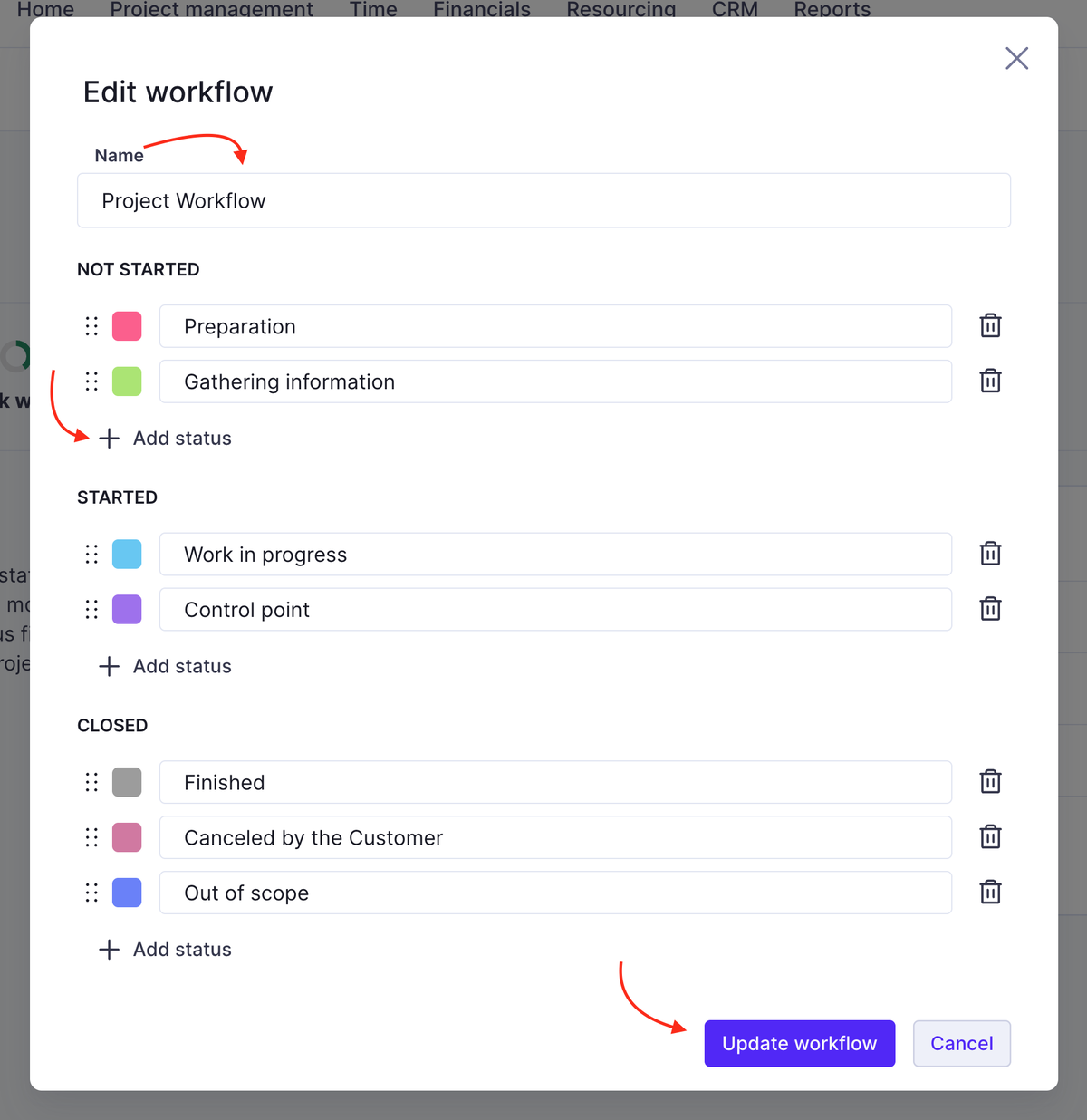
Use Custom Workflow Statuses in Productive.
Naming stages is not value stream management on its own. It gives the map a place to pull from.
Give Every Handoff Its Own Status
Step 3: Choose a Value Stream to Map
Selecting the right value stream is a key activity for optimizing customer value delivery and driving organizational success. Consider the following factors when making your decision:
- Strategic alignment: Prioritize value streams that directly contribute to achieving business objectives and enhancing customer satisfaction.
- Cross-functional collaboration: Involve diverse teams to gain a thorough understanding of the process and identify critical touch points.
- Performance metrics: Utilize existing data to pinpoint value streams exhibiting inefficiencies or delays, as these areas for improvement can yield significant benefits.
- Impact on flow efficiency: Focus on value streams with the potential to streamline workflows and eliminate bottlenecks, ultimately improving overall performance.
Step 4: Identify Ownership and Responsibilities
Give each value stream an owner who is accountable for it end-to-end. Clearly defined managerial roles help each team member understand their part. That pushes people to take the initiative in improving processes and workflows.
Some organizations go further and align their organizational structure to value streams. A value stream manager, sometimes called a value stream leader, owns flow across all the teams involved. Clearly communicated responsibilities make collaboration smoother across cross-functional teams. Review ownership regularly to keep up with changing team dynamics.
Step 5: Track, Analyze, and Identify Improvements
With ownership in place, analyze the collected flow data and turn the findings into a prioritized improvement plan. Flow Metrics such as flow velocity, flow time, flow load, and flow efficiency show speed, bottlenecks, work in progress, and productivity. We cover each one in the metrics section below. When you analyze the data, you can:
- Uncover delays and bottlenecks hindering the smooth flow of value
- Collaborate with cross-functional teams to assess the impact of potential changes
- Prioritize enhancements that reduce waste and optimize workflows
- Regularly review KPIs to drive ongoing adjustments
Step 6: Continuously Improve
Schedule the next mapping session before the current one ends. Like all Lean approaches, the practice depends on a culture of continuous improvement.
Use flow metrics to track progress between sessions. Encourage teams to share what they see through a feedback loop. Update the value stream map at each interval to reveal new opportunities.
Every one of those steps depends on measuring the right things.
What Value Stream Metrics Should You Track?
You should track three groups of value stream metrics: Flow Metrics, DORA Metrics, and Objectives and Key Results (OKRs). Together with other key project management metrics, they give a thorough view of value stream performance.
We’ll take a closer look at each.
Flow Metrics
Flow metrics show how work progresses through the system. They reveal bottlenecks, inefficiencies, and opportunities for additional improvement. Here are the most important ones to keep an eye on:
- Flow Velocity: The number of completed value units over a specific period. It gives you a clear picture of the speed at which work is delivered.
- Flow Time: The total duration from the initiation of work until its release to the customer, highlighting potential inefficiencies.
- Flow Load: The amount of work in progress (WIP). It’s one of the strongest indicators of bottlenecks and capacity constraints within the value stream.
- Flow Efficiency: The ratio of active work time to total flow time. Flow efficiency pinpoints where delays and non-value-added activities may be occurring.
DORA Metrics
DORA (DevOps Research and Assessment) metrics measure the effectiveness of your software value streams. The four original key metrics are:
- Deployment frequency
- Lead time for changes
- Mean time to recovery
- Change failure rate
Deployment frequency quantifies how often you deploy new code to production. It reflects your team’s ability to release updates regularly and respond to customer needs. Lead time for changes measures the time from code commit to deployment, indicating how quickly you deliver value.
Mean time to recovery assesses how quickly your team restores service after a failure. Change failure rate is the share of deployments that need immediate intervention. Reading the four together shows whether faster releases are also stable releases.
The current DORA metrics guide adds a fifth metric, deployment rework rate, for unplanned deployments caused by production incidents.
Objectives and Key Results (OKRs)
Objectives and Key Results (OKRs) connect value stream performance to business outcomes. Establish high-level OKRs at the executive level and cascade them down to individual teams. This alignment enables your organization to:
- Focus on delivering value to customers through targeted initiatives
- Measure progress using specific, actionable key results
- Stay agile by reviewing OKRs quarterly and making necessary adjustments
- Identify and proactively manage obstacles that may affect organizational performance
Whether measured or not, some obstacles tend to arise when teams try to improve their streams.
What Are the Key Challenges in Value Stream Optimization?
The key challenges in value stream optimization are a lack of cross-functional engagement, weak commitment to improvement, insufficient data, neglected development value streams, and misaligned team and business metrics.
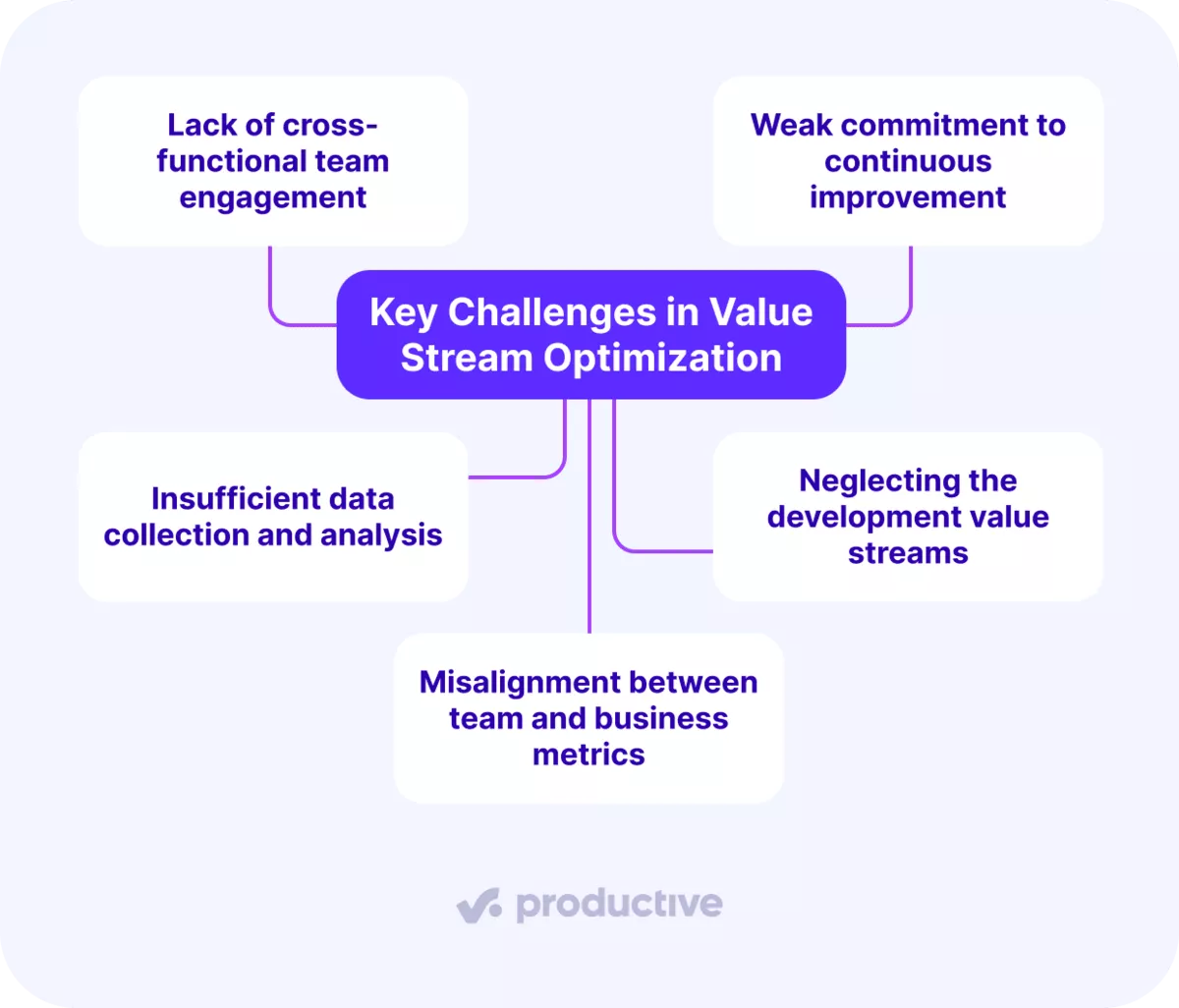
Here is how each one can show up inside a delivery team:
- Lack of cross-functional team engagement results in incomplete mapping. The session includes engineering but not QA, security, or the account lead. Days spent waiting for review and client sign-off never make it to the map.
- Weak commitment to continuous improvement leads to stagnation. The team maps once, fixes the obvious bottleneck, then stops reviewing flow data. Cycle time can drift back to where it started.
- Insufficient data collection and analysis makes waste and delays harder to identify. Ticket timestamps sit in one system and logged hours in another. Nobody can say how long a build waited between code complete and deploy.
- Neglecting the development value streams leaves the build, test, and release steps off the map. Pipeline steps are handled informally, while client-facing steps are documented, which is where DevOps project management discipline can slip.
- Misalignment between team and business metrics leaves improvements unfunded. A squad shortens flow time and still cannot tie that to customer satisfaction, renewals, or revenue. Leadership then reads the effort as an engineering initiative rather than a business one.
These challenges reinforce each other. Thin data makes it hard to prove improvement, and an unproven improvement weakens commitment to the next cycle. Start with per-step timestamps, because without them every other challenge is a matter of opinion.
Several of those challenges are data problems, which is where software comes in.
How Does Software Support Value Stream Management?
Value stream management software supports the practice in three ways: flow visualization, automated metric collection, and cross-team dependency tracking. Each one replaces a manual routine:
- Flow visualization replaces the whiteboard map that stops matching reality after one sprint.
- Automated metric collection replaces the spreadsheet where someone retypes cycle times from ticket histories.
- Cross-team dependency tracking replaces the standup where a blocker surfaces long after it started costing time.
Value stream mapping software does this by timestamping each change in stage. The gap between “code review requested” and “code review completed” is work sitting idle while it waits for a reviewer. Dedicated VSM platforms pull those timestamps from issue trackers, code repositories, and deployment pipelines, so bottlenecks surface without anyone configuring a dashboard.
A services firm has no pipeline to read from. Its value stream ends at an invoice, so status changes show how long work waited, and logged time shows how long someone worked on it. Value stream management there relies on logged time for touch time.
The weak point is that people forget to log hours, a pattern we hear repeatedly from agencies. In Productive, time is tracked on the task itself, and Productive AI can draft time entries from your calendar events for you to confirm
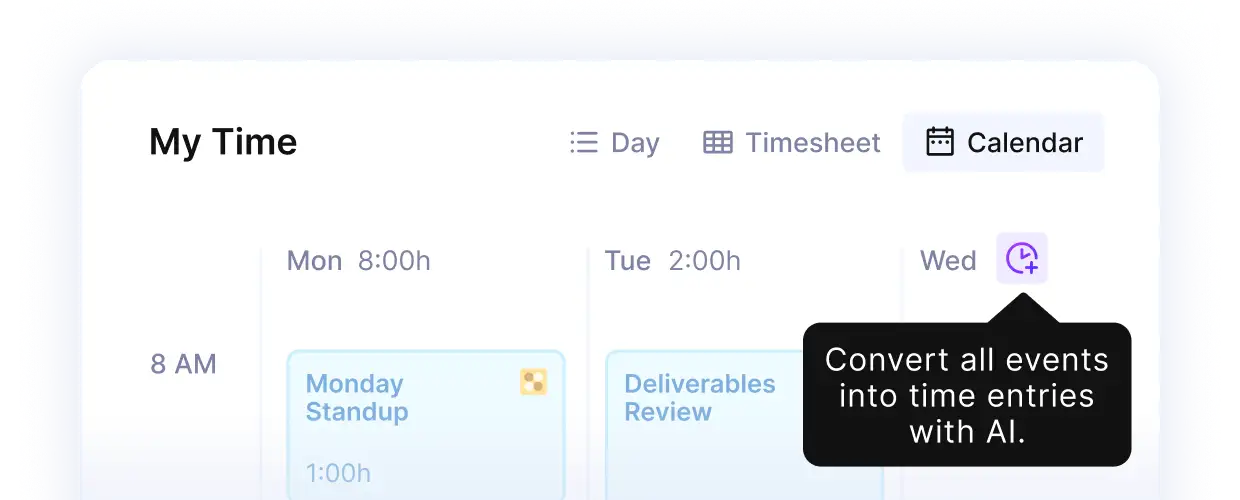
Let AI fill in your time entries in Productive.
AI won’t optimize your value stream, but it lowers the logging overhead behind clean touch-time data.
If you are comparing tools that track time this way, our review of professional services time tracking software covers seven of them.
Keep Your Delivery Data in One Place
Value stream management comes down to three things: map the activities that turn a request into delivered value, measure the flow with Flow Metrics, DORA Metrics, and OKRs, and rerun that cycle at fixed intervals. The main obstacles are data problems, so per-step timestamps and shared ownership matter more than the diagram.
Software carries that data between cycles, so each review starts from what happened instead of what people remember. For agencies and consultancies, Productive keeps tasks, workflow statuses, tracked time, budgets, and profitability in one platform, so the numbers your metrics depend on are already connected.
To see how that would look for your team, book a demo with Productive.
Keep Projects on Track With Productive
Switch from multiple tools and spreadsheets to an all-in-one-platform and track every aspect of project delivery.
