Project Management Skills: 20 Skills With Examples (2026)

Successful project managers blend technical expertise with strong people skills, but these abilities aren’t innate. Project management skills (PM skills) are abilities you use to plan, run, and close a project on budget.
You’ll get a project management skills list of 20 skills, our own selection, with the methods behind them. Then you’ll see how to keep developing them and how they shape your career.
Key Takeaways
- Project managers combine technical expertise (like budgeting and scheduling) with interpersonal abilities (like communication and leadership) to deliver successful projects on PM platforms project managers rely on.
- Hard skills include planning, risk assessment, and cost management, while soft ones are about team guidance and stakeholder communication.
- Proficiency with modern PM tools like Productive increases workflow efficiency in managing project timelines.
- Understanding methodologies like Agile, Scrum, and traditional Waterfall helps you stay adaptable to different project requirements.
What Are Project Management Skills?
Project management skills are the abilities to initiate, plan, execute, monitor, and complete a project on budget. Examples of project management skills include scoping a statement of work, staffing a schedule, and checking budgets weekly.
They matter because a project can look fine on one front and fail on another. A website build can ship on time and still lose money, or stay on budget and lose the client.
The skills of a project manager fall into three types.
What Are the Types of Project Management Skills?
The three types of PM skills are hard skills, soft skills, and technical skills.
Each type protects a different part of delivery. Hard skills protect scope and margin. Soft skills protect the client relationship, and technical skills protect the schedule and reporting data.
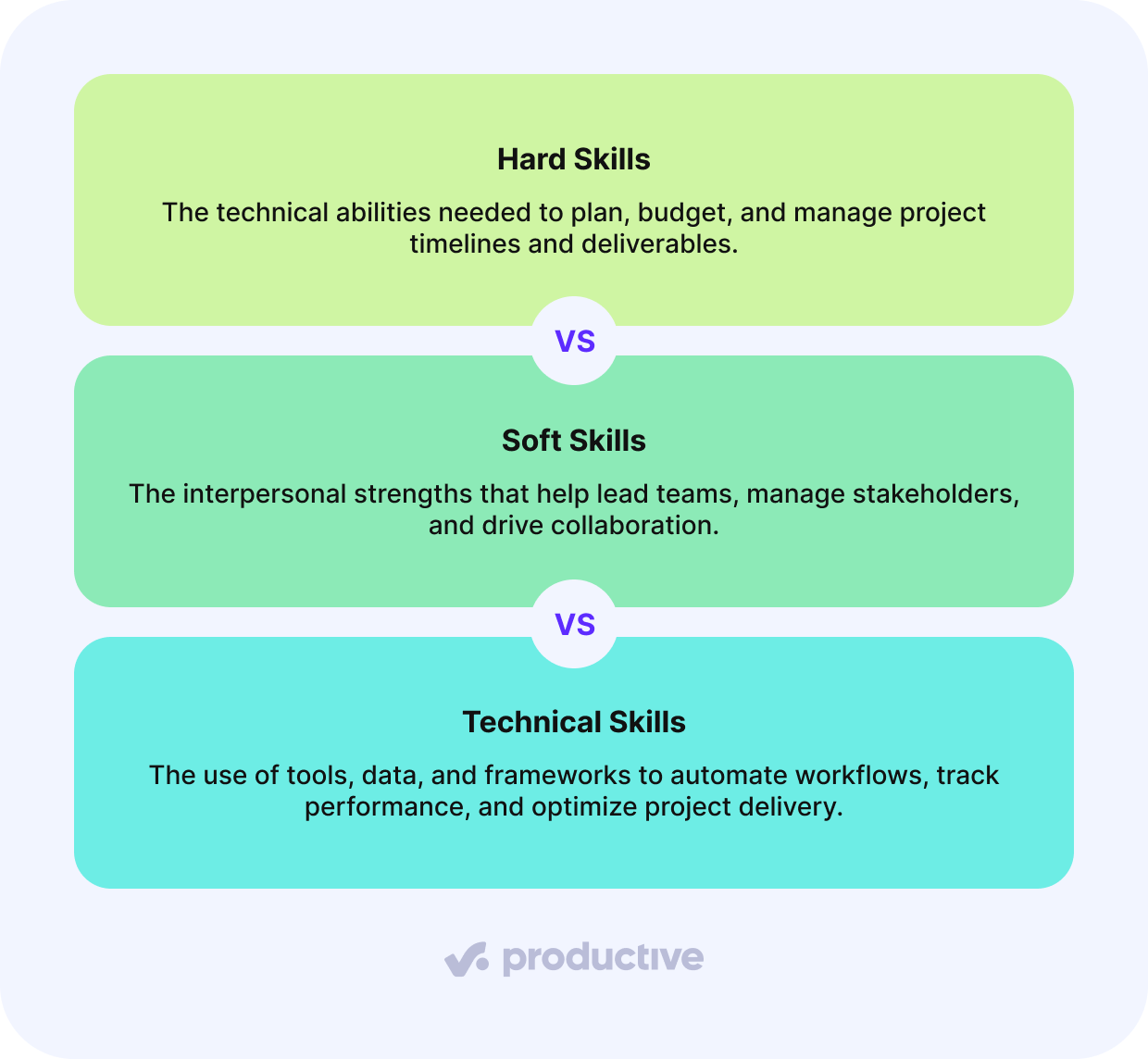
Hard skills for project managers include estimating, work breakdown structures, cost control, and risk logging. Each one produces a document, such as a signed change request or a budget-to-actuals view in your PM tool. Without them, you catch the over-service after invoicing.
Project management soft skills include communication, leadership, collaboration, and conflict resolution. You see them when you tell a client about a slipped deadline before they ask.
Project management technical skills are what you can do with tools and methodologies for executing projects. You build a schedule with dependencies, read a utilization report, and reconcile logged hours against the estimate.
Next is who needs these skills.
Who Needs Project Management Skills?
PM skills are useful for anyone who coordinates tasks, manages resources, and delivers outcomes.
Whether you’re in healthcare, technology, construction, or finance, these skills are valuable across industries and roles. Industries that rely on them include:
- Construction and engineering – coordinating architects, engineers, and construction crews.
- IT and technology – overseeing software development and infrastructure initiatives.
- Healthcare – managing compliance issues and system integration.
Skills for project managers also serve team leaders, business analysts, and executives who organize resources and manage timelines.
The skills themselves start with the hard ones.
What Are the Key Project Management Hard Skills?
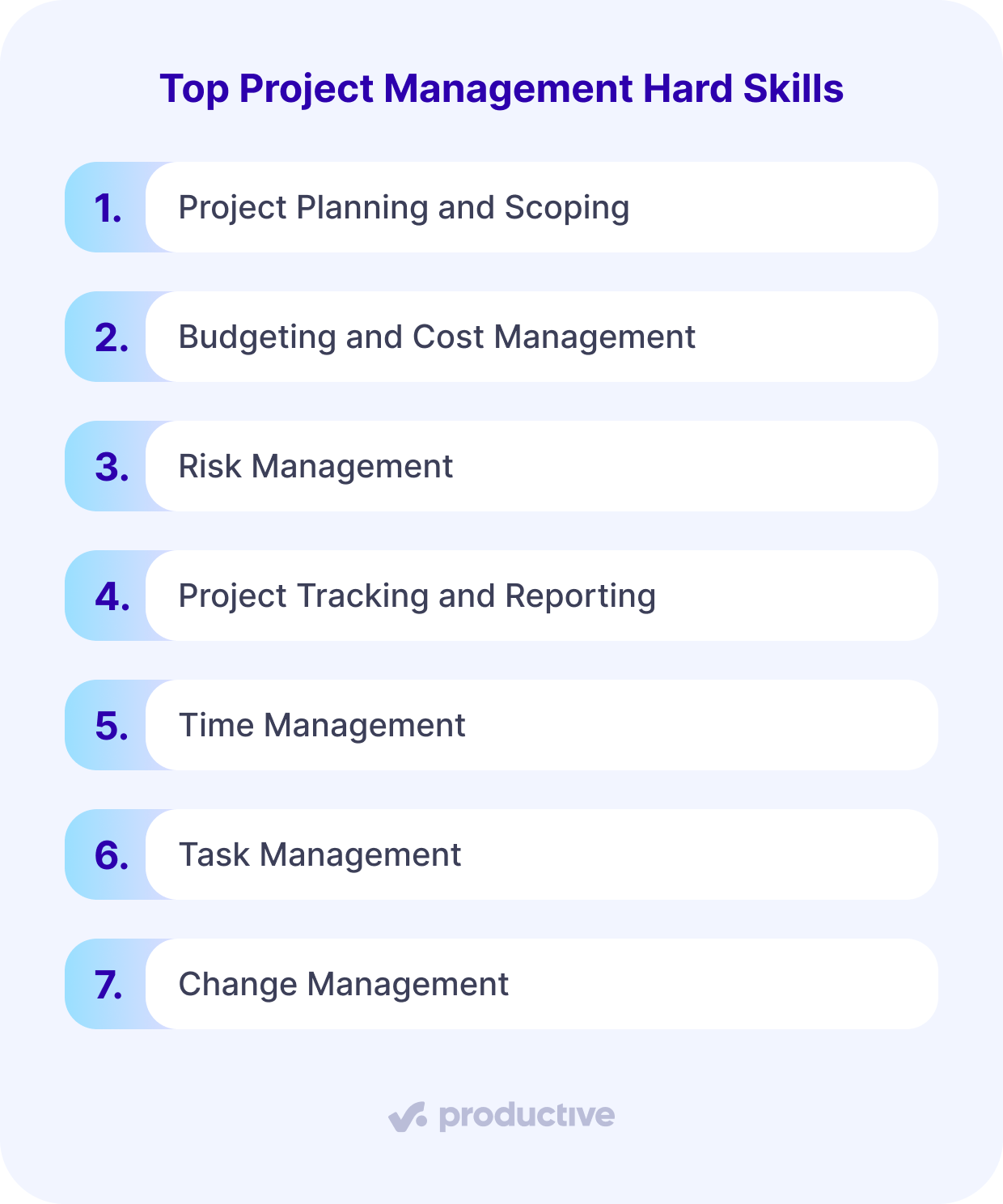
The key project management skills on the hard side include project planning and scoping, budgeting and cost management, risk management, project tracking and reporting, time management, task management, and change management. We’ll take a closer look at each.
You need budgeting and cost management as much as a project schedule, because one bad week can hurt both.
1. Project Planning and Scoping
Project planning starts when you turn the signed statement of work into deliverables with owners and dates. Successful project scoping requires:
- Defining very explicit boundaries and deliverables to prevent scope creep.
- Creating a thorough Work Breakdown Structure (WBS) to organize activities logically.
- Documenting stakeholder requirements in a detailed project charter and establishing verification procedures.
The artifact is a project plan: a scope document plus a dated schedule with dependencies.
Example: A week of silence on client copy pushes the build back a week on the schedule.
2. Budgeting and Cost Management
Budgeting and cost management start with a baseline built on analogous, parametric, top-down, or bottom-up estimates.
Analogous works when you’ve delivered several similar website builds. Bottom-up is what you use when the work is new, and every task has to be priced.
- Once implemented, use cost control mechanisms like Earned Value Management to track performance against your baseline.
- Regular financial reporting and budget reviews enable you to identify variances early and make necessary adjustments.
- Integrate change control processes to manage scope modifications that impact actual costs.
Compare burn to delivery every week. Catch overruns while a change request is still defensible, not during the invoice run.
Example: A designer priced at eight hours per page template logs 10, so that line runs 25 percent over. Across 12 templates, you’ve given away 24 unbilled hours.
With Productive’s Budgeting, you build and manage project budgets where the work is tracked.
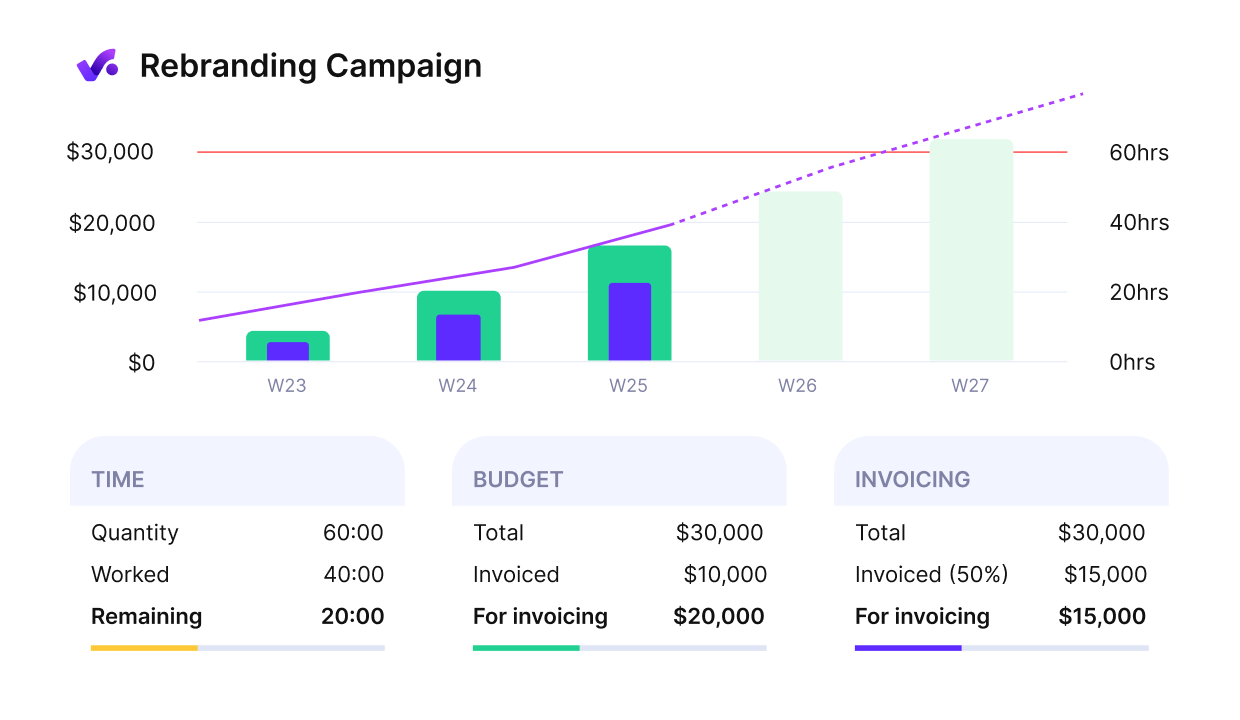
Track project spend and stay on course with Productive’s live budget burn charts.
A project’s financials dashboard shows how much of its open budgets you’ve used. The budget’s forecast chart adds scheduled bookings to past data, so you see when a budget might run out.

I can check our budgets in just a few clicks now, and we’re not in a situation where we’re at the end of the month, and we still have to deliver 40% of the budget and overwork ourselves relentlessly.
Read the full customer story to see how Refyne keeps projects on budget with Productive.
3. Risk Management
Risk management is a standing slot in your weekly delivery meeting. Every open risk gets read out with an owner and a review date. To make the slot work, you should:
- Develop a thorough risk register that documents identified risks, their probability, impact, and planned responses.
- Integrate risk analysis with cost, schedule, and quality management processes.
- Maintain a proactive approach by continuously monitoring risks and adapting strategies as project conditions evolve.
Stakeholder engagement matters here because the client can see some risks before you do.
Example: The client’s legal review can hold up a launch, and the client hears about it first.
You know the skill is absent when the client raises the surprise before your team does.
4. Project Tracking and Reporting
Project tracking means one place holding percent complete, hours logged against estimate, and open decisions for every live engagement.
The output is a one-page weekly status.
It covers progress, variance against estimate, open risks, and the decision you need from the client.
Example: A website build is 60 percent complete, 12 hours over, with one open risk and one pending decision.
You’ll know tracking is missing when you build that status by messaging three people on Friday afternoon.
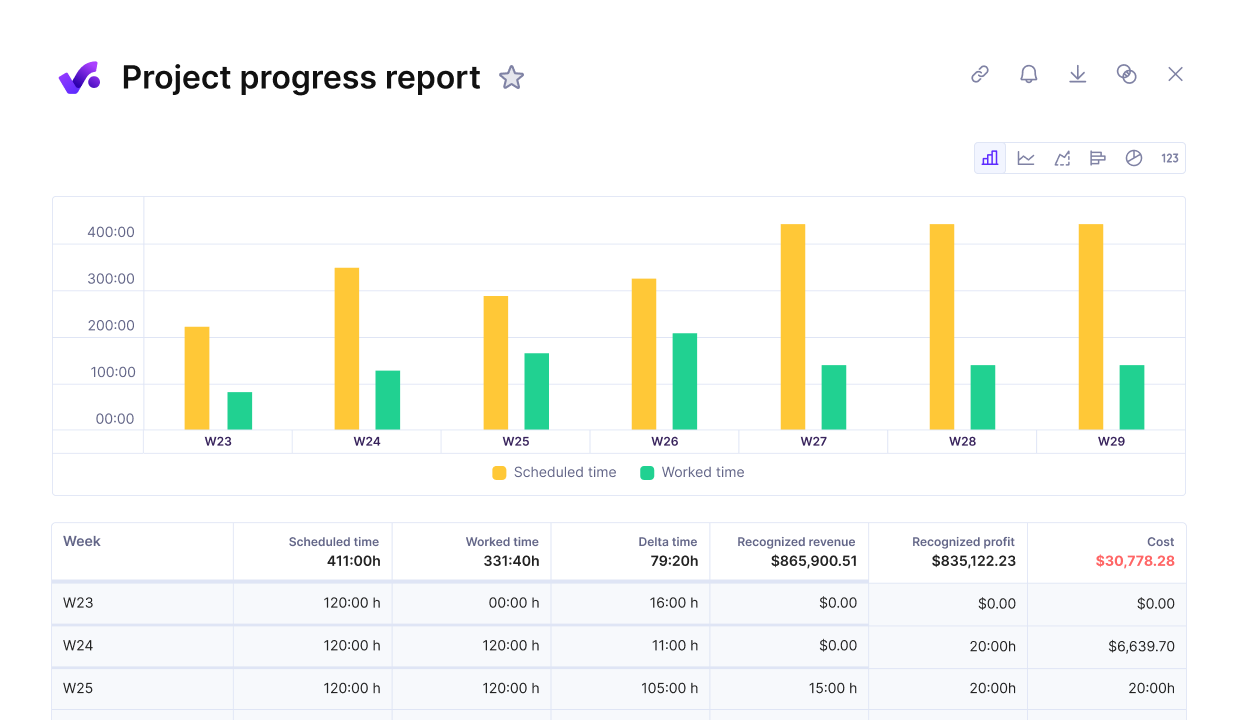
Visualize team performance with detailed progress reports.
5. Time Management
Time management is how you hold a date when four engagements want the same week. To be really good at time management, you should:
- Use the 80/20 rule to focus on high-impact activities that deliver the majority of your results.
- Include buffer time into your schedules to accommodate unexpected delays.
- Break large operations into manageable segments and track progress using visual tools like Gantt charts.
Put buffer around client reviews, since approvals are a delay you can’t control. Without it, deadlines move in the same week they fall due.
Example: If design approval is due Wednesday, start the build the following Monday, not Thursday.
6. Task Management
While time management focuses on when work happens, task management centers on what work gets done and how. Every task carries an owner, a due date, and a status that moves from ready to verified. Check dependencies before you reassign anyone.
Example: The homepage build waits on a verified design, so reassigning the designer stalls the developer too.
Without it, half the team keeps work in personal notes and the rest in chat threads. Nobody can list what’s in flight this week.
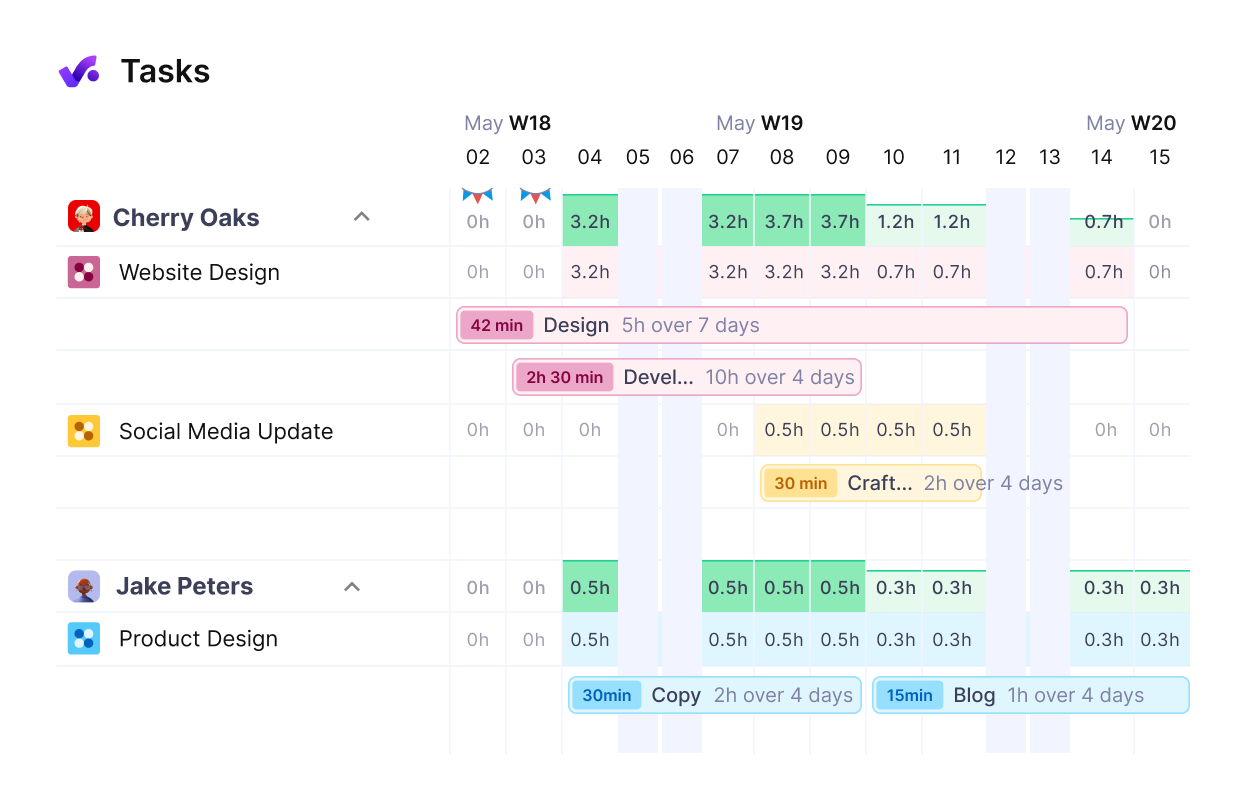
map out tasks, milestones, and deliverables in one visual timeline.
7. Change Management
Change management is the skill of steering a team through a new way of working. It goes beyond traditional PM techniques, because it deals with how people adapt. To improve your change management, develop these critical skills:
- Communication to clearly articulate the rationale and benefits of changes.
- Coaching abilities to support stakeholders through shifts.
- Strategic thinking to plan, implement, and reinforce sustainable change.
Write a short adoption plan naming who trains whom. A month later, check how many people follow the new process.
Example: You require written client sign-off before any file goes out. A month later, half the team still emails files directly. The rollout failed, not the people.
The soft skills come next.
What Soft Skills Do Project Managers Need?
The soft skills project managers need include leadership, communication, collaboration, problem-solving, adaptability, critical thinking, and conflict resolution.
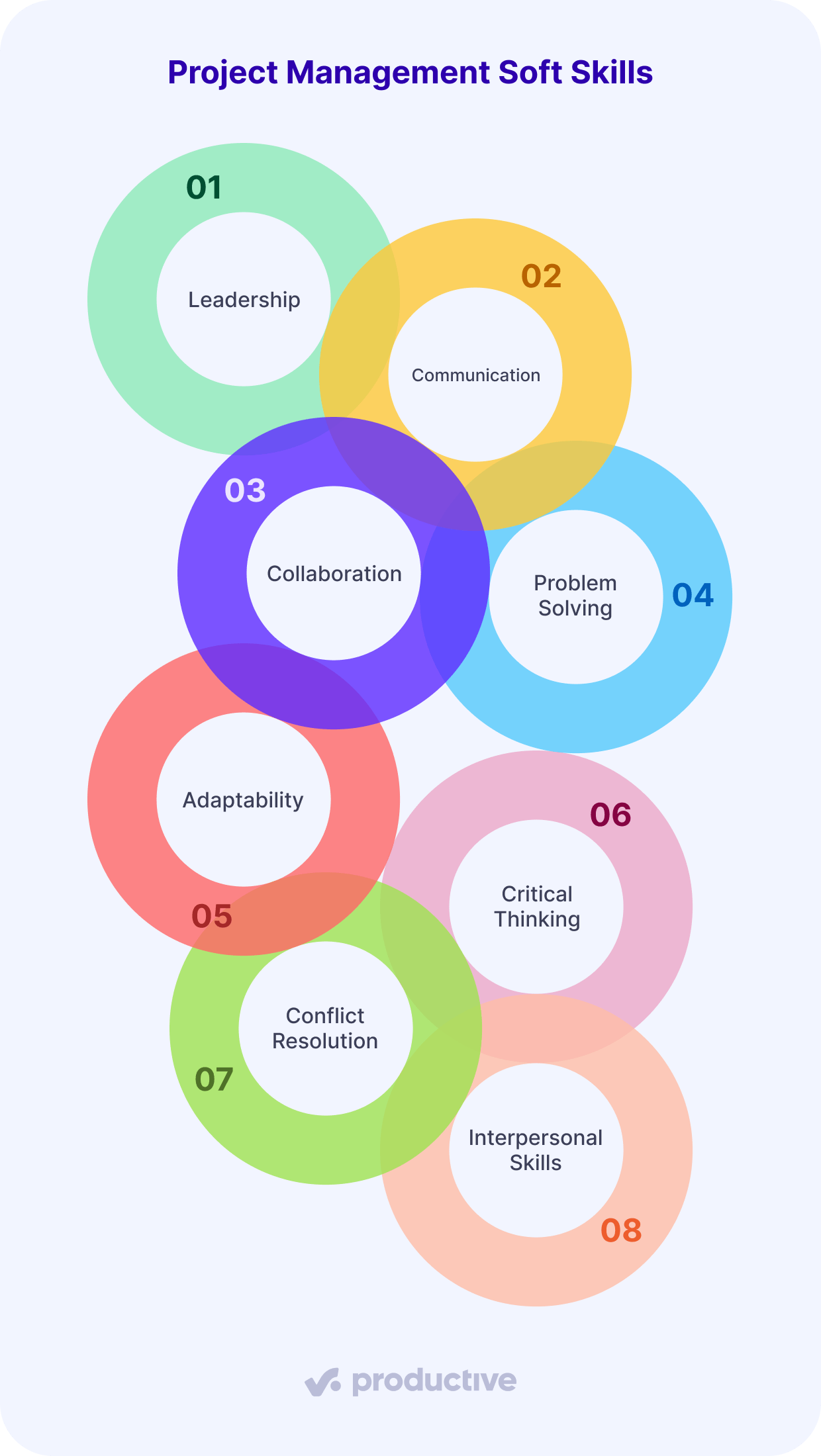
We’ll take a closer look at each.
8. Leadership
The leadership skill a delivery team feels is a call made early, before people stall waiting on you. To be a better leader, focus on developing:
- Emotional intelligence: understanding your team’s motivations and managing interpersonal dynamics.
- Situational awareness: flex your leading style based on project conditions and team needs.
- Decision-making proficiency: make informed choices quickly while maintaining integrity.
Example: A senior developer is out for a week. By the next morning, you’ve said which live deadline moves.
Write the decision down with a date and two lines of reasoning that the project team can read. When leadership is missing, three people wait on you, and nothing moves until the next status call.
9. Communication
Communication is scheduled work for a project manager, not something that happens between tasks. Write a communication plan that names every project stakeholder, what they receive, how often, and through which channel.
Example: The client’s marketing director gets a Thursday written summary, and the studio lead gets a Monday stand-up.
You know communication has broken down when a client emails asking where things stand. Another sign is your team hearing about a direction change from the client first.
In Productive, the AI Assistant can generate an instant status summary of a project.
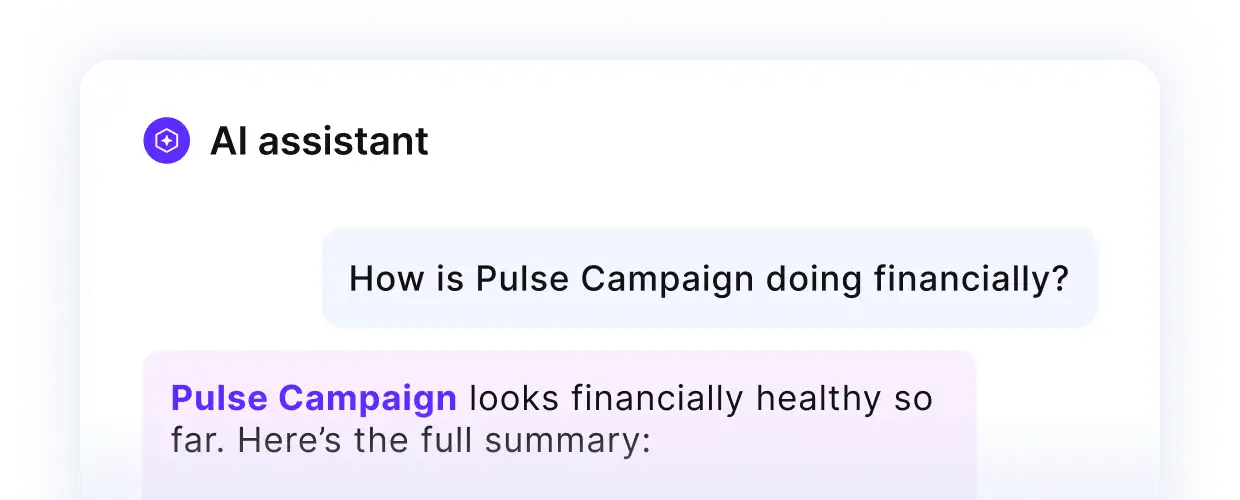
Ask AI for insights in plain language in Productive.
Pick an executive summary or a quick recap, review it, and send it before the client follows up.
Summarize any project’s status with AI.
10. Collaboration
Collaboration is getting the people who will disagree later into the same room early. To build collaborative environments, focus on:
- Active listening: Maintain engagement during interactions to make sure you understand each stakeholder.
- Co-creation opportunities: Develop spaces where all contributions are valued and encouraged.
- Transparent communication: Implement open information-exchange protocols that minimize misunderstandings.
Example: On an e-commerce replatform, the designer and lead developer review the component list before design starts.
Keep a shared decisions log from that session. When collaboration is missing, you get rework: designs handed to build, then redrawn because a component was never possible.
11. Problem Solving
Effective problem solving consists of accurate identification, systematic analysis, and decisive implementation of solutions. It starts with writing the problem down in one sentence before anyone proposes a fix.
- When tackling specific challenges, use data-driven approaches alongside creative thinking techniques like mind mapping and brainstorming.
- Structured frameworks such as Kepner-Tregoe can guide your decision-making process.
Write a short note naming the root cause and the one thing you changed. Otherwise, the same issue returns a month later under a different name.
Example: If QA slips three releases in a row, look at what reaches QA, not only at the testers.
12. Adaptability
Adaptability is how fast you re-plan when the brief changes. Three key approaches to enhance your adaptability:
- Use Agile frameworks like Scrum, which plan work in short, fixed-length Sprints.
- Establish regular feedback loops to capture evolving requirements.
- Develop cross-functional teams that can quickly pivot when challenges arise.
Example: A client rejects the second creative route but keeps the launch date. You send a revised schedule and a fresh estimate of hours remaining the same day.
13. Critical Thinking
Critical thinking is objective analysis of information to form sound judgments. In practice, you test the number you were handed. Challenge your assumptions, ask what evidence supports each number, and consider alternative explanations before acting.
Example: A team booked at 95 percent with flat billable revenue is a question, not a result.
Note which assumption you tested and what you found. When this skill is absent, a quote gets defended with “that is what we charged last time.”
14. Conflict Resolution
Conflict resolution means settling disagreements before they reach the client. If and when tensions arise, use these techniques:
- Active listening – Focus completely on understanding others’ perspectives before formulating your response.
- Problem-focused approach – Address the root cause rather than assigning blame, keeping discussions centered on solutions.
- Timely intervention – Identify conflict indicators early through observation of team dynamics and communication patterns.
Example: An account lead promises a client Friday delivery that the studio lead never agreed to.
Get both people on a 30-minute call the same day and leave with one date in the schedule. If you skip it, the disagreement continues by email with you copied in.
The technical skills come next.
What Technical Project Management Skills Do You Need?
The technical project management skills you need include software selection and integration, Gantt chart scheduling, workflow automation design, data analysis, dashboard reporting, and critical path analysis.
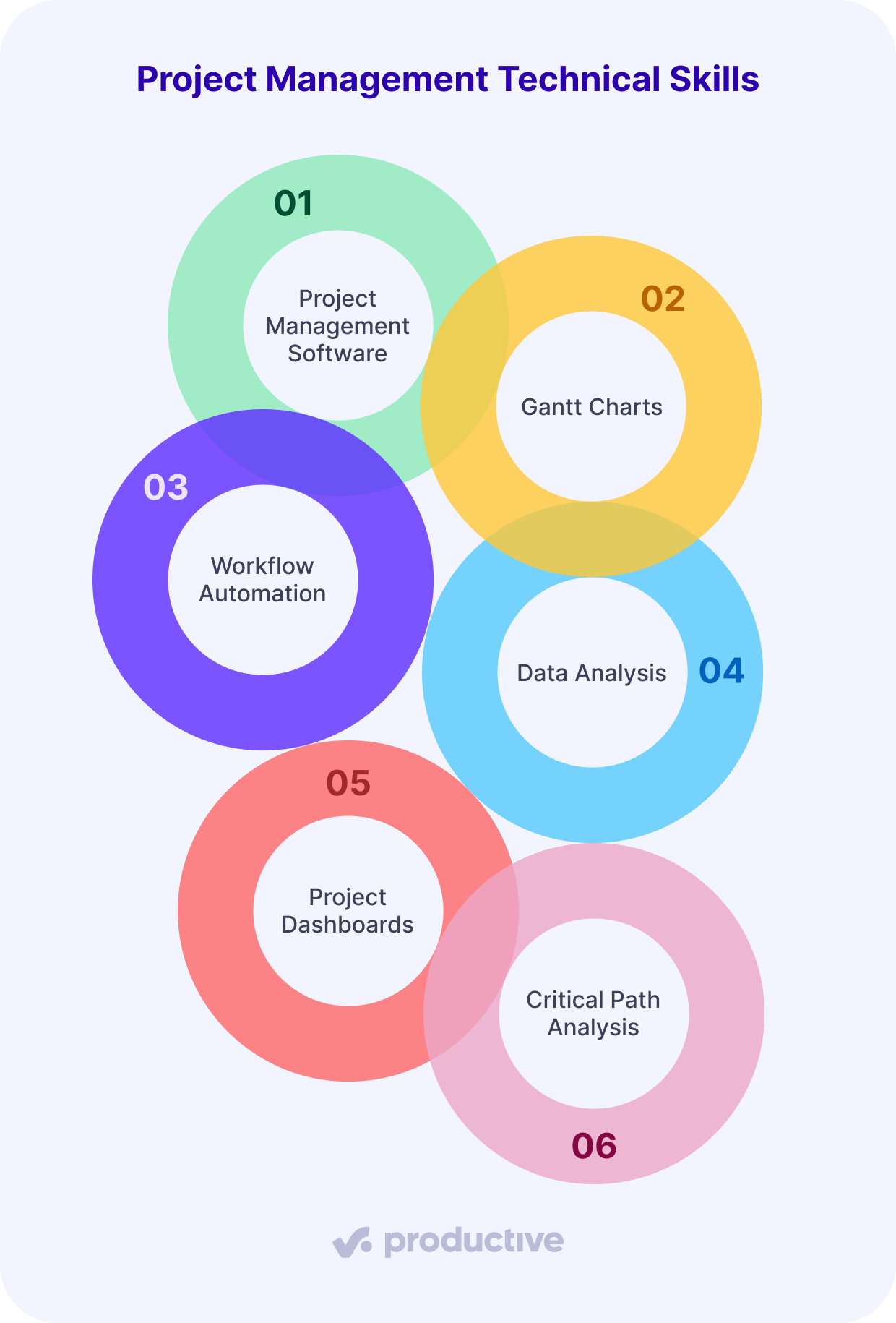
We’ll take a closer look at each.
15. Software Selection and Integration
Software selection and integration means matching project management software to your methods, your data, and your other systems. That takes three skills:
- Knowledge of your delivery approach (Agile, Scrum, Kanban) for selecting appropriate tools.
- Data analysis capabilities to interpret metrics and make informed conclusions.
- Integration expertise to connect various systems into a cohesive workflow.
Our guide on choosing the right PM software walks through the selection step by step.
If your projects, time, and budgets sit in separate tools and spreadsheets, someone glues them together by hand.
Example: Estimates sit in one spreadsheet and logged time in another app. Check that a new tool can import both before you switch.
16. Gantt Chart Scheduling
Gantt chart scheduling means displaying tasks along a timeline, with horizontal bars for duration and diamonds marking key milestones. When implementing Gantt charts, you’re able to clearly visualize dependencies between activities, allocate resources efficiently, and identify potential bottlenecks.
They’re useful for tracking progress against your baseline project plan and communicating status to every stakeholder.
Example: A website launch chart shows design, build, and QA as bars. QA starts only after build ends, and a diamond marks launch day.
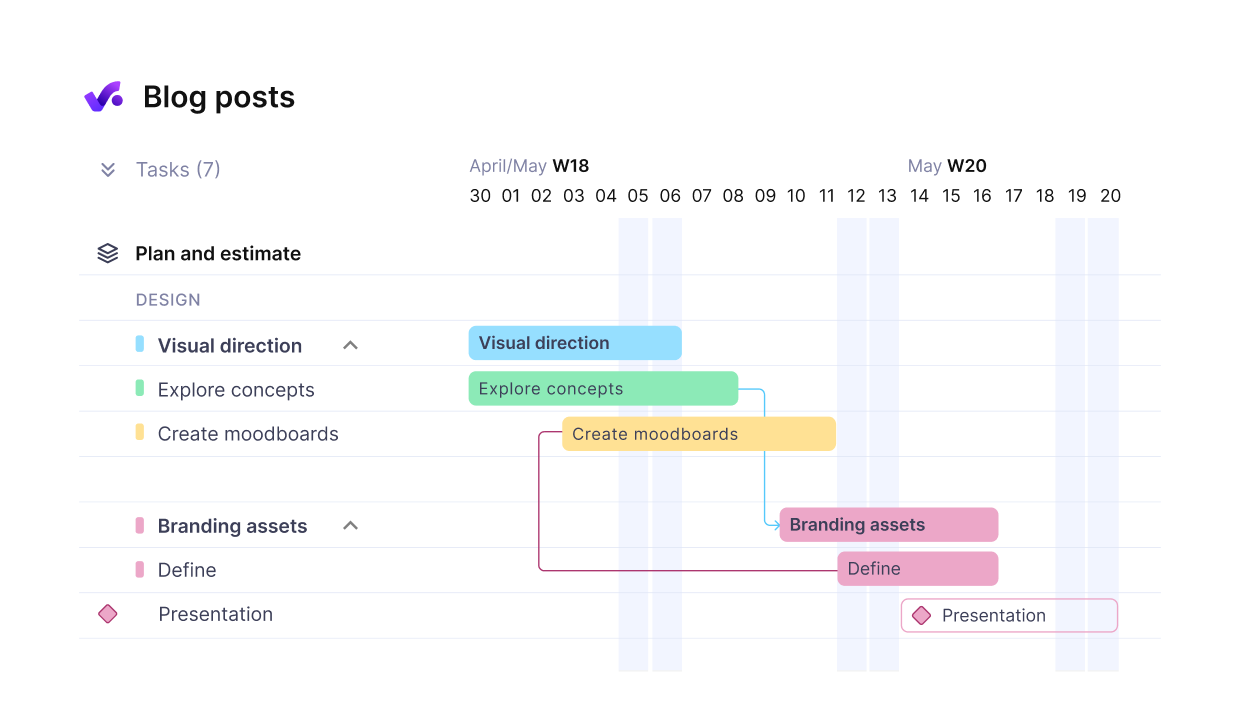
Manage timelines by mapping out tasks, milestones, and deliverables in one visual chart.
17. Workflow Automation Design
Workflow automation design means deciding which repetitive steps a tool should handle, such as approval workflows or task assignments. To implement workflow automation in your projects, you should:
- Identify processes that can be automated, starting with the steps your team repeats every week.
- Document your current state before mapping out your ideal future workflow.
- Select appropriate tools that connect to the systems you already use, such as dedicated BPM software.
Example: A rule assigns the reviewer automatically whenever a task moves to a Review status.
Cut down manual updates and repetitive tasks with workflow automations.
18. Data Analysis
Data analysis transforms raw information into actionable insights that back strategic decisions. You’ll need to master various technical skills to analyze project data and identify patterns that inform your next steps. The three types of analysis, with example tools, are:
| Analysis Type | Example Tools | Application |
|---|---|---|
| Descriptive | Tableau, Excel | Historical performance tracking |
| Predictive | Python, R | Risk assessment, forecasting |
| Prescriptive | SQL, SPSS | Resource optimization, decision support |
Example: A descriptive report shows a team’s billable hours dropping three months in a row. A predictive view asks whether that trend continues next quarter. A prescriptive view then suggests which bookings to move.
19. Dashboard Reporting
Dashboard reporting means turning project data into charts you can read at a glance. Dashboards support data-driven decisions and stakeholder communication by visualizing project metrics in real time. To implement effective dashboards, you’ll need to:
- Select appropriate software that integrates with your existing systems and offers customization options.
- Design for clarity, ensuring complex information is presented in an easily digestible format.
- Incorporate interactive visualizations and automated data updates to maintain relevance.
Example: A client dashboard shows percent complete, budget used, and open risks. Those are the same items as your weekly status, so the two tell the same story.
Building each report by hand is the slow part. With Productive’s Report Intelligence, you ask anything about your business data and get the answer in plain language.
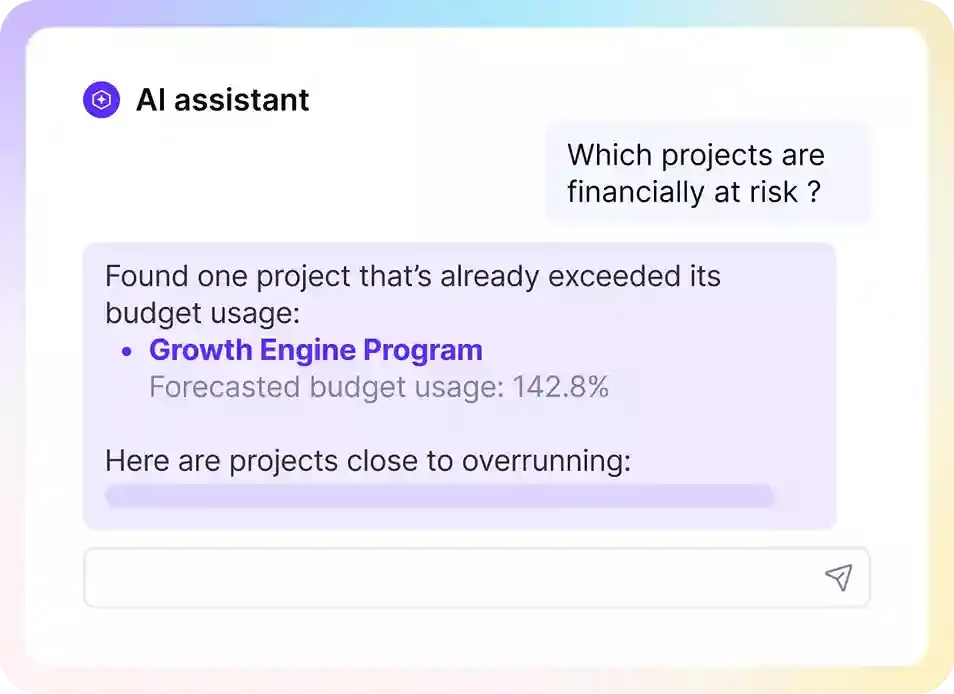
Gain INSIGHTS with ai IN pRODUCTIVE.
You can also turn any report into a ready-to-share Artifact for clients or executives. Artifacts save automatically, and you can download each one as a PDF.
If you’re comparing AI tools, check out our list of the top AI project management tools.
20. Critical Path Analysis
Critical Path Analysis (CPA) is a scheduling method for finding the tasks that set your project’s end date. With it, you work out which activities directly affect your project’s duration.
When you identify the critical path, you’ll distinguish between activities that can float and those that mustn’t be delayed. Finding it takes four steps: list every task, set dependencies, estimate durations, and find the longest path.
Example: A launch has four tasks. Task A takes three days and comes first. Task B (five days) and task C (two days) both follow A, and task D (two days) follows both.
Our detailed guide on critical paths covers the full method. The methods behind these skills come next.
What Do Project Managers Need to Know About Agile and Frameworks?
Project managers need to know how Agile changes team planning and how to pick a fitting framework. The two parts are running Agile projects and selecting a framework. We’ll take a closer look at each. The terms sit at different levels. Agile sets out values and principles, Scrum is a framework, and Kanban is a strategy.
Different methods suit different work: Scrum for complex problems, Kanban for managing flow, and hybrid models. Knowing them helps your team adapt when things change.
Critical Chain Project Management (CCPM) helps when resources are tight and timing is critical.
Running Agile Projects
Running Agile projects means working in iterative cycles and adapting as you go. Traditional project management sticks to linear processes.
Approaches used with Agile include Scrum, a lightweight framework with sprints and accountabilities. Others are the Kanban strategy for visualizing workflow and Extreme Programming.
Tools for this include Jira for sprint planning, Kanban boards for tracking progress, and Slack for collaboration. Agile aims at early and continuous delivery, but it needs stakeholder commitment and makes long-range dates harder to predict.
Framework Selection
To select a framework, match it to your project’s complexity, your team, and the control stakeholders need. Frameworks provide adaptable approaches, while methodologies offer specific procedures within them. When selecting a framework, consider:
- Project complexity – Waterfall suits well-defined requirements, while Scrum suits evolving specifications.
- Team dynamics – Kanban, a strategy rather than a framework, visualizes workflow and controls work in progress.
- Need for a documented method – PRINCE2 is a best practice project management method that works across industries.
Each approach uses specific tools: Gantt charts for Waterfall, Kanban boards for flow, and work breakdown structures across approaches.
Next is how you improve these skills.
How Can You Improve Your Project Management Skills?
You improve your PM skills through training and certification, practical experience, continuous learning, and mentorship and networking. We’ll take a closer look at each.
Effective project management skills come from combining learning with repetition on real projects.
Start investing your time in recognized certifications like Project Management Professional (PMP) or PRINCE2. Expand your network through mentors and industry forums, and you’ll benefit from diverse perspectives.
Real growth happens when you get your hands dirty. That means leading projects, handling shifting deadlines and tough conversations, and course-correcting when plans fall apart. Learning from real-world experience, not just textbooks, is how you sharpen your instincts.
Training and Certification
Training and certification give you a structured path. It runs from introductory courses like Google’s Foundations of Project Management to certifications such as PRINCE2 and PMI-ACP. Introductory courses cover basic project management skills. To maximize your professional development:
- Start with foundational courses that align with your career goals, through platforms like Coursera or directly from PMI.
- Supplement formal education with mentorship programs and hands-on experience.
- Consider specialized certifications that reflect your industry’s methodologies, whether Agile, Waterfall, or hybrid approaches.
Practical Experience
Practical experience means applying the skills at work, in volunteer roles, or on side projects. Each setting builds different skills:
| Experience Type | Benefits | Development Focus |
|---|---|---|
| Work Projects | Real stakeholder interactions | Communication & risk management |
| Volunteering | Low-pressure skill building | Guidance & team cohesion |
| Side Ventures | Autonomy to experiment | Planning & execution methodologies |
Seek leading roles within your current organization, even without the formal PM title. Join the PMI community to connect with mentors who can provide guidance. Proficiency comes from applying what you learned, receiving feedback, and adapting your approach accordingly.
Continuous Learning Approaches
Continuous learning means adopting strategies that evolve with industry demands. You need to cultivate a growth mindset that views challenges as opportunities rather than obstacles. To keep learning:
- Use certification study, like PMP prep, to spot gaps in your knowledge.
- Participate in industry conferences, events, and webinars to gain insights from thought leaders.
- Apply new methodologies in controlled simulations before implementing them in actual projects.
Regular self-reflection and documentation of lessons learned will solidify your understanding while contributing to your team’s collective knowledge.
Mentorship and Networking
Mentorship and networking add feedback from people who have already done the job, which complements your technical knowledge.
Structured mentorship relationships help you develop leadership qualities like emotional intelligence, communication, and adaptability.
Effective mentorship programs feature clear objectives, thoughtful mentor-mentee matching, and formal frameworks with scheduled touchpoints. Networking through professional communities, conferences, and peer learning groups creates connections that open career opportunities.
Next is how these skills affect your career.
How Do Project Management Skills Affect Your Career?
PM skills affect your career by setting your next role and keeping you in demand.
Career levels, typical roles, and key requirements look like this:
| Career Levels | Typical Roles | Key Requirements |
|---|---|---|
| Entry-level | Project Assistant, Coordinator | CAPM certification, soft skills |
| Mid-level | Project Manager, Implementation Manager | PMP certification, leadership experience |
| Senior | Senior PM, Head of Projects | Strategic thinking, multiple project oversight |
| Executive | Director, VP of Project Management | Organizational strategy, industry expertise |
On a project management skills resume, list the skills and certifications in the row that matches the role you want.
Name each skill the way the job posting does, then back it with one result. List certifications such as CAPM or PMP with the year you earned them.
Continuous learning and certification help you advance, while specialized knowledge in a method or industry can speed it up.
Rising Demand for Project Talent
Rising demand for project talent shows in PMI’s 2025 numbers. “Up to 30 million new project professionals are needed to meet global demand by 2035,” says PMI’s 2025 talent gap press release.
The release puts today’s global workforce at almost 40 million.
If you can lead a team, juggle deadlines, manage risks, and deliver results, that demand works in your favor.
Manage Your Projects, Budgets, and Team in One Place
Essential project management skills combine hard skills like budgeting and scoping with soft skills like communication. Technical skills like scheduling and data analysis tie them to your tools. You build all three through training, practice on real projects, and feedback from mentors.
Software gives those skills one place to work from. With Productive, you run projects, budgets, and resources in one place with real-time insights.
Book a demo to see how Productive runs your projects, budgets, and resources.
Run Every Project From One Place
Plan tasks, track budgets against logged time, and see when a budget will run out.
