How to Run Agency Project Management in 2026? Full Guide

Agency project management covers everything between winning a client project and invoicing it. That includes the scope, the estimate, the people you book, the hours they log and the margin left over.
In this guide we walk through the whole agency project management process, from lifecycle and scoping to capacity and invoicing.
We also cover the performance metrics, estimations, tools, risk and client management.
Key Takeaways on Managing Agency Projects
- Estimate from your own history: Start from the hours your last comparable project actually took, not the client’s budget.
- Plan on real available hours: Subtract leave, admin and new business from contracted hours before you promise a date.
- Price every change request: Log it, quote the hours, and have it approved in writing before the work begins.
- Compare spend with progress: Budget consumed only means something next to the work the client has signed off.
What Is Agency Project Management?
Agency project management is the practice of planning, running and delivering client work. The job is to deliver what was agreed, on the date agreed, and still make a profit.
First you scope and price the work, then book people against real availability. From there you run delivery, track spending against the budget, and turn finished work into an invoice.
How Is Agency Project Management Different From In-House Project Management?
Agency project management differs because you run several client projects at once, against a fee fixed before work started. An in-house team has one client, one budget cycle and one set of priorities. Six differences follow from that.
- Timelines overlap. Three projects can need the same designer in the same week, and only one can have her.
- The fee does not change when the work grows. Every hour past the quote comes out of your profit, not the client’s budget.
- Billable and non-billable time are tracked apart. Internal work is real, but it adds no billable hours, so it has to be counted separately.
- People are shared across accounts. Nobody is dedicated to one product, so every booking takes capacity away from another client.
- Approvals sit outside your company. You cannot chase a client the way you chase your own team, so you plan around the delay.
- Change requests arrive as conversation. They come in a call or a message rather than a ticket, so they get agreed before anyone prices them.
Who Owns What on an Agency Project?
Five roles own different parts of an agency project. They are the project manager, account manager, resource lead, discipline lead, and client-side approver. Here is what each one decides and answers for.
| Role | What they decide | What they are accountable for |
|---|---|---|
| Project manager | Sequence, dates, and who does what | The project landing on scope and on time |
| Account manager | What gets promised and how the client hears it | The relationship and the renewal |
| Resource or delivery lead | Who is available and what they work on | Capacity across every project at once |
| Discipline lead | Whether the work is good enough to send | The quality of the craft |
| Client-side approver | Whether a deliverable is accepted | Feedback arriving in time to act on |
What Does the Agency Project Management Lifecycle Look Like?
The agency project management lifecycle moves through six stages: intake, scope and estimate, kickoff, delivery, review, and invoice. Each stage has a financial checkpoint and a condition you have to meet before moving to the next one.
| Stage | What happens | Financial checkpoint | Exit criteria |
|---|---|---|---|
| 1. Intake | Brief arrives, you decide whether to bid | Rough size in hours | Go or no-go on record |
| 2. Scope and estimate | Deliverables listed, hours priced by role | Estimate at cost and at billable rate | Client signs the scope |
| 3. Kickoff | People booked, dates set, budget built | Budget matches the signed estimate | Team knows the first milestone |
| 4. Delivery | Work runs, time logged, changes priced | Burn against percent complete, weekly | Deliverables ready for review |
| 5. Review | Client reviews, revisions run | Revision rounds against the number quoted | Written acceptance |
| 6. Close and invoice | Time closed, expenses added, invoice raised | Final margin against the estimate | Invoice sent, variance logged |
These stages sit on top of the agency workflows you already run. Most of the structure is probably in place, including client onboarding at kickoff.
Most agencies run the first four stages well and lose money in the last two.
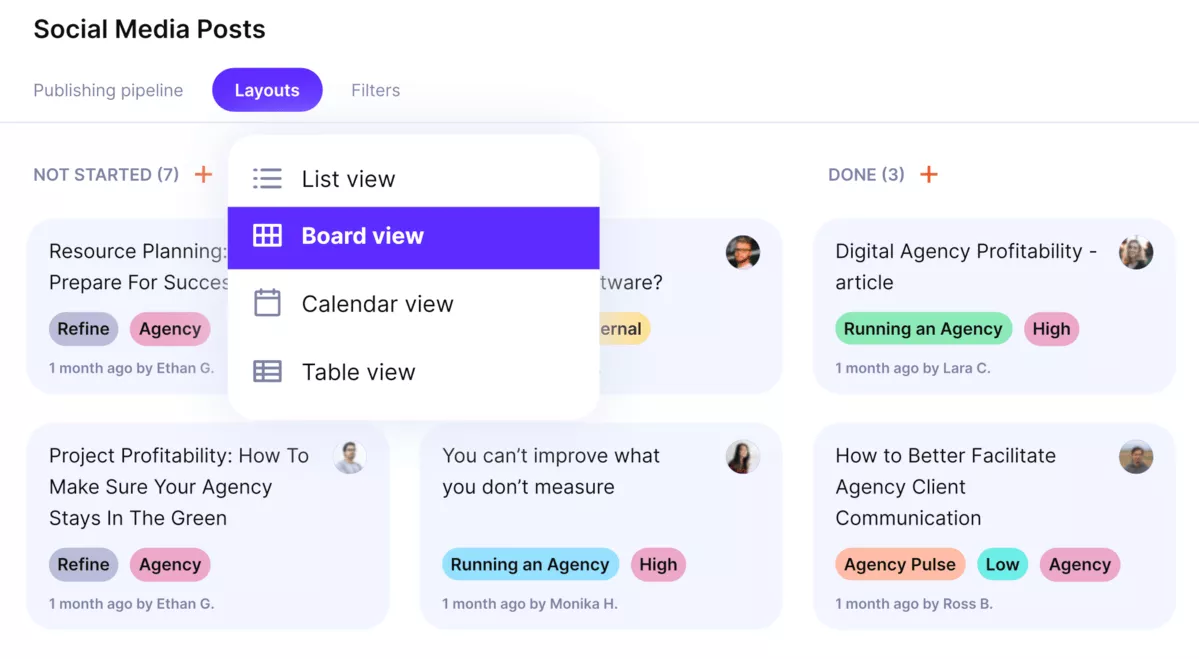
Manage your client’s projects with Kanban, calendar and board views.
Revisions run past the number quoted, and time logged late never reaches the invoice. You can catch both if you check the numbers at each stage instead of waiting until month end.
Which Handoffs Break Most Agency Projects?
The handoffs that break most agency projects are sales to delivery, and delivery to invoice.
Sales to delivery fails because the person who sold the work is not the person who builds it. The project timeline gets set before anyone checks it against real hours. Fix it with a written handover listing the assumptions and exclusions the estimate depends on.
The delivery lead signs that off before the contract is signed. Delivery to invoice fails because work gets done, time gets logged late, and the invoice goes out short.
Fix this by setting fixed dates instead of chasing people. Close time entries every Friday at 17:00 and run billing on the second working day. Anyone who logs late misses that invoice.
In Productive: winning a deal in Productive’s Sales CRM creates the project and budget from it. The services and rates you priced carry over.
Deliver Client Projects On Scope and In Profit
Plan, deliver, and bill client projects from one system that keeps your estimate, your logged hours, and your invoice in agreement.

Which Project Management Methodology Fits Agency Work?
No single methodology fits every agency project. The right one depends on how often the scope changes and how the client approves work. Project size and discipline matter less than either.
A creative agency running brand work and a dev shop running sprints will not land on the same method. The creative process needs review points, while a dev sprint common for digital agency project management need a backlog. Kanban boards suit work that arrives without a start date.
Below is an overview of the methods, along with when to use each one:
| Method | Use it when | Where it costs you |
|---|---|---|
| Waterfall | Scope is fixed in the contract and the client approves at defined stages | Late feedback becomes rework you already priced as final |
| Agile | Scope will change and the client is available to review continuously | Budgets drift without a cap on iterations |
| Scrum | The work is big enough to justify sprints and a dedicated team | Stand-ups, planning and retros eat billable hours on small accounts |
| Lean | You run repeat work and want fewer handoffs between disciplines | Hard to apply across a portfolio of unlike projects |
| Kanban boards | Work arrives continuously and priorities shift, as on support and retainer accounts | No fixed end date, so a fixed fee has nothing to anchor to |
| Hybrid | Design approves on milestones while build runs in sprints | Nobody is responsible for keeping the two tracks in step |
The client often decides the method for you.
If procurement wants a fixed price against a fixed scope, you are running Waterfall whatever your team calls it. Agile methodology inside a fixed-fee contract only works when the contract caps iterations. Agile delivery and a fixed price pull against each other otherwise. Otherwise you absorb the cost of every change.
Your methodology decides how often you stop and make decisions. It does not change the task management underneath. Someone still owns each piece of work, with a date and an estimate.
How Do You Choose the Right Project Management Method?
You choose the right agency management method based on the scope change after kickoff and depending on your client’s approval cadence.
- Fixed scope, staged approval: Waterfall. The contract and the delivery plan agree with each other.
- Fixed scope, continuous approval: Waterfall with a weekly review. Continuous feedback against a fixed scope mostly produces change requests, so price them as they arrive.
- Changing scope, staged approval: Hybrid. Run the volatile track in sprints and hold the fixed track to milestones.
- Changing scope, continuous approval: Agile, with a capped number of iterations written into the contract.
Most agencies land on hybrid whether they name it or not. The risk is that nobody is made responsible for keeping the two tracks in step. Name that person at kickoff. Otherwise the sprint track finishes work the milestone track has not approved.
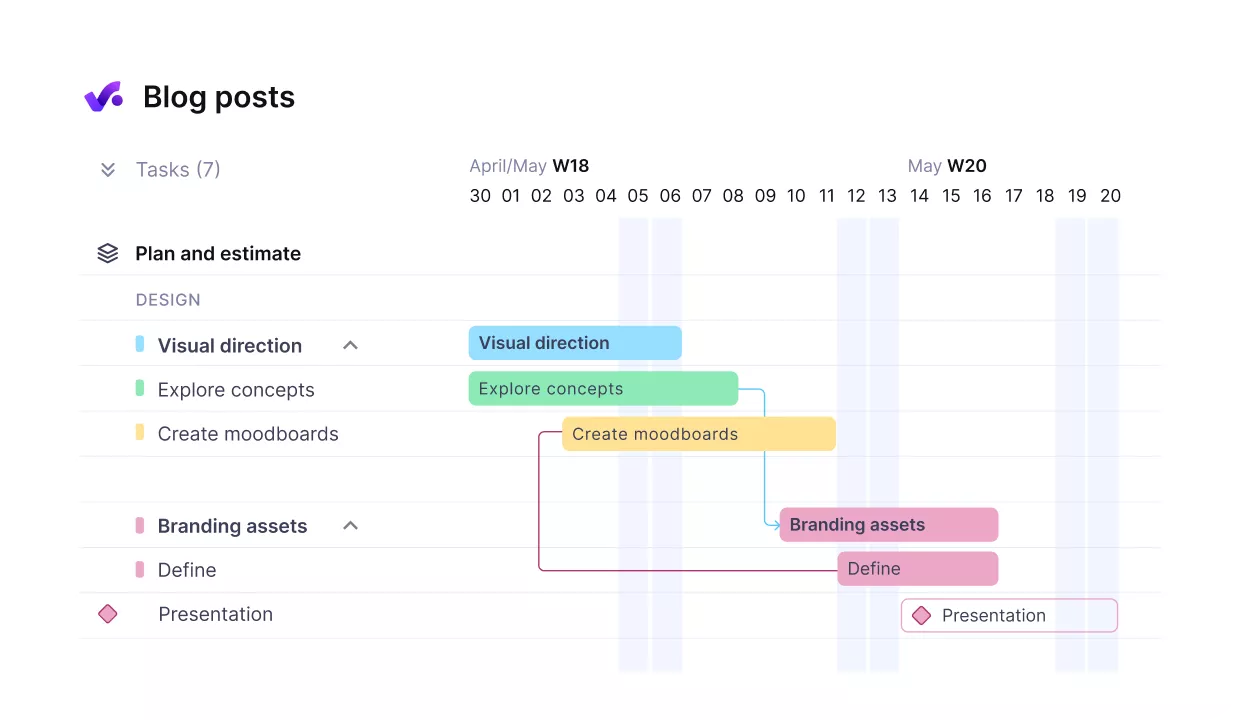
Break up projects into multiple phases with milestones and dependencies.
How Do You Scope a Project So It Survives the Client?
You scope a project so it survives the client by stating quantities and exclusions, not just a list of work. Those two are what you point at when someone asks for more.
All of it should be written and sent before you price the work. In agency project management, this is the document that stops a fixed fee turning into unpaid work.
Agency scoping differs from internal scoping because the person who changes their mind is not on your payroll.
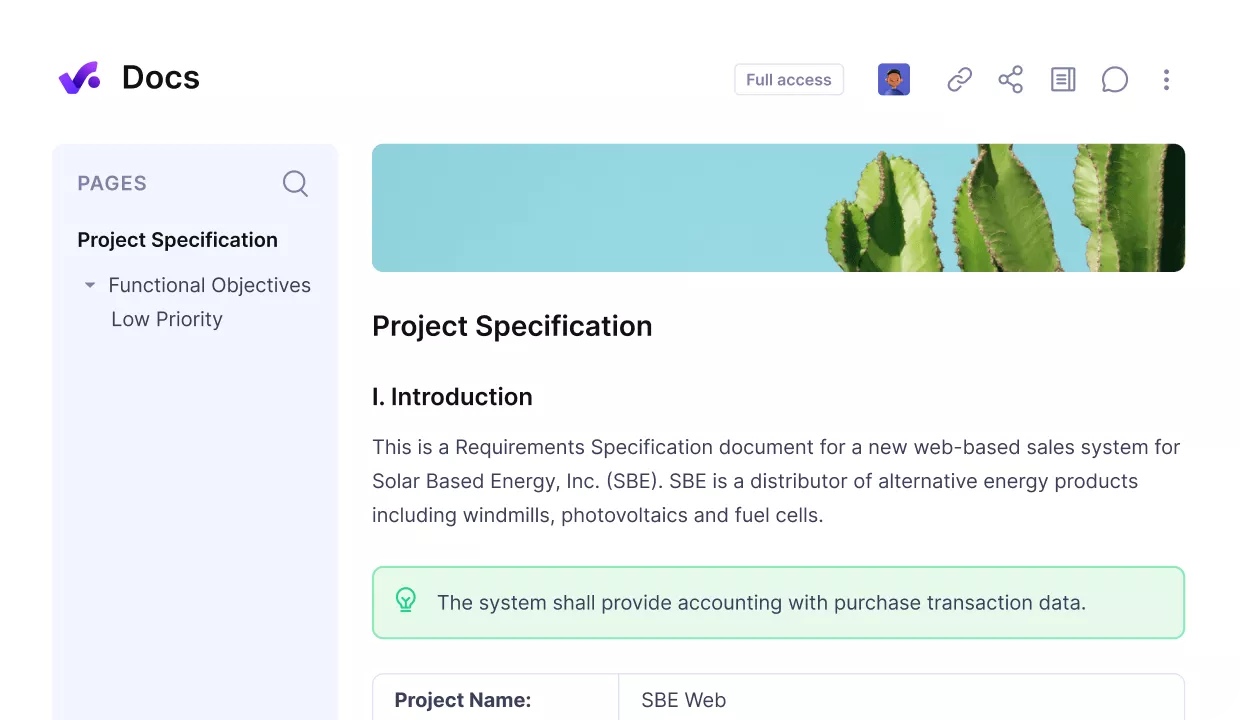
Write down docs and defined scope in Productive’s docs.
The most common mistake is describing the work in general terms. A project scope written during a pitch talks about goals and outcomes, because that is what wins the meeting.
It does not say how many pages, how many rounds of revision, or who writes the copy. Six weeks later the client asks for a fourth round of changes and you have nothing to point at.
What Belongs in a Scope Before You Price It?
A scope needs deliverables, acceptance criteria, the assumptions you priced against, and exclusions.
- Deliverables with quantities. “A website” and “an eleven-page website with three template layouts” are two different jobs at two different prices.
- Acceptance criteria. Write down the test each item has to pass, so approval is a decision rather than an opinion.
- Assumptions you priced against. State them plainly. The client sends final copy by an agreed date, brand assets exist, and one person collects the feedback.
- Exclusions. List the work a client could reasonably assume is included when it is not.
Together those four make up the statement of work the client signs.
Quantities are the part people leave out, because putting a number on revision rounds feels like distrust during a pitch. Without that number you cannot charge for a fourth round, since nobody ever agreed there were only three.
Give each deliverable a date as well, so the scope and the schedule say the same thing.
How Do You Write Exclusions That Hold Up?
You write exclusions that hold up by putting them in the body of the proposal, next to the price. An exclusion only works if the client read it before signing, and nobody reads the appendix.
Below are common examaples of exclusions:
- Two rounds of revision per page. Further rounds are quoted at the rates in this proposal.
- Copy supplied by the client in final form. Copywriting is not included.
- Third-party licences, stock imagery and fonts are billed at cost.
- Support after launch is not included. A maintenance retainer is available separately.
Exclusions also help the client. They show what to budget for elsewhere, and that often turns into the next brief.
Most scope creep starts here. The client asks for something extra, nobody can find the line that ruled it out, and the work gets absorbed.
How Do You Estimate an Agency Project Accurately?
You estimate an agency project accurately by listing deliverables, costing each by role, and pricing hours from your own records. The estimate becomes the price you quote. An error in one is an error in the other.
Estimates go wrong most often when they start from the client’s budget. The work still takes the hours it takes, so the difference comes out of your margin.
A Six-Step Estimating Method You Can Run This Week
The worked example running through these six steps is a five-page marketing website.
1. List the deliverables, not the phases. Phases like design and build hide the work inside them. Five page designs, a style guide, five built pages, a contact form and a CMS setup can be counted.
2. Assign each deliverable to a role. Designer, developer, copywriter, project manager. Use roles rather than names, so the estimate still holds if someone leaves.
3. Put hours against each role for each deliverable. Take the numbers from your last comparable project. If the last five-page site took the designer 34 hours, start at 34. Do not start at the 28 you hoped for.
4. Add the work nobody estimates. Kickoff, internal review, client revision rounds, project management and handover. On most agency projects this block runs between a fifth and a quarter of the total. The more involved the client, the higher it goes.
5. Price the hours twice. Once at your cost rates, to see what the work costs you. Once at your billable rates, to see what the client pays. The gap between the two is your margin, and you should see it before the client sees the price.
6. Check the total against your last comparable project. If the two are more than ten percent apart, find the reason before you send it. An unexplained gap is usually a deliverable you forgot to list.
You finish with two things: a number, and the list of assumptions behind it. The second one matters more, because the assumptions are what a change gets measured against.
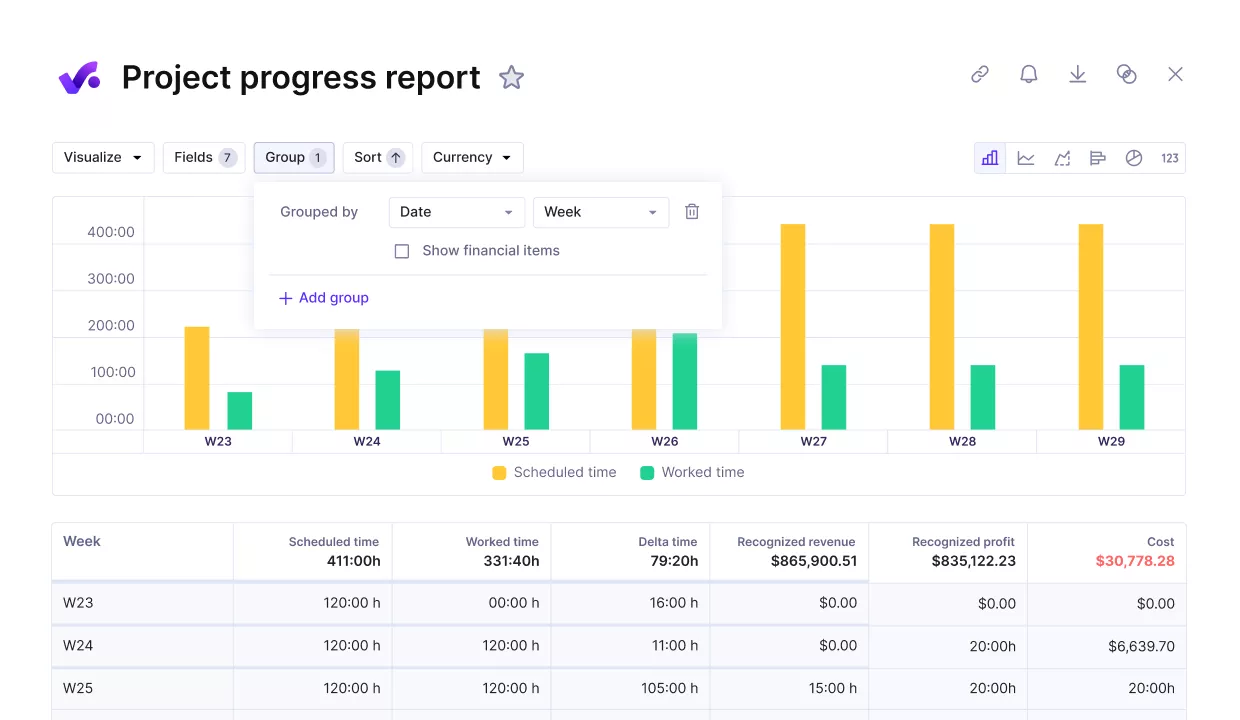
Compare progress against key financial and performance metrics.
Which Estimating Technique Fits Which Job?
Analogous, bottom-up and historical-rate estimating cover most agency work. Which one fits depends on how much you already know about the job.
- Analogous. Price the new job against a similar finished one. Fast and accurate when the two jobs really are alike. Unreliable when the client, the scope or the technology is new to you.
- Bottom-up. Estimate every deliverable separately and add them up. Slowest and most accurate, and worth the time on any fixed-fee project large enough that being wrong hurts.
- Historical rate. Use your own average hours per unit, such as hours per page or hours per campaign asset. Good for repeat work, and it needs several finished projects with clean time data behind it.
Every project estimation technique depends on having logged the hours on past work. If your time records are patchy, all of them become guesses.
How Do You Add Contingency Without Padding?
You add contingency without padding by attaching the extra hours to a named risk.
Padding is buffer time added because the estimate feels tight, with no reason attached to it. Contingency is buffer time attached to something specific that might go wrong.
If the client has three stakeholders and no single approver, revision rounds are the risk. Add hours to the review block, and say so in the proposal. A client who can see what the extra covers will argue about the assumption rather than your price.
How Do You Estimate a Retainer?
You estimate a retainer by costing one month rather than one project. A retainer is a monthly commitment of hours. List what recurs every month, put hours against each item by role, then add review and admin time.
Compare that total against what the client pays.
- Decide whether you are selling hours or deliverables, and never both. If the contract names deliverables and the client uses the hours faster than expected, you still owe the deliverables.
- Decide what happens to unused hours before you quote, because that decision changes the number. Hours can expire at month end, roll into the next month, or roll within a capped window.
Whichever you pick belongs in the contract, since this gets agreed in conversation and forgotten by month four.
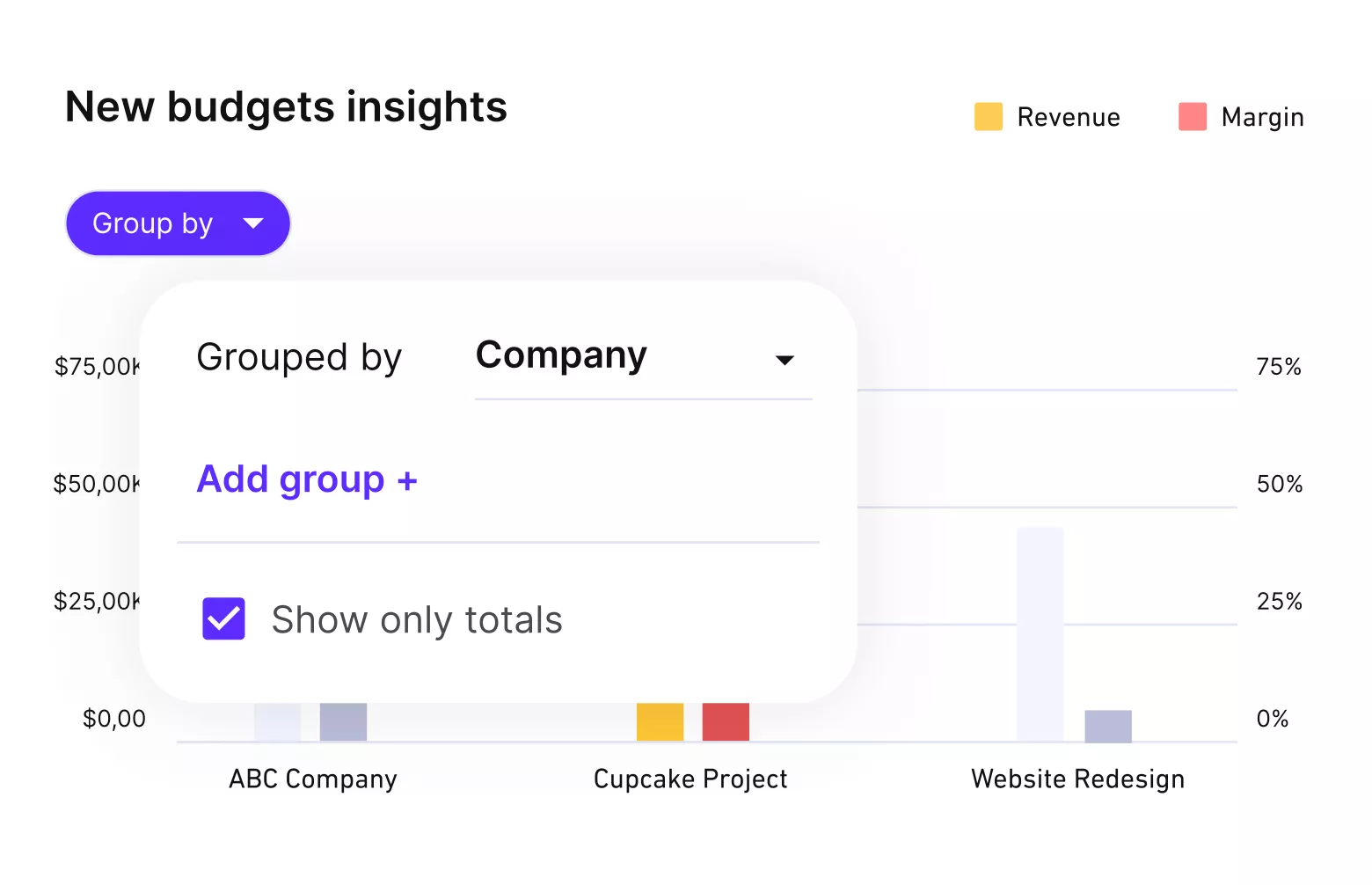
Get real time updates on budgets and profitability.
In Productive: a budget in Productive’s budgeting tools is built from services, each carrying its own estimated hours and rate. The estimate you send is the thing you later track time against.
How Do You Plan Capacity and Build a Timeline That Holds?
You plan capacity by working out real available hours, booking them against named deliverables, then reviewing twice a week. In agency project management, capacity planning is what turns an estimate in hours into dates you can commit to.
Agency planning starts from the hours people actually have. Most plans fail because they are built on headcount multiplied by forty. Nobody delivers forty billable hours in a week, so the plan is late before anyone starts.
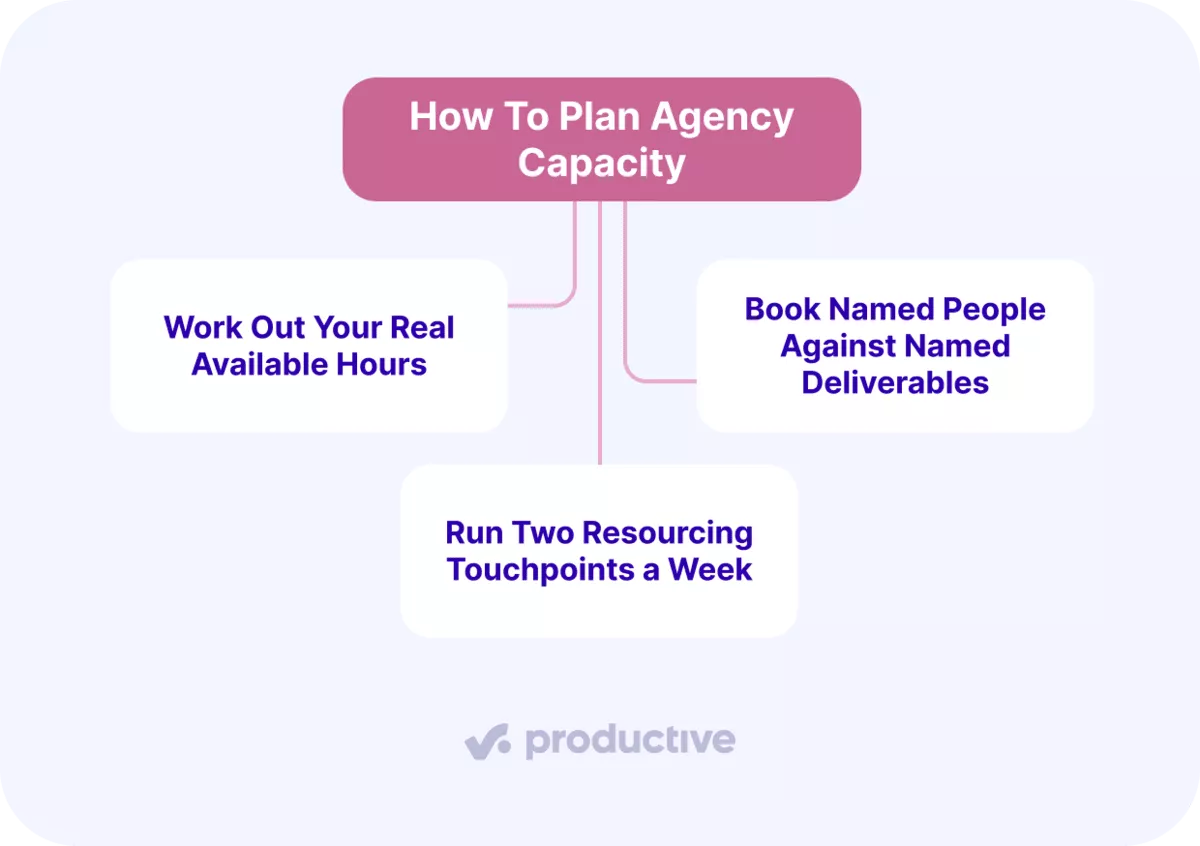
Step 1: Work Out Your Real Available Hours
Start with contracted hours and subtract everything that is not client work. For a full-time person on a 40-hour week:
- Contracted hours: 40
- Holidays and annual leave, averaged across the year: subtract 4
- Internal meetings, admin and training: subtract 4
- New business and pitch support: subtract 2
- Left for project delivery: 30
Thirty is the number your timeline should use. It is also the ceiling on billable hours for that person.
Resource allocation built on the gross figure produces dates nobody can hit.

Prevent overbooking or idle hours with real-time capacity updates.
The split differs by role. Designers and developers usually land higher, because less of their week goes to client calls and pitching. Account and strategy roles often land nearer half their contracted hours.
Those numbers are an illustration, and our guide to planning team capacity walks through the same calculation in more detail. Run the same subtraction against your own time records. Your leave policy and meeting load are not the same as anyone else’s.
Step 2: Book Named People Against Named Deliverables
Turn the estimated role hours into bookings against real people. Do this before you confirm a date with the client.
The estimate said the designer needs 34 hours. This step asks which designer, in which weeks, and whether those hours are still free. A Gantt chart shows the sequence, while the booking shows whether team capacity exists to run it.
Resource management means booking the person rather than the role, because only the person has a calendar.
You learn something in the act of booking. Two projects both need the same senior developer in week three. The estimate never showed it, because an estimate only counts hours.
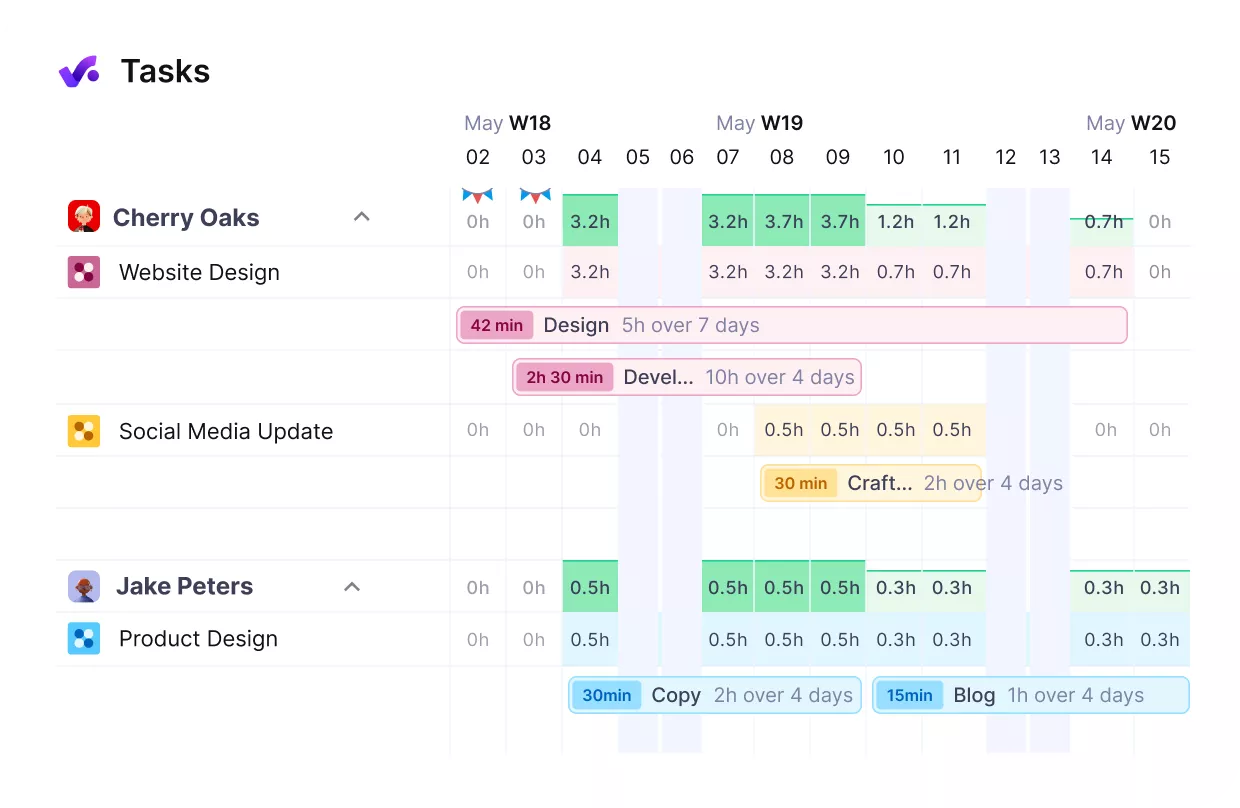
Schedule hours per person, day by day, across every project.
When the booking will not fit, our resource planning guide covers the three options. Move the date, change the people, or cut deliverables. Carrying on and hoping is not one of them. Resource management works when someone is allowed to say the date has moved.
Step 3: Run Two Resourcing Touchpoints a Week
Hold two short reviews a week, one to confirm the current week and one to look at the next.
- Monday, fifteen minutes, delivery lead and project managers. Check who is over capacity this week, which projects slipped last week, and what has to move today.
- Thursday, fifteen minutes, the same people. Look at next week only, and catch the collisions while there is still time to move someone.
Two touchpoints work because they are short and they have one question each. Anything longer gets cancelled within a month, and then you are back to finding out on Monday morning.
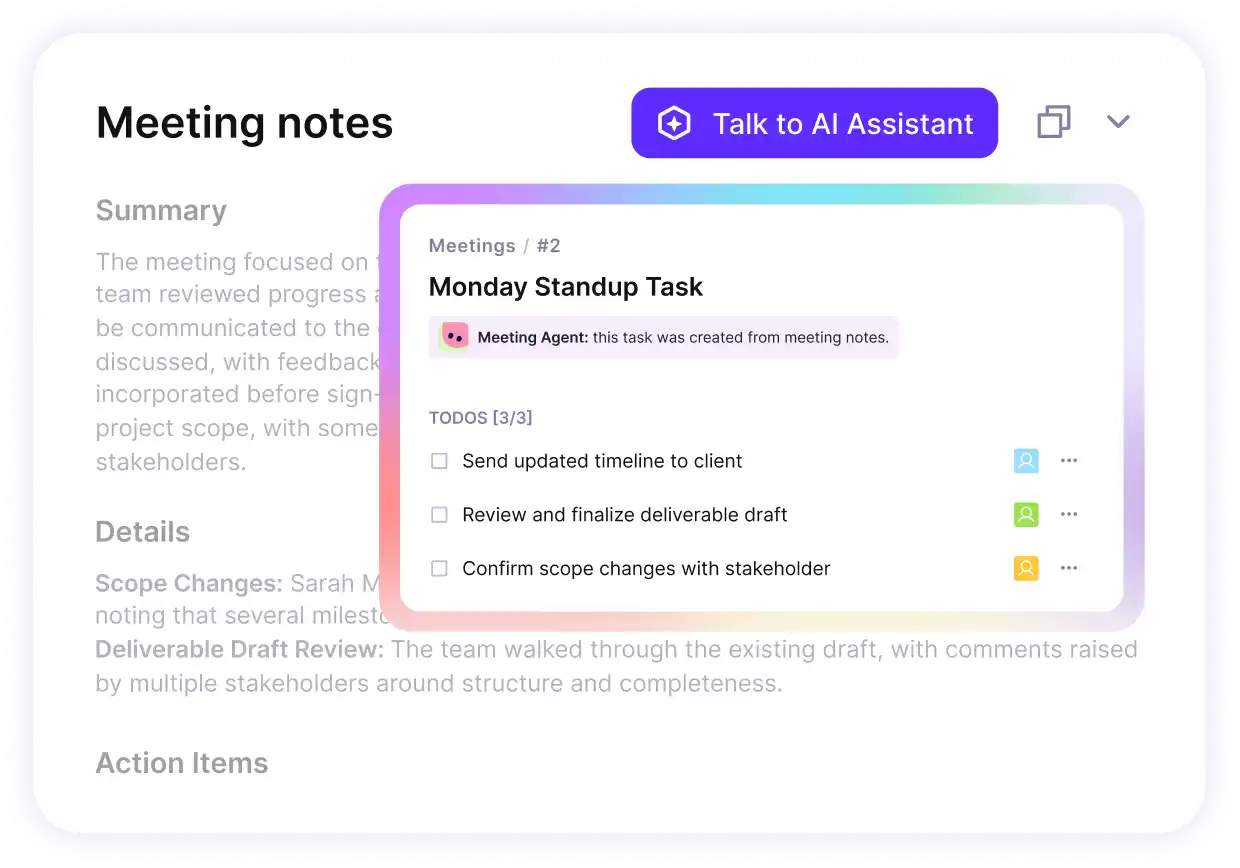
Create tasks from meeting notes.
How Do You Resource Work You Have Not Won Yet?
You resource unwon work by booking it provisionally and marking it unconfirmed. It then shows in the plan without blocking the person.
Apply the deal’s probability, the same weighting used in financial forecasting for agencies. A job at 30 percent does not get the same hold as one at 80. Then set a review date, and on that date the booking either becomes confirmed or releases the person.
Two things go wrong here:
- Some agencies refuse to plan for unwon work, then scramble for people the week it lands.
- Others treat the pipeline as confirmed, and block three developers for a job that never closes.
In Productive: tentative bookings in Productive’s Resource Planning hold a person against a deal you have not won. They stay out of confirmed capacity until the deal closes.
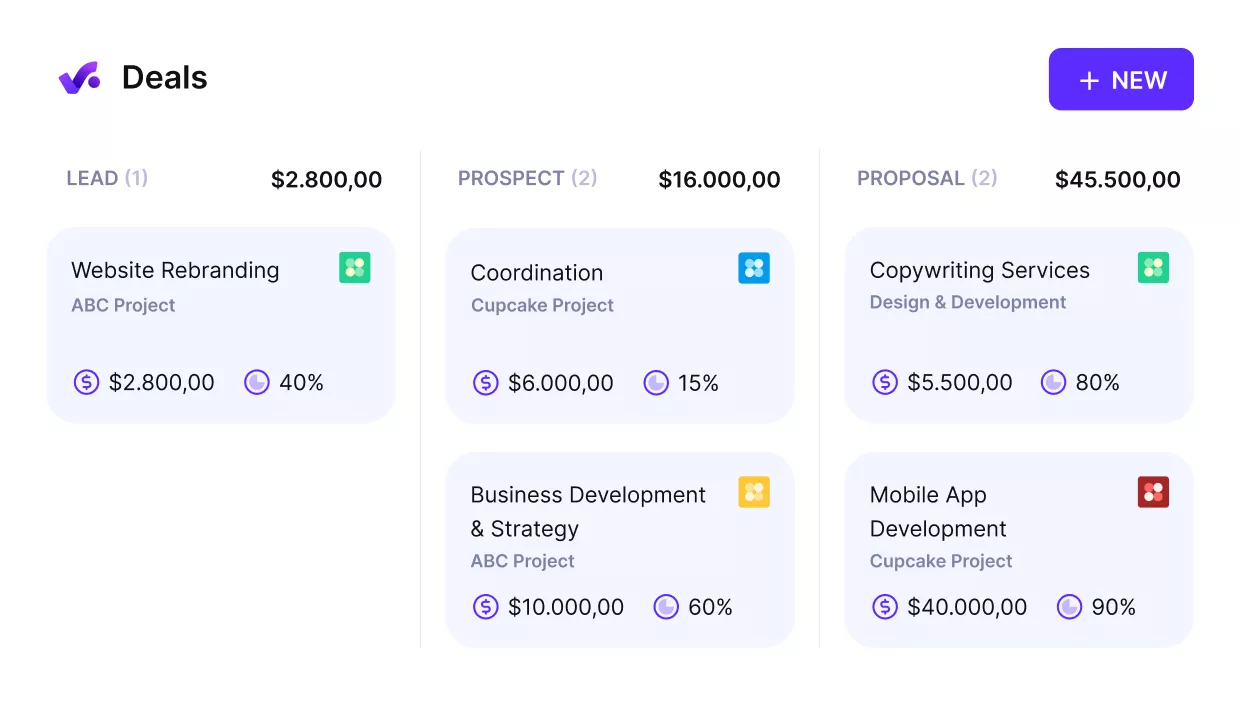
Turn won deals into started projects.
How Do You Run the Work Week to Week?
You run the week by keeping status in one place, holding one short check-in, and pricing changes before work starts. Most of agency project management happens in this weekly loop rather than in the plan. It runs the same way across every agency, and across all your client projects.
The usual problem is that status lives in four places. The task board says one thing, the client email says another, and the timesheet says a third.
The project manager holds the real version in her head. Task management tools show what is being done. They do not show whether it is still inside the fee.
How Do You Keep One Source of Truth for Status?
You keep one source of truth by picking one place and putting four fields in it. Update those fields instead of writing a separate report.
Every project needs the current stage, the owner, the next action, and whether the date is at risk.
Add more fields and nobody fills them in. Use fewer and someone has to ask.
The habit to break is rebuilding status by hand into a client deck every Thursday. It costs two hours, it is stale by Friday, and the client’s version stops matching the team’s.
When those two versions differ, the client decides on the wrong information. That is how a project gets approved to continue when it should have been re-scoped.
Workflow automation can move the status when the work moves, so nobody updates it twice. A Gantt chart answers when work happens, not whether the date is at risk. Keep the four fields above the task management detail. A Client Portal helps only if it reads the same record rather than a copy.
Whatever agency workflow software you use, the rule holds: one place, four fields, updated by whoever does the work.
How Do You Price and Approve a Change Request?
You price and approve a change request by logging it in writing and costing it at your original rates. State the effect on the date as well as the fee, then get written approval before anyone starts.
An extra landing page is fourteen hours. That is a fee you can quote and four working days added to delivery. Send both numbers, because clients often accept the fee and object to the date.
Small requests are the expensive ones. Nobody quotes a twenty-minute change, so nobody logs it. Forty of them across a project is a week of unpaid work.
Set a threshold. Everything gets logged, and anything above two hours gets quoted before it starts. That sequence is your change order process, and it works because it never varies. A threshold stops scope creep without making you argue about every small favour.
How Do You Actually Get People to Log Their Time?
You get people to log their time by making time tracking a daily habit against the calendar. Friday reconstruction from memory is guesswork.
People do not skip time tracking because they are careless. They skip it because at six on Friday evening they cannot remember Tuesday.
- Log against the calendar. Start from the meetings and blocks already in the diary, then fill the gaps. Remembering is the hard part, not typing.
- Make the deadline daily. A day-old entry is a memory. A week-old entry is a guess.
- Give managers a short-hours view. Chasing people individually costs a manager an hour a week. A view showing who is under their expected hours costs a minute.
- Say what the data is for. A team that believes their logged hours feed a performance review will round every entry to something safe.
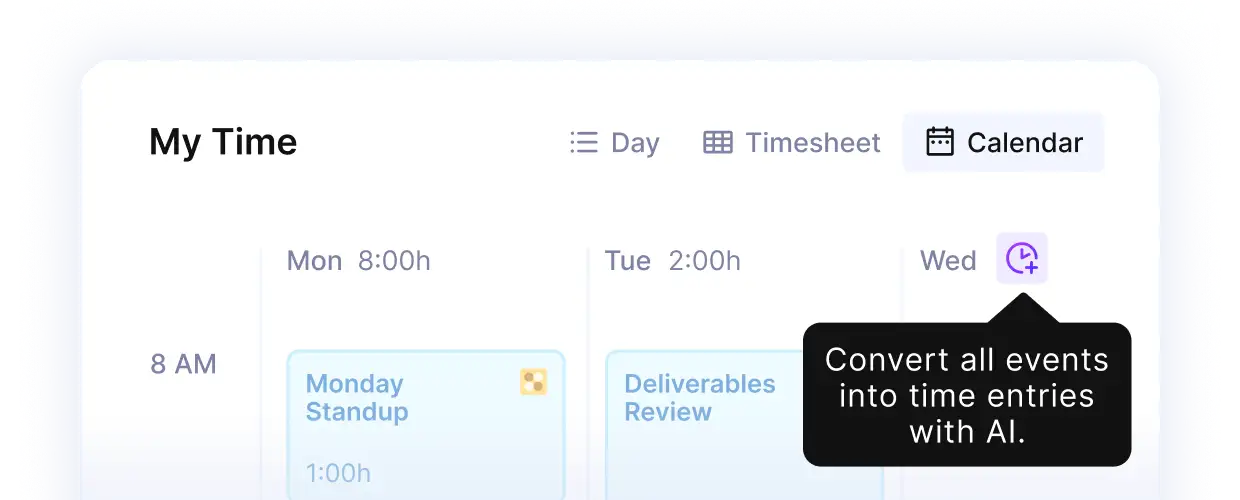
Use Productive’s AI time tracker to create time entries from calendar events.
Time tracking that lands a week late is an estimate rather than a record. Unlogged time is money you cannot invoice on time and materials. On fixed fee it is an estimating error you never find. Next year’s estimate gets built on hours nobody recorded.
In Productive: AI time entry in Productive’s time tracking turns calendar events into time entries. Logging starts from the diary rather than memory.
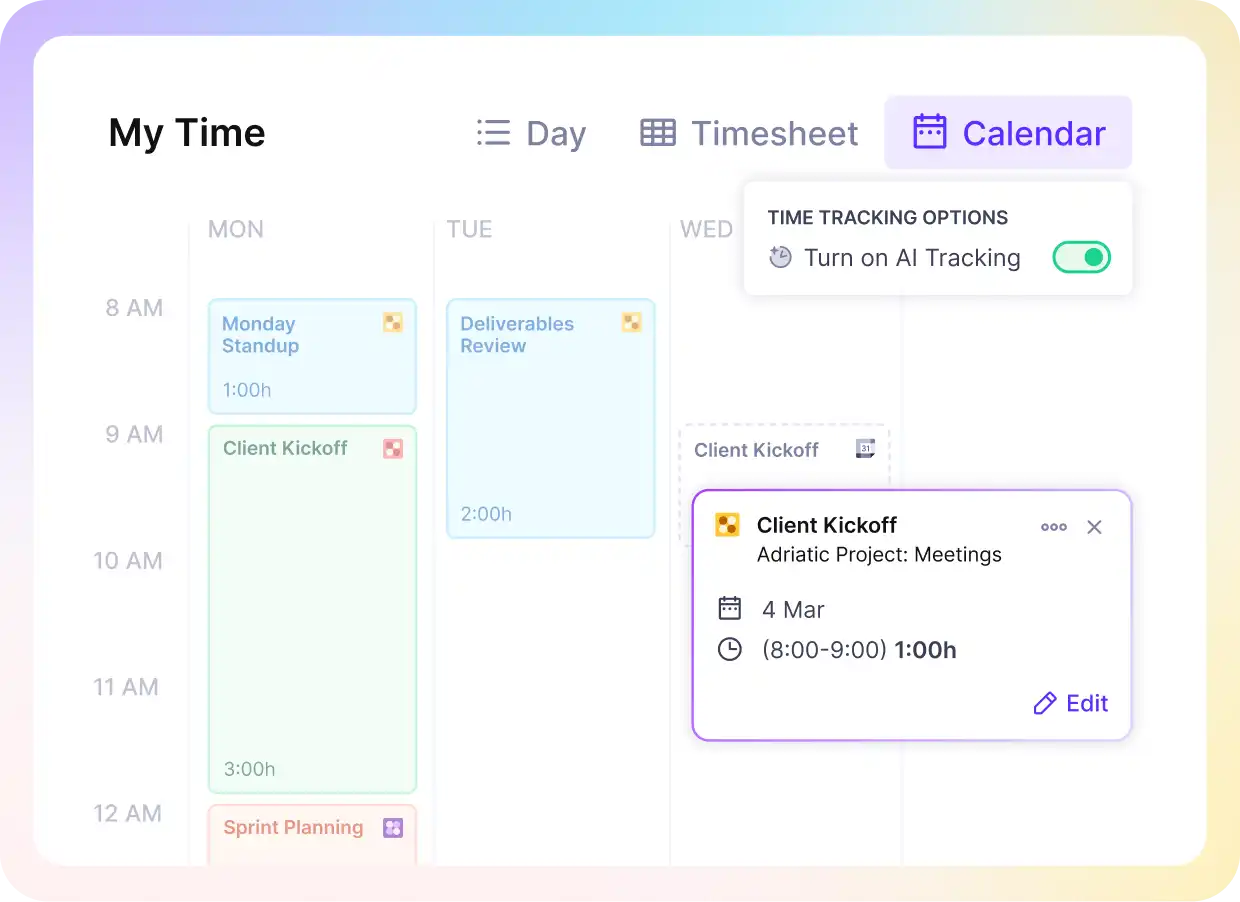
Track time directly on tasks or from your calendar entries.
What Communication Cadence Fits Your Contract Type?
Client communication should follow the contract type. A fixed-scope project needs a weekly written update and a review at each milestone. A retainer needs a monthly report on hours used against hours bought, plus a quarterly planning session.
The weekly update is four lines. What shipped, what is next, what you need from the client, and whether the date moved. Send it the same day every week, even in the weeks when nothing moved.
The retainer report is one number and one sentence. Hours used against hours bought, and what that means for the rest of the month.
Write the client communication rhythm into the contract. Client collaboration works best on a fixed cadence, and client feedback arrives faster when the update is expected.
The failure here is that retainer clients only hear from you in the month the hours run out. By then you are asking them to approve extra budget they had not expected.
Which Numbers Tell You a Project Is Going Wrong?
Four numbers tell you a project is going wrong: utilization, budget burn, estimate versus actual, and client response time. Check them weekly, because by month end the project has finished and the numbers only explain the loss. Profitability tracking at that cadence is what gives you financial visibility while you can still act.
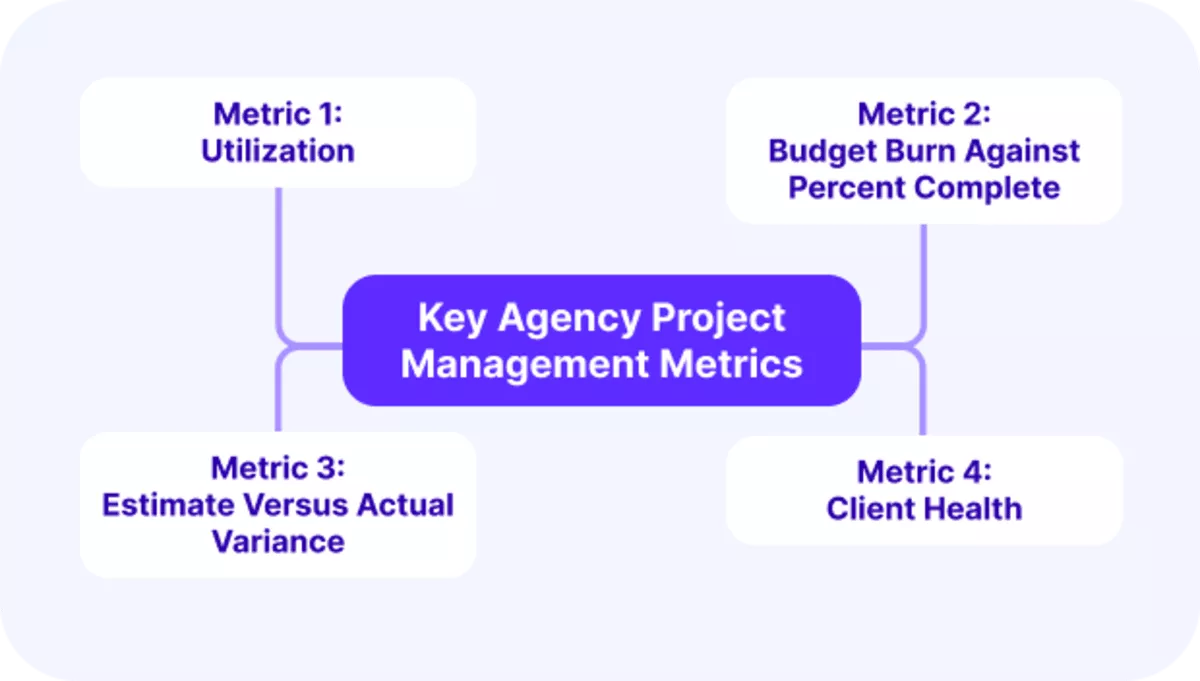
Metric 1: Utilization
Utilization is the share of someone’s available hours that gets billed to a client. Divide hours billed by hours available and multiply by 100. A designer with 30 available hours who billed 24 is at 80 percent.
A high number is not automatically good. Ninety percent usually means somebody is working through their own admin time. They will either leave or start making mistakes.

Use real-time utilization reports to avoid idle hours or overbooking.
It also says nothing about the rate those hours went out at. Agency time tracking software is where the rate and the hours meet. A fully booked team billing below cost still loses money every week.
Set the team utilization rate by role. A single company-wide target punishes the people whose job includes pitching and client calls.
Metric 2: Budget Burn Against Percent Complete
Compare the share of budget spent with the share of work the client has accepted. Spend on its own tells you nothing, which is why budget monitoring has to be weekly.
Sixty percent of the budget spent against thirty-five percent of the work accepted means the project is already losing money. The remaining sixty-five percent of the work has forty percent of the budget behind it.
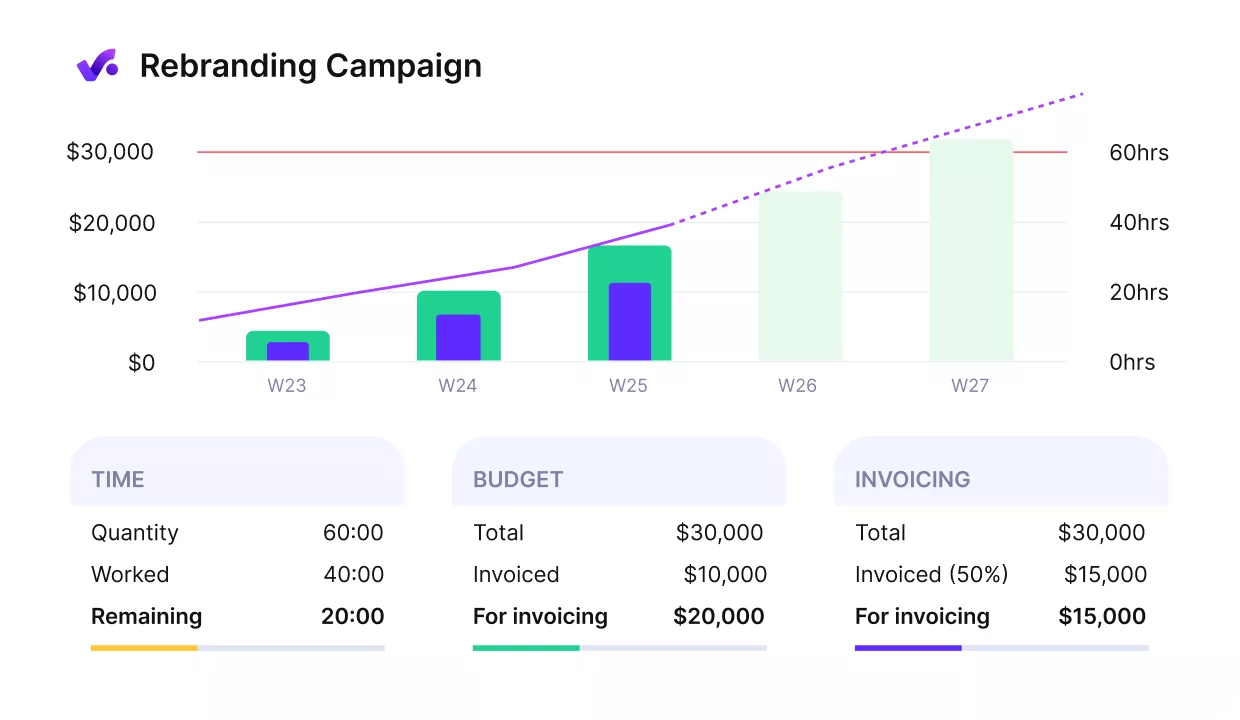
Get early warnings of budget overruns.
Project profitability is decided in that gap, so profitability tracking has to be weekly. You have three moves, set out in our guide to managing a project budget. All of them work better in week four than week ten.
Cut what is left to deliver. Change who does it, if a cheaper role can finish the work. Or go back to the client now with a revised number.
Metric 3: Estimate Versus Actual Variance
Compare what you estimated against what the work actually took, once the project has closed.
The number does nothing during a project. Its value is that it corrects your next estimate, which is why it is worth recording at all.
Log it by project type, never by person. A five-page site that ran 20 percent over is useful information. A designer who ran 20 percent over is a performance conversation, and once people expect that, they stop logging honestly.
Review it quarterly. Four projects of the same type is enough to move your baseline.
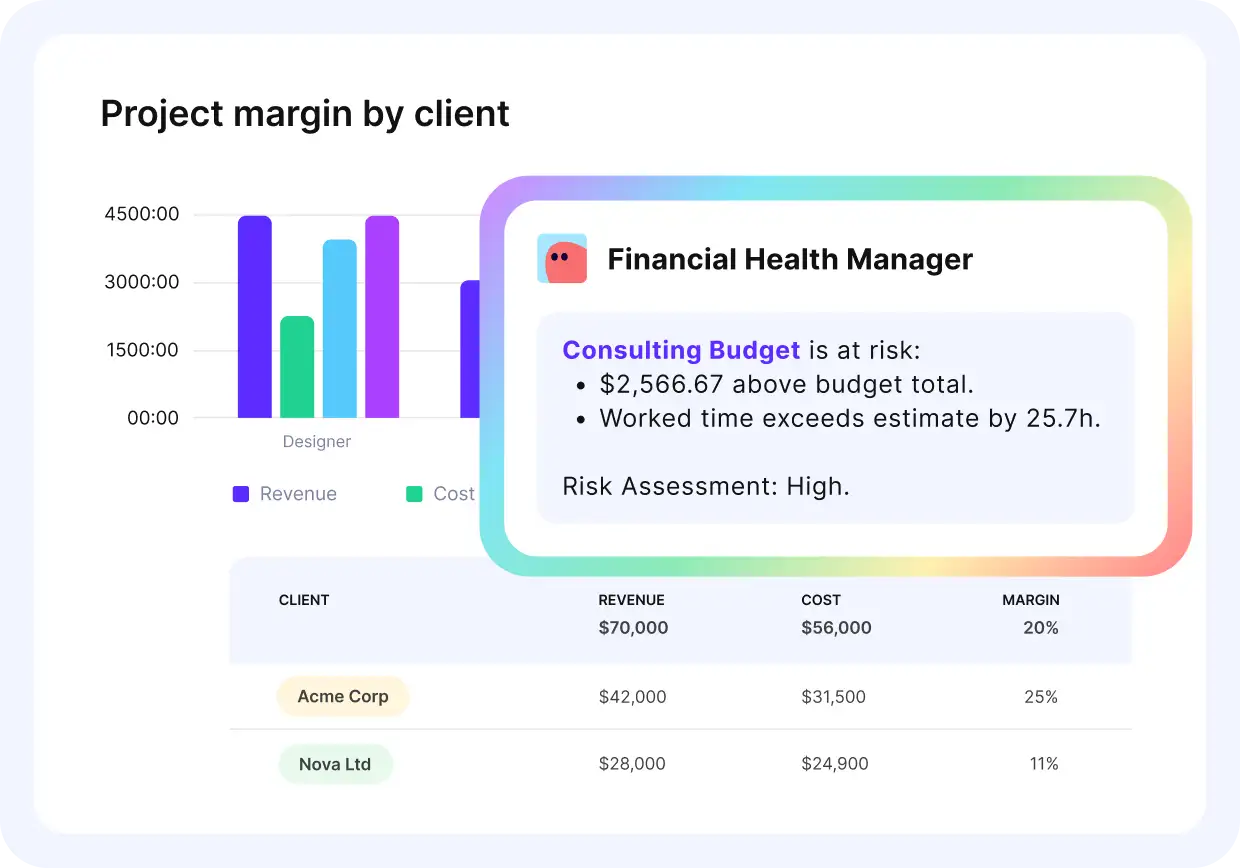
Ask the AI ASSISTANT in plain English about your budgets – get instant answers.
Metric 4: Client Health
Ask for a score after each milestone, then watch two behaviours in between. It sits alongside the KPIs agencies track for profitability. How fast the client replies, and how many feedback rounds each piece of work is taking.
Client satisfaction scores or a Net Promoter Score question after a milestone give you a number you can track. Track it beside the other project performance numbers, because client feedback speed moves first. The two behaviors warn you earlier.
A client who used to reply in a day and now takes four has usually decided something.
In Productive: Productive’s profitability reporting puts project profitability and budget burn on one report with delivery progress. The gap shows on a single screen.
Where Does Agency Margin Actually Leak?
Margin leaks through work you gave away, rates below your cost, the wrong pricing model, and hours nobody logged. The fourth is covered in the section on getting time logged, so this one takes the other three.
None of them show up as a single event. Each one leaks a few hours at a time, which is how they survive a monthly review.
Reason 1: Over-Servicing
Over-servicing is delivering more than the scope priced for. It usually happens because saying no to a small request felt worse than absorbing the hours.
You find it afterwards by comparing hours logged against hours quoted, item by item instead of project by project. The project total hides it. One item running 40 percent over disappears when three others came in under.
Unlike scope creep, nobody raises this, because the work was offered rather than requested.
The fix sits earlier, in pricing requests as they arrive. What this check gives you is a number for the next scoping conversation. An item that runs over on three consecutive projects is underpriced, and the scope needs rewriting before the estimate does.
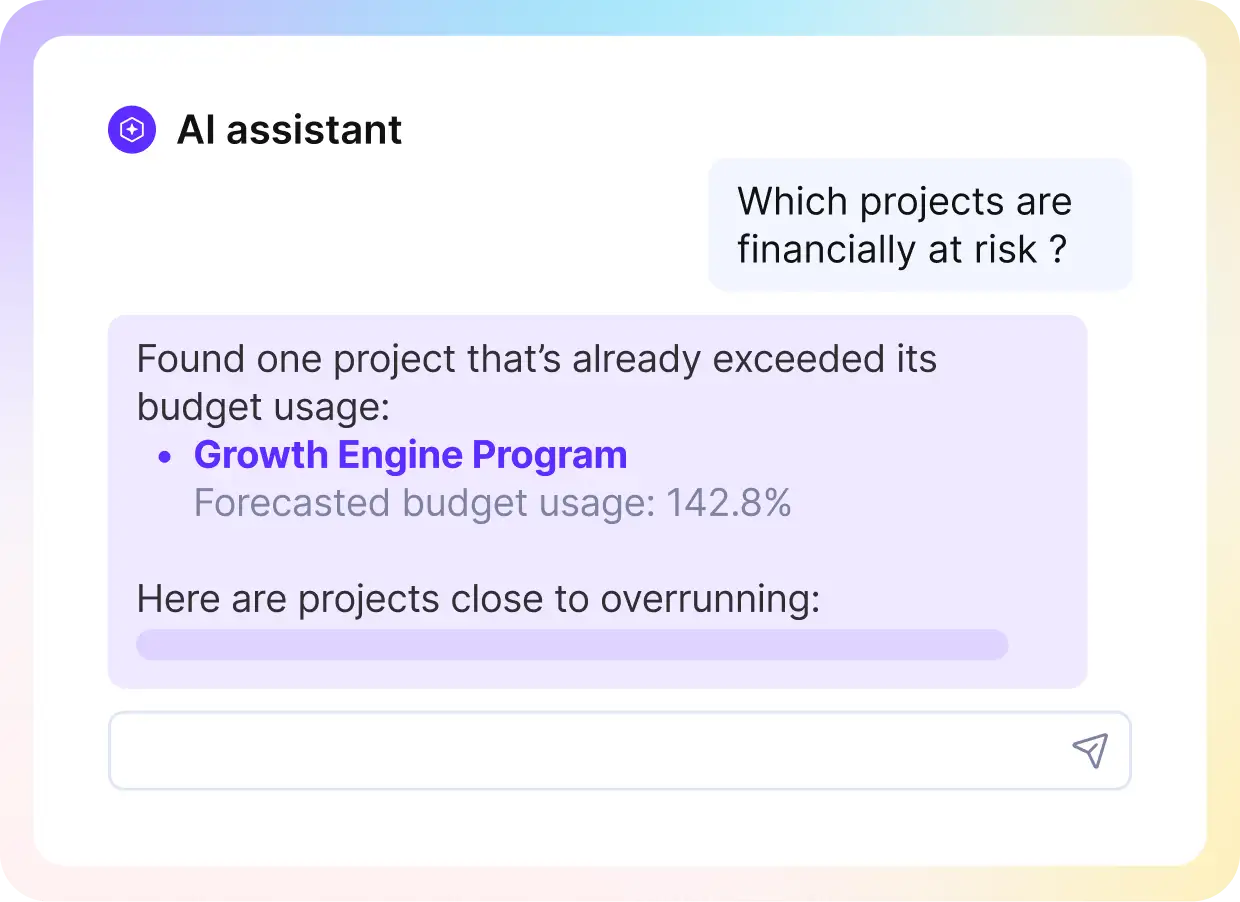
Get instant answers on financial questions written in plain english.
Reason 2: Rates That Do Not Cover Cost
Your cost rate is what an hour of someone’s time costs you, salary plus overhead. Your billable rate is what you charge the client for that hour. The gap between them is your margin.
The failure is a blended rate. You quote one average rate for the whole team, then staff the work entirely with senior people. The average assumed a mix of seniority, and you did not deliver a mix.
Check it per project after close, which is what project accounting software is for. If the roles that did the work cost more than the roles you priced, your staffing was wrong.
If every project shows the same gap, your rate cards are out of date. Profitability tracking per project is what surfaces the pattern.
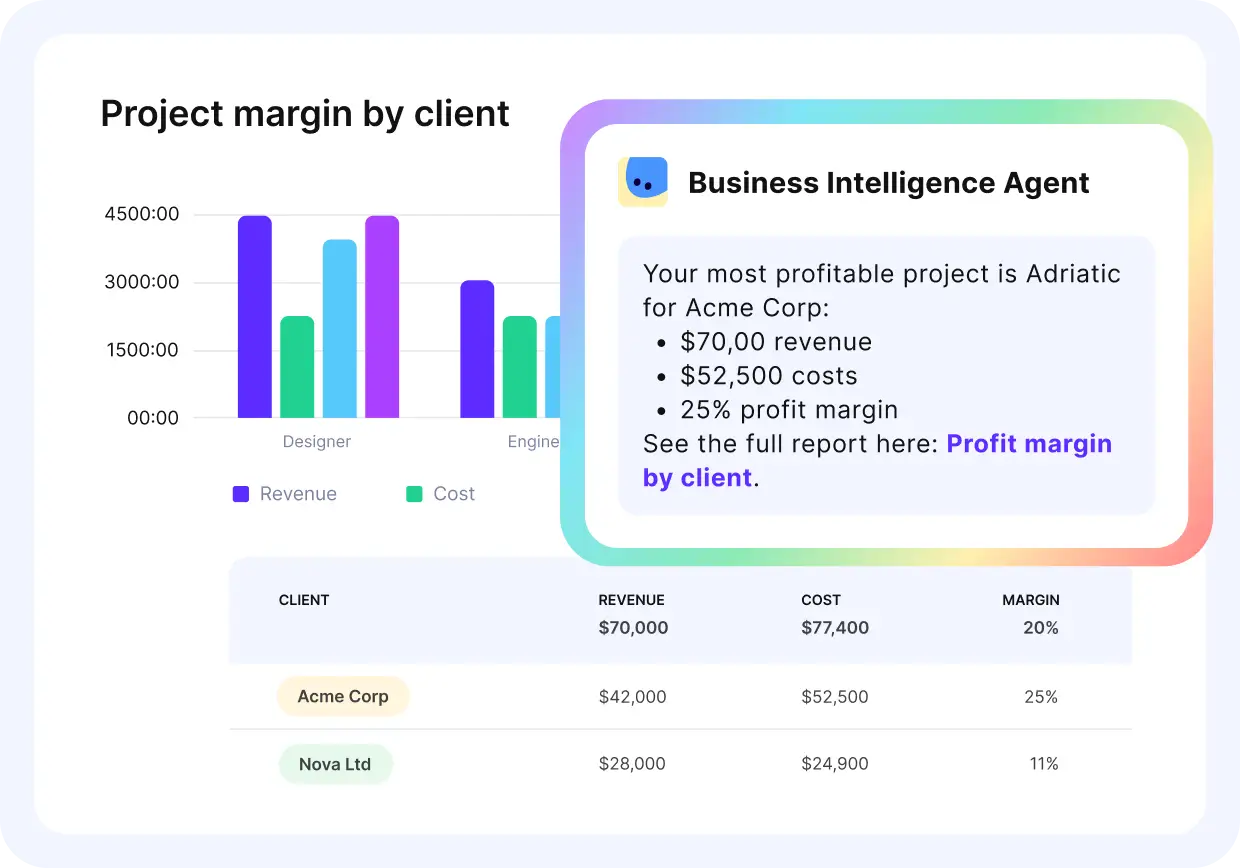
The business intelligence agent gives you update son magins, revenue and costs.
Which Pricing Model Should You Use?
You pick a pricing model by deciding who should carry the risk of the work taking longer than planned.
| Model | Who carries the risk | When it hurts you |
|---|---|---|
| Fixed fee | You | The scope was never actually fixed, so every change becomes an argument |
| Time and materials | The client | The client sees every hour and starts questioning individual entries |
| Retainer | Shared, up to the monthly cap | Demand is uneven, so you carry quiet months and miss deadlines in busy ones |
Fixed fee only works when the scope is genuinely fixed. Fixed price versus hourly rate for agencies sets out the trade in full. If you cannot write the exclusions, you are not ready to write the fixed fee.
Productive’s survey of 174 agencies that use AI found two groups pulling apart. Among agencies seeing multiple positive results from AI, 52 percent are holding or raising prices with better margins.
Among those still working on implementation, 61 percent have not settled on a model at all.
The agencies that can measure what their delivery actually costs are the ones pricing with confidence.
How Do You Turn Delivered Work Into an Invoice?
You turn delivered work into an invoice by recording everything that will appear on it before the billing run. The work that decides the invoice size happens long before finance opens the file.
The usual failure is a month-end scramble, which our guide to billing for professional services work covers in more detail. Someone reconstructs the month from memory and email, then chases four people for their hours.
The invoice still goes out smaller than the work done.
The checklist before every billing run:
- Time logged and closed. Hours that arrive after the run go onto next month’s invoice, or onto no invoice at all.
- Expenses attached to the budget. A stock licence bought on someone’s card in week two is invisible unless it was filed against the project.
- Work marked accepted. If nobody recorded the client’s sign-off, you are billing for something they can still dispute.
- Approved changes added as lines. The extra landing page was quoted and approved, and it still has to reach the invoice.
- Budget reconciled against the quote. Compare what you are about to bill with what you quoted, and find the difference before the client does.
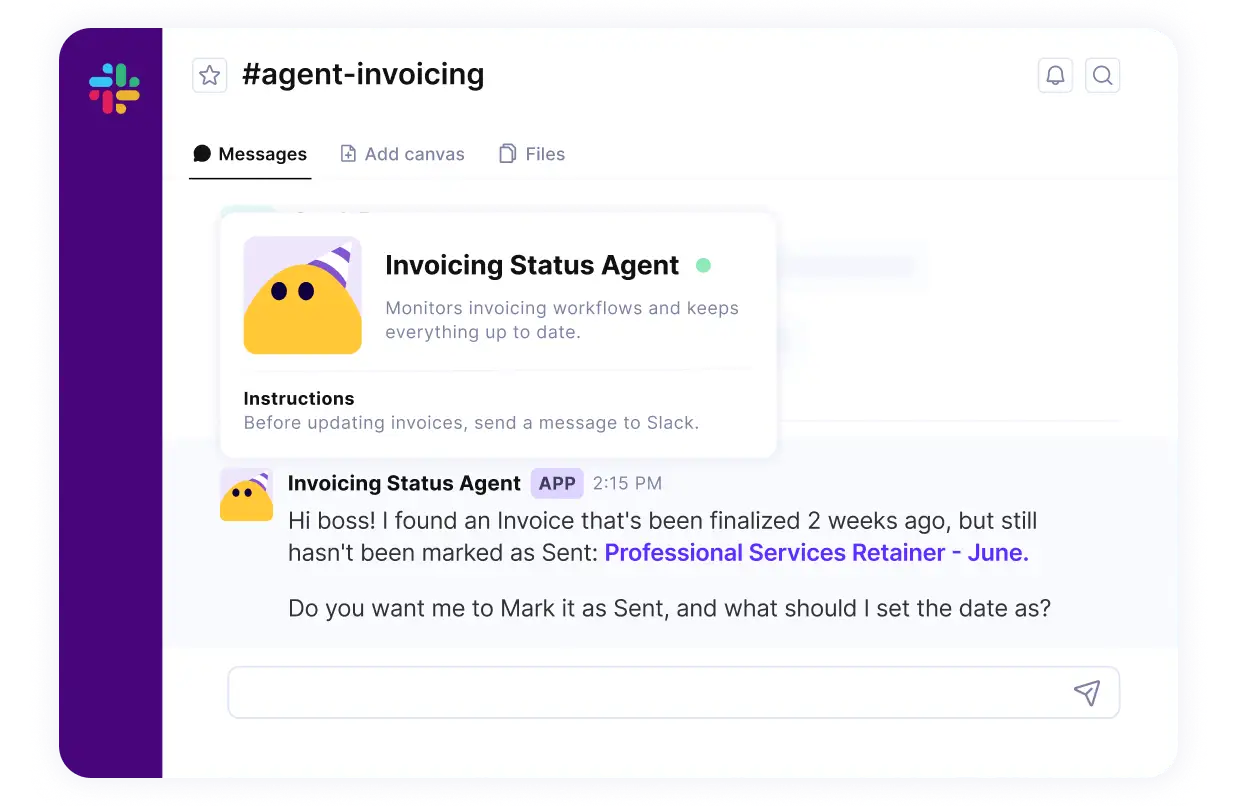
Ask agents to build invoices directly from where the work happens.
On a retainer, apply the rollover treatment you agreed when you quoted. Unused hours either expire, carry over, or carry within a cap. The invoice has to say which one applied this month.
When one item is not ready, invoice the rest and carry that item forward. Holding the whole invoice for one unapproved line costs you the cash on everything else.
In Productive: a recurring budget in Productive’s invoicing repeats every month and can carry unused hours into the next occurrence.
How Do You Manage Risk in Agency Project Management?
You manage risk in agency project management by giving every project risk an owner and a trigger before kickoff. Review them on the cadence you already run. A trigger is the observable event that tells you the risk has started.
Most risk registers die because they are written once into a kickoff document and never opened again. Without a trigger, an entry is a worry nobody can check.
Which Risks Actually Show Up?
Client approval delays, unavailable people, scope creep, supplier slippage and budget overrun show up on almost every project.
| Risk | Early signal | Owner | Best response |
|---|---|---|---|
| Client approval delay | Two chases with no reply | Account manager | Move the date in writing and say why |
| Key person unavailable | Someone booked over capacity three weeks out | Resource lead | Reassign before the week starts |
| Scope creep | Requests arriving without a quote attached | Project manager | Quote them before more arrive |
| Third-party dependency | A supplier misses a first deadline | Project manager | Get a revised date and re-plan |
| Budget overrun | Spend running ahead of accepted work | Project manager | Raise it the same week |
How Do You Review Risk Without Adding a Meeting?
You review risk without adding a meeting by attaching it to the Thursday look-ahead as a two-minute item. Only discuss the risks whose trigger has fired.
Read down the signal column. If nothing has fired, the item takes thirty seconds. If something has fired, the owner and the response are already written down. The conversation is about timing, not about what to do.
A meeting that exists only for risk stops happening after a few quiet weeks. Attaching the review to a slot that already runs is what keeps it alive.
How Do You Choose Agency Project Management Software?
You choose agency project management software by checking whether one system carries a project from estimate to invoice. Most tools well before the invoice. Nobody should retype a number along the way.
If you’re having a hard time choosing the right tool, start from where your numbers currently disagree.

The way we explain Productive is: It’s like Trello, it’s super simple — but it has a whole lot more. It’s got multiple boards and it does end-to-end, not just the boards.

In most agencies the estimate sits in a spreadsheet, the hours in a tracker, and the invoice in accounting software. Reconciling the three takes an afternoon of copying, plus it leaves plenty of room for errors.
This is why agencies keep landing on all-in-one platforms rather than assembling specialist tools. In case you need a general PM solution, head over to our overview of the best project management software in 2026.
Six specialist products each do their own job better than any single system does. They also produce six versions of the truth, and someone spends Monday morning deciding which to believe.
A platform that covers five of the six jobs adequately usually beats five tools that each cover one perfectly. Our review of agency management software compares them on that basis.
Manage Agency Projects From Brief to Invoice
Run agency projects on an all-in-one platform that connects scoping, resourcing, time tracking, and invoicing in one place.
What Features to Look for in Agency Management Tools?
- Scoping and estimating. Without it the estimate lives in a spreadsheet, and the thing you track against is a different object entirely.
- Resource management against real availability. Without it you plan on headcount and find the clash in the week it happens.
- Time recorded against a budget. Without it you know how many hours went in, but not how many were left.
- Profitability reporting per project and per client. Without it you find out which work paid at the end of the year.
- Client collaboration and a client portal. Without one, someone rebuilds status by hand every week.
- Workflow automation. Without it, status changes and reminders stay somebody’s manual job.
- Finance integration. Without it invoices get retyped, and the numbers stop matching.
Project management software that covers project delivery but stops at the invoice fails this test. Count how many of the six a tool covers before you compare anything else. Check the candidates against our roundup of best agency project management tools.
A tool that does four of them well still leaves two jobs on spreadsheets. That is where the numbers stop agreeing.
What Should You Ask on a Demo?
Ask the questions that need the vendor to open the product rather than a slide.
- Can I see budget spent and work delivered on the same screen, without building a report first?
- Can I set a different cost rate and billable rate for each person?
- What happens to a project when the scope changes halfway through?
- Can I carry unused retainer hours into the next month?
- Can I book someone provisionally against a deal I have not won?
- Can a client see live progress in a Client Portal without me building a deck?
- How do time entries reach an invoice, and who has to do what?
Most project management tools look identical in a demo. Then run a pilot on a real project with real numbers. Demo data always behaves, and your projects do not.
Final Thoughts – Agencies Should Be Managed With All-In-One Tools
Scoping, estimating, capacity, delivery and invoicing share one set of data, so one agency project management system should hold it. Productive keeps all five on one record, which is why the number you quote is the number you bill.
If your scope, hours and invoices currently disagree, there is a 14-day free trial or a demo.There is a 14-day free trial, or a demo if you would rather want a personalized walkthrough.
Connect With Agency Peers
Access agency-related Slack channels, exchange business insights, and join in on members-only live sessions.

Frequently Asked Questions
What are the most common agency project management mistakes?
The most common mistake in agency project management is estimating from the client’s budget instead of your own recorded hours. Everything downstream inherits that error, from the timeline to the invoice.
What does an agency project manager do?
An agency project manager decides the order of the work, sets the dates, and assigns each piece to someone. On smaller teams the same person also carries the budget.
What is the difference between account management and project management?
Account management owns what gets promised to the client and the health of the relationship. Project management owns whether that promise can be delivered in the hours available.
How many projects can one project manager handle?
It depends on project size and how much of the client work repeats. Project managers on small retainer accounts carry more of them at once. One large build can take a manager’s whole week on its own.
Do you need software to run agency projects?
In theory no, in reality yes. A small team can run on a shared sheet and a time tracker. Once you cannot say which projects made money, reconciling by hand costs more than the software.