Hike One Has Control Over Their Data and Growth With Productive

Hike One is a digital product design agency of over 70 “Hikers”. With offices in Amsterdam, Rotterdam and Eindhoven, Hike One works on digital products for big Dutch corporations. Though this agency boasts a flat hierarchy, we had a chat with Martijn Pillich who plays the role of Managing Director. Read on to discover the main benefits they’ve experienced after almost a year of using Productive.
Can you tell us a bit about Hike One?
We’re a design agency highly specialized in the design of functional digital products: mobile apps, web applications, and other types of apps. We’re spread across three offices—nowadays that’s a place where we get together since people mostly work from home. We have a couple of producers and strategists and we do research and then our in-house team works with partners who develop those products.
What were you using before Productive? What were your main requirements for a new tool?
We were using a combination of spreadsheets and a few different tools, but we couldn’t get all the data that we needed.
Right before Productive, we were using Simplicate. Even though we were putting a lot of data into the tool, we were missing reporting and we desperately needed to fix that.
Another thing that we needed was a system for resource management. With resource planning comes forecasting and getting a better idea of where your agency is going in the next few months.
Achieve Your Agency’s True Potential
Switch from multiple tools and spreadsheets to one scalable agency management system.
We Help Your Agency Reach New Heights
Switch from multiple tools and spreadsheets to one scalable agency management system.
How and when did you first hear about Productive?
Productive was on our shortlist while we were looking for a core agency management tool. Though our previous tool was in the same city, we now get much better support.
“We were relying on gut feelings and we knew that we didn’t have control over our data. Productive gave us that control.”
Can you share some concrete benefits you experienced after switching to Productive?
We started using Productive about a year ago. I started seeing benefits roughly three months in—patterns in the data. We were relying on gut feelings before and we knew that we didn’t have control over our data. Productive gave us that control.
Productive’s reports have already helped us make much more informed decisions. Before, we didn’t know profitability per client or profitability per employee.
Productive has helped us to increase our billable utilization by around 10%, resulting in a healthier profit margin
With Productive, we can plan further ahead – 6 to 8 weeks instead of 1 or 2 weeks, which brings more peace to the team
Thanks to Productive, potential problems in projects or with employees come to light much earlier, so we can solve them faster

Was it hard to learn how to use Reports?
I’d say no, but maybe that’s just me. I like getting reports so I’m really willing to learn. I love that Productive is really flexible. I can use it the way I want to and customize reports with custom fields and formulas. I can even export that data if I want to.
“What’s surprising about it is that you feel like you have this great relationship with a client, you’re doing great work and everyone is happy. Then you see the numbers and realize the profit margin is not that good at all, so you start reconsidering.“
Did any data that you started seeing shock or surprise you?
Absolutely. What’s surprising about it is that you feel like you have this great relationship with a client, you’re doing great work and everyone is happy. Then you see the numbers and realize the profit margin is not that good at all, so you start reconsidering.
We (also) saw that our seniors were underpriced, so we changed our pricing model thanks to the data we got in Productive. We then learned very quickly that some of our clients are happy to pay more if they can get more experienced people. But it’s that kind of thing that you don’t really think about if you don’t have those numbers in front of you.
So Reports definitely opened up a lot of good discussions. Instead of one gut feeling vs. another gut feeling, you can just open the reports and have a more rational conversation.
“With Productive we’re able to look a lot further ahead now. Before we used to plan projects about two weeks in advance. Now we’re accepting bookings for projects that start in 4-6 weeks.“
How has your forecasting window for resource planning and hiring changed?
With Productive we’re able to look a lot further ahead now. That changes the game quite a bit. Now our sales reps take that into account when talking to a client. Instead of promising we can start anytime, they can actually influence the efficient allocation of the entire team. That helps a lot.
It’s a delicate balance. Typically you need some preparation time before a new project, but you still want to start as soon as possible. Before we used to plan projects about two weeks in advance. Now we’re accepting bookings for projects that start in 4-6 weeks. That window gives us more time to prepare projects than before.
Now we have the optimal amount of time to inform everyone and it’s less volatile now. The next few weeks are fully booked, designers know what they can expect. Also, they can do better work if they’re not booked on too many projects at once, which Productive has helped us with, too.
“It’s my job to figure out what’s holding us back from growing even more. Productive gives me an answer to that question. All I do is make a new report to figure out what’s going on.”

Generally speaking, how much easier is your job since you started using Productive?
My job is a lot easier now! Maybe that’s because I’m a numbers guy. I like to understand what’s going on and be able to quantify what’s going on. It gives me a better vision of what’s the next most important objective.
It’s my job to figure out what’s holding us back from growing even more. Productive gives me an answer to that question. Before it would take a lot of talking to people and making custom spreadsheets. Now, all I do is make a new Report to figure out what’s going on.
Achieve Your Agency’s True Potential
Switch from multiple tools and spreadsheets to one scalable agency management system.
More stories

With Productive, Brigada Increased Project Profitability

With over a decade of award-winning work under their belt, Brigada successfully bonds different, yet very connected fields of work. This multi-disciplinary spatial design agency joins architecture, spatial and product design, marketing, and psychology to create exciting solutions, mainly for retail purposes. We spoke with Zoja Ivanišević, Head of Development at Brigada to hear what areas of their day-to-day work evolved after they started using Productive.
Tell us a bit about your role and how Brigada is set up as an agency.
I’ve been at Brigada for almost three years now. During that time, my role has shifted from Project Manager to Head of Development. We have three main teams in our agency: business development (I admit that we use Productive the most), our team of architects and product designers.
How did you forecast and manage resource planning before Productive?
We started using Productive about two years ago. Before Productive, we used a number of communication and project management tools, but all our data was spread across multiple platforms. All our internal communication was in Slack.
For resource planning, we had a huge whiteboard in our office, where we’d physically move our people around different color-coordinated projects. In theory, our method was great, but in reality—it wasn’t visually easy to understand.
Related: Top Architecture Project Management Software Solutions
Achieve Your Agency’s True Potential
Switch from multiple tools and spreadsheets to one scalable agency management system.
We Help Your Agency Reach New Heights
Switch from multiple tools and spreadsheets to one scalable agency management system.
Did you track time before?
Somewhat. We used Google Calendar to note which projects we worked on at the end of each day, but we didn’t literally track time in an app, or know which phase of a project people were working on. So we could never get the level of detail we have today.
“Before, we didn’t have precise insight into how profitable a project was until we actually delivered it.”
So how did you know how profitable each project was?
At the end of each project, we’d do an evaluation in Excel to see our profitability. So we could never get the level of accuracy we have today. Before, we didn’t have precise insight into how profitable a project was until we actually delivered it.
Because our profitability evaluation would happen after a project was done, we could never figure out, mid-project, whether we’d see less profit or break a budget until it was in the past.

What pain points did you start experiencing before moving to Productive? Why did you start looking for a tool?
Let’s say that we had all the tools we needed, but they were a mix of analog and digital channels, which gave us much less accuracy and it took us significantly more time to consolidate data.
When we started looking for a tool, we found a lot of solutions that were geared towards tech agencies. We found out about Productive through Infinum, and figured out it had everything that we needed. We wanted a tool that would make our processes easier, for everything to be in one place, and things to be visually easy to use.
What was switching over to Productive like?
It was super easy to import our entire business into the tool, it took us two and a half months to fully migrate our agency. On top of that, we got support whenever we needed it.

“Overall, I’d say we’ve saved 2 hours a week on project management since we started using Productive.”
How has your job evolved over the years?
Productive has helped us with long-term planning. Every six months we do a review of certain project phases. For example, through time, we figured out we had to raise the prices of certain project phases because they weren’t bringing us profit. Actually, those same phases were bringing our profitability down in each similar project. Thanks to the analysis we’re able to do with Productive, we learned which services we needed to raise the prices for and consequently, we’re seeing an increase in profit.
Productive also helps me a ton with resource planning. Now that we have bigger and bigger projects and clients, we’re able to forecast hiring needs using Scheduling. Also, if I see that the scope of a project will increase for a short period of time, I know I need to book contractors in advance. Before, it was a lot more ad hoc and hoping for the best.
Overall, I’d say we’ve saved 2 hours a week on project management since we started using Productive.
What benefits do you think your team members got with Productive?
Our architects and product designers definitely save time on communication and figuring out who’s working on what and when someone’s off or working from home. We’re all on the same page thanks to Productive.

And lastly, how would you feel if you didn’t have Productive in 2021?
I think I’d feel totally handicapped. I’m so used to using Productive and having our whole business in the tool. It’s such an essential part of our daily work routine now. What’s more, we have our entire archive of financial data available within a few clicks.
Achieve Your Agency’s True Potential
Switch from multiple tools and spreadsheets to one scalable agency management system.
More stories
Infinum Scaled From 70 to 350 People In the Last Five Years Using Productive
Infinum Grew 350% Using Productive
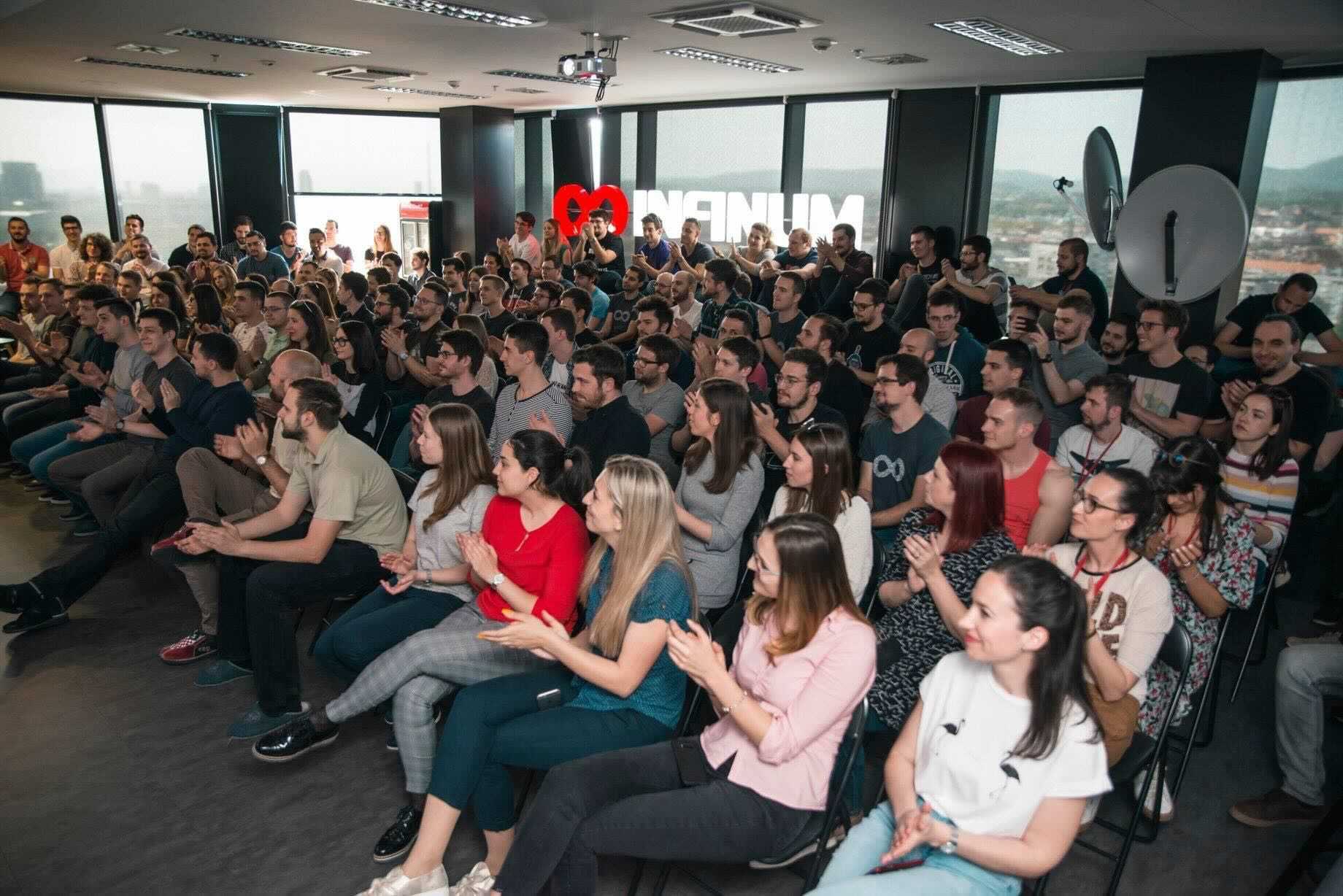
Recognized by trade and industry authorities such as Deloitte and Inc. 5000, Infinum is a renowned digital agency that partners with leading brands to envision and build beautiful digital products. For over 14 years, their apps and websites have been used by millions across the globe. In the past five years, Infinum grew from 70 to 350 people, while using only Productive as a tool for running their business. To learn how they successfully navigated their growth, we spoke with Luka Višić, Operations Manager and Ervin Jagatić, Head of Client Services.
Tell us about your roles and responsibilities at Infinum.
Luka: I’ve been managing the agency’s resources for the past four years. By manage, I mean I’ve been working on allocating our talent across different projects and clients and matching our talent with their needs. Around 250 people at Infinum are a part of production, so we have a lot of resources to manage on a daily basis. The job is very dynamic. Just last week, four or five projects were downsized at once. That influenced around 15 people to be left without work for the coming period. The job is really time-sensitive and it makes you have to learn how to communicate changes and expectations with so many different characters.
Ervin: I came to Infinum five years ago and started off as a Project manager. Before I worked as a programmer and product specialist. The great part about working here was having one place to track time and automatically see expenses and profit per each project. That was the first big benefit that I saw in Productive.
As our work developed and our team got bigger, I became Head of Client Services. Now I’m in charge of monitoring all our delivery and I make sure that our clients are happy with our performance and output. Through Reports, we started monitoring our production.
What did you use for resource management before Productive?
Luka: Before Productive, we used Hubplanner. Around three years ago we switched to Productive when they released the Scheduling feature. What’s great about using Productive’s Scheduling feature is that we gave a lot of feedback while it was being developed. It’s almost like we got a tailor-made resource planning tool. As the agency is constantly growing, we’re now facing a new challenge: how to keep everything visually accessible. Currently, we can get a high-level view of schedules by putting a few screens together.
Learn How Infinum Grew 350% Using Productive
Download the full case study here.
We Help Your Agency Reach New Heights
Switch from multiple tools and spreadsheets to one scalable agency management system.
What did project management look like five years ago?
Ervin: Back then, task management was quite rudimentary, but Productive has developed a ton ever since. After becoming a team lead, I started working with the rest of the project management team on a higher level. We were looking into Reports in Productive. Nowadays, not a week goes by that I don’t go through reports.
See also: Website Project Management: Expert Guide to Web Builds
“Reports have become our central place to follow key metrics, analytics, numbers, graphs, and—simply said—the pulse of our agency. Currently, it’s hard to imagine what our jobs would look like without reports. It’s a lock-in feature for us, for sure.”
You’ve been using Reports since 2016. How much easier have your jobs been since then?
Ervin: The great thing about decision making at Infinum is that thanks to Reports, each decision is based on data. Our business decisions are never made on an inner feeling or intuition. Productive gives you answers to questions like what’s the profit, how much are the expenses, what’s the projected revenue, what’s the utilization? That entire set of key metrics is what gives management a basis to move forward. Without tracking time in detail and keeping track of expenses, there’s no way you can make the best possible decisions.
Reports have become our central place to follow key metrics, analytics, numbers, graphs, and—simply said—the pulse of our agency. Currently, it’s hard to imagine what our jobs would look like without reports. It’s a lock-in feature for us, for sure.

You’ve grown 350% in the past 5 years. How has having all these key metrics at your fingertips helped you with hiring?
Luka: Hiring is another area of our work that’s extremely tricky, so having all our data in one place helped us immensely. There’s no following a gut feeling, wondering if we have or won’t have enough work. We go and check to see: do we have a lot of overtime? How many hours were tracked on each project? Then we check out our teams and see which team is tracking more overtime and which teams are tracking more production hours. All that data helps us understand whether we need to hire more, charge more, give a client a discount, increase a budget, etc.
Growth in numbers:
Stable increase in billable utilization year on year
Profitability of projects through time: in Q1 and Q2 of 2021, we saw a 27% increase in profit
Better decision-making based on data, not assumptions
On a weekly basis, our project managers save 3 hours of time
Our forecasting horizon increased to 180 days (two business quarters)
Our number of clients doubled in the last four years
Which key agency metrics and numbers do you regularly keep an eye on?
Luka: On a daily basis, we monitor:
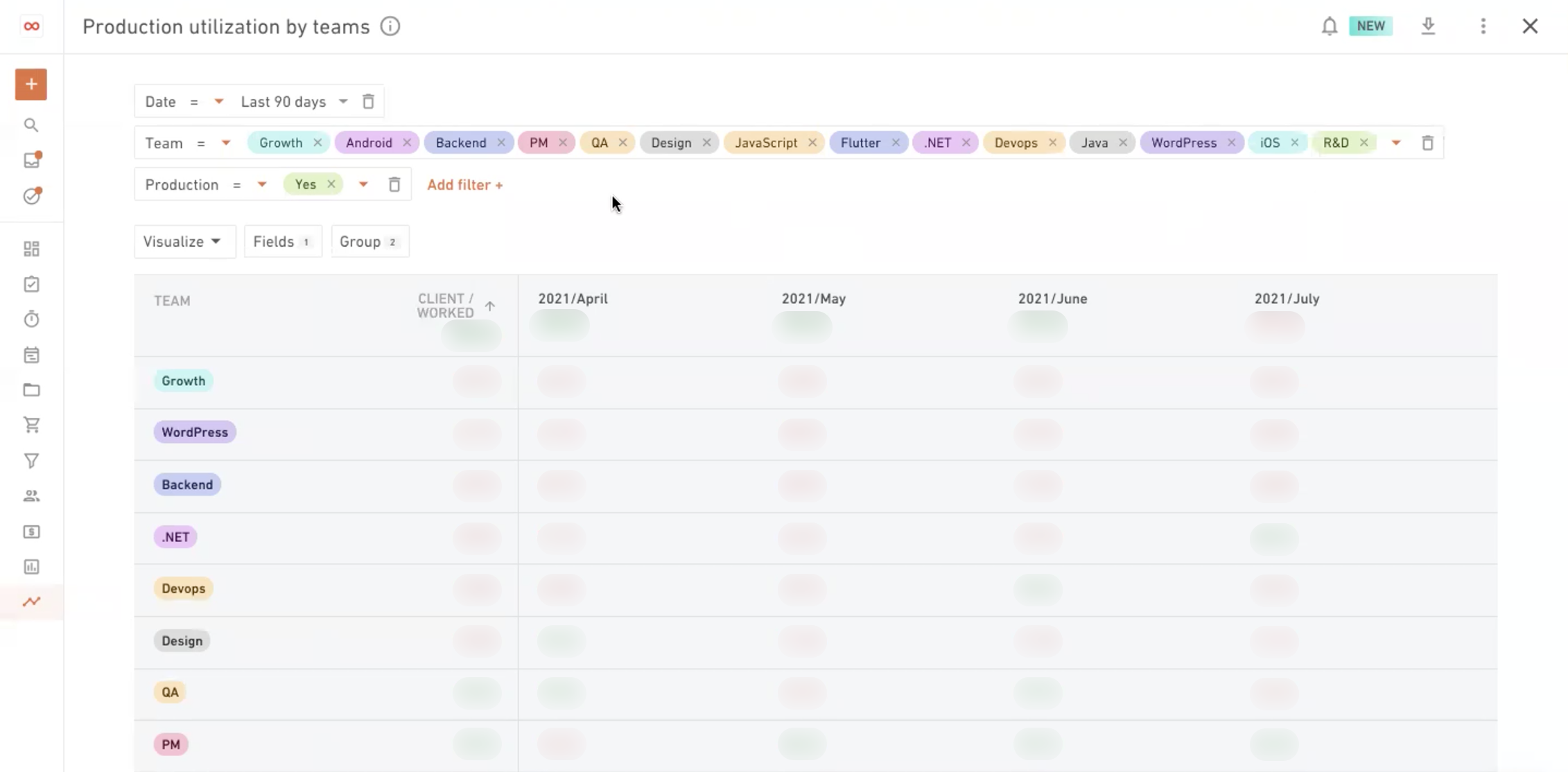
Production utilization by teams
Forecast of production utilization
Overtime by teams and people
The Overtime by teams and people insight gives us a clear picture for hiring and the Who’s late with time tracking report is super important for us so we have the most up-to-date reporting possible.

Production utilization by teams
Forecast of production utilization
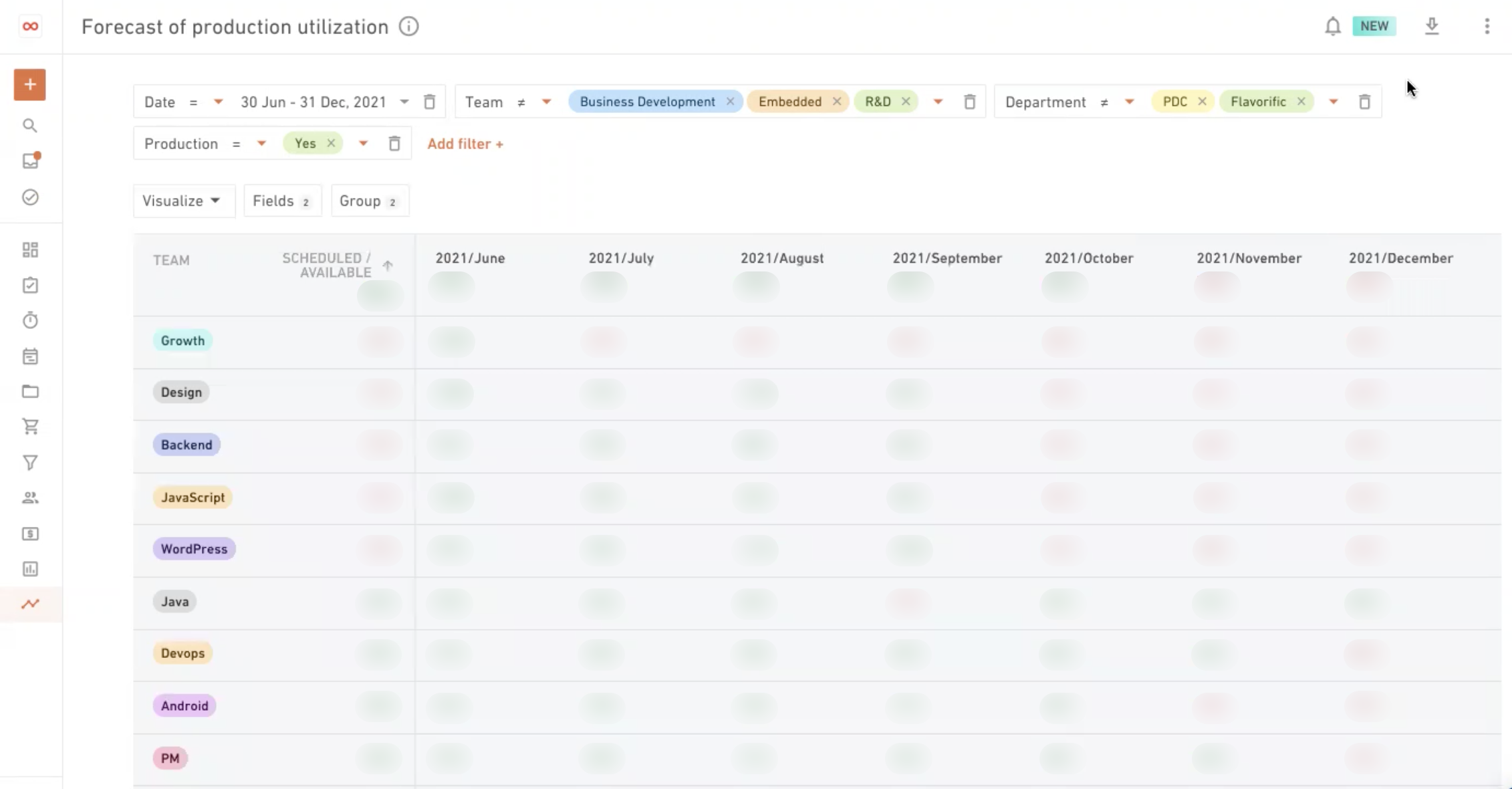
In terms of forecasting, one of the most important metrics we have to watch is: do we have people available in the next 2-3 months, or not?
Ervin: Other insights that we follow on a daily and weekly basis are:
Recognized revenue per quarter/year
In this report we compare the revenue we forecasted the year before and recognized revenue from last quarter.
Production delivered hours by engagement type: in-house vs. contractors
This is another piece of data we monitor: the amount of hours contractors work in comparison to our in-house teams.
Project level insights
The great thing about this report is that we can easily sync with the rest of the production team and quickly give clients insight as to where we stand with a particular project.
How much time do you think you’ve saved using Pulse?
Ervin: I think it’s more of a trigger for getting certain people informed. Some time does get saved, but what’s better about Pulse for me is that you don’t have to actively think about keeping an eye on certain metrics. For example, if I want our financial manager to get informed about all the budgets that were closed in the past quarter, I just set up a pulse to automatically do that for me, instead of me spending time on it and thinking about it.
How would you feel if you didn’t have Productive?
Ervin: If someone told us that we’d need to move to a different tool, I think that’d be nearly impossible. I think it’d take a year and a half to migrate to one or more tools.
Luka: There was no point in time when we saw that we needed to use an additional tool. We’ve been monitoring all our key metrics in Productive since the beginning, and I can’t imagine work without it.

Tell us about the integration with Slack.
Ervin: Since Slack is our primary communication tool, now we save some time on regularly checking notifications and updates in Productive. Since we’ve connected Slack and Productive, now we get automatic updates.
How has Productive’s Invoice Builder been beneficial for you?
Ervin: Auto-generating invoices in Productive is a game-changer for project managers in Productive. There’s no copying and pasting and double-checking if all the data is accurate. Productive has really eliminated the chance of human errors. All you need to do is make sure that everything in your budget is correct and then you pull that information up when you go to build an invoice. After that, it’s one click to invoice and the Finance team takes over. On average, I save a few hours per month on invoicing.
Last, but not least: have you started managing PTO in Productive, too?
Luka: We’ve recently switched from Calamari to Productive to manage time off. The flow around approving and managing schedules is complicated in our agency. With over 350 employees, there are many people who need to be informed about time off, and having that in Productive now is going to be a big money saver in terms of overhead costs.
Achieve Your Agency’s True Potential
Switch from multiple tools and spreadsheets to one scalable agency management system.
More stories
Using Productive, Globaldatanet Gets Data That They Never Had Before

Globaldatanet is a cloud-native development and optimization agency with headquarters in Hamburg and offices in Berlin and Belgrade. Recently we had a chat with their CEO, Marc Schröter, to hear how Globaldatanet now successfully manages their three branches in Productive—from sales to invoicing.
Tell us a bit about your clients, the type of work you do, and how big you are as an agency.
I’m the CEO and founder of Globaldatanet. We started out with one person (me) four years ago, and today we’re 24 people across three branches. We focus on helping our partners build innovative solutions on Amazon Web Services.
When did you start using Productive?
In December 2020 we signed up for a trial, and we committed already then.
Achieve Your Agency’s True Potential
Switch from multiple tools and spreadsheets to one scalable agency management system.
We Help Your Agency Reach New Heights
Switch from multiple tools and spreadsheets to one scalable agency management system.
What did your operations look like before? Were you using other tools?
We tried a lot of tools, but we couldn’t find the perfect one for our needs. In the end, the tool we were using before Productive was just for invoicing and creating projects, but since we have a lot of multi-base invoicing—it was very challenging.
We used to have a lot of discussions with accounting to figure out what we needed to invoice. Our team was growing at the time, so we had a lot of different work going on. We struggled a lot to stay on top of everything.
“We used to have a lot of discussions with accounting to figure out what we needed to invoice. We struggled a lot to stay on top of everything.”
So you couldn’t get real data on where your team’s time was going?
No, especially while working on bigger projects where we had multiple roles and budgets within a project.

What were other pain points you wanted to solve with Productive?
We didn’t have resource management before. We couldn’t schedule our teammates on different projects. As our team got bigger, we needed the possibility to see the resource scheduling and utilization rates of our team members. We couldn’t manage multiple branches or have an overview of time off management.
Can you say that managing your entire agency in Productive has streamlined your processes and made them faster?
Yes, now processes are definitely faster since we manage everything in one place. We use Productive to create proposals, manage projects, and then create invoices once they’re delivered. You also helped us create our custom invoice template, which was really cool.
With Productive, we see a lot of numbers that we didn’t see before. Now we’re tracking time on internal projects, which we never used to do. Now we know too much!
Since we’re developing our own product internally, we can see how much money we’re spending on it, along with internal meetings. We also hired a project manager and she’s really happy with the project forecasting. She can track available budgets, even on a task level. The teammates are able to see the number of hours that are left on certain tasks.
“It’s great to be able to see until what point some projects will be profitable and when they won’t be anymore.”
Does it give your teammates more responsibility or make them feel more accountable for their work?
Before, they were completely blind as to whether we were on track. They always needed to ask how many hours were left per project, but now they can see that in the tool. So yes, Productive gives them more accountability and responsibility. It’s great to be able to see until what point some projects will be profitable and when they won’t be anymore.
Is there anything that you gained from Productive that wasn’t immediately visible? Were you surprised by something unexpected that you got?
Yes, there were a lot of pleasant surprises. Initially, we switched tools because we wanted to invoice in an easier way. There’s a lot of different ways to invoice, like fixed-price, hourly, payments in advance, multiple services, multiple roles, etc. This was the biggest problem we were experiencing before.
We never really had the need for more transparency because we didn’t have it, so we thought everything was fine. That was a really surprising moment, to get accurate numbers. Now we have clear data, data that we could never see before.
Another thing we didn’t expect was that you’re really interested in your customers’ suggestions. Sometimes you push out new releases in a few days and that really shows us that you listen to our needs.
Any growth results you can share?
I think the greatest result we can actually measure is the fact that our teammates are really happy to use the tool. We work with young, really innovative people, and they need to have the best tools.
Achieve Your Agency’s True Potential
Switch from multiple tools and spreadsheets to one scalable agency management system.
More stories
How Contra Agency Makes the Most of Productive’s API

Contra is a leading London-based agency with over 20 years of experience in all things digital. Since April 2020, Contra Agency has been managing all its design and development of digital content, websites, and web apps in Productive.
After less than half a year that Contra’s been using our platform, we spoke with co-founders Roberto Ciarleglio and Ben Edge to see how they switched to working remotely and made the most of Productive’s API.
Tell us a bit about Contra. What markets do you operate in, who are your clients?
Our work is split into two main categories: we help our clients with their marketing and we help digitally transform them with websites and web apps. We work mainly in B2B. Some of our clients are big finance companies, quite a lot are in the tech space, and we also work with some top universities—like Oxford and Cambridge in the UK.
You switched to Productive recently, right?
We started the process about nine months ago. We found Productive, signed up for a free trial, had a few demo calls. To give you some background, when we started our agency 20 years ago, we didn’t have any agency management tool at all. I don’t think that even existed back then! Soon, we realized that we need to be organized.
The first thing we started out with was Sharepoint. That served us for a few years, but we lost money realizing that we didn’t invoice certain projects. Then, about 15 years ago, we started the hunt for a system.
The first one was Traffic, which was a disaster. The basics were wrong, and it would calculate incorrectly. Then we switched to Streamtime. Those two tools just didn’t do enough. Alongside those, we’d use BaseCamp, Trello, and various other tools. Streamtime did invoicing, but wasn’t suitable for project planning and clients to use.
Part of our journey was to find a system that could do everything that we needed it to do. We’ve looked at so many of these systems and done so many trials that we knew what a lot of our questions were.
Achieve Your Agency’s True Potential
Switch from multiple tools and spreadsheets to one scalable agency management system.
We Help Your Agency Reach New Heights
Switch from multiple tools and spreadsheets to one scalable agency management system.
So the number one thing you were looking for was to have an all-in-one tool?
I guess either a tool that could do everything or a tool that we could integrate well so that collectively, it could do everything without us losing things. Your system is good because it does a lot, but also the API is great so we were able to integrate it with our other tools. For example, it doesn’t have a messaging system that can compete with Slack, but we can integrate it with Slack.
I think the other thing that we really like is that all our staff is really happy with the switch. The user interface is fast and smooth, it’s a very single-page application—and it works really well. You’ve hit this balance where it’s powerful, but it’s not too complicated. Our previous system was Accelo, and it was massive. You could do everything under the sun, but you had to do it in a certain way.
Related: 15 Top Accelo Alternatives & Competitors for Agencies
What’s good about Productive is that it’s powerful, but it doesn’t force you to do things in a certain way. You can be creative in the way you use it. You don’t want to fight a system, you want to work with a system.
See also: Scoro vs Accelo vs Productive: Which is Best for You?
It’s important that your team adopted to it well!
Now our team can fill out timesheets really quickly. Even if it’s only a small amount that’s causing a delay. Eventually, when you have to do loads of time entries, it becomes very laborious. Whereas in Productive, you can do your timesheet very, very quickly.
And how was the transition to remote work for your team?
A lot has changed in the company since we all started working from home. We had to instantly form new habits. Combined, the team has probably been working more efficiently than it has been for a long time.
Can you let us in on how your team is using the tool? What do your daily stand-ups look like?
We have the Scheduling view up on our screen when we do our daily stand-ups and two project managers who run the meetings. We tend to not plan too far in advance, only a week or two, though we may have some rough placeholders down the line.
Placeholders are very quick and I like the way they feed into the timesheets. When we first started to look at using placeholders, we came from a background where every task in the plan was scheduled. It took us a while to realize the benefits of blocking time to work on a project.
“The reason we look at Scheduling is not so much to look too far in advance on a daily basis, it’s to look at today’s workload while having a sense of why we need to do something—because there’s something else coming up in the near future.“
So Scheduling is your main starting point each day?
We base our stand-ups around Scheduling because it gives us a sense of what the whole company is doing and you can see into the future a bit. The reason we look at Scheduling is not so much to look too far in advance on a daily basis, it’s to look at today’s workload while having a sense of why we need to do something—because there’s something else coming up in the near future.
Is there anything you particularly like about the tool?
It’s really encouraging to see that there’s a roadmap and features coming out regularly. It’s also really nice to have a dialogue with you guys, especially in the chat.
Thanks, we’re constantly working on the tool. Every week we go through around 50 customer requests to see what many people need.
We wouldn’t have wanted to take on a product that wasn’t constantly being improved. It’s really encouraging because we know that software is never finished.
“Because Productive is flexible, we were able to create some patterns for more flexible projects and other patterns for more rigid projects. This has actually helped us to be more consistent. If we need to create another project structure, we can still do that because we have the flexibility with the boards.“
Even though you’ve only been using Productive for a few months, do you think that you’ve mastered the platform? What was the learning curve like for you?
It was fairly intuitive. My biggest questions were around how we do things as an agency. I was really keen on speaking with your colleagues to ask how they’d approach certain problems. I’m prepared to change the way I think if it makes sense. I don’t really want to fight a piece of software and make it do something a certain way if it wasn’t designed for that.
In terms of the learning curve for our team, we had one screen share and nobody’s really struggled since. It’s an open book, a blank canvas in some areas. You’ve got relationships and entities, customers, projects, contacts, companies…all these things are fixed. But how you run a project is very open. You can have one board, you can have ten boards. You can have one budget, you can have 100 budgets in one project. There are so many different ways of approaching it.
To be clear, we run different projects in different ways. Some are agile, some waterfall, some linear. Because Productive is flexible, we were able to create some patterns for more flexible projects and other patterns for more rigid projects. This has actually helped us to be more consistent. If we need to create another project structure, we can still do that because we have the flexibility with the boards.
We wanted to work out how to structure certain projects and teams so that we could give our project managers a framework that would work.
Were you pleasantly surprised by a certain feature or a capability of Productive? New metrics, data, anything you didn’t expect when you bought the platform?
From a business level, now we make better decisions regarding our utilization. I’m understanding new things about profitability. I’ve made certain assumptions before, and some of those assumptions have proven to be wrong. For some projects, we weren’t sure how far over budget we were, and now we can really see.
In terms of features, I’m particularly impressed with your reports. The filtering and the options you can do with those reports is too much! The fact that you can add custom formulas, change how things are rounded, enable colors to change above a certain number… It’s pretty impressive!
“It’s difficult to create something that looks very simple, but actually has a lot of depth to it, in a way that you can customize, but it isn’t difficult to customize. That’s the sweet spot of software. I think you guys have done a really good job there.“
So the fact that you can customize data and how it’s reported is something that you’re really happy with?
It is because we know how difficult it is to do that.
I think of this a lot about Productive: when you look at it, at a glance, it seems very simple and maybe even like it doesn’t have a lot of features. But then when you start using it, you realize that there’s a lot of very good attention to detail, and that’s a really difficult balance in software.
We create software for our clients as well, and it’s difficult to create something that looks very simple, but actually has a lot of depth to it, in a way that you can customize, but it isn’t difficult to customize. That’s the sweet spot of software. I think you guys have done a really good job there.
Our customers from Texas to South Africa are saying: when switching to remote work, everything was already there, we just made sure they would really track time on a daily basis so we could plan resources better. It’s great to hear that you’re experiencing business benefits using Productive, too.
I think you need to run it like a machine, but it needs to be fun as well—otherwise, it’s like being in the army. Productive has got a good balance of being structured, flexible, and enjoyable to use.
In terms of integrations, there are a lot of things we’ve done ourselves. When we build a typical web project, we go through a number of phases. We try to do as much QA and validations upfront as we can. What we’ve been able to do with the API and the integrations we’ve written with Slack is create a whole series of board templates: all the different projects, tasks, and TODO lists. Anything that we expect to be ticked off before the next phase. A project manager can just go to Slack and create a new project for QA, and the command goes off and creates that board. We’ve become more efficient.
Let’s talk about that API client that you came up with. Was the Slackbot you mentioned the main idea behind it, or did you create any other integrations?
We did quite a few. The Quickbooks integration was the first one. The integration you’ve already got with Quickbooks is great for getting invoicing done, but there were a few gaps that we felt were a challenge for us. For example, it’s common for our staff to create an invoice and then for someone to say “Can you add in a PO number?” or “Can you change the date on it?” With the way the integration stands at the moment, you can’t re-push the invoice into Quickbooks.
Another thing is that we have 20 years’ worth of data in QuickBooks, where different service lines are linked to different incomes. To not lose that data going forward, we wrote a webhook that listens to a new update or a new invoice, reads through your service lines, checks with QuickBooks, then updates the new invoice and sorts it all out.
That was where it started. We only needed four or five endpoints on your API, so we just built them. Then, we thought it’d be really great if we had templates for reports, so we built that. After that, we thought it’d be good that support emails we receive would automatically turn into tasks. I’ve written probably a quarter of the endpoints. I just kind of saw it as a challenge and decided to write out the endpoints that we were using. So I went a bit crazy and wrote the whole thing!
A lot of our integrations are within Slack. We use a lot of Slackbots to trigger things in Productive, and we use your webhooks to trigger things as well.
It’s really nice that some companies are willing to shape Productive in a way that fits them.
Well, that’s really our brand: we call ourselves “doers who get it done”. We’ve always been people who build our own things. The thing about your API is that it gives us the power to do what we need to do and fill any gap that we need to—because it’s flexible enough.
Achieve Your Agency’s True Potential
Switch from multiple tools and spreadsheets to one scalable agency management system.
More stories
Using Productive, DotDev Has Grown 50% YoY For the Past Three Years

DotDev is a product development company with three core values: creating long-lasting relationships, reliability, and excellence in everything they do. Following these values has gained them a reputation as Australia’s leading omni-channel integration partner across platforms such as Apparel21, Retail Express, and SAP. After 24 months that DotDev has been using Productive, we chatted with Co-founder and Technical Director, Brendon Nicholas to see how their business has transformed.
You specialize in e-commerce, right? Do you have more diverse clients now after the crisis started? What does your company look like now, in 2020?
We’re a team of around 34 now. Probably 60-70% of our work is related to fashion brands, the rest is product development and larger retailers. Now there are a lot of startup-based things, like home delivery. A lot of brands are going from large, retailer models to online models. There have been a few bigger changes since we started using Productive. The biggest change from the project management side was when we got to a team of 20. We broke down into three separate teams and brought a Tech and a Delivery Lead in.
Which industries do you serve?
Our customer base has changed from the quantity of projects, we’re definitely not doing as many at a time. We moved to a lot larger budgets and a lot longer projects, and they’re a bit more technical and custom, rather than smaller, higher-volume stuff we were doing before. I’d say we manage around 7-8 larger projects at one time. Support work has definitely increased—that’s probably 40-50% of our revenue now. So when we launch projects, they go into support and optimization.
Achieve Your Agency’s True Potential
Switch from multiple tools and spreadsheets to one scalable agency management system.
We Help Your Agency Reach New Heights
Switch from multiple tools and spreadsheets to one scalable agency management system.
You said that the sizes of your projects have increased. Does that bring more risk?
It definitely brings more risk. The more technical and larger you get, the more expectations there are. We’ve gone through 12 months of rapid growth and doing more technical things. The fact is, if you have big aspirations, planning is fundamental to ensure that growth happens. High aspirations also need reliable systems and efficient processes. This is crucial to ensuring that the level of quality remains constant as the business grows.
“If you have big aspirations, then planning is fundamental to ensure that growth happens. High aspirations also need reliable systems and efficient processes. This is crucial to ensuring that the level of quality remains constant as the business grows.”
What were your operations like before? Can you name the tools you tried before Productive? What were some pain points you were going through?
To be honest, we have tried many, many different tools. I think 20 or 30 at the time. Over the last 12 months, I don’t think I’ve looked at what’s going on with other systems. I’ve been pretty happy with the way Productive is working. We went right through from things like StreamTime and bespoke platforms like that, which kind of offer a similar approach, right through to enterprise platforms. We’re content with the pace you guys are moving.
We really struggled to find a system that not only provided all the features we required but was also fast and user-friendly enough that our team could do what’s required without having to read a 30-page manual. Even simple things like releasing checklists on tasks actually have a massive impact and provide us a lot of functionality to be able to manage end-to-end. It’s features like that that have allowed us to bring in our delivery plans from external tools into one platform.
“We really struggled to find a system that not only provided all the features we required but was also fast and user-friendly enough that our team could do what’s required without having to read a 30-page manual.”
So, would you say that Productive’s roadmap and development are actually following your needs as well?
Yeah, definitely. Having that relationship with you guys, being able to get responses quickly, and knowing that it gets heard is a big benefit for us. You’re not just another customer where you request things and it gets lost in the backlog. There have been many different things we’ve recommended over the years, and we’ve seen those get released in weeks, sometimes months after. For us, that makes us feel good as a customer.

You’ve clearly tried out a lot of different tools. So what was the learning curve like for you in Productive?
I think that’s probably one of the single biggest things why I eventually came across to it. Productive acts and behaves like an enterprise tool, but it doesn’t feel like it. When we looked at some other tools, we really needed to understand the terminology and go through their manuals and training documents to really get an idea of how to go through the end-to-end flow. The way we explain it is: It’s like Trello, it’s super simple, but it has a whole lot more. It’s got multiple boards and it does end-to-end, not just the boards part.
How about your delivery team? Because they’re mostly involved with Productive, was it hard for them to learn how to use Productive—and use it in the best possible way?
I think it was pretty seamless, to be honest. Always, the first time onboarding, when we get a new delivery team, it’s a couple of hours of onboarding. We take them through so they can get familiar with the task. I think it’s got a UX they’re familiar with.
Do you have difficulty with getting people to track time? It’s important for your utilization to keep things up to date in real-time. Has that ever been a challenge for you?
We have a Delivery Lead that manages the resourcing, time approvals, and task updates—that’s definitely improved things a lot. The team understands the importance of tracking. We have a generic, company-wide delivery board, where every moment they understand what they’re doing today, what they’re going to achieve. We update it at the end of the day, going through what we completed and any issues or blockers for the next day. The only real process change we recently had to make was getting everyone to write their daily tasks, to map out what they’re doing and what they’ve done at the end of each day.

How about we touch back on the lockdown situation. In the beginning, everyone was wondering “Are we going to be able to survive this?” Have profitability reports in Productive additionally eased up the anxiety for you?
For me, it was an easy move, because I knew I had the visibility. I know I can jump in anytime and get an understanding of budgets, time, what people are doing, or what’s going on within the business. I’ve spoken to another couple of directors of agencies in Australia and some of them have really struggled to make the shift. They’re using really large, enterprise, ancient tools that just don’t have the real-time capability. The financial reporting that we can get in a couple of clicks—they’re having to get their accountants to go in and drill that data in Excel. Having that insight made it pretty easy. I’m out here in the countryside, pretty relaxed in the middle of this.
After using Productive for about a year and a half now, how has your role shifted, has it become easier? Are you focusing on more decision-making, strategic thinking? How has it changed?
My role was very heavy across the process and workflow of the business 12-18 months ago. Putting in tools like this has allowed me to implement those processes, get the team across it, then sit back and not really have to worry about things. I’m working with the team a little bit closer, upscaling, and playing a lead role across some of our solutions.
Were there things that you discovered in Productive that you didn’t expect you would benefit from at the beginning?
The benefit was finding one system that’s not overly complicated, that can do end-to-end. That was probably the single biggest thing—reducing the amount of tools, platforms, and systems, and using just one. The other benefits that came up, which were never really an area of focus, were the Reporting, the financial capabilities and understanding. Having a platform that considers everybody’s salaries, the operating expenses of the whole business, and feeding that into project budgets and looking at the internal time vs. client time, gives us a lot more real-time and accurate view of the profitability of actual, specific projects. So that was never a focus before, but it’s something I use more than anything right now.
You said profitability wasn’t really looked at before, it wasn’t the number one reason why you purchased Productive. Maybe it wasn’t as important at the time?
I guess I probably never thought I could find a tool that was end-to-end: from leads, through management, financials, insights and reporting. Having it all in one has allowed us to drop a couple of the other platforms we used.

Was this already an internal process in DotDev before—to analyze your profit margins, compare it against your rates, calculate average rates per client?
I probably take it for granted now, but no, not really (in the same sense). There was a lot of guessing before. We knew that there were hours spent and hours that were quoted, but that was about it. Definitely not down to a level of individual resources or how much time we spent on internal projects. That’s a key thing that we get out of the reports that really feeds into our utilization and resourcing. If we know we’re spending 30% of our time on internal projects, then we know we’ve got the capacity to take on more work.
“That’s a key thing that we get out of the reports that really feeds into our utilization and resourcing. If we know we’re doing 30% on the internal projects, then we know we’ve got the capacity to take on more work.”
Did you calculate utilization before? Did you use other tools?
Not really, to be honest. We definitely didn’t have the visibility to look at.
So, how did you plan hiring before?
A key thing for us around the Scheduling is to essentially place a hold on the projects that are coming in. Now, everyone is locked out for about 3-4 months. We also place a hold on all the deals and sales we have in the pipeline. Now, we can get visibility for over 3-6 months, other than just 4-8 weeks and having to guess. Before, hiring always seemed a lot more like a risk and unknown because you’re kind of guessing based on a gut feeling, which isn’t always the best when you’ve got a lot going on.
Has that eased up the chaos? Do you see more overall satisfaction from your employees?
Yeah, I think less chaotic is the feedback I get, especially when we’re trying to do a team of 20 all at once. They can see two months out what they’re going to be working on, to think or prepare. Maybe they’ve got a bit of upscaling to do, or some research they want to do based on the projects coming in. For them, that just brings on a little bit of anxiety. So, as much visibility and stability they can have, makes it all easier.
Do you have any growth numbers you can share that you think are maybe a product of the switch over to Productive, having everything more organized, all in one place?
A standard QA/UAT phase was taking us around 120-180 hours. We’ve been able to launch a really big enterprise site on the same level, and that went through a testing phase of 60-70 hours. Obviously, there’s a lot of different factors that go into that, like technology and processes, but having all that centralized has made managing those phases remarkably quicker. I think it’s the context of jumping between different tools, then jumping back to Productive where you’re managing the support—that would waste a lot of time.
Any other measurable impact that you can share?
I think you can directly relate that we’ve grown 50% YoY for the last three years. I don’t think we would have got past 12 employees if we didn’t have Productive. The ability to scale and not have to change processes because it supports any scale or size that we need.
Do you use Productive end-to-end, from pre-sales to invoicing and billing? Do you have a standardized process that you use as a template?
Being a technical company, we kind of went back and forth, toying with the idea of bringing our delivery plans out of Productive. Around 3-4 months ago, we brought everything back from Gitlab into Productive. We’re trying to manage everything end-to-end there. From the initial scoping and delivery boards, we’ve broken down tasks and estimates and everything that the developers are doing, to the QA and testing phases, where the clients are logging issues. Having everything in one place was enough benefit for us to move back to Productive. It’s simpler for clients to understand, they only have access to one thing. From the team’s point of view, they know that they need to come in and look at what they’re doing. Everything that they’re involved in is in Productive, rather than being fragmented out into different systems.
Is there any project you’re especially proud of that you’d like share?
For us, the biggest shift over the last 12 months has been moving to headless e-commerce. It’s a big shift in the way we approach things, how flexible we are, and what we can provide our clients. We launched one for the AFL store, which is quite a large retail chain here.
Do you have a favorite feature that you think is the coolest part of Productive?
Over the last six months, I’d say project checklists! I know it seems so simple, but it’s allowed us to bring delivery boards and testing all into one tool. The ability to add filters, pivot the data, charts, have raw data…that saves a lot of time. Essentially, we don’t have to have numerous Google Sheets and exports. We have different data across the platform.
Achieve Your Agency’s True Potential
Switch from multiple tools and spreadsheets to one scalable agency management system.
More stories
Clear Launch Has More Predictability and Consistency With Productive

Before using Productive, software development agency Clear Launch struggled with optimizing their utilization rates and predicting future work. This made it hard to understand which projects weren’t profitable and how much time they were spending on internal work. Now, they run their entire agency in Productive: from sales to invoicing, and everything in between. We spoke with Orion Jensen, CEO of Clear Launch, to see how they optimized their internal processes and grew using Productive.
How old is Clear Launch, how many people do you employ?
We were founded in 2013. We kind of bootstrapped the business. It started off with me writing software for people from our network. I’ve got one partner—he’s an investor who was trying to help local companies get off the ground. The company was formed by getting these startups off the ground. Over time, we slowly grew with the market. Today we’ve got 15 individuals on staff. We’re broken down into 3 smaller software development teams. We do a mix of startup work and enterprise software development. We tend to focus on Microsoft technologies, which is a little more enterprisey.
Would you say that your clients are mostly startups and if yes, which industries do they cater to?
Some of our earlier clients were startups but we have grown as they have. One of our bigger clients is Tiff’s Treats, they have 59 locations in Texas, Georgia, Tennessee and North Carolina. They were the first company in the United States to focus on online warm cookie delivery. Another one of our clients is basically the TurboTax for truckers and has processed over 1 million Heavy Highway Vehicles. Sports Clips is a national chain with over 1,600 locations which caters to men and boys by providing hassle-free hairstyling in a sports-themed environment. Our focus and drive is building powerful, custom, operation-focused technology solutions for committed clients.
“That was probably the biggest added value of switching to Productive: connecting billing and project management.”
Achieve Your Agency’s True Potential
Switch from multiple tools and spreadsheets to one scalable agency management system.
We Help Your Agency Reach New Heights
Switch from multiple tools and spreadsheets to one scalable agency management system.
Do you remember what your operations and project management looked like before you started using Productive? What kind of overview did you have of what was happening in the company?
In the very beginning, we started with Harvest, which covered time tracking and invoicing. On the project management side, we bounced back and forth between Trello and AgileCentral (Rally was another name for it). We used a number of different things. As you know, time tracking and billing are disconnected from your work. So, being able to go down to a micro-level and do an estimate vs. an actual, we can say: “OK, well, I told you this thing was going to take me 100 hours, but it took me 200 hours. Let’s see where we went wrong.” We never had that data because our management systems were disconnected. That was probably the biggest added value of switching to Productive: connecting billing and project management.
So when you say those things were disconnected… What did that cause for you internally? What were the side effects?
One big side effect was just not having the data for our client to know their true project status. Setting good customer expectations is huge in our business. It was never possible to give someone a comprehensive project update that said: “We’re 50% through your budget and we’re 50% through with your project, so we’re on track.” Instead, we would know one or the other, but trying to marry the two was just so time-intensive that it wouldn’t get done. So, you’d get to the end of a project, and then there would be surprises in terms of the budget—which ultimately leads to unhappy clients.
“Having estimates at the detailed, task-level and the system automatically keeping track of how much time is remaining—now we have the tool that has the capability to do this.”
Did you ever break a budget?
Yeah, it’s happened. Your project ends up going over and you don’t realize it along the way because you don’t have these micro-level estimates. We had that with at least one client who wanted to go back and dive into the details of how we went over budget. We had timesheets, but there was no way to tell why something went over.
With software development, we have to build based on estimates, and there’s a lot of things that are or aren’t in your control. A project is made up of hundreds and thousands of tasks and to-dos. If you can explain things reasonably, clients are generally understanding. But if you don’t have the data, you lose that story over the course of months of work. If you lose track of the details, it’s hard for clients to feel OK about the bill they’re getting at the end of the day.
Do you easily get information out and communicate it with clients in Productive, or is it still a lot of work?
It’s much better. Having estimates at the detailed, task-level and the system automatically keeping track of how much time is remaining—now we have the tool that has the capability to do this. There’s still a bit of work to make sure that the data stays good. Our business is always challenging, but the tool is way better than what we had before, and now we have the data.
“We’ve always known how we were doing as a company on a monthly basis, but knowing on a per-project level, in real time—we never really had that visibility.”
Were you always aware of how much profit you were making? Were you surprised when you got more details?
I feel like it’s way better now. We do our financials at the end of the month. We’ve always known on a monthly basis how we’re doing as a company, but knowing on a per-project level, in real time—we never really had that visibility. You guys do a good job of providing that. If you look at it on a yearly basis, it does give us the ability to look, per client and per project, where we really stand. Being an agency, we have to keep everybody busy. The Scheduling component is more interesting and more valuable to us than the profitability side of the tool.
So, you want to keep people fully utilized, not too much, not too little, right?
Yeah, and it takes a lot of planning. You can’t just throw a person onto a project. Depending on their skills and what they do, the project has to be at the right stage for someone to jump in and contribute. So, if I throw a front-end developer into a project that doesn’t have requirements yet, he’s not going to be able to contribute well.
So, I have to know that this person has free time coming up in the next two weeks, and I need to have something for him to do. How do I get something that’s far enough along for this person, or within his wheelhouse, to keep him utilized?
That’s what you use Scheduling for, right?
For a business like ours, utilization is the only metric that a business like ours really cares about.
How were you tracking your utilization before? Was it lower or higher than now? Did you have enough data?
It wasn’t scientific, we didn’t really have a tool for it. It was more just managing it on the fly. Now we have visibility into it. This forecasting report that you guys have, we turned that into a weekly meeting. Our project management team looks at all their projects and balances all their resources and see if we have any holes, or if we’re fighting over the same resources. We’re able to trade and plan through it, which is not something that we did before.
That’s a really good internal process. Have you seen the benefits? Are project managers happier? Do you see improvements in utilization, is there less chaos?
There’s less chaos for sure. Before, I’d have to think of something for people to do without having any planning towards it. Often it would end up being just busy work and not things that were super valuable to our company. We have internal projects that we have people contribute to, as long as we have a week’s notice in advance, I can scope something out and find something we can really get value out of.
“Since the process has been baked into the tool and we clone it, the chances of people following the process and not missing critical details has been a huge win.”
Have you seen more progress with your internal projects since implementing this process? Are people bringing more value to those projects, are you commercializing them?
The one thing that we never had before that I really like is the ability to almost templatize our projects. We created a sample project that has all of our standard processes built into it. Whenever we start a new project, it’s something we can clone. That’s a huge advancement in terms of trying to have a consistent process across the company, and one that everybody follows. In the past, we used a giant document that people had read, looked at, or completely ignored. Since the process has been baked into the tool and we clone it, the chances of people following the process and not missing critical details has been a huge win.
“The fact that Productive is agency-focused means that the whole ecosystem fits together so that there are fewer tools we have to pull together in order to do what we need to do.”

Initially, you were looking for a tool that would help you drill down on estimates vs. projects. What made you decide to go for Productive?
Well, we were looking at a lot of different tools, but most of them weren’t agency-focused. The fact that Productive is agency-focused means that the whole ecosystem fits together so that there are fewer tools we have to pull together in order to do what we need to do. We have a more comprehensive picture and we’re not fighting the tool to make it work for what we do. You guys understand who we are and what we’re trying to accomplish. And that’s just been a huge win.
Do you remember what other tools you were considering at the time?
We looked at Jira a time or two. We’ve looked at Projectmanager.com—they have a lot of Gantt chart style planning. In Productive, the ability to tie invoicing and detailed estimates and project deliverables: that’s kind of been the secret sauce.
Did you expect to get all of that in the beginning, or were you just expecting estimates and actuals?
I think trying to tie the invoicing to the tasks was the biggest thing I was looking for. The reporting, the support—there have been a lot of amazing things that we didn’t expect.
After implementing Productive, you’ve been using it for more than a year, what has changed? Do you feel that you’re a more mature organization, are you spending less time in spreadsheets, are you making more money?
More predictability is probably the biggest win for us. Having all of our projects be more consistent and reliable. It’s tough having three different teams each having 3-6 projects of varying nature and complexity. Being able to look into the details of what they’re doing and how, and being able to understand it quickly.
From a leadership standpoint, I’m able to jump in and analyze these projects, and from a team member’s standpoint, I’m able to go and work on three different projects and have a consistent process and a consistent set of tools. Some of our projects are very agile, some waterfall, some short, some very, very long. I feel like consistency and predictability has been very hard to get in our world. Some clients have a release every six weeks for years, other clients have one-time, three-month projects. Being able to take all that variability and put it into a consistent process allows us to actually manage it with transparency.
Did you get some benefits from Productive that you didn’t really expect at first?
Scheduling has brought a ton of value. The ability to add our clients to a project and collaborate using boards. The simplicity of billing clients at the end of a month with accuracy and profitability in mind. Plus, the API access, I wasn’t really planning on the ability to build my own stuff but knowing I can offers so much extensibility. Productive has been beyond my expectations.
Did you create your own Agile dashboard?
It’s really just meant to be a status report. The idea is having the system generate an automatic status report that sends to us on a weekly basis. If we’ve done our job right in maintaining the data in the system, a good automatic summary for a client tells them:
How are they doing on their budget, task estimates?
What are the risks right now?
What did we finish last week, what are we doing next week?
They get a comprehensive snapshot of the project so that the client never gets a surprise. We don’t have to worry if any client hasn’t got a budget update in a few months. We’ve automated that so that our Project Managers don’t have to do that.

For you as the CEO, Orion, how did your job change with Productive? Did you have a big learning curve? Are you now spending less time on something, more on something else?
Before, I think I was trusting the project managers a lot to make the projects work and succeed however they could. Some project managers are capable of pulling it all together and having no issues, and others come in to ask for help when things are on fire—when it’s too late to fix anything. A lot of my focus has been trying to get our teams in a consistent set of processes and tools so that there’s more visibility and predictability. So, my role has been process management and training, and using Productive to organize the way we do work as a result.
“Because we’ve always strived to be a high-quality vendor, I feel like having an all-in-one tool helps a lot.”
Did you spend a lot of time doing reports before, or you just didn’t have the data?
We didn’t have the data before, so we would hope things would work out ok. Ultimately, this will raise the quality of what we do because we can go back and take lessons learned. If we end up going over budget on particular tasks, we can go back and bake that into our process, and then it’s less likely for things to fall through the cracks. Because we’ve always strived to be a high-quality vendor, I feel like having an all-in-one tool helps a lot.
Are you sleeping more soundly because you have the data now?
The truth is, we can quickly get a pulse for where we are, at any given time. One way to get a pulse on the business is to get the monthly financials, but for the monthly financials to come in, it takes the accounting department about 15 days after the month ends before we get a picture of how we really did that month. Whereas, with the financial tools that Productive offers, you can check it on a daily basis. We have clear visibility at any given time.
Are there any growth numbers you can share, anything where you see significant improvement since using Productive?
From a revenue standpoint, our growth has been slower than expected due to the impacts of price pressure from offshore development companies, the delayed customer spending impacts from Covid-19 and the ever increasing volume of off the shelf software that constantly fills the market. But as these things happen you have to focus on containing expenses, improving efficiency, and ensuring customer value. Productive increases our efficiency and our productivity so we can focus on maximizing client value. I think just from my involvement, I’ve been able to step back a lot more and I don’t have to be part of every project— I can just trust the process. I don’t have to go talk to every project manager or ask a dozen questions. From my time and level of involvement, it’s improved a lot.
Do you think that Productive’s roadmap can follow the direction you’re taking in the future?
I am often excited by Productive’s roadmap. I feel like we are contributors in a way since I am often chatting with the Productive team by offering suggestions and the way we think about using Productive and I feel noticed and heard and features are constantly forthcoming that add value to what we are doing for our clients. You don’t get that from a lot of companies: a constantly improving, feature-rich roadmap with high visibility and eager anticipation.
Can you tell us about any project that you’re proud of?
We have so many cool ones, it’s tough to choose one! Tiff’s Treats are our cookie delivery folks. We did an entire platform for them: we’ve been working on mobile apps, back-end APIs, front-end, e-commerce websites. They’re the most technologically advanced cookie company you can imagine. Last year, we worked on an augmented reality solution with them, where you could scan your box of cookies and somebody can leave a custom video message for them. After you record that custom video message, it gets saved into your order and somebody scans their box of cookies with their mobile phone, and a virtual cookie walks on top of your box and plays your video. It’s taking a business that’s not a tech business but leveraging the most cutting edge technology that’s available, for such a cool purpose.
What’s your favorite feature in Productive?
Being a software guy, I’d say the APIs.
Achieve Your Agency’s True Potential
Switch from multiple tools and spreadsheets to one scalable agency management system.