Top 7 Harvest Alternatives (Paid & Free) Review for 2026

In case you’re having a hard time deciding between the tons of Harvest alternatives out there, this article is for you.
This guide compares the best Harvest alternatives, what each option is best for, their key features, pricing notes including free options, and a short final verdict so you can decide faster.
You can also use the comparison tables and the migration checklist to plan a clean move off your current tracker.
What Are the Best Harvest App Alternatives in 2026?
The best Harvest alternatives in 2026 are Productive, Hubstaff, Wrike, Everhour, Clockify, Beebole, and QuickBooks Time.
List of Top Harvest Alternatives
In case you need a quick overview with jump links, scan the list below (each replacement has a descriptive tag and a “free option” remark). If you already know your deal-breakers, we have a comparison table (what buyers want to know).
Harvest Substitutes Comparison (What Buyers Want To Know)
| Tool | Best fit | What buyers usually want it for | Choose if | Skip if | Free option available |
|---|---|---|---|---|---|
| Productive | Services teams | Replace multiple tools with one system for delivery and complete financial visibility | You want time tied to tasks, budgets, and billing | You only need simple time entry and reports | No |
| Hubstaff | Distributed teams | Visibility into activity, location, and hours worked | You need monitoring features alongside tracked hours | You want profitability and resourcing workflows | No |
| Wrike | Work and project planning | Strong task workflows, timelines, and collaboration | You want a planning-first platform and can add tracking as needed | You want budgeting and billing in the same tool | Yes (limited) |
| Everhour | Teams using Asana or Trello | Add time logs and budgets inside an existing project tool | You want to keep your PM tool and add tracking | You want resource planning and profitability reporting | Yes (limited) |
| Clockify | Free-first timesheets | A free baseline for tracking across many users | You want unlimited users on a free plan | You need budget burn and profit visibility mid-project | Yes |
| QuickBooks | QuickBooks payroll users | Time tied to payroll and job costing | You are already running payroll in QuickBooks | You need agency-style project delivery and resourcing | No |
| Beebole | Enterprise timesheets and reporting control | You need structured approvals and detailed reporting | You need structured approvals and detailed reporting | You want broader project planning and billing | No |
If you are switching from a standalone time tracker, buyers usually care about three things: whether the tool replaces extra apps, whether you get budget and profit visibility while work is running, and whether billing is easier.
How Did We Choose These Tools?
We built this list for small business owners, services teams, professional service teams, and product businesses who want clear tradeoffs, not vague descriptions and feature lists.
For each tool, we reviewed repeated themes in user reviews on trusted software review sites like G2 and Capterra.
We also used Reddit and YouTube to sanity-check switching experiences and day-to-day workflows, without treating them as feature proof.
Finally, we cross-checked key claims, including customization options, plan limits, approval workflows, and seamless integrations, against vendor documentation so the article reflects what the tools actually support, without adding administrative overhead.
1. Productive – The Best Harvest Alternative for End-to-End Professional Service Management
If a standalone time tracker is only one part of your stack, Productive is a strong upgrade. It brings time tracking, project delivery, resourcing, budgets, and billing into one system, so you do not have to stitch together data from separate tools.
Teams usually switch when they need answers while work is still running. Are we on budget? Are we profitable? Who is actually available? Productive is built around those questions, not just logging hours.
Try Productive as your alternative
Log Hours Fast, With Clean Approvals and No Friction
Productive’s Time Tracking helps teams capture billable and non-billable time without turning it into an admin chore. Compared to a standalone tracker, it also gives you stronger visibility into time-related metrics and project costs.
You can view integrated time data for employees and contractors in the Company time tab.
- Use the integrated timer to track work as it happens. There is also a desktop widget, so you do not have to keep the app open.
- Add manual time entries when you need to fill in gaps.
- Approve time entries in bulk or one by one.
- Set a lock date so timesheets cannot be edited after a cutoff.
These controls are useful when time data feeds budgets, profitability, and invoices.
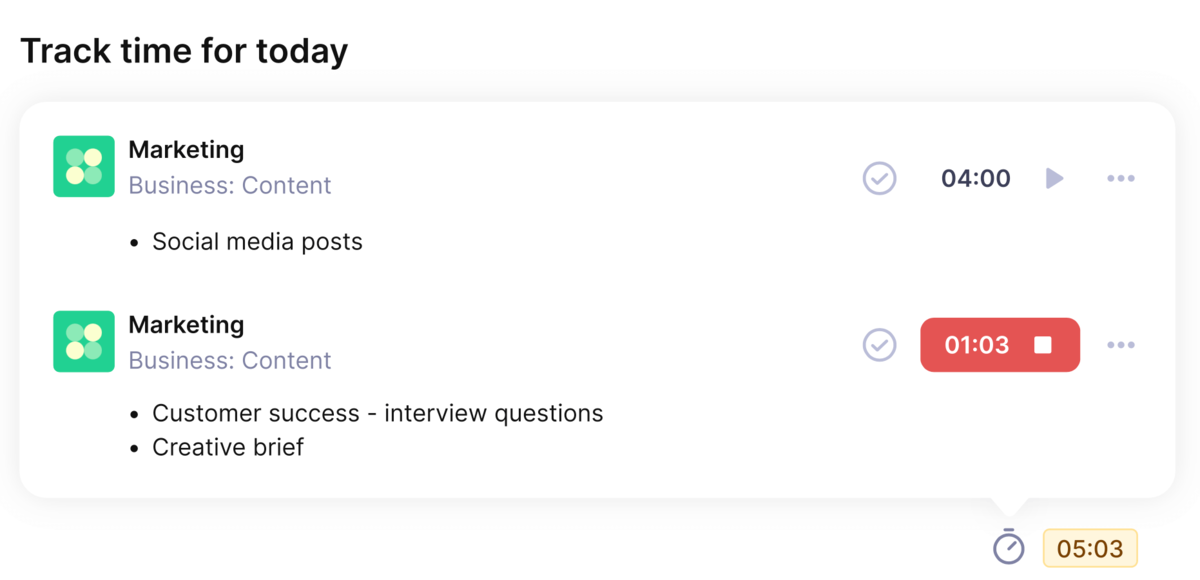
Productive’s automatic time trackers track time directly on tasks, easily tie that data to budgets and margins.
Keep Time Connected to Tasks and Delivery
With Productive’s Project Management, time isn’t tracked in a separate tool. Teams can track progress in the same place they plan work and collaborate.
Productive’s users can:
- Set task priorities
- Assign or tag team members to notify them of updates,
- Estimate completion time
- Set up task dependencies
You can switch between multiple project views, including List, Kanban boards, Gantt charts, Workload, Calendar, and more.

Before using Productive, we had less clarity and control over projects and time tracking.
Read the rest of Karla’s story of gaining more control over projects with Productive.
There are also Docs for shared documentation. Productive’s AI features are available directly from pages to help create and format content.

Get early warnings of budget overruns.
Plan Capacity With Real-Time Availability
Harvest does not include scheduling or utilization views, so teams often add another tool. With Productive, Resource Planning is connected to projects, budgets, and tracked time, so planning reflects reality.
You can schedule work, manage availability, and review utilization in one place. Time off is also included in the Resource Planner.
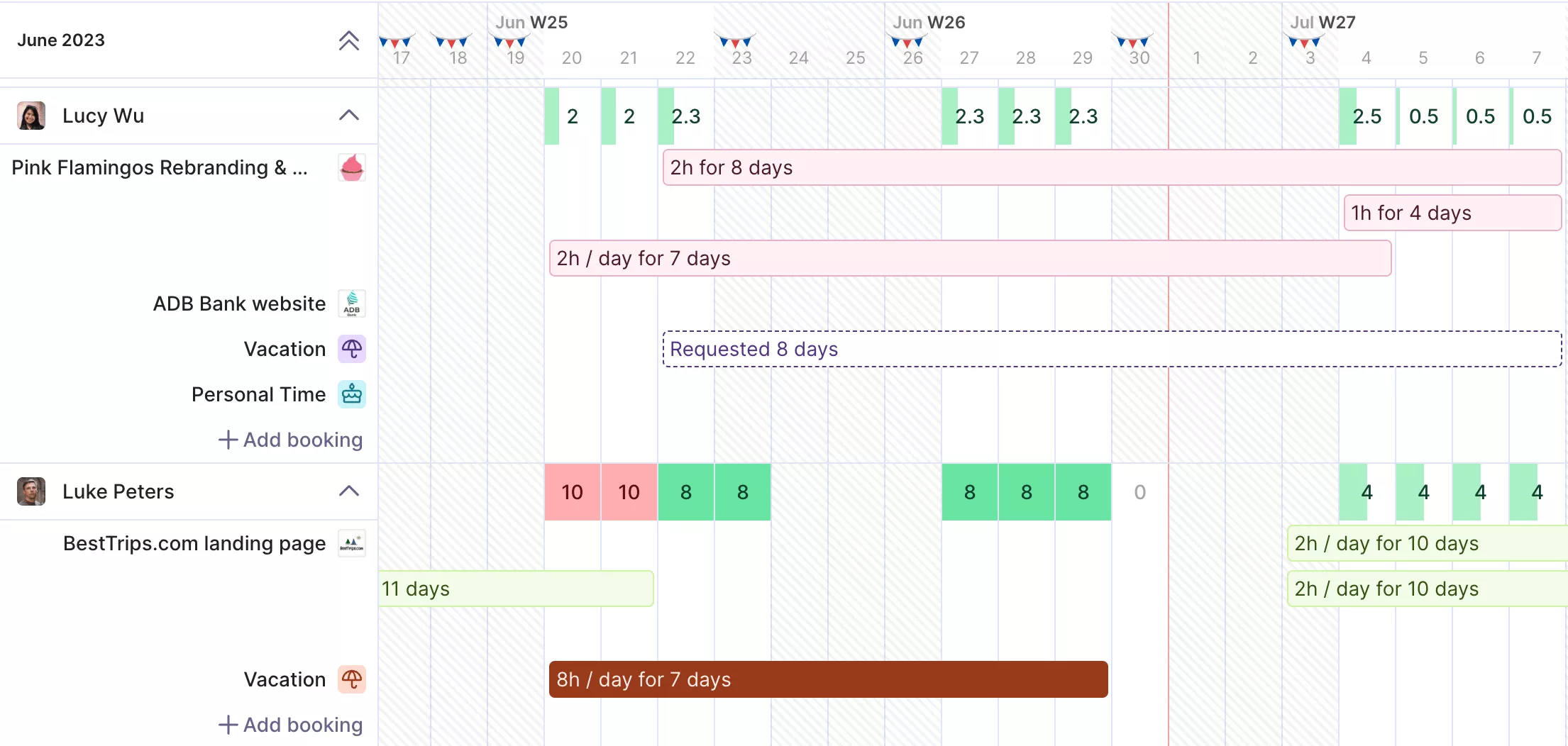
Manage and plan your resources in real time.
Productive supports HRIS integrations, so you can sync time-off types and related data from tools such as Breathe, BambooHR, Rippling, Humaans, and more.
Another useful option is Forecasting. By combining scheduling and budgeting data, it can help you predict budget burn, revenue, and margins so you can spot risk early.
Catch Budget Risk Early and Protect Margins
Productive connects delivery data to financials, which helps when you are running fixed-fee projects or retainers.
With Productive’s Budgeting, you can set up and track budgets and profitability across projects or at a higher level. You can also split complex projects into multiple budgets, such as design, development, and maintenance phases.
With Reporting, you can build reports from live timesheets and budgets. You can use preset templates or create custom views, including a utilization report, budget burn, and profitability by project.
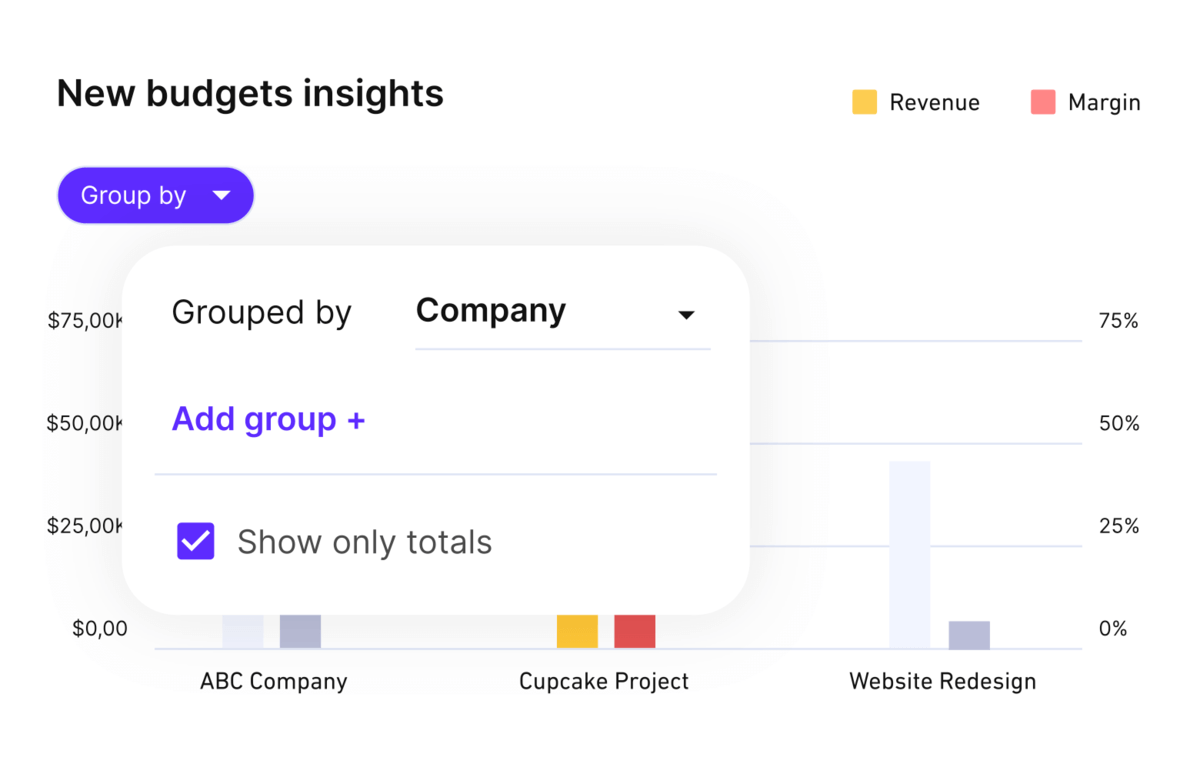
Update budgets in real-time.
Instead of finding out after the project ends, Productive helps you monitor budget burn and profitability as work progresses.
With Billing, you can create brand-friendly invoices, review invoice history, and track what is pending. For retainers and fixed-fee work, Productive supports recurring budgets and connects billing back to tracked work.
Productive also includes accounting integrations with Xero and QuickBooks.

Track employee utilization in real-time and export the timesheet reports.
Keep the Tools You Still Rely on Connected
Productive’s integrations include Slack, Google Calendar, and Outlook for scheduling and updates, Xero and QuickBooks Online for accounting, BambooHR, Breathe, and Personio for HRM, Jira and Memtime for tracking time, and more.
Productive integrates directly with most of these tools, so you can reduce manual exports and imports.
Pricing
- Plans start with the Essential plan at $10 per user per month, which includes essential features such as budgeting, project & task management, docs, time tracking, expense management, reporting, and time off management.
- The Professional plan includes custom fields, recurring budgets, advanced reports, billable time approvals, and much more for $25 per user per month.
- The Ultimate plan has everything that the Essential plan and Professional plan offer, along with the HubSpot integration, advanced forecasting, advanced custom fields, overhead calculations, and more. Book a demo or reach out to our team for the monthly price per user.
You can go for a free 14-day trial before you decide to check out a paid plan.
Replace Your Time Tracker Plus Extra Tools With Productive
Track time, plan capacity, and invoice from the same system, with reporting that scales as you grow.

2. Hubstaff – A Good Choice for Creative Agencies
Hubstaff is a work-hours tracker that allows users to log time, manage projects, and monitor employee productivity. A cool feature is the ability to track time on desktop, web, and mobile apps, which makes it easy to stay productive even if you’re on the go.
In case you want to learn more about keeping your team productive, you might want to check our different list of the best time management tools and techniques.
Key Features
- Track work hours
- Task management
- Detailed reporting, including sites usage reports, activity levels, and insights into employee activities
- Payroll processing via seamless integrations
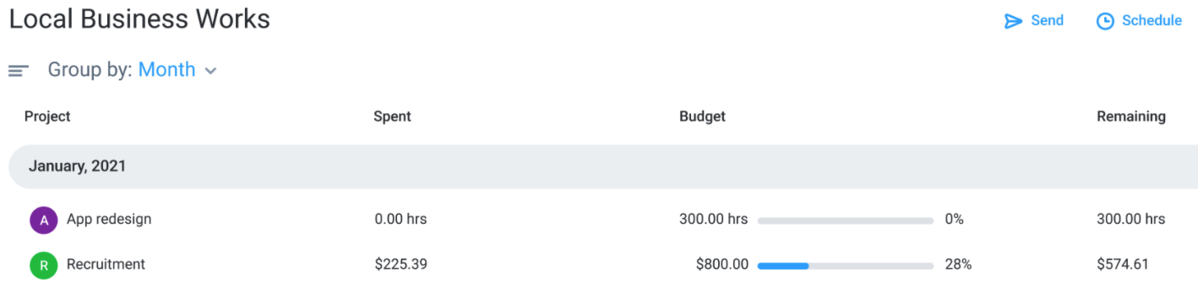
SOurce: hubstaff
Final Verdict
All in all, Hubstaff is a fair choice for teams looking for Harvest alternatives. If monitoring raises privacy concerns for your team, you may want a lighter tracker. You have all the basic features and integrations that’ll make your day-to-day project management easier.
Users like Hubstaff because of its easy-to-use interface and helpful customer support. Some customers complain about occasional glitches in the software and difficulties with payroll integration.
3. Wrike – A Solid Solution for Medium-sized Companies
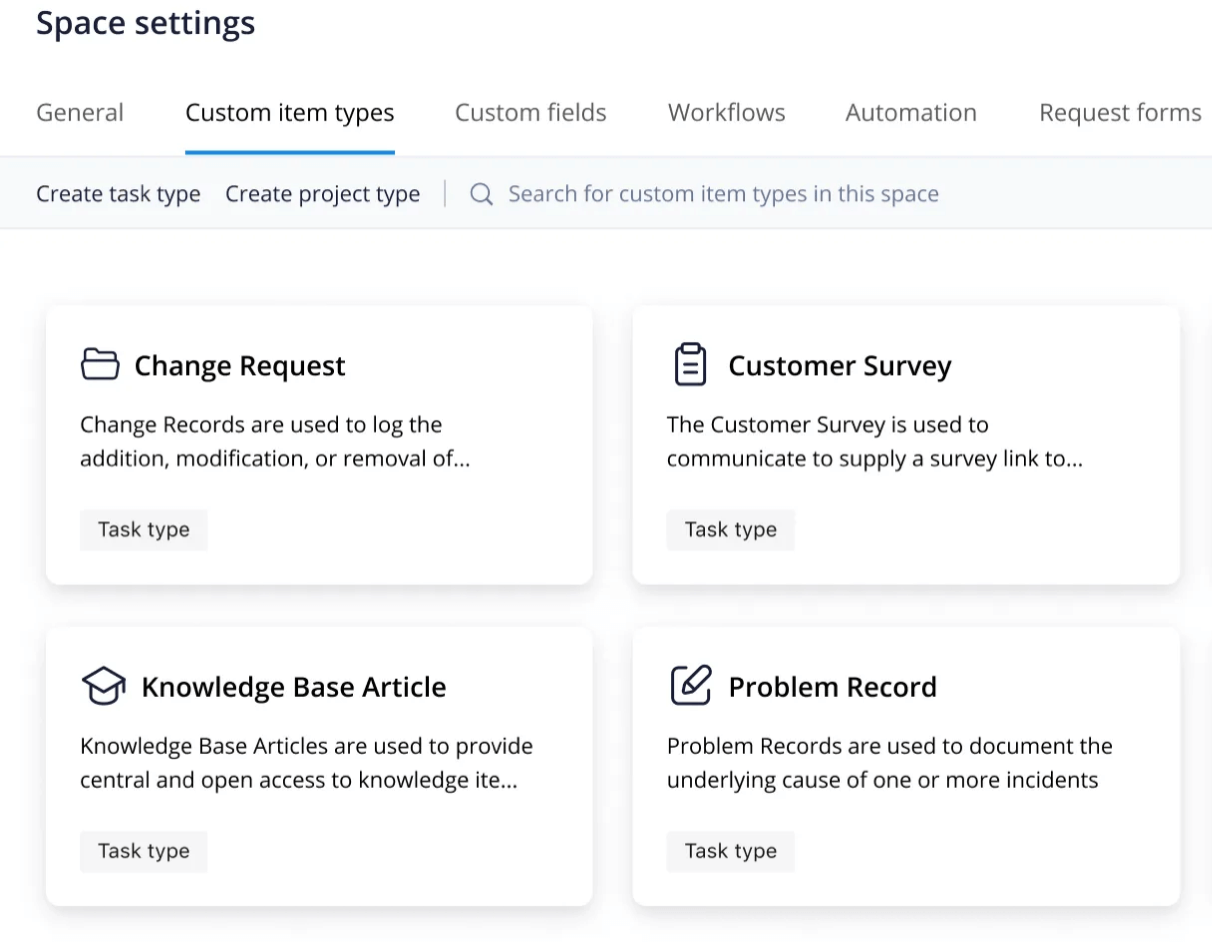
Wrike is a work management platform that supports time logs and billing rates for projects. The software is known for its intuitive user interface, customizable workflows, and lots of integrations.
Wrike allows users to keep track of time spent on tasks, create reports, and set up billing rates for each project.
Key Features
- Track work hours with automated timesheets
- Customizable billing rates
- Real-time collaboration
- Customizable dashboards
Source: wrike
Final Verdict
Wrike is a solid Harvest replacement that offers many of the same features. Customers like the flexibility for various types of teams and the intuitive user interface.
However, users have mentioned issues with customer support response times and the steep learning curve for new users.
Additionally, Wrike only offers budgeting as part of its most advanced pricing tier. Compare Wrike and Teamwork to Productive, where budgeting is available in all of the plans.
4. Everhour – A Good Choice for Creative Teams
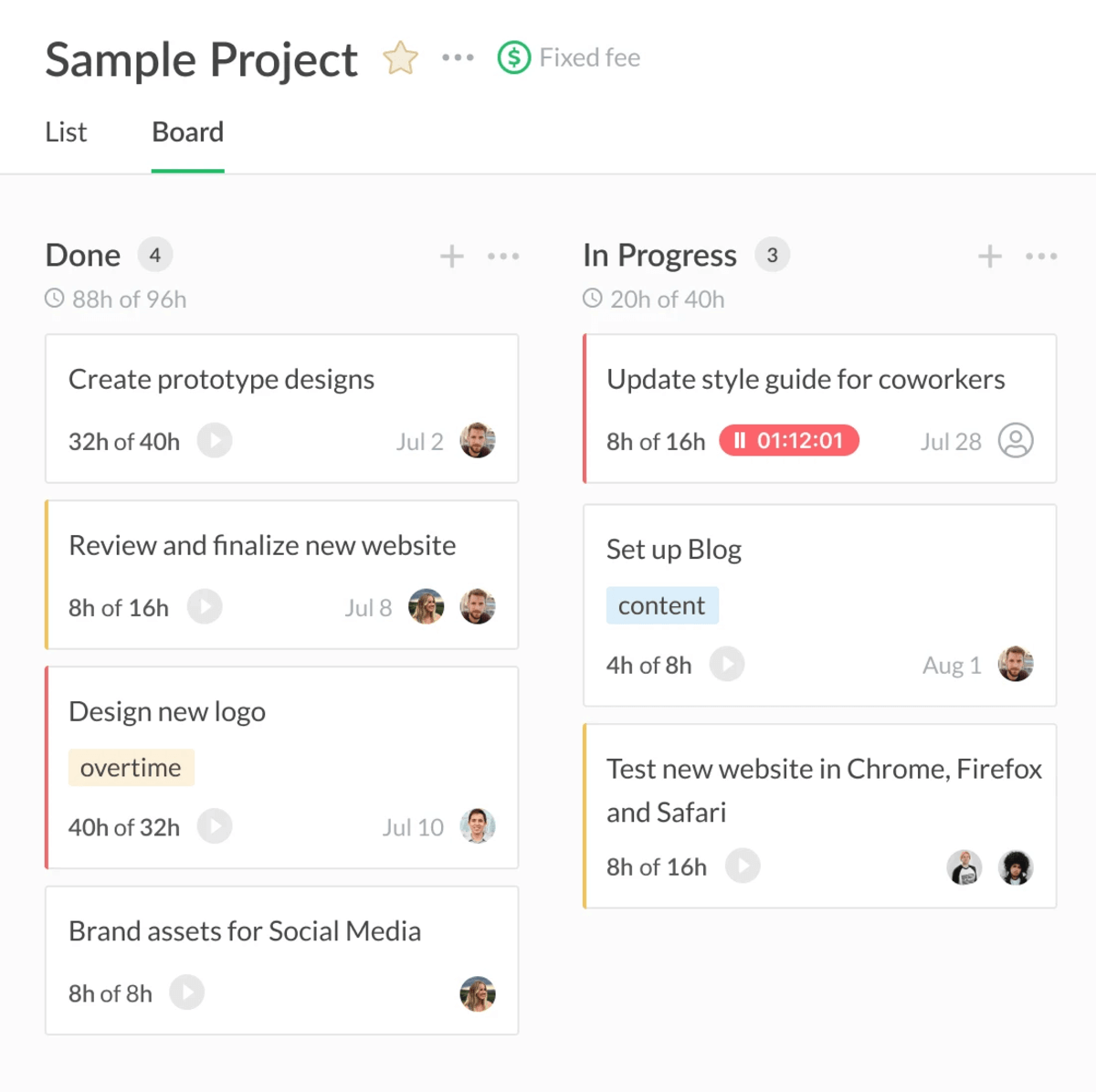
Everhour is a simple Harvest alternative for logging hours, with budgeting features that integrates with popular project tools like Asana, Trello, and Jira. The tracking tool allows users to track time on tasks, set up budgets, and create custom reports.
Key Features
- Track work hours with automated timesheets
- Budget tracking
- Customizable invoicing with billable rates
- Customizable dashboards and reports
source: everhour
Final Verdict
Everhour is a good Harvest alternative option since it allows employees to track hours across projects and tasks. Customers are generally happy with the project management software integration and time tracking, but some users mention occasional glitches in the software and difficulty setting up certain features.
5. Beebole – Flexible Time Tracking for Enterprises
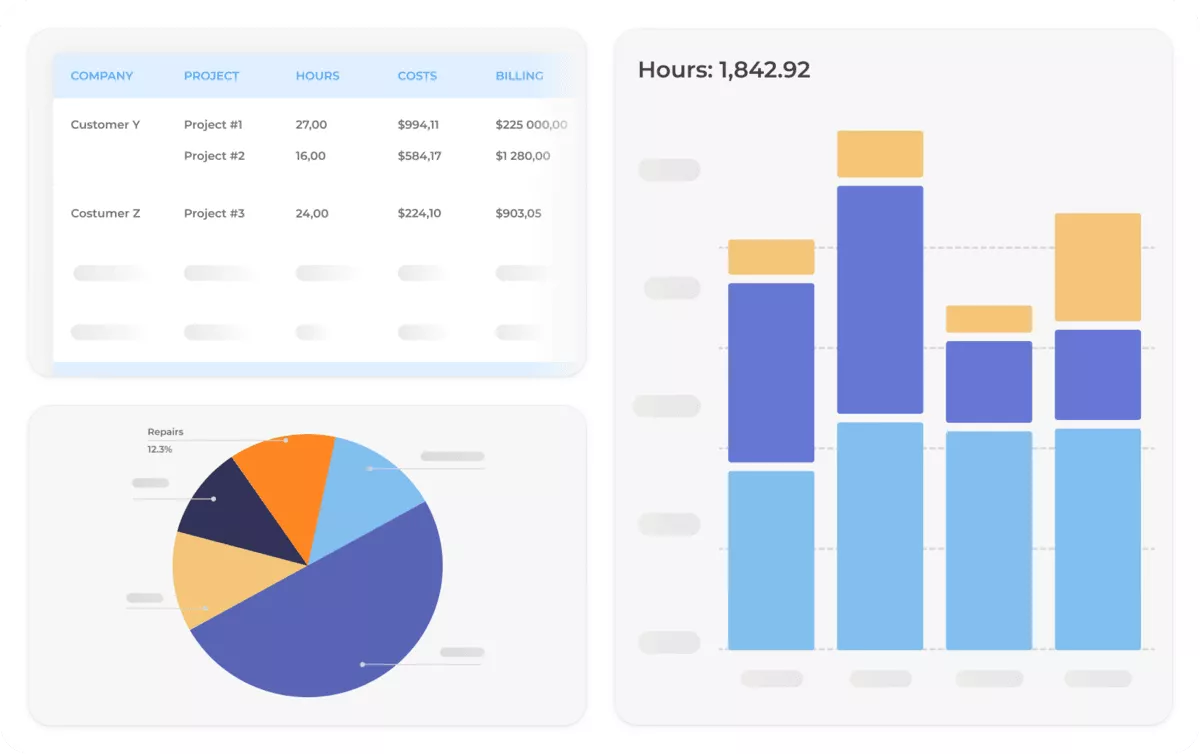
Beebole is a secure, enterprise-grade time tracking platform built for teams needing flexibility and control. It supports unlimited clients, projects, and tasks with role-based permissions, multi-level activity hierarchies, and detailed custom reporting.
With multiple billing options, budgeting tools, and powerful integrations, Beebole is ideal for organizations managing complex workflows.
source: beebole
Key Features
- Unlimited clients, projects, and tasks
- Role-based permissions
- Custom KPI dashboards and exportable reports
- API access with Zapier and Pipedream integrations
Final Verdict
Beebole gives you the flexibility to handle complex billing scenarios while maintaining strong security, compliance, and global adaptability. Users often praise Beebole’s granular customizability, customer support, and powerful custom reporting.
6. Clockify – A Popular Choice for Businesses of All Sizes With a Free Plan
Clockify is a work-hours tracking tool that offers a variety of features for businesses of all sizes. If you’re looking for a free-first tracker, Clockify is among the most popular options.
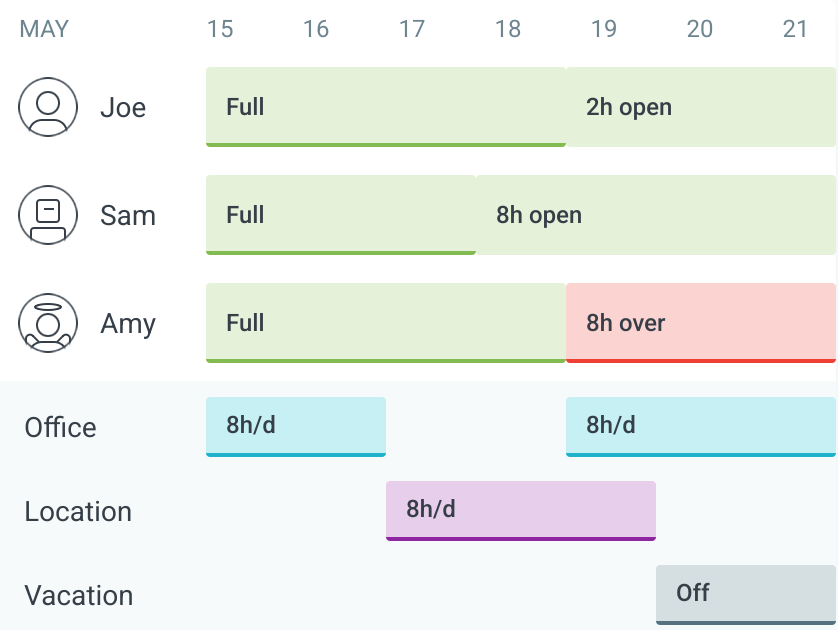
Regarding Clockify’s paid tiers- its users can track time on tasks, set up budgets, and create custom reports. Additionally, Clockify offers features for invoicing, team management, and productivity monitoring. It also has a basic free version.
Key Features
- Track work hours with automated timesheets
- Project budget tracking
- Customizable invoicing with billable hourly rates
- Resource management
source: clockify
Final Verdict
Clockify is a good option because the basic time tracking features are free, so if you’re just getting started it’s nice to have the option to try out a tool for free. Customers like its user-friendly interface, time tracking and reporting features.
Other customers have complained about limited customization options for certain features and a lack of project management functionality.
7. QuickBooks Time – A Cloud-based Solution for Enterprises
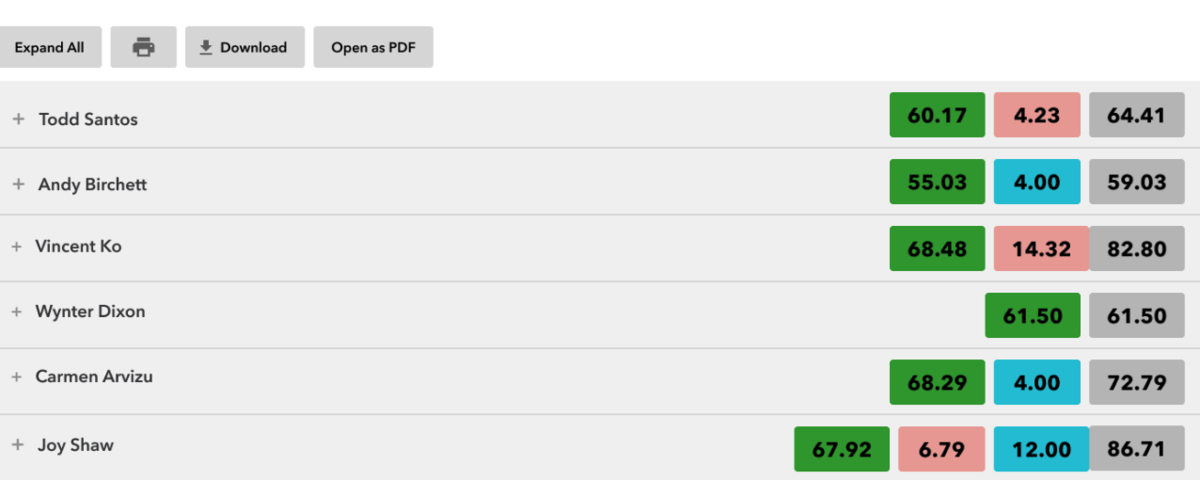
QuickBooks Time is a cloud-based tool for logging work hours that’s designed for teams using QuickBooks Online.
This Harvest alternative allows users to log time on tasks, set up budgets, and create custom reports. Additionally, QuickBooks Time offers features for team management, scheduling, and productivity monitoring.
Key Features
- Work hours on tasks
- Customizable invoicing with payment integrations
- Employee activity tracking
- GPS tracking for field teams
source: quickbooks
Final Verdict
QuickBooks is generally one of the best Harvest alternatives when it comes to tracking work time and billing, since it integrates so well with QuickBooks.
Still, customers have complained about its lack of automation features and difficulty with navigation and organization of data.
If you want to learn more about accounting software, we have a detailed comparison of Netsuite vs QuickBooks.
Why Look For a Harvest Replacement App?
Teams look for a Harvest alternative because reporting feels too basic, key admin fields (like PO numbers) are missing, edits to logged time are harder to audit, and the overall value can feel weak for the price once you move beyond the free plan.
On top of that, a lot of teams are now exploring alternatives because of the recent price increase and the way it was communicated.
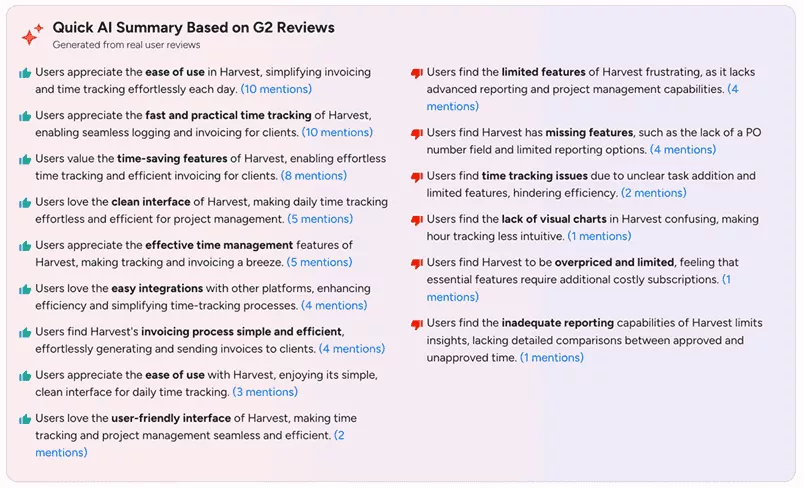
Harvest G2 review screenshot
Backlash After Price Increase
In early 2026, a wave of users reported surprise renewal changes. The common theme was not just the size of the increase, but the lack of clarity.
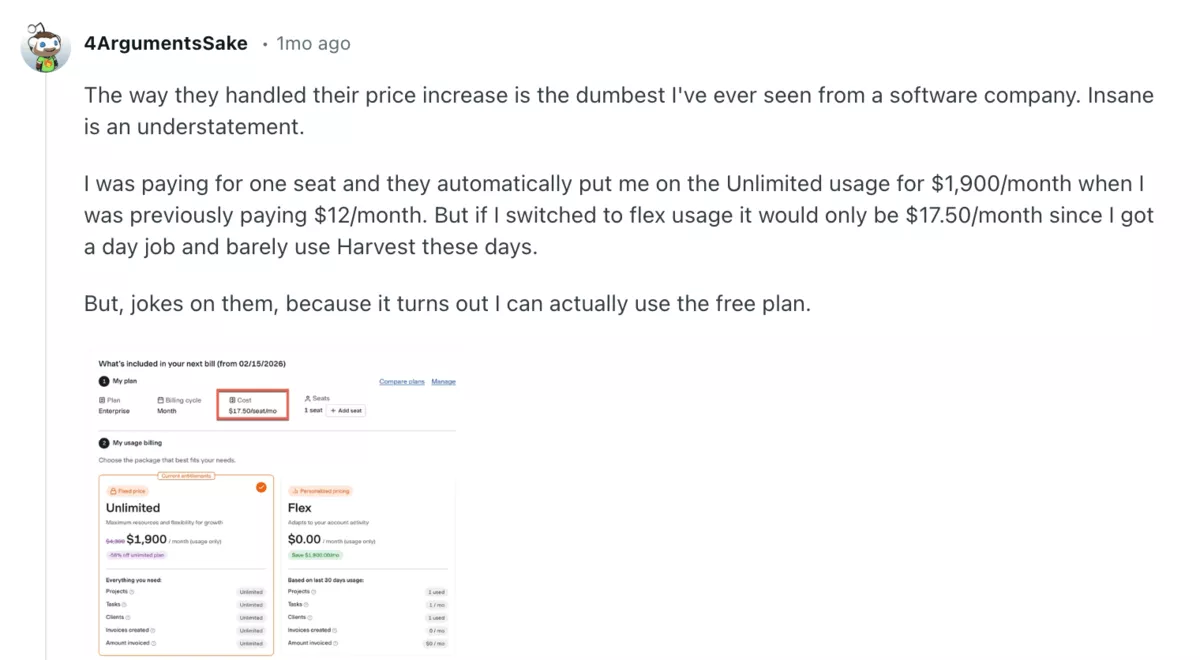
Some people say they received an email notice that their account would be moved to a higher tier automatically at renewal, with costs jumping from a low monthly fee to thousands per month.
Source: reddit.com
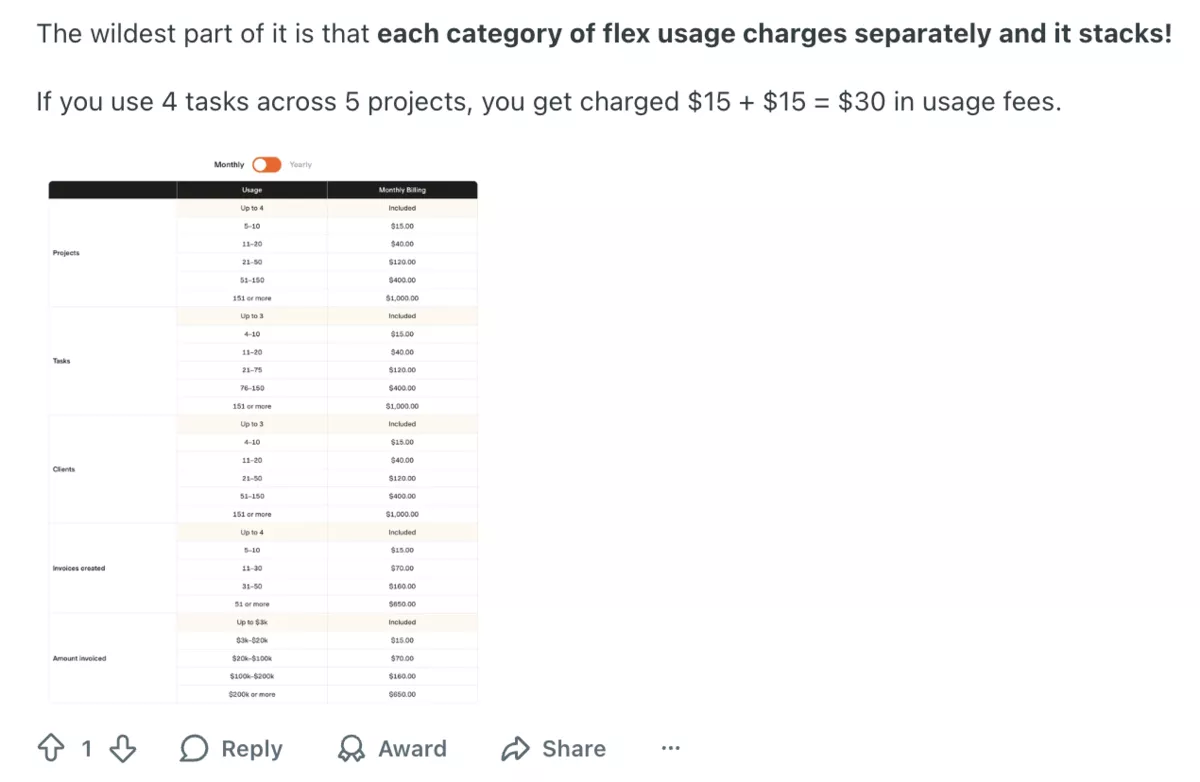
Others describe a new usage-based model where the bill can rise based on things like projects, tasks, clients, invoices, or invoiced volume, and that the triggers were not obvious from the pricing page.
Several users say the renewal email was the first time they saw the real number. One wrote:
I was paying for one seat and they automatically put me on the Unlimited usage for $1,900/month when I was previously paying $12/month. But if I switched to flex usage it would only be $17.50/month since I got a day job and barely use Harvest these days.
Source: reddit.com
In case you’re curious about what other users have to say, read the rest of the price increase Reddit discussion.
If you’re done with alternatives browsing, but you still need some help with the final choice, stick with this article.
FYI, you run a services team, check out our shortlist about agency software for tracking time.
How To Choose a Harvest Replacement?
Choose a Harvest replacement by validating workflow fit, financial visibility, and rollout risk before you migrate any data. The next step is making sure the tool works for your real workflows, not just in a demo.
Start with these checks, in order:
1. List your non-negotiables. Decide what must be built-in: approval workflows, project budgets, invoicing capabilities, utilization reporting, tracking of employee availability, capacity scheduling, a time-off management feature, plus granular permissions and tracking permissions for who can log, edit, and approve time.
2. Confirm your core workflows. If you rely on Kanban boards, Gantt charts, recurring tasks, and task dependencies, make sure the tool supports them the way your team actually works.
3. Test the money path. Create one sample project and verify budget burn, billable vs. non-billable hours, expense logging, and invoice output. If you bill retainers or fixed-fee projects, confirm recurring budgets and overage handling.
4. Check reporting depth. Make sure you can produce a utilization report plus project profitability and billing status without exporting to spreadsheets, and that stakeholders have access to reports, including sites usage reports when you need them.
5. Decide on capture style. Choose between manual timers and logs, or automatic time tracking (for example, app and website based capture) if your team needs it.
6. Run a short pilot. Have a small group log a week of real work and compare totals, invoices, and reports before you cut over fully.
Free Harvest Migration Checklist
Use this checklist to move off your current tracker without losing data, breaking billing, or confusing the team.
- Set the cutover date and owners. Pick the week you will stop logging hours in your current tracker (avoid month-end if you invoice monthly). Assign one owner for the migration and one for billing and reporting sign-off.
- Map your current setup in one page. List what your current tracker covers today (time, expenses, invoicing, approvals, reporting) plus every connected tool (project tool, scheduling, accounting).
- Export and clean your data. Export People, Clients, Projects, Tasks, Time entries, Expenses, and invoices (if used). Archive closed projects, remove duplicates, and standardize names before importing.
- Define mapping rules and must-have reports. Decide how clients, projects, tasks, billable rates, and cost rates map over, plus rules for billable vs. non-billable time and leave, including vacation days, sick days, and tracking of vacation requests. Lock the reports you need to match after migration (budget burn, utilization, profitability, WIP, invoice status).
- Configure the new tool with guardrails. Set teams, roles, permissions, time entry rules, and timesheet lock rules. Recreate the workflows your team relies on, such as Kanban boards, Gantt charts, recurring tasks, and task dependencies.
- Import in the right order and validate. Import clients and active projects first (with rates), then import history for the smallest useful period (often the current quarter). Spot check totals against your export before you move on.
- Rebuild billing and accounting, then test. Recreate your invoicing workflow (tracked time, fixed fees, milestones) and connect accounting (Xero or QuickBooks). Generate a test invoice and confirm the sync behaves as expected.
- Pilot, cut over, and audit the first cycle. Run a 3 to 5 day parallel test with a small group, then freeze edits in the old system on cutover day. After the first billing cycle, compare invoices, time totals, and expenses, and fix any gaps.
Conclusion: Are These Alternatives Worth the Switch?
Yes, for most teams it is.
Most tools on this list offer better value once you factor in what they replace. If you only need a lightweight tracker, pick one that keeps billing simple. If you want fewer tools and cleaner numbers, all-in-one platforms like Productive connect projects, budgets, capacity, and billing in one place.
If you want to see what that looks like for your workflow, you can book a demo today.
Connect With Agency Peers
Access agency-related Slack channels, exchange business insights, and join in on members-only live sessions.
