Tracking Time, Boosting Profit: Growth Bite’s Journey with Productive

Growth Bite is a digital marketing agency specializing in SEO, content marketing, and data-driven PR. Founded in 2021, they help businesses of all sizes achieve measurable, ROI-focused growth across digital channels.
We spoke with Rasa Sosnovskytė, the CEO of Growth Bite, who also manages key client accounts, about how the team uses Productive to bring financial clarity to their operations, accurately plan resources, and confidently make profitability-driven decisions as they grow.
We Help Your Agency Reach New Heights
Switch from multiple tools and spreadsheets to one scalable agency management system.
Tell us a bit about Growth Bite and what you do
We founded Growth Bite back in 2021 as a digital marketing agency built on a data-driven approach. Our goal has always been to help businesses of all sizes maximize their digital marketing ROI, and today we work with a wide range of clients, from startups to established enterprises across various industries. Whether they’re looking to strengthen their brand presence or achieve measurable growth, we support them through SEO, content marketing, and data-driven PR.
Our team includes our cofounder, SEO specialists, content strategists, copywriters, and other marketing experts. I serve as both CEO and key account manager, which means I’m deeply involved in both how the business runs and how we deliver results to clients.

What pain points were you experiencing before Productive?
Before we switched to Productive, we used Trello to manage our projects and client work. Trello worked well enough for basic task management, but as we grew, it became evident that it wasn’t built to handle the financial and operational complexity of running an agency. One of our biggest challenges was working with different freelancers across projects. Each freelancer has different rates, which means the cost of delivering work varies significantly from project to project. Trello gave us no way to track this. We couldn’t see the actual cost of delivering work for each client, which made it nearly impossible to understand our actual margins.
Another major issue was that we couldn’t easily determine how many hours each client had remaining on their contract. Pricing appropriately was extremely difficult because we had no clear visibility into the actual effort and costs involved in each project. Without this data, pricing decisions were based more on intuition than on strategy.
In short, Trello showed us tasks, but it didn’t show us the business behind them. We couldn’t connect the dots between hours worked, freelancer costs, remaining contract hours, and project profitability. Everything was siloed, and getting a full picture required manual work we simply didn’t have time for.
What made you look for a new tool?
The main trigger that actually made us look for a new tool was the complete lack of visibility into time, both internally for our team and externally for client reporting. We couldn’t see how much time we were spending on different activities, and we couldn’t give clients clear updates on remaining hours or budget status. On top of that, we were building a new internal tool and allocating some of our expert hours toward its development. We needed much better tracking to understand how time-intensive this initiative was and how many resources we were dedicating to it.
When evaluating tools, we knew we needed something that could help us manage staff time effectively and, crucially, support different cost rates for each individual. Since we work with a mix of in-house team members and freelancers at varying rates, that feature was essential for accurate profitability tracking. A bonus that sealed the deal for us was Productive’s built-in vacation booking system. Having time-off management integrated directly into the same platform where we track projects and resources is incredibly convenient. It also ensures that our capacity planning is always accurate, one less tool, one less source of error.

One of the biggest improvements has come from Productive’s budgeting functionality. It has been an absolute game-changer for us. We can easily track contract changes and monitor profitability rates in real time, which has fundamentally changed how we make resourcing decisions.
What benefits did you see once you started using Productive?
As both CEO and key account manager, Productive has completely transformed how I work. I can now manage clients’ time much more effectively, generate reports without manually gathering data, and see precisely how long tasks actually take. That level of visibility means I can have informed conversations with clients about timelines and budgets and make strategic decisions about resource allocation with confidence.
One of the biggest improvements has come from Productive’s budgeting functionality. It has been an absolute game-changer for us. We can easily track contract changes and monitor profitability rates in real time, which has fundamentally changed how we make resourcing decisions. We’ve even discovered that for some clients, it’s more profitable to hire external freelancers, sometimes even less experienced ones, because their cost of work is lower. Before Productive, we would have defaulted to doing everything in-house without ever realizing the impact on margins. Now we can make far more data-driven decisions about when to use internal resources and when it makes more sense to bring in external talent.
How was your onboarding onto Productive?
The onboarding wasn’t the easiest thing we’ve ever done, but that’s okay; it was very worth it. We had to think through a few workarounds to fit Productive into our specific workflows. However, our account manager was extremely supportive and readily answered our questions, which made a big difference.
We also came up with a clever internal solution: we fed the entire onboarding and documentation content into an AI assistant so we could ask custom questions and receive tailored answers quickly. This significantly accelerated the learning curve and helped the team become comfortable with the platform much faster.
We can set budgets for each project, track time against them in real time, and immediately see when we’re approaching limits or when a project is more profitable than expected. This combination has become the foundation of how we run the agency.
What’s your favorite feature?
My favorite features in Productive are the budgeting option and time tracking. These two capabilities work hand-in-hand to give us the financial visibility we were missing before. We can set budgets for each project, track time against them in real time, and immediately see when we’re approaching limits or when a project is more profitable than expected. This combination has become the foundation of how we run the agency.
How would you feel if you didn’t have Productive?
Honestly, without Productive, we would have to build some kind of Excel formula extravaganza just to attempt to replicate what we have now. I’m afraid to even think about it. The amount of manual work, the room for error, and the lack of real-time visibility would be a nightmare. Productive has become so embedded in how we operate that going back isn’t really an option.
Achieve Your Agency’s True Potential
Switch from multiple tools and spreadsheets to one scalable agency management system.
More stories


Driving Growth With Productive: How Numble Scaled Smarter

Numble is a fast-growing, project-based digital agency operating within the Cronos Group, one of Belgium’s largest IT ecosystems. Their expertise lies in crafting innovative, efficient, and scalable solutions tailored to unique business needs.
We spoke with Nicola Nauwynck, co-founder of Numble, about how they’ve leveraged Productive to scale their internal processes and champion adoption across the broader Cronos network, bringing over 800 new users to the platform.
We Help Your Agency Reach New Heights
Switch from multiple tools and spreadsheets to one scalable agency management system.
Can you tell us a bit about Numble and your role?
I’m one of the co-founders of Numble, a project-based agency we started five years ago within the larger Cronos Group, which is an ecosystem of over 600 IT companies and around 9,500 people today. I originally joined Cronos as a full-stack developer right after my studies, but I quickly transitioned into project and account management roles before founding Numble with two others.
At Numble, we operate in the digital and IT space, primarily serving clients who require complex, project-based work. Our approach has always been a bit atypical compared to other Cronos companies, many of which focus on consultancy. Because of this, budgeting and project planning have always been absolutely essential to how we work.
We’ve grown from three to 35 people over the last five years, and I currently handle many of the company’s sales responsibilities, in addition to helping optimize our internal operations.
How did you find Productive?
There was never really a “before” Productive for us—we implemented it on day one. Even back in 2019, we already knew that relying on Excel files and outdated workflows wouldn’t be a fit for the way we wanted to run our company. We needed a modern, flexible solution that could grow with us.
Although I had experience implementing tools like Harvest, Forecast, and Tempo in the past, I found that Productive had a lot more to offer, especially when it came to planning and budget management. That made it a clear choice from the start.
If we didn’t have Productive today, I don’t know what we’d do; it’s essential to how we work.
What benefits did you see once you started using Productive?
The benefits were clear from the very beginning. In the early days of the agency, when we were a small team, I handled everything—sales, project management, and budget tracking. Productive gave us structure and insights into all our workflows, from project planning to financial oversight.
As we grew, Productive scaled with us. Today, our project managers own their budgets inside the platform, and we use Productive very differently than we did a few years ago. But what hasn’t changed is the value it brings to our day-to-day operations.
Honestly, I can’t imagine going back to Excel-based processes. If we didn’t have Productive today, I don’t know what we’d do; it’s essential to how we work.
One of the most impactful things we’ve done is build a synchronization between Productive and Cronos’s internal systems. That allowed us to connect time tracking data for invoicing purposes and push leave requests from our HR system into Productive. The result is a much more streamlined internal workflow, where everything syncs automatically and we avoid repetitive manual work.
However, beyond our own company, this integration evolved into something much larger. As a result, we successfully introduced Productive to 30 other companies within the Cronos ecosystem. Today, around 800 people across Cronos use Productive. That’s a huge milestone—and one I’m really proud of.
What was the onboarding experience like?
We mostly onboarded ourselves in the beginning, and that worked well because I already had some background in tool implementation. But over the past two years, we’ve been working closely with Luka from your team, and that support has been great. Whenever we had a question or needed help figuring something out, he was there.
Dashboards, combined with advanced reports, are powerful for creating insights and tracking what truly matters to us.
Do you have a favorite feature in Productive?
I’d say it’s a tie between the custom fields and the dashboards. Custom fields give us a lot of flexibility, especially when integrating Productive with other systems like Cronos or our HR tools. And dashboards, combined with advanced reports, are powerful for creating insights and tracking what truly matters to us. Those two features have really helped us tailor Productive to our needs.
How would you feel if you didn’t have Productive?
Honestly, I couldn’t imagine running Numble without it. We rely on it for everything—from planning and budgets to reporting and sales tracking. Going back to a more manual or fragmented system just isn’t an option anymore.
Achieve Your Agency’s True Potential
Switch from multiple tools and spreadsheets to one scalable agency management system.
More stories
From Complexity to Clarity: How ZenDev Streamlined Operations and Boosted Profitability with Productive

ZenDev is a Swedish/Bosnian award-winning IT staff augmentation and software development agency founded in 2016 by Senad Šantić and Nikola Mirković. They met in Gothenburg, Sweden, and shared a passion for technology and innovation. Their mission is to build an innovation ecosystem, creating first-class IT solutions tailored to their clients’ needs while nurturing tech talent in Sweden, Bosnia and Herzegovina.
We spoke with Anđela Čović, Chief Marketing Officer, and Farik Vrce, General Manager, about how Productive helped ZenDev boost profitability and streamline operations.
We Help Your Agency Reach New Heights
Switch from multiple tools and spreadsheets to one scalable agency management system.
Can you tell us a bit about ZenDev and your roles in the company?
Anđela: ZenDev is an agency focused on staff augmentation and product development. I’m the Chief Marketing Officer at ZenDev. I started as a digital marketing specialist almost five years ago.
Farik: And I’m the General Manager at ZenDev. I started working here almost six years ago.
Anđela: If you need experienced developers to strengthen your team or help with specific project parts, we can onboard quickly and get to work immediately. On the product development side, we can take your idea from concept to launch. We ensure your project isn’t just built using the latest tech but is designed to make the most of it, whether it’s an MVP or a complete product.
We operate primarily in Western Europe and Scandinavia, focusing on the Swedish market, where many client relationships originated.
Our strategic nearshore model combines Swedish business understanding with Bosnian technical expertise, offering clients the perfect balance of cultural compatibility, technical excellence, and cost efficiency.
We have offices in Sweden and Bosnia & Herzegovina.
We serve mid to large-sized enterprises across diverse industries, including:
- Manufacturing
- E-commerce
- Healthcare
- Logistics
- Property Management
- Automotive sector
Our ideal clients are looking for a reliable software partner who understands their business and can help them implement the most effective IT solutions for their specific challenges.

How did you handle things before Productive?
Anđela: Operations, sales, and project management relied on individual work and many Excel spreadsheets. All the data was scattered, making it difficult to see and make informed decisions.
Farik: Resource planning was done manually, without a centralized system, which made processes more complex and less efficient.
We relied on Excel sheets to track profitability and hours for each team member.
At the end of each month, we’d manually summarize everything. Combining timesheets with project names and creating calendar views by hand.
This approach became a liability:
- More team members = more data = unmanageable spreadsheets
- High risk of human error in calculations
- Constant manual updates eating up valuable time
- No way to scale as we grew
What started as a simple solution became a serious problem threatening our ability to understand project performance and make good decisions.
Why did you start looking for a tool?
Farik: As the team grew, and we reached 13-14 employees, it became clear that the previous way of working was not sustainable. The increasing amount of data in different spreadsheets made it difficult to track key metrics, and manually managing resources, invoicing, and time off became a bit complex.
We were looking for a solution that would allow us to centralize all of our key data – from finances and time management to resource planning and invoicing.
The goal was to have one place where we could easily manage projects, optimize resource utilization, and make better business decisions based on accurate data.
The unified system is our single source of truth, enabling our sales team to commit to staff augmentation opportunities confidently. At the same time, project managers can plan using actual resource availability data.
What benefits did you see once you started using Productive?
Anđela: After switching to Productive, we quickly noticed significant benefits and changes in our work. The biggest change was centralizing all key data in one place, which allowed us to be more efficient and better organize our business. Instead of relying on various Excel spreadsheets and manual processes, we now have all the key information – from invoicing and resource planning to time tracking and cost prediction – within one tool.
Growing our team has dramatically improved our operational control in two key areas:
Leave management & resource planning
- Consolidated view of all team availability (both paid and unpaid time off)
- Accurate forecasting for project timelines and resource allocation
- Clear visibility into bench capacity for the sales team to leverage
Financial oversight
- Centralized cost tracking in a single platform
- Custom filtering by category, date, and flexible reporting options
- Quarterly hour utilization analysis driving better profitability
The unified system is our single source of truth, enabling our sales team to commit to staff augmentation opportunities confidently. At the same time, project managers can plan using actual resource availability data.
This structured approach has directly contributed to improved profitability through more efficient resource allocation and reduced bench time.
With Productive, our resourcing process is so efficient that what used to require a full-time role in spreadsheets is now streamlined, allowing our team to focus on higher-impact work.
Do you have a favorite feature in Productive and why?
Farik: These past few months, I’ve been doing a lot of work in the Resourcing part of Productive, tracking our utilization and projections, and whether we’re meeting them. We also use time management, cost and revenue predictions, and team skills visibility to the fullest, which helps us make informed decisions.
With Productive, our resourcing process is so efficient that what used to require a full-time role in spreadsheets is now streamlined, allowing our team to focus on higher-impact work.
I’ve also been exploring the Scenario Builder since its release, and I can already tell it will greatly impact how we do business.
Anđela: It’s probably Productive’s CRM because we have it all set up, and it’s easy to get reports and the data we need. No more wasting time on making PowerPoints.
I also have to mention something we implemented across the entire company: the weekly and monthly pulses on mail and Slack for almost everything. We created a Risks and Opportunities board where team leads write a weekly update about the status of their projects. If they have stated opportunities or threats based on the level of threat or opportunity, they are sent to accountable people on Slack.
How would you feel if you didn’t have Productive?
Anđela: Without Productive, our work would be significantly more complex and less efficient. Given the amount of data we monitor and analyze, it would be difficult for us to make accurate decisions and plan for future growth.
Productive is not just a tool for us – it has become a key part of our business, allowing us to optimize processes, learn from data, and strategically plan for the coming months and quarters.
Achieve Your Agency’s True Potential
Switch from multiple tools and spreadsheets to one scalable agency management system.
More stories
How XWP Optimized Agency Operations and Resource Planning with Productive

XWP is a globally distributed agency specializing in enterprise WordPress development. They partner with some of the world’s leading digital publishers and technology companies to solve complex content management challenges. From migrating 25 years of Rolling Stone archives with zero downtime to powering over 70 media brands on a shared WordPress platform, XWP is at the forefront of scalable, high-performance publishing solutions.
We spoke to Magnolia Wren, Operations Manager at XWP, about how they use Productive to streamline operations, enhance cross-department visibility, and optimize resource planning.
We Help Your Agency Reach New Heights
Switch from multiple tools and spreadsheets to one scalable agency management system.
Can you tell us a bit about XWP and your role?
XWP was founded in 2014 and specializes in helping enterprise publishers drive measurable business growth through strategic WordPress development. We focus on solving complex digital publishing challenges by leveraging existing tools in the WordPress industry while also developing custom solutions that balance innovation with efficiency. We primarily serve enterprise clients in digital publishing, fintech, and technology.
When we first launched Productive, I was an Operations Coordinator focused on improving scheduling and reporting for our delivery and engineering teams. Over time, I became the primary contact for Productive across all functionalities within XWP. As an Operations Manager, I now focus on optimizing it to support our operations team.

Did you use any tools before Productive?
Before using Productive, our departments were well-organized with documented processes, but there was a disconnect between them. Sales, for example, had limited visibility into delivery, making cross-team alignment more challenging.
We used Harvest and Forecast—Forecast was a straightforward tool for scheduling, and Harvest helped with time tracking. However, we needed more flexibility in reporting to gain deeper insights into financials and workload fluctuations.
Utilization tracking required manual calculations, pulling data into spreadsheets, and extensive filtering. There wasn’t a seamless way to analyze utilization across teams or at different levels of the organization.
Why did you start looking for a new tool?
We needed something customizable, user-friendly, and affordable. Since we work with contractors and have varying workloads, we require a system that can handle contractual guarantees versus actual capacity.
Our most significant pain points were:
- Lack of cross-department visibility.
- Too much reliance on spreadsheets for reporting.
- Inability to handle edge cases like contractor engagements and fluctuating workloads.
- Inability to centralize and customize data and reporting within our previous register of tools.
We explored many other options with robust features, but they didn’t fully align with our budget, and the user-experience of other tools was a far steeper learning curve than we were aiming for. What stood out about Productive was:
- Its balance of customization and ease of use.
- Strong support team.
- Integrations with key tools like HubSpot and Jira.
- A pricing model that made sense for an agency of our size.
What benefits did you see once you started using Productive? What were the biggest changes?
We saw a lot of changes across various points, but these are the most significant ones:
- Cross-department visibility improved dramatically.
- We now have all of our key employee and time data in one place, which has eliminated a great number of spreadsheets and one-off reports.
- Customizable permissions allowed us to empower our team while keeping sensitive data private.
- Our scheduling has been streamlined through multiple functionalities and increased visibility in the resource planning tool, reducing time spent on manual calculations and searching for supporting information.
- The customizable reports and dashboards have saved leadership and operations countless hours.
My favorite feature in Productive is the customizable permissions. They allow us to give employees as much visibility as possible while securing sensitive data.
Do you have a favorite feature in Productive and why?
My favorite feature in Productive is the customizable permissions. They allow us to give our teammates as much visibility as possible while securing sensitive data. I also love the ability to use customizable fields and formulas in reporting- it’s been a total game-changer for us. Building and sharing specific reports has saved us time and supported efficient decision-making across our organization. I’m also a huge fan of the recent updates to resourcing. The improved visibility into individual absences from the “project” view has made scheduling much smoother and more efficient.
How would you feel if you didn’t have Productive?
Without Productive, we would lose valuable time reverting back to countless spreadsheets, and rebuilding our current processes would take months. Our ability to track our utilization, manage our fluctuating team capacities, and resource our teams efficiently would be significantly impacted.
Achieve Your Agency’s True Potential
Switch from multiple tools and spreadsheets to one scalable agency management system.
More stories
Steamroller Studio Built an Employee Management System Using Productive

Steamroller Studios is a collective that mainly works within the animation and entertainment industry. They’re the creative force for some of the world’s largest film and gaming studios. In their own words, they live to create the unforgettable.
We spoke to Aaron Gilman, CEO of Steamroller Studios and Mark Cleaver, Head of Operations, about how they use Productive for innovative resource management.
How did you find Productive?
Aaron: When I first came to Steamroller, my first question was: “How are you tracking everything you do?” I quickly realized that they had six or seven different tools that were all over the place. Some people used one tool, others used a different tool, and it was a lot. The biggest issue was that these tools weren’t talking to each other.
When I joined the company, I was looking for something pretty specific: a way to track humans, not tasks. I looked at monday.com, Trello, Asana, etc. but had no luck. Then Mark suggested I try Productive since we already had it in the company.
What tools did you use at Steamroller Studios before Productive?
Mark: Before Productive, we used multiple systems. Tracking time was really important for us since we used it for payroll. At the end of the month, gathering all the data from three different tools would be a nightmare. We needed a tool that would unify all of our data.
We still use a few task-tracking tools, but since we have in-house engineers, we were able to build APIs that connect other tools we use with Productive. This means that at the end of the month, we can pull everything we need into Productive. It’s our source of truth for budgets and time logs; we also use it for resourcing.
We Help Your Agency Reach New Heights
Switch from multiple tools and spreadsheets to one scalable agency management system.

We use Productive to care for our employees, which has been an important contributing factor to having a 98% retention rate this past year.
You have a unique use case for Productive. Could you tell us a bit more?
Aaron: We use Productive to care for our employees, which has been an important contributing factor to having a 98% retention rate this past year. Each employee in the company is set a task in Productive, which holds all the necessary information about that person. The managers who are responsible for their teams are in Productive all the time, and they can’t ignore the tickets that are coming through, which means problems get solved extremely fast.
We have a series of “Tier Action Boards” set up in Productive, with the specific goal of categorizing issues and delegating them to key stakeholders in the company to implement solutions. If you want oatmeal in the kitchen or maybe a taller desk, we’ll see it here. A subset of people is responsible for solving these tasks, and when they can’t, they are elevated to the next board, which has a different subset of people higher in the leadership structure. Some tasks go directly to the tier one board, which is my board and can be seen by the upper management. Those tasks are usually high-level, such as approving requests for promotion, contract re-negotiations, work visa submissions, grievances, or performance-related issues. Every week, I sit down with the Head of Human Resources and review my tier-one items.

Budgeting and cost tracking have been much more helpful and quicker since switching to Productive.
What other benefits have you seen since switching to Productive?
Mark: We really like the fact that we can use different types of budgets. We use a blend of budgets in Productive; we use the time and materials budget and add the do-not-exceed on top of it. We can use the time and materials budget until the do-not-exceed kicks in, and then we have no more revenue coming in from that budget. That’s how our contracts are built. Having that visibility and seeing your projections and roadmaps is great. Budgeting and cost tracking have been much more helpful and quicker since switching to Productive. I have a bunch of filters, and I can check where our budgets stand for each project, making presenting financials so much easier.
Aaron: Productive has allowed us to be more accountable. When people have concerns, complaints, or are confused about something, they oftentimes speak about it, but most of the time, they don’t hear back. Productive really filled that gap for us. We’re able to engage in dialogue with our employees quickly and effectively. That’s probably the single biggest value proposition for me.
How would you feel if you didn’t have Productive?
Mark: We would have to put much time and effort into a system that would unify the entire company. It’s a really long process; the last time we did it, the preparation process lasted about a year.
Aaron: I think the psychology side would be our biggest problem. It took about a year to get everything set up and fully onboarded. I think everyone is really happy with Productive now, and it would be really unfortunate if we had to switch it our for a different tool.
Achieve Your Agency’s True Potential
Switch from multiple tools and spreadsheets to one scalable agency management system.
More stories
How Giraffe Social Optimized Their Resource Planning With Productive

Giraffe Social is a creative agency helping some of the world’s most ambitious brands achieve meaningful results on social media by balancing strategic thinking with creative brilliance and a human-first approach.
We spoke with Kate Webster, Head of Operations at Giraffe, about how Productive helped them optimize their resource planning.

Productive allowed us to bring it all under one umbrella, which means we got a better picture of our business as a whole.
How did you come across Productive?
When I came to the company, we used Asana, which worked well regarding tasks. The thing we found lacking was resourcing. We manually processed our resource allocation, which was time-consuming and opened up more room for error.
We quickly realized that resourcing was becoming a big pain point for us. How do we know how long it will take to deliver this project? It’s just one of many questions we didn’t have an answer for. We integrated EverHour, but the learning curve was too steep, and we had to get the team used to time tracking. So, we decided to start looking for a solution that was an all-in-one tool.
It was unexpected that we managed to find a tool that allowed us to not only manage projects and tasks better but also allocate our resources and get an overview of our profitability. Productive allowed us to bring it all under one umbrella, which means we got a better picture of our business as a whole.
We Help Your Agency Reach New Heights
Switch from multiple tools and spreadsheets to one scalable agency management system.

We love your support team. Our team often comes to me with questions, and it’s really nice knowing I can rely on the support team to get things done. They’re efficient, super friendly, and thorough.
What was the transition like?
Our CEO was the primary driver behind choosing Productive. He did the initial demo and then a demo with the leadership team. We had Bernarda, one of your Business Development Representatives, guide our hands through the entire process. We decided it would probably be best to implement top-down so management would start using the tool first and then drive its usage to other team members.
We onboarded our team to project management first so that they could get comfortable and start exploring other things in the tool.
We love your support team. Our team often comes to me with questions, and it’s really nice knowing I can rely on the support team to get things done. They’re efficient, super friendly, and thorough.

Do you have any favorite features?
I spend a lot of my time in the Resourcing tab. I’m trying to make sure that we’re maximizing billable time, that there’s no underutilization, and that our teams’s time is well spent between client work and internal work. Resourcing in Productive allows me to understand if the team has time to contribute to other things. From the team’s perspective, they have much more clarity about how much time they should spend on clients.
We changed our business model from packages to retainers, and Productive really helped with that. With Productive’s Resourcing, I can be sure that I’m never allocating more work to the team than they can actually do in a week based on working hours.
I feel like once we’ve put enough data into Productive, it’s going to help us strengthen and grow our business in the future.
Achieve Your Agency’s True Potential
Switch from multiple tools and spreadsheets to one scalable agency management system.
More stories
How Prolex Media Made Productive the Backbone of Their Agency Operations

Prolex Media is an award-winning video production agency based out of Winnipeg.
As a group of creatives, they help transform brands into industry leaders through captivating video and scroll-stopping content that creates meaningful connections.
We spoke to Alex Streltsov, General Manager at Prolex Media, about how Productive became the backbone of their agency operations.
What led you to Productive?
When we started out, we decided to go with Trello, and it was a solid tool. Back then it didn’t have many advanced features, but it worked for us for a while. Once we got things rolling at the company, we realized that not having the ability to track time or build budgets was an issue for us.
We decided to switch to Monday.com then and that didn’t go well, so we kept searching and searching, but came up with nothing. At that point I was pretty desperate, to the point that I told our IT guy that we might as well build our own tool that’ll suit the needs of an agency.
Thankfully, we stumbled upon Productive at the right time.
We Help Your Agency Reach New Heights
Switch from multiple tools and spreadsheets to one scalable agency management system.
Which Productive features would you say were most helpful?
I’d say it’s got to be Resourcing and Project Management. Scheduling was a real pain with Monday and Productive made things so much easier, especially since Gantt charts were released. Being able to allocate time per task was a big deal for me since I could finally see how much time each person is spending on a project and how much capacity we have.
Another thing we loved were project templates. Most of our projects are similar and having to write out the entire 150 step process each time we do a new project is just inefficient. With templates we can be sure we have everything we need and that nothing got missed while we were working on the project. Tasks just tie everything together so nicely, there’s a real depth to them. You can turn projects into boards, lists, tasks and it just tickles the right parts of my brain.

The main challenge for us was consolidating everything we needed into one tool, we were using six different tools at the time, and Productive really delivered on that note.
What benefits did you get from using Productive?
It made collaboration a lot easier. There’s no need to ping people and ask for project updates, we can just check what the project status is in Productive and who’s currently working on which task. I don’t have to go around and micro-manage things, I know what’s due and when and I just have to see if it’s finished.
We also love the ability to invite our clients into the projects. It takes the middle man out of the equation, no need to go back and forth via e-mail, we can get all of the feedback within Productive. It’s great to have the ability to have your project managers and clients talk directly and not having to worry about catching up on emails at 8PM. This also let’s the client see how much work is actually going into the project and you can see that they have a greater appreciation for what we do.
I’m very much a numbers guy and seeing all the reports on profitability, capacity and availability helps me figure out what the next logical hire would be, which is huge. Before, I was guessing. I’d feel like we were busy and that would be it—we’re hiring. Now I know if we can afford another staff member, which gaps we’re trying to cover with this hire, and what kind of responsibilities should they have.
The main challenge for us was consolidating everything we needed into one tool. We were using six different tools at the time, and Productive really delivered on that note. You can imagine the amount of time and money we saved when we switched to using just one tool. It also made the onboarding a lot easier, since people didn’t have to bounce around from tool to tool to track time or check budgets.
The onboarding process was probably less complicated than I thought it would be. The whole experience was great, our account manager was fantastic and you Support was terrific and answered questions quickly.
Productive really brought peace of mind, transparency, analytics and easier management of my team.
How would you feel if you didn’t have Productive? Any favorite features for you personally?
I think not being able to rely on Productive would be really frustrating, I would have a lot more questions for my team and would be bugging them more often.
In terms of a favorite feature, I don’t think I can really single anything out. I think for me, what makes Productive great, is the fact that it’s an all-in-one tool. It answers all of my questions and I can do everything within one tool to see how my company’s doing, business-wise. I couldn’t imagine switching to a different tool.
Productive really brought peace of mind, transparency, analytics and easier management of my team.
Achieve Your Agency’s True Potential
Switch from multiple tools and spreadsheets to one scalable agency management system.
More stories
Resource Planning For Professionals: Managing 350+ People Using Productive
Infinum is a digital agency of 370 people with offices in the USA, UK, Croatia, Montenegro, and North Macedonia. With more than 15 years of experience, numerous awards and clients like Nike, Philips, Samsung and Coca-Cola, they know a thing or two about resource allocation and planning the work for a team on an international scale.
We spoke with Luka Marić, the Head of Operations who gave us a detailed insight on how they use Productive’s powerful resource planning features to track workload, assign people on projects and create reports on utilization.
See also: 12 Best Resource Management Software Solutions
It’s challenging to plan work for 350+ people, so how do you manage a team of that size? Are people divided in teams by their skill, department they belong to, or other parameters?
Luka: I agree, planning work for 350+ people can be challenging, but we’ve developed a system which handles the scale. People are grouped in technical teams (PM, Design, Devops, Android, iOS, Rails, .NET,…) and each member of the planning department is in charge of a certain number of teams. We do have more levels of complexity (seniority, skills, preferences, etc.) which we take into account while scheduling people to projects as well.
We Help Your Agency Reach New Heights
Switch from multiple tools and spreadsheets to one scalable agency management system.
Macro planning seems to be the key here—why do you think it’s important for companies and teams of all sizes?
Luka: I think it’s really important because that’s the only way planning can be in line with a company’s strategic goals. The earlier Planning and Operations are exposed to strategic decisions, the better. We’re the ones allocating the resources on a daily basis, and if macro factors are neglected, we could easily go off track from where we want to be at a certain period.
Scheduling (Resource Planning) in Productive offers us different categories of time off events which helps us a lot. There’s, of course, vacation and sick leave, but we also have separate categories for Maternity or Paternity leaves, Student exams… All of those are requested by people and tracked in Scheduling, which automatically recalculates available time a specific person is able to spend on project-related work.
That way, we can shape expectations from project managers and clients for the delivery and output on a project. In some cases, we are trying to be proactive about this, so we schedule collective vacation leave, exam time off for students, and other types of predictable time off early in the year.
“A single Productive report, Forecast of Production Capacity, is actually very important for us for making hiring decisions.“
Can you name a few reports that are of most value to you, that you got from the data in Scheduling?
Luka: We use more of them on daily basis, but let me give you the most important ones:
Utilization by Teams: We track the ratio of Client / Worked hours on a team level on a monthly, quarterly and yearly basis. For an agency, this data is the bread and butter, and we always need to be aware of these numbers.

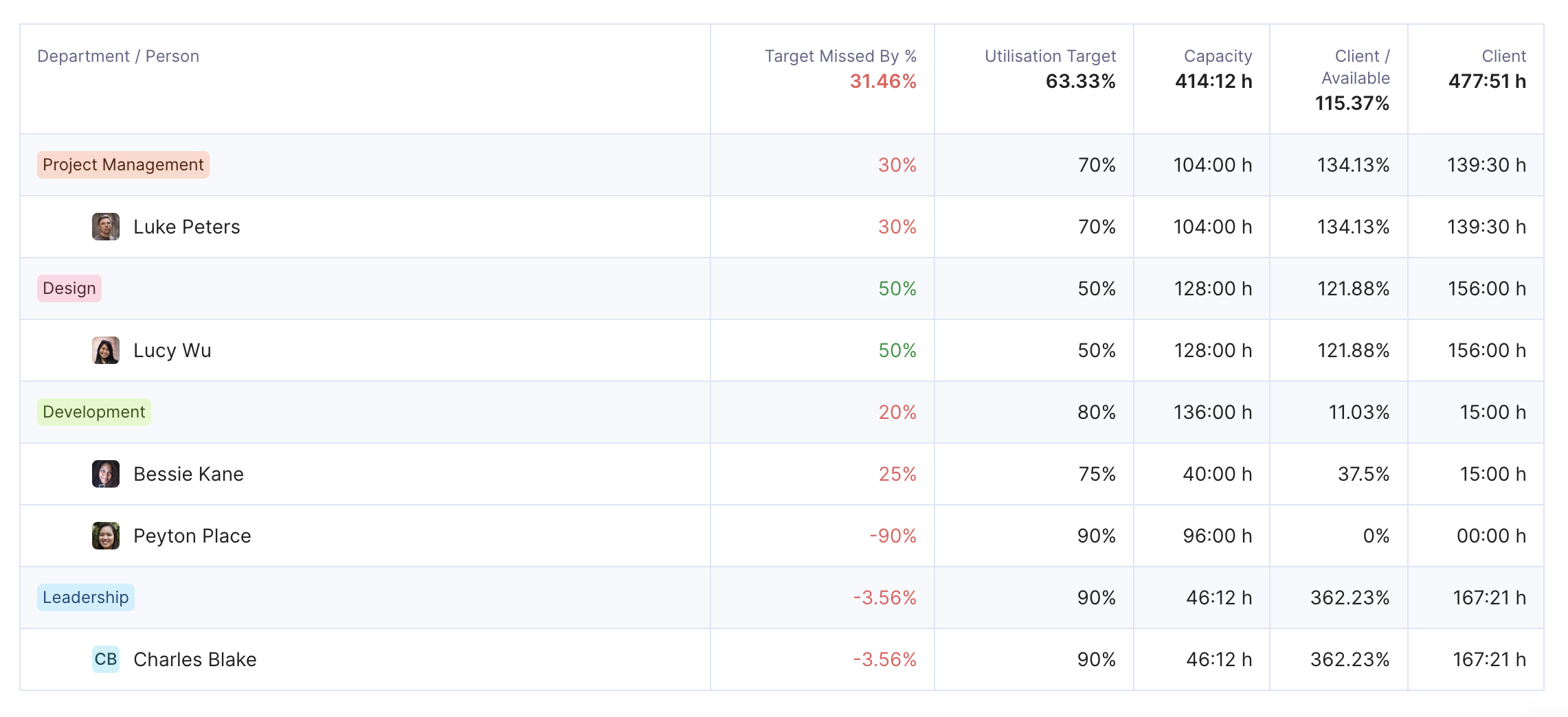
Utilization Target Realization: Built on top of our utilization report, we look into specific team and individual targets and how the reality compares to it.
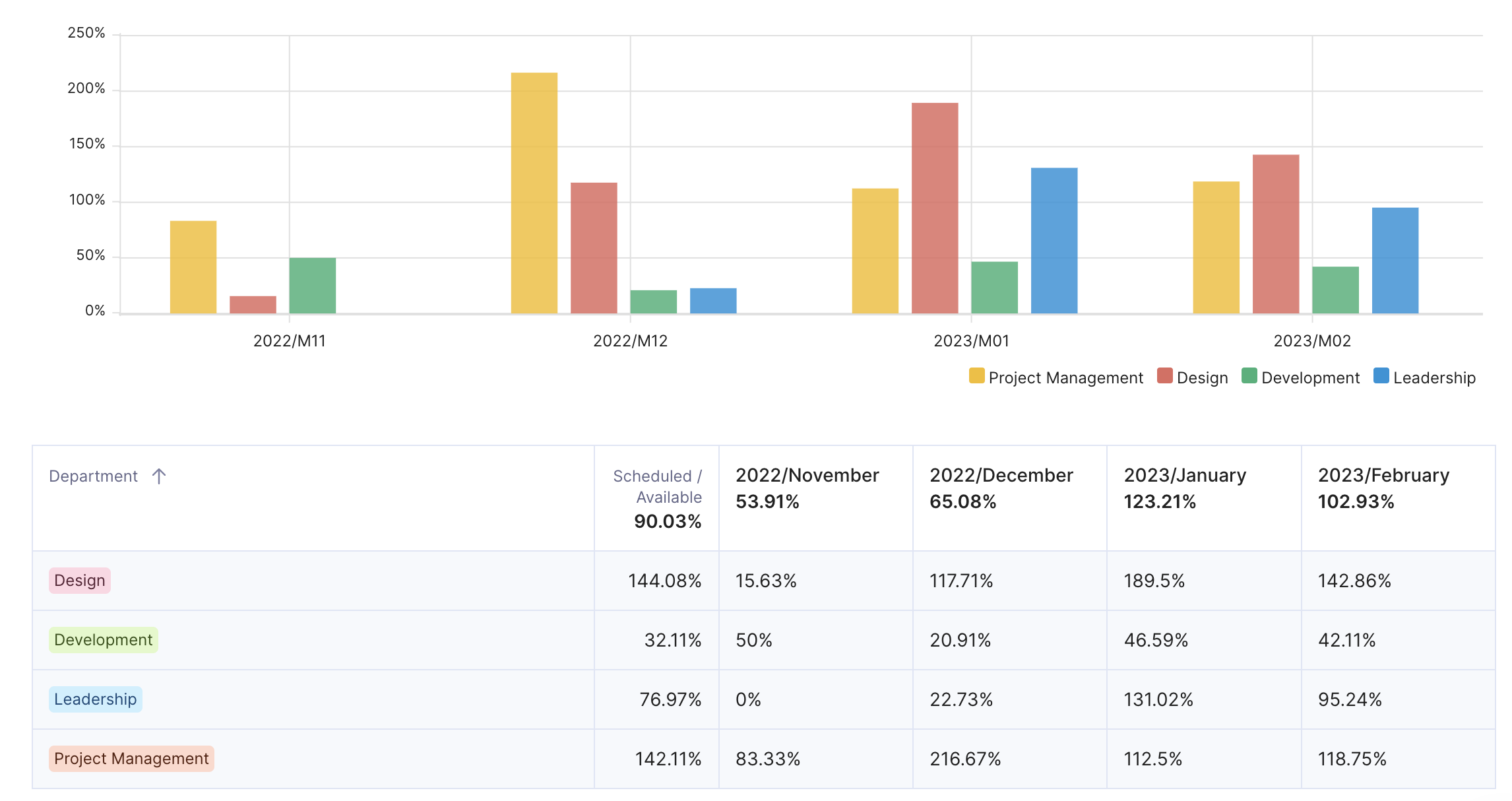
Forecast of Production Capacity: We look into the Scheduled / Available ratio for the upcoming months/quarters, also on the team level. This serves as an indicator of future availability, which is really important while shaping hiring decisions.
What about hiring—can it tell you if you should add new teammates?
Luka: The report I’ve mentioned before, Forecast of Production Capacity, which shows us the Scheduled/Available ratio in the future months, is actually very important for us for making hiring decisions. This way we can see whether we’re over or under capacitated at a certain period of time. We usually look at this for the time period of 7-30 days for our day-to-day activities, but we use the 90-and-more-day forecast to decide whether we need to hire more people in some teams.
One simple example would be: We have team X, whose Scheduled/Available ratio is 110% when looking into the upcoming quarter. This means that we’ll need an extra 10% of our current capacity to be able to do the work we have scheduled. Then we translate those percentages into the numbers of full time employees we actually need and signal this to HR so that they can start with the hiring process.
In reality, it’s a bit more complex because there are some other factors we tend to include, but this would be the essence of it.
Related: The Best ERP for Professional Services
The discussion about the recession is ramping up. How are you preparing for it? What is the data every operations person should be tracking carefully to be ready if everything goes haywire?
Luka: Well, the earlier mentioned data on forecasting production capacity is one of the most important things, I’d say. Hiring decisions are of extreme importance in such scenarios. You definitely don’t want to over-extend and over-hire in such periods, so I advocate for a more conservative approach, especially if we’re anticipating some negative scenarios. The art of running business is finding a balance between the supply and demand. In such volatile times, I believe planning should work especially close with the Sales and HR department to be able to find that sweet spot.
Planning and Operations are usually more focused on so-called lagging metrics, those that assess the current state of the business. Leading indicators, on the other hand, predict future conditions and at uncertain times we need to combine both in a meaningful way to be able to shape our decisions.
Achieve Your Agency’s True Potential
Switch from multiple tools and spreadsheets to one scalable agency management system.
More stories

Born Social Grew Over 25% In Under a Year Using Productive

Born Social is a global, full-service social media agency of 120 people who serve the needs of clients such as Guinness, Uber, and Nando’s. They operate and deliver content globally, with teams in the UK, France, Spain, Portugal, and Germany. We spoke with Born Social’s Managing Director, Kate Higham to hear about the benefits they’ve experienced since having switched to Productive.
Can you tell us about your role at Born Social?
I’m a Managing Director. I describe my role in two parts, part finance and operations, how we’re running the business as smoothly and effectively as we can, and part people and culture, so how we’re evolving our culture to meet the growth of the agency.
Achieve Your Agency’s True Potential
Switch from multiple tools and spreadsheets to one scalable agency management system.
We Help Your Agency Reach New Heights
Switch from multiple tools and spreadsheets to one scalable agency management system.
Let’s head straight into the learning curve you had with Productive. What has the UX been like?
I’ve only got positive things to say about Productive. It has really changed how we do things at Born Social. We timed the launch of Productive with the hiring of our first Resource Manager, so it was timed really well with us going through a change management process of centralizing our resource function. To have a fresh slate and a new tool to do that with was a really great opportunity.
When we were on the hunt for a new tool, one of the most important things for us was the user experience. You can’t underestimate finding a tool that feels like your company. Productive was exactly that for us. Onboarding and getting the team engaged in it has been super simple and smooth because of how intuitive the platform is. And, yeah, one of the things I love the most is that it looks and feels like Born Social.
How about customer success? What has your experience with Productive’s support been like?
I can’t speak more highly of the customer success and service team at Productive. We have moved from a tool where getting help and support was clunky—it was through a ticket system that could sometimes take days or weeks at times for requests. Having the internal chat function at Productive, along with the 3-month dedicated Slack Support for onboarding has been a real game changer.
In my role as a Managing Director, I can often be the funnel for requests, but thanks to the features at Productive I don’t need to be. Everyone can get their own help & support when they need it. That saves me time to spend on bigger things across the business. So, Productive’s customer success through those tools and that intuitive UX has been just an amazing time-save for us as a business.
“Even during month 1, the reporting we were getting out of there—we felt like the data integrity was right.”
When did you start seeing you were using the tool to the fullest?
We’ve been using Productive for around 8 months. If we look at the Scheduling, Budgeting, Time tracking, and Reporting—even during month 1, the reporting we were getting out of there—we felt like the data integrity was right. We were understanding how our time was being used better than we ever had before. We’ve had a big improvement in time tracking accuracy, particularly throughout the last quarter.
As an agency, what kind of reports do you focus most on?
Out of the key business metrics we’re tracking, I’m focused on 3-4 that are the most important to us. I immediately built a series of custom reports based on these key metrics, and it’s been so powerful to get such a clear picture of how we’re managing our time Recovery is perhaps our most important one. Recovery for us is like utilization but of just billable time.
Thanks to Productive’s Scheduling feature, and having our first dedicated Resource Manager, I would say we’ve been about a 10% growth in recovery so far. So you can really see the impact of better management of time in our commercials.
Next is our tracked vs. scoped time. So, of the time we sold, how much have we tracked? This is the metric that continues to grow in accuracy. With diving into that and really being able to see on an account-by-account level which roles are over-burning, or where we haven’t sold enough time—we’re getting all that clarity through the reports now.
We also look at account contribution. For us, that’s the profitability of accounts. That’s really helped us see which clients are bringing in a good margin and how we can make operational changes to improve that.
“Productive has played a key role in how we plan resourcing and hiring—really fueling that growth for us. Our headcount has grown 27% so far in 2022, and it feels like we’re on track to hit 30% growth by the end of the year.”
Since you started using the tool, you’ve grown from around 60 to over 100 people. Would you say that Productive was in any way beneficial for your growth?
Yes. It felt like for the first time we could see more clearly where we’ve got time available to sell, so that helped us use all of the time we had. Through the pipeline feature and Placeholder scheduling, we’ve got a clearer 90-day forecast.
All in all Productive has played a key role in how we plan resourcing and hiring—really fueling that growth for us. Our headcount has grown 27% so far in 2022, and it feels like we’re on track to hit 30% growth by the end of the year.
To wrap up, what would you say is the main benefit Productive brings you?
If I had to describe the one thing that Productive does for us it’s decision-making. Not just in my role, but across our finance and operations team. We are in and out of the platform on a daily basis, using the data and the reporting to help us make key commercial decisions about how we’re running the business, running our accounts, how we’re hiring and managing resources. It really is the tool for helping us make decisions.
Achieve Your Agency’s True Potential
Switch from multiple tools and spreadsheets to one scalable agency management system.
More stories
Productive Serves Makerstreet as a Single Source of Truth

Makerstreet is an Amsterdam-based collective of agencies with over 300 employees in four offices in the Netherlands and one in Spain. Makerstreet brings brands to life through design, digital products and services. We spoke with Fréderique van der Wijk, Operations Director at Makerstreet Marketing & Innovation and Makerstreet Partner Maike Vilé to learn how Productive facilitated their day-to-day work and growth.
See also: 11 Top Project Management Software for Designers in 2023
Can you tell us a bit about your roles within Makerstreet?
Fréderique: I’m responsible for the operations part in the marketing and innovation part within Makerstreet, and there are several units amongst that. I’m responsible for the planning and financial part.
Maike: I’m one of the managing partners at Makerstreet. I focus on internal operations in the fields of project management, HR, and finance. I’ve been here for about 10 years, so I’ve watched the agency grow from the small company that it was in around—well, I believe it was 12 years ago—really, a room in an attic, to what we are now.
We Help Your Agency Reach New Heights
Switch from multiple tools and spreadsheets to one scalable agency management system.
What impressed you or caught your interest when you first saw a demo of Productive?
Fréderique: Productive was more elaborate than the other tools we used, and for the whole Makerstreet collective, it was really important that we use one and the same tool for all our companies because now we are now working on more projects together. From the beginning, it was very user-friendly for us and I noticed team members liked using it, and management liked using it.
At first, people don’t like change, but then when you say “Just try!” Everyone was quiet and they said it was really easy, and now they find it really nice to work with.

How would you describe your operations and resource planning workflow now?
Maike: What’s nice about Productive is now we use scheduling as an actual data resource to create our financial forecasts. So the actual data in scheduling is the source for our financial forecasting now. So no more manual work, which is really nice and it gives everybody an extra push to make sure that their scheduling is accurate because it’s the basis of the financial forecast. So, if you want an accurate financial forecast, if you want that—you should have accurate scheduling. We’re really happy with that.
“With growth comes a bigger need for one source of truth, and that’s what it gives us, and that’s really important.”
What would you say are the top business benefits agencies can experience when using Productive?
Fréderique: I think the greatest benefit is that we have it all in one tool, in one—all together. Before Productive and before we used the other tool, we were like 15 people and an Excel might do the trick. Not to the best, but it did it. You know you have a lot in your head, so it worked… But, because we grow, that’s the main reason why we need it, and why it’s so helpful.
Maike: What’s really nice about it is it enables us to work easily together across the whole company, but it still gives us the opportunity to treat the different departments as separate businesses, which they still are.
With growth comes a bigger need for one source of truth, and that’s what it gives us, and that’s really important.
Achieve Your Agency’s True Potential
Switch from multiple tools and spreadsheets to one scalable agency management system.

