People Management Guide – Skills, Mistakes, and Best Practices

People management is the discipline of turning business goals into coordinated team action by supporting employees to perform at their best. Without a proper framework, it can get really messy, really fast.
To put all the basics in one place, this guide includes what people management is, why it matters, and which skills make it work. We will cover the most common mistakes, the best practices that keep teams steady, and how software supports professional services.
Key Takeaways
- People management directs and supports employees to achieve business goals: it determines the success of your business and protects stability.
- Understanding capacity and utilization improves decision-making: when you clearly see who is available and how time is spent, you protect your team from overload and prevent avoidable delays.
- Unclear communication and inconsistent leadership are a recipe for disaster: maintain consistent feedback and build trust to avoid larger challenges amongst teams.
- Software makes people management measurable and visible: by connecting resource allocation, leave, and financial impact in one system, teams can make informed staffing decisions that protect both delivery and margin.
What Is People Management?
People management is the strategic process of recruiting, training, motivating, and directing employees to achieve organizational goals while fostering a positive and productive work environment.
In practice, people management is about transforming business goals into coordinated action. A strong people manager goes beyond handing out tasks; they create clarity, maintain focus, and guide employees so that work progresses smoothly and without confusion.
Managing people day-to-day includes:
- Setting clear expectations about outcomes and timelines
- Allocating work based on skills and availability
- Giving direct, helpful feedback
- Supporting professional growth and development
- Making steady leadership decisions under pressure
In professional services, this shows up in very real ways. It means knowing which team member is available at which time, balancing billable and non-billable time, approving leave without disrupting delivery, and making sure employees focus on work that protects margin.
People management is not the same as human resource management. Payroll, contracts, and compliance sit under HR. People management lives in daily execution, where leadership decisions shape team performance.
Now let’s look at why this matters in real delivery work.
Why Is People Management Important?
People management is important because people determine success, career growth drives performance, flexibility expands your talent pool, legal requirements shape management decisions, sustainment protects stability, and the right staffing mix protects delivery (PMI).
We will explore each of these factors in a bit more detail below.
People Determine Success
Your strategy is only as strong as your team’s ability to execute it. Effective people management:
- builds alignment
- sharpens focus
- elevates performance
Clear direction is especially important to reduce uncertainty within times of tight deadlines or shifting client priorities. Without it, confusion increases, delivery slows, and frustration grows.
Career Growth Drives Performance
Employees stay where they see growth. When leadership invests in development and clear performance management, people are more likely to reach their full potential and contribute consistently over the long term.
Flexibility Expands Your Talent Pool
Flexible policies help attract a broader range of talent. In professional services, flexibility is often the key to competing for top candidates in a tight market. However, to be effective, flexibility must be balanced with carefuly, ensuring that workload, communication, and expectations remain clear across the team.
Legal Requirements Shape Management Decisions
Employment laws, contracts, and compliance obligations directly affect managers’ decisions. Ignoring them creates a risk that no amount of leadership skill can undo.
Sustainment Protects Stability
High staff morale and healthy staff retention rates do not happen by accident. When leaders ignore early warning signs, you often see a rising annual staff turnover rate and a quiet source of frustration across the team.
The Right Staffing Mix Protects Delivery
Every organization runs on a combination of skills, seniority, and availability. Good management means knowing which people you have, which skills you lack, and how your staffing decisions affect delivery. If you assign work based on guesswork, you create bottlenecks that hurt timelines and profitability.
With the importance of people management clear, let’s explore the specific skills that bring it to life day to day.
What Skills Are Needed for Effective People Management?
The skills needed for people management are organization, delegation, communication, conflict management, trust building, and decision-making.
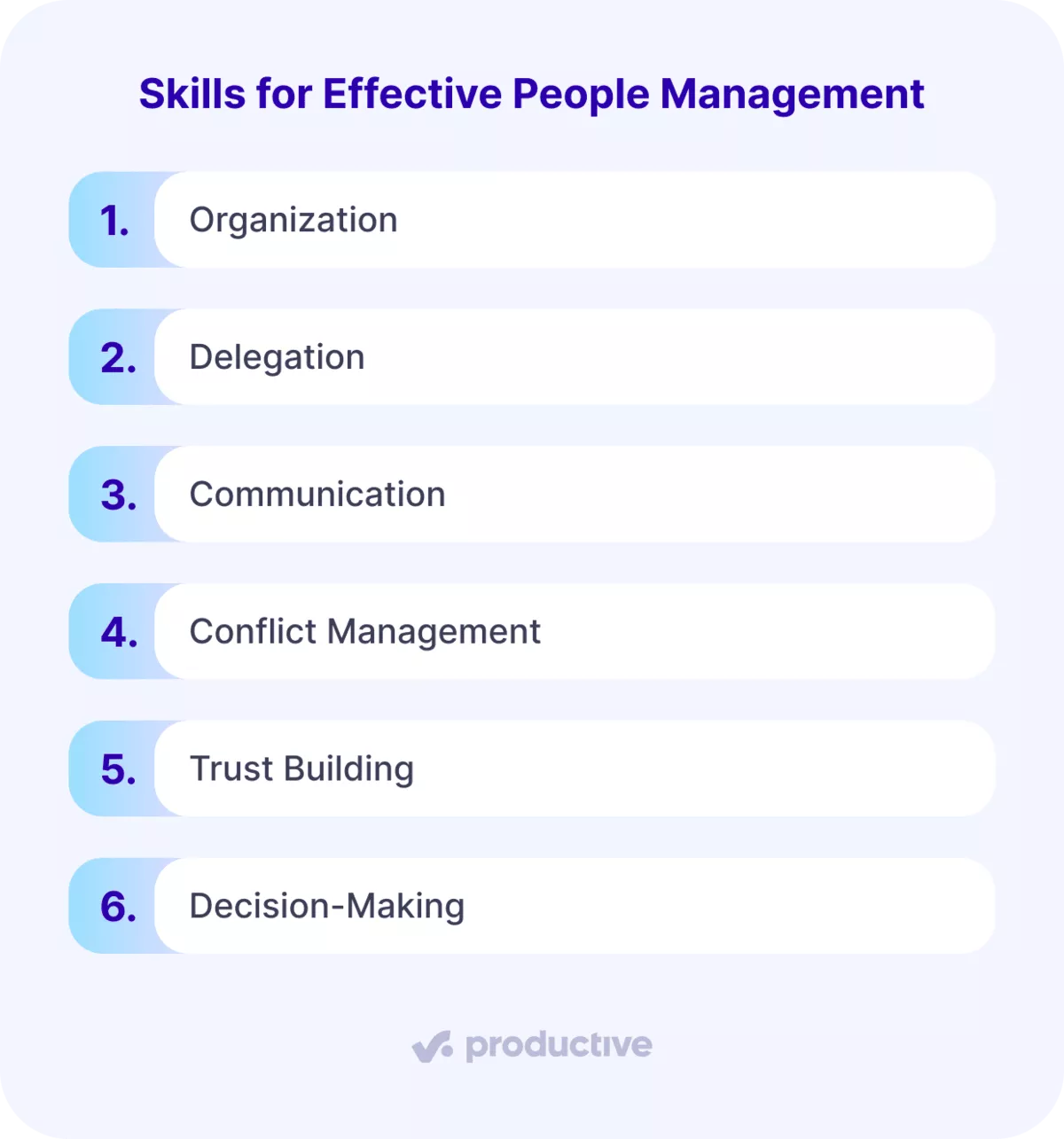
We will look at each skill in more depth below.
Organization
Organization means knowing who is working on what, who is available, and where capacity is tight. Over a period of time, poor organization quietly damages staff morale. When employees are double-booked or unclear about priorities, frustration builds.
This is where tools start to matter. In Productive, you can book people in the Resource Planner by entering specific hours per day, using a percentage of availability, or assigning total hours without a daily breakdown.
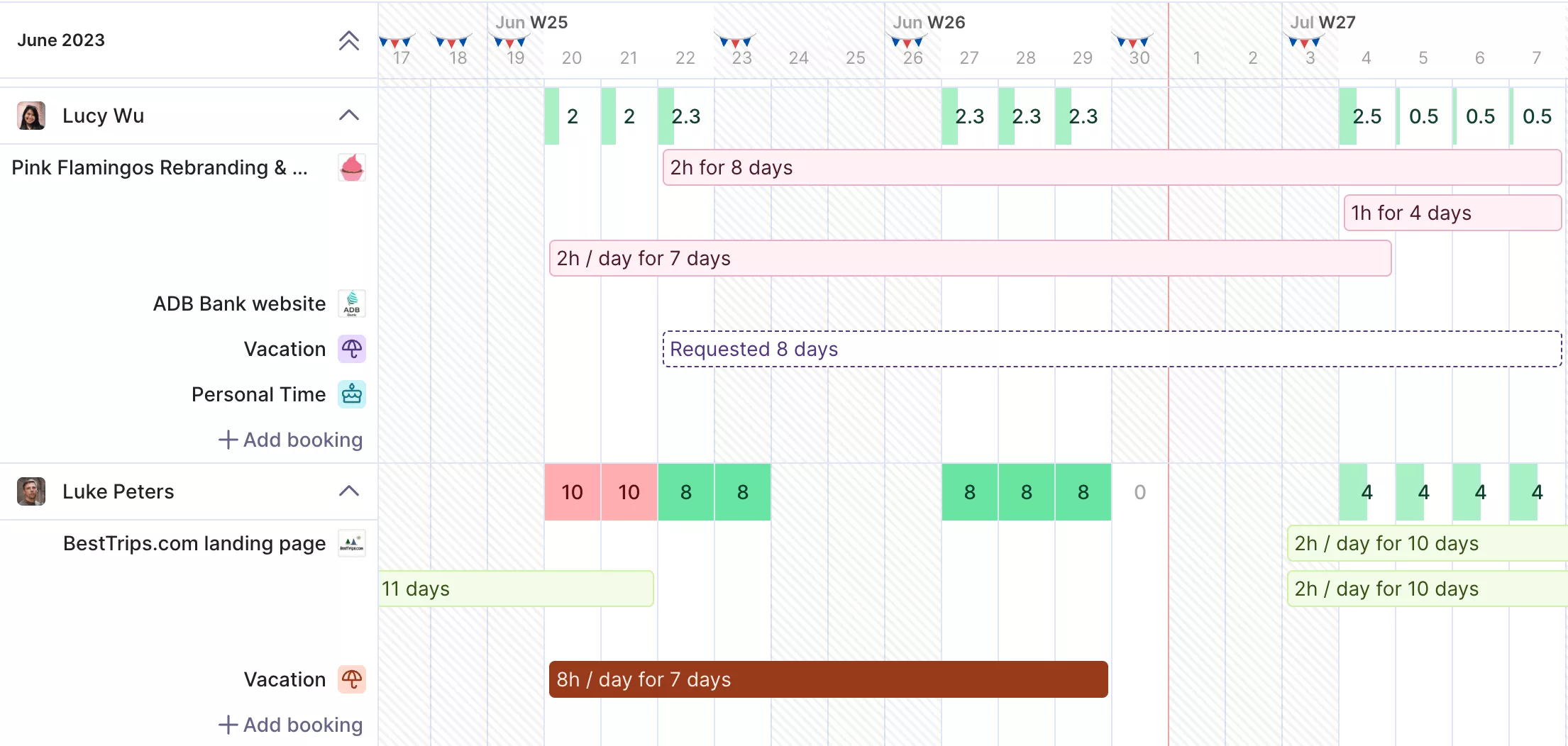
USE PRODUCTIVE TO KEEP TRACK OF YOUR RESOURCES.
Manage your people in Productive
Because time off is included in the same view, you cannot allocate people who are already unavailable.
Delegation
Delegation means assigning work with clarity and authority, not just passing along tasks. Strong people management skills require knowing who should own what and why.
When employees understand their responsibilities and have room to act, employee engagement rises. Clear delegation helps people reach their maximum potential and maintain a positive attitude toward their work.
Communication
Have you ever thought, “Why didn’t they do it the way I imagined?” That moment usually points back to unclear workplace communication. When expectations live only in your head, employees fill in the gaps themselves.
Strong communication skills show up in small moments. You give helpful feedback rather than vague criticism, and you protect the employee relationship before friction spreads across the team.
Conflict Management
Conflict management means addressing tension directly and constructively.
A missed deadline or an unclear brief can quickly create bad feelings. In those moments, strong leaders pause, take a deep breath, keep a level head under pressure, and reassess the situation before setting clear priorities and moving forward.
Strong leadership addresses the difficult situation early, uses simple root cause analysis to understand what happened, and resets expectations before problems escalate.
Trust Building
A Gartner survey cited by Harvard Business Review found that only 38% were satisfied with the quality of their manager, and that just over half reported trusting their manager. That gap says a lot about how fragile trust can be in the workplace.
Trust means believing you can rely on someone’s ability, support, or judgment when it matters most. Teams should trust that their leader supports them and believes in their work. Leaders should trust that their team can complete tasks correctly and on time.
Decision-Making
Ever approved a decision quickly, only to realize later it created more problems than it solved? Decision-making is a core leadership soft skill. Managers constantly weigh tradeoffs between speed, quality, cost, and team capacity.
Sometimes, technical skills guide the answer. Other times, context and timing matter more. Clear decisions reduce confusion and help the team move forward with confidence.
Strong people management skills turn principles into daily habits. Next, let’s look at how you can deliberately develop these skills over time.
How Can Managers Develop People Management Skills?
Managers develop people management skills by maintaining a continuous learning mindset, finding a mentor, and understanding their team’s capacity and utilization.
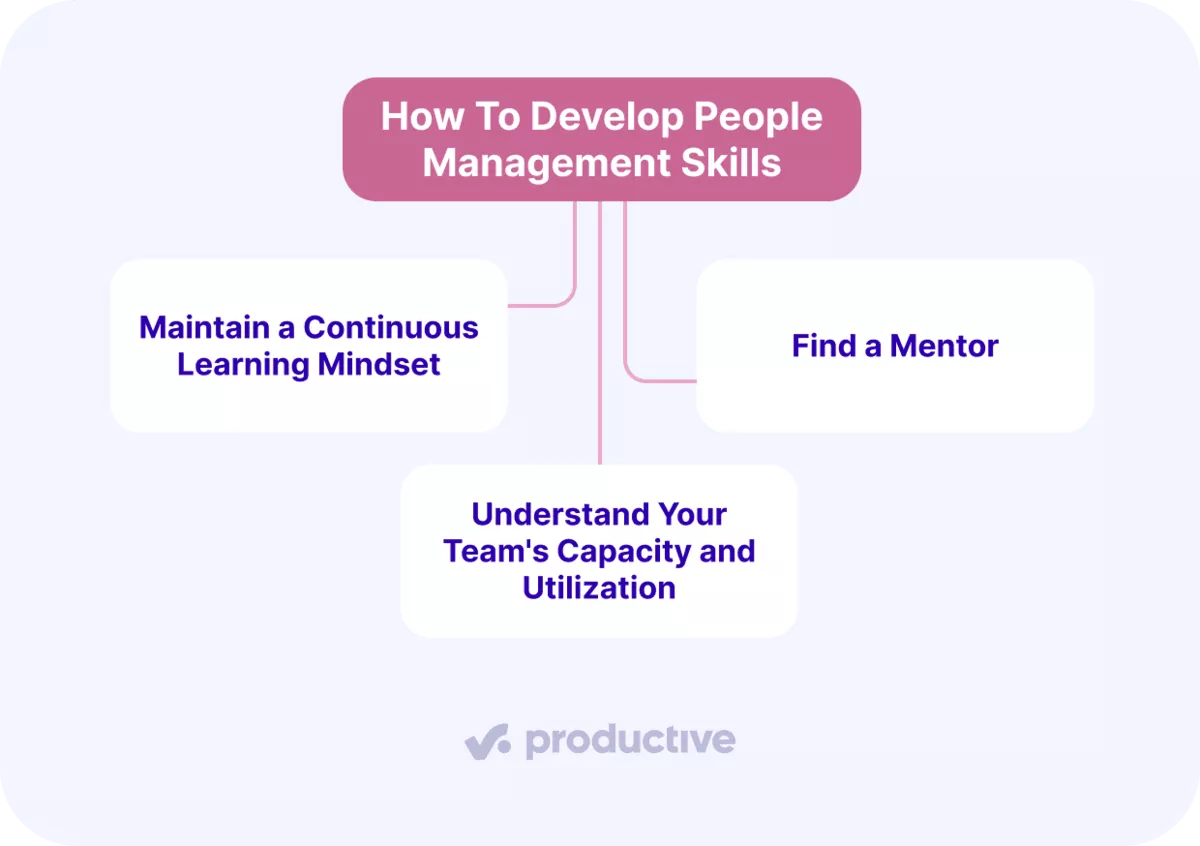
We will explore each of these in more detail below.
Maintaining a Continuous Learning Mindset
Strong skills are built through ongoing professional development. Take time to reflect after challenging conversations, observe patterns in your decisions, and make intentional adjustments.
A learning mindset transforms mistakes into real growth. Over time, this approach leads to stronger communication skills and steadier leadership.
Finding a Mentor
A mentor accelerates career development because you learn from someone who has already handled a broad range of situations.
You can learn:
- How to balance people and performance
- How they structure tough conversations
- How they think through tradeoffs
One focused conversation can save months of trial and error and expose you to a broader range of perspectives.
Understanding Their Team’s Capacity and Utilization
One of the most practical ways to become a better people manager is to understand your team’s capacity and utilization in real terms.
If you do not know who is overloaded, who has room, and how much time is spent on billable versus non-billable work, you are managing on instinct rather than evidence.
To get started, use this capacity planning template.
Free Capacity Planning Template
Download our template to schedule time for billable vs non-billable tasks, track workloads, and get insights into utilization with preset formulas.

To use the template, you can:
- Enter how many hours each person can work for each day of the week in the Daily capacity column.
- Split each person’s scheduled work for that day into billable and non-billable hours.
Once you fill this out for each person for the month, you can review useful metrics such as total capacity, billable utilization, and team utilization.
Next, let’s look at the most common people management mistakes.
What Are the Most Common Mistakes While Managing Employees?
The most common mistakes while managing employees include reactive management, inconsistent leadership, poor leave planning, and avoiding difficult conversations.
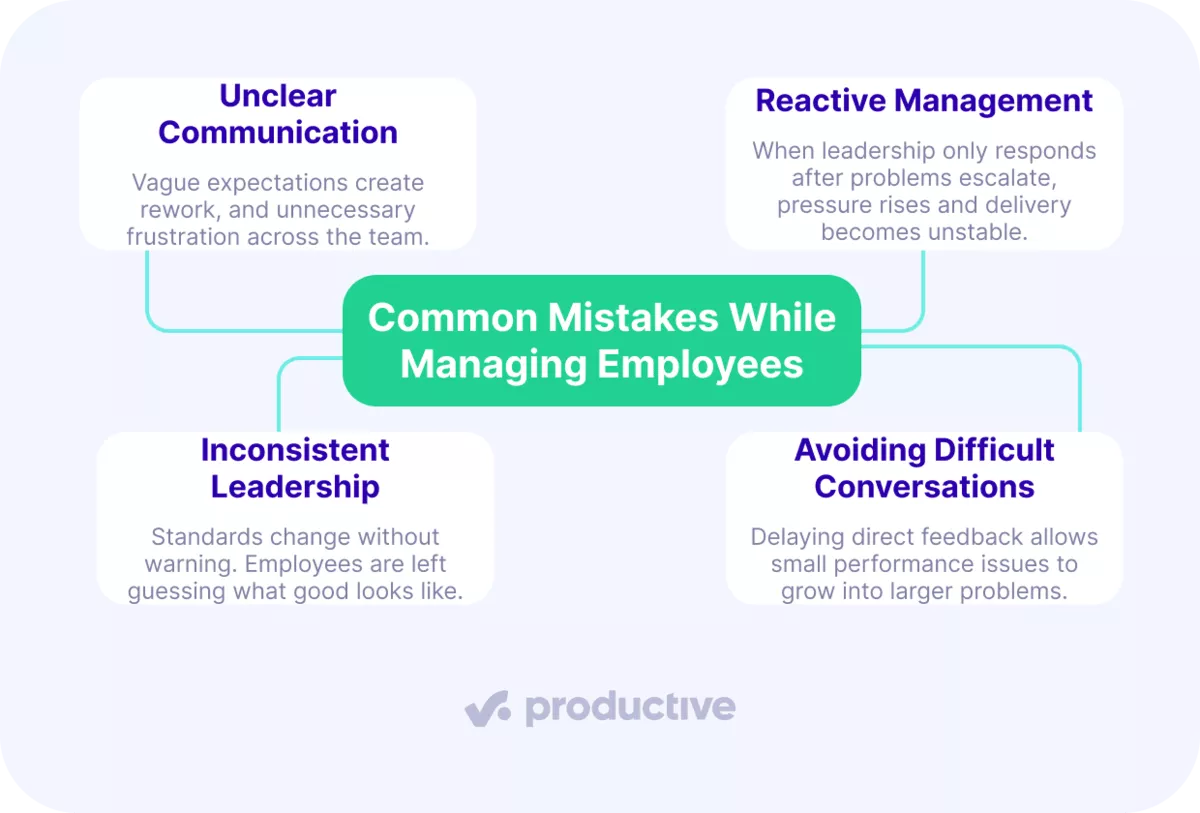
We will briefly walk through each one so you can see how they show up in real management situations:
- Reactive management. Leadership only steps in once work is already off track. Priorities shift midstream. Pressure rises. Over time, routine responsibilities start to feel like dreaded tasks because expectations keep changing.
- Inconsistent leadership. Standards depend on the week or the person. Feedback is clear with one employee and vague with another. Employees struggle to understand what good looks like, and credibility suffers.
- Poor leave management. Time off gets approved without reviewing workload or project timelines. Suddenly, key employees are unavailable during critical phases, and the rest of the team absorbs the pressure. Small scheduling decisions quietly turn into delivery risk.
- Avoiding difficult conversations. A performance issue lingers because leaders avoid direct feedback. Other employees absorb the impact. What could have been a quick correction becomes a source of frustration.
Now, let’s shift from common mistakes to practical best practices and tips for managing employees more effectively.
What Are the Best Practices for Managing People?
The best practices for managing people are using utilization as a management signal, holding structured, consistent check-ins, and reinforcing positive performance.
We will look at each best practice in more detail below:
Using Utilization as a Signal
Utilization is not just an operational metric. It shows whether delegation is balanced and whether workload is sustainable across the team.
With tools like Productive, managers can visualize utilization and forecast upcoming work.
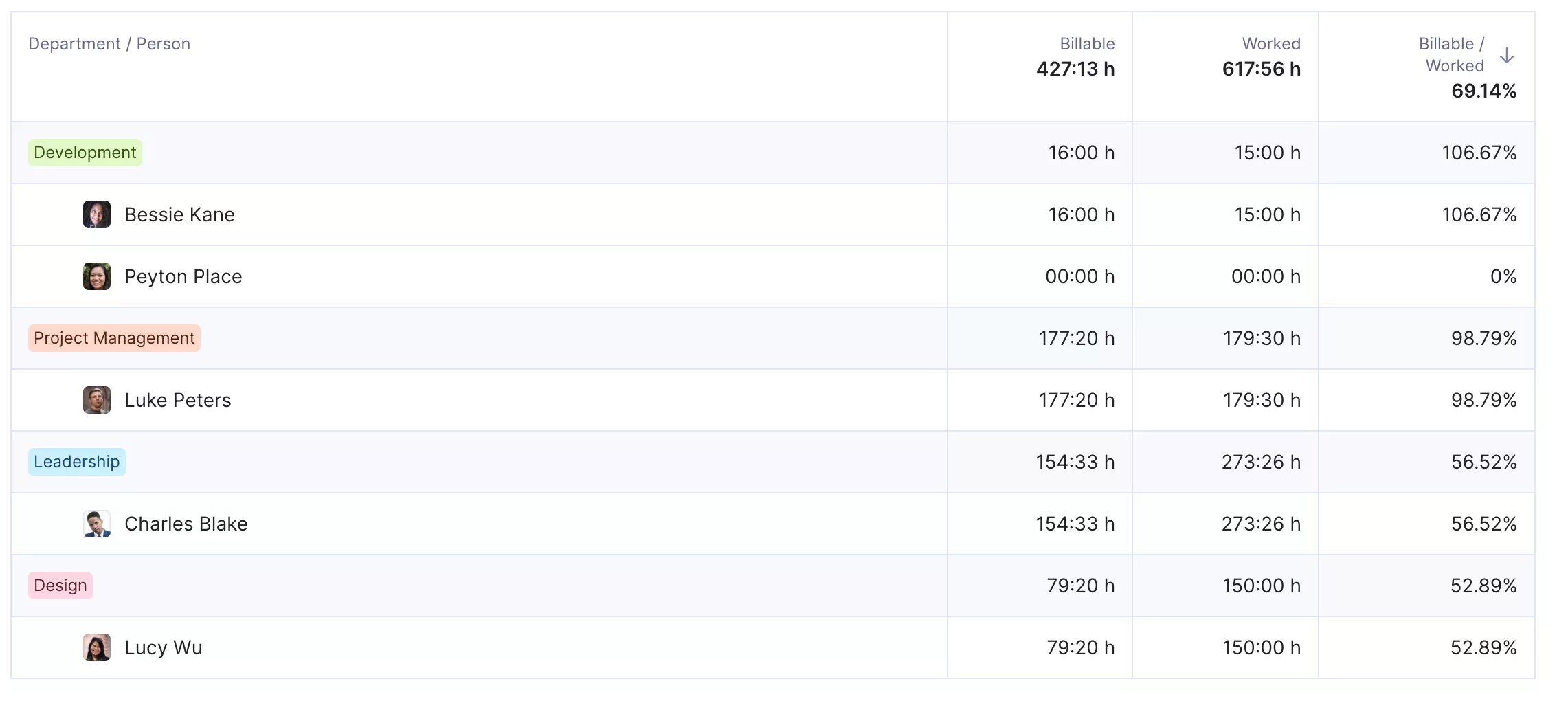
TRACK YOUR TEAMS’ BILLABLE UTILIZATION WITH PRODUCTIVE.
You can set specific utilization targets for each employee. By adding these targets to reports, people managers can track performance against goals, turning assumptions into evidence-based insights.
Holding Structured and Consistent Check-Ins
Strong leadership is consistent and reliable. By scheduling regular one-on-ones and team reviews, leaders surface issues early and strengthen team alignment.
These conversations should go beyond status updates; they are opportunities for clarity, feedback, and course correction. Rather than relying solely on annual performance cycles, effective managers treat feedback as an ongoing process.
Use check-ins to ask practical, open questions such as:
- What is currently slowing you down?
- Where do you need more clarity or support?
- Is your workload sustainable right now?
- What should I start, stop, or continue doing as your manager?
A focused 30-minute check-in often prevents a wider-scale problem later. It also shows the team that leadership pays consistent, outstanding attention, not only when something goes wrong.
Reinforcing Positive Performance
Everyone values having their work recognized.
Reinforcing positive performance isn’t about applause; it’s about making standards visible. When leadership highlights the quality of individual effort or soft skills that advance a project, the entire team gains clarity on the standards to follow.
Many teams use simple recognition tools to make wins visible across the organization. The aim isn’t automation for its own sake, but building consistency in how strong performance is acknowledged.
Now let’s look at how software can support this in practice.
How Can Software Support People Managers?
Software can support people managers by linking resource decisions to financial outcomes, managing leave proactively, and creating full visibility across projects.
Let’s take a closer look at each area:
Linking Resource Decisions to Financial Outcomes
Every allocation decision affects margin. When you assign a senior employee to low-margin work or overload your strongest contributor, you change profitability, not just workload.
Software closes that gap between resource planning and finance. In Productive, when you schedule people, the system immediately shows how those decisions affect budgeting and financial projections.
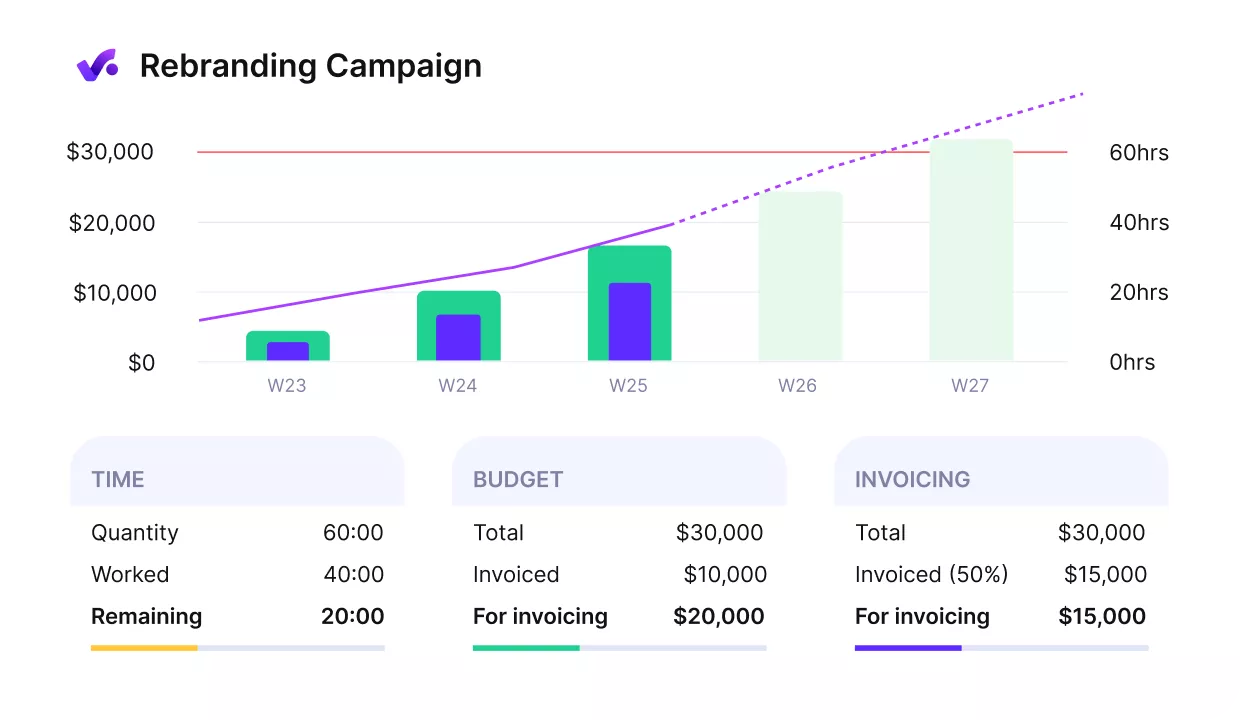
VIEW HOW RESOURCING AFFECTS YOUR BUDGET WITH PRODUCTIVE.
You see real-time revenue, profitability, and budget burn across upcoming weeks and months. If a project trends toward a lower margin, you can reassign the team and instantly see the financial impact.
That visibility helps people management decisions protect both delivery and profit, turning structured management into a strong asset for the business.

With Productive, our resourcing process is so efficient that what used to require a full-time role in spreadsheets is now streamlined, allowing our team to focus on higher-impact work.
See the complete customer story to understand how Productive supports professional services teams.
Managing Leave Proactively
Strong people managers treat leave as a capacity decision, not just an HR management task, because it directly impacts delivery.
For example, if a senior consultant requests leave during a key client launch, approving it without checking workload can delay milestones or overload other team members.
With software that links availability and workload, you see the impact of time off before approving it. If employees are already at capacity, granting more leave during a busy period shows what will shift, what might be delayed, and who will absorb the extra work.
Creating Full Visibility Across Projects
Fragmented tools create blind spots. When workload lives in one system, finance in another, and time off in a spreadsheet, people management becomes reactive.
Software solves that fragmentation by bringing projects, employees, capacity, and performance controls into a single, connected view. When recognition software is integrated into the same system, performance signals are not lost in chat threads or scattered documents. Instead of guessing, leadership can quickly see:
- Who is overloaded and who has available capacity
- Which projects are drifting off track
- Where priorities conflict across the team
- How workload decisions affect performance
That full visibility supports more stable decision-making and reduces unnecessary reshuffling across the team.
If you would like to explore tools in this space, you can read our full list of resource management software and compare different options.
Final Thoughts
People management means balancing capacity, protecting timelines, and ensuring the right people are assigned to the right work at the right time. When those decisions are made with clarity, projects stay on track and margins remain healthy.
Software supports that clarity. By connecting allocation, availability, and financial impact in one place, tools like Productive help professional services teams make informed staffing decisions and protect both delivery and profitability.
If you want a structured way to manage people at scale, book a demo with Productive to see how it works in practice.
Manage Your Team With Full Visibility
Plan capacity, account for time off, balance utilization, and protect profitability in one place. Productive connects people management with delivery and financial performance, so decisions are based on real data.
