How Contra Agency Makes the Most of Productive’s API

Contra is a leading London-based agency with over 20 years of experience in all things digital. Since April 2020, Contra Agency has been managing all its design and development of digital content, websites, and web apps in Productive.
After less than half a year that Contra’s been using our platform, we spoke with co-founders Roberto Ciarleglio and Ben Edge to see how they switched to working remotely and made the most of Productive’s API.
Tell us a bit about Contra. What markets do you operate in, who are your clients?
Our work is split into two main categories: we help our clients with their marketing and we help digitally transform them with websites and web apps. We work mainly in B2B. Some of our clients are big finance companies, quite a lot are in the tech space, and we also work with some top universities—like Oxford and Cambridge in the UK.
You switched to Productive recently, right?
We started the process about nine months ago. We found Productive, signed up for a free trial, had a few demo calls. To give you some background, when we started our agency 20 years ago, we didn’t have any agency management tool at all. I don’t think that even existed back then! Soon, we realized that we need to be organized.
The first thing we started out with was Sharepoint. That served us for a few years, but we lost money realizing that we didn’t invoice certain projects. Then, about 15 years ago, we started the hunt for a system.
The first one was Traffic, which was a disaster. The basics were wrong, and it would calculate incorrectly. Then we switched to Streamtime. Those two tools just didn’t do enough. Alongside those, we’d use BaseCamp, Trello, and various other tools. Streamtime did invoicing, but wasn’t suitable for project planning and clients to use.
Part of our journey was to find a system that could do everything that we needed it to do. We’ve looked at so many of these systems and done so many trials that we knew what a lot of our questions were.
Achieve Your Agency’s True Potential
Switch from multiple tools and spreadsheets to one scalable agency management system.
We Help Your Agency Reach New Heights
Switch from multiple tools and spreadsheets to one scalable agency management system.
So the number one thing you were looking for was to have an all-in-one tool?
I guess either a tool that could do everything or a tool that we could integrate well so that collectively, it could do everything without us losing things. Your system is good because it does a lot, but also the API is great so we were able to integrate it with our other tools. For example, it doesn’t have a messaging system that can compete with Slack, but we can integrate it with Slack.
I think the other thing that we really like is that all our staff is really happy with the switch. The user interface is fast and smooth, it’s a very single-page application—and it works really well. You’ve hit this balance where it’s powerful, but it’s not too complicated. Our previous system was Accelo, and it was massive. You could do everything under the sun, but you had to do it in a certain way.
Related: 15 Top Accelo Alternatives & Competitors for Agencies
What’s good about Productive is that it’s powerful, but it doesn’t force you to do things in a certain way. You can be creative in the way you use it. You don’t want to fight a system, you want to work with a system.
See also: Scoro vs Accelo vs Productive: Which is Best for You?
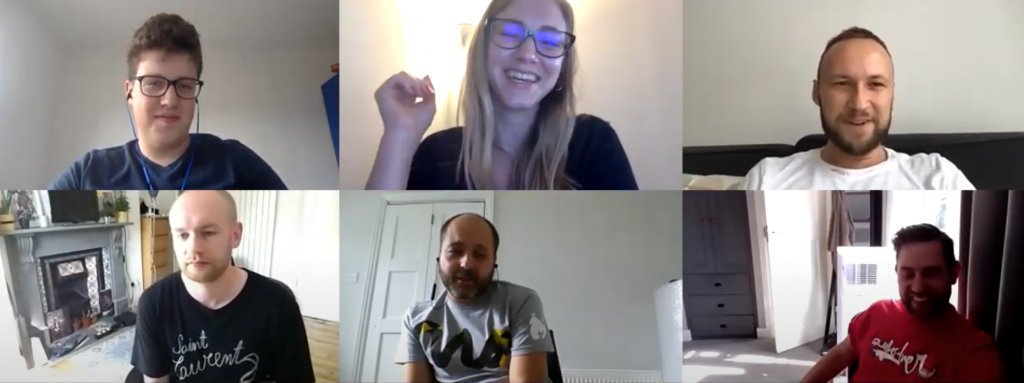
It’s important that your team adopted to it well!
Now our team can fill out timesheets really quickly. Even if it’s only a small amount that’s causing a delay. Eventually, when you have to do loads of time entries, it becomes very laborious. Whereas in Productive, you can do your timesheet very, very quickly.
And how was the transition to remote work for your team?
A lot has changed in the company since we all started working from home. We had to instantly form new habits. Combined, the team has probably been working more efficiently than it has been for a long time.
Can you let us in on how your team is using the tool? What do your daily stand-ups look like?
We have the Scheduling view up on our screen when we do our daily stand-ups and two project managers who run the meetings. We tend to not plan too far in advance, only a week or two, though we may have some rough placeholders down the line.
Placeholders are very quick and I like the way they feed into the timesheets. When we first started to look at using placeholders, we came from a background where every task in the plan was scheduled. It took us a while to realize the benefits of blocking time to work on a project.
“The reason we look at Scheduling is not so much to look too far in advance on a daily basis, it’s to look at today’s workload while having a sense of why we need to do something—because there’s something else coming up in the near future.“
So Scheduling is your main starting point each day?
We base our stand-ups around Scheduling because it gives us a sense of what the whole company is doing and you can see into the future a bit. The reason we look at Scheduling is not so much to look too far in advance on a daily basis, it’s to look at today’s workload while having a sense of why we need to do something—because there’s something else coming up in the near future.
Is there anything you particularly like about the tool?
It’s really encouraging to see that there’s a roadmap and features coming out regularly. It’s also really nice to have a dialogue with you guys, especially in the chat.
Thanks, we’re constantly working on the tool. Every week we go through around 50 customer requests to see what many people need.
We wouldn’t have wanted to take on a product that wasn’t constantly being improved. It’s really encouraging because we know that software is never finished.
“Because Productive is flexible, we were able to create some patterns for more flexible projects and other patterns for more rigid projects. This has actually helped us to be more consistent. If we need to create another project structure, we can still do that because we have the flexibility with the boards.“
Even though you’ve only been using Productive for a few months, do you think that you’ve mastered the platform? What was the learning curve like for you?
It was fairly intuitive. My biggest questions were around how we do things as an agency. I was really keen on speaking with your colleagues to ask how they’d approach certain problems. I’m prepared to change the way I think if it makes sense. I don’t really want to fight a piece of software and make it do something a certain way if it wasn’t designed for that.
In terms of the learning curve for our team, we had one screen share and nobody’s really struggled since. It’s an open book, a blank canvas in some areas. You’ve got relationships and entities, customers, projects, contacts, companies…all these things are fixed. But how you run a project is very open. You can have one board, you can have ten boards. You can have one budget, you can have 100 budgets in one project. There are so many different ways of approaching it.
To be clear, we run different projects in different ways. Some are agile, some waterfall, some linear. Because Productive is flexible, we were able to create some patterns for more flexible projects and other patterns for more rigid projects. This has actually helped us to be more consistent. If we need to create another project structure, we can still do that because we have the flexibility with the boards.
We wanted to work out how to structure certain projects and teams so that we could give our project managers a framework that would work.
Were you pleasantly surprised by a certain feature or a capability of Productive? New metrics, data, anything you didn’t expect when you bought the platform?
From a business level, now we make better decisions regarding our utilization. I’m understanding new things about profitability. I’ve made certain assumptions before, and some of those assumptions have proven to be wrong. For some projects, we weren’t sure how far over budget we were, and now we can really see.
In terms of features, I’m particularly impressed with your reports. The filtering and the options you can do with those reports is too much! The fact that you can add custom formulas, change how things are rounded, enable colors to change above a certain number… It’s pretty impressive!
“It’s difficult to create something that looks very simple, but actually has a lot of depth to it, in a way that you can customize, but it isn’t difficult to customize. That’s the sweet spot of software. I think you guys have done a really good job there.“
So the fact that you can customize data and how it’s reported is something that you’re really happy with?
It is because we know how difficult it is to do that.
I think of this a lot about Productive: when you look at it, at a glance, it seems very simple and maybe even like it doesn’t have a lot of features. But then when you start using it, you realize that there’s a lot of very good attention to detail, and that’s a really difficult balance in software.
We create software for our clients as well, and it’s difficult to create something that looks very simple, but actually has a lot of depth to it, in a way that you can customize, but it isn’t difficult to customize. That’s the sweet spot of software. I think you guys have done a really good job there.
Our customers from Texas to South Africa are saying: when switching to remote work, everything was already there, we just made sure they would really track time on a daily basis so we could plan resources better. It’s great to hear that you’re experiencing business benefits using Productive, too.
I think you need to run it like a machine, but it needs to be fun as well—otherwise, it’s like being in the army. Productive has got a good balance of being structured, flexible, and enjoyable to use.
In terms of integrations, there are a lot of things we’ve done ourselves. When we build a typical web project, we go through a number of phases. We try to do as much QA and validations upfront as we can. What we’ve been able to do with the API and the integrations we’ve written with Slack is create a whole series of board templates: all the different projects, tasks, and TODO lists. Anything that we expect to be ticked off before the next phase. A project manager can just go to Slack and create a new project for QA, and the command goes off and creates that board. We’ve become more efficient.
Let’s talk about that API client that you came up with. Was the Slackbot you mentioned the main idea behind it, or did you create any other integrations?
We did quite a few. The Quickbooks integration was the first one. The integration you’ve already got with Quickbooks is great for getting invoicing done, but there were a few gaps that we felt were a challenge for us. For example, it’s common for our staff to create an invoice and then for someone to say “Can you add in a PO number?” or “Can you change the date on it?” With the way the integration stands at the moment, you can’t re-push the invoice into Quickbooks.
Another thing is that we have 20 years’ worth of data in QuickBooks, where different service lines are linked to different incomes. To not lose that data going forward, we wrote a webhook that listens to a new update or a new invoice, reads through your service lines, checks with QuickBooks, then updates the new invoice and sorts it all out.
That was where it started. We only needed four or five endpoints on your API, so we just built them. Then, we thought it’d be really great if we had templates for reports, so we built that. After that, we thought it’d be good that support emails we receive would automatically turn into tasks. I’ve written probably a quarter of the endpoints. I just kind of saw it as a challenge and decided to write out the endpoints that we were using. So I went a bit crazy and wrote the whole thing!
A lot of our integrations are within Slack. We use a lot of Slackbots to trigger things in Productive, and we use your webhooks to trigger things as well.
It’s really nice that some companies are willing to shape Productive in a way that fits them.
Well, that’s really our brand: we call ourselves “doers who get it done”. We’ve always been people who build our own things. The thing about your API is that it gives us the power to do what we need to do and fill any gap that we need to—because it’s flexible enough.
Achieve Your Agency’s True Potential
Switch from multiple tools and spreadsheets to one scalable agency management system.
More stories


Using Productive, DotDev Has Grown 50% YoY For the Past Three Years

DotDev is a product development company with three core values: creating long-lasting relationships, reliability, and excellence in everything they do. Following these values has gained them a reputation as Australia’s leading omni-channel integration partner across platforms such as Apparel21, Retail Express, and SAP. After 24 months that DotDev has been using Productive, we chatted with Co-founder and Technical Director, Brendon Nicholas to see how their business has transformed.
You specialize in e-commerce, right? Do you have more diverse clients now after the crisis started? What does your company look like now, in 2020?
We’re a team of around 34 now. Probably 60-70% of our work is related to fashion brands, the rest is product development and larger retailers. Now there are a lot of startup-based things, like home delivery. A lot of brands are going from large, retailer models to online models. There have been a few bigger changes since we started using Productive. The biggest change from the project management side was when we got to a team of 20. We broke down into three separate teams and brought a Tech and a Delivery Lead in.
Which industries do you serve?
Our customer base has changed from the quantity of projects, we’re definitely not doing as many at a time. We moved to a lot larger budgets and a lot longer projects, and they’re a bit more technical and custom, rather than smaller, higher-volume stuff we were doing before. I’d say we manage around 7-8 larger projects at one time. Support work has definitely increased—that’s probably 40-50% of our revenue now. So when we launch projects, they go into support and optimization.
Achieve Your Agency’s True Potential
Switch from multiple tools and spreadsheets to one scalable agency management system.
We Help Your Agency Reach New Heights
Switch from multiple tools and spreadsheets to one scalable agency management system.
You said that the sizes of your projects have increased. Does that bring more risk?
It definitely brings more risk. The more technical and larger you get, the more expectations there are. We’ve gone through 12 months of rapid growth and doing more technical things. The fact is, if you have big aspirations, planning is fundamental to ensure that growth happens. High aspirations also need reliable systems and efficient processes. This is crucial to ensuring that the level of quality remains constant as the business grows.
“If you have big aspirations, then planning is fundamental to ensure that growth happens. High aspirations also need reliable systems and efficient processes. This is crucial to ensuring that the level of quality remains constant as the business grows.”
What were your operations like before? Can you name the tools you tried before Productive? What were some pain points you were going through?
To be honest, we have tried many, many different tools. I think 20 or 30 at the time. Over the last 12 months, I don’t think I’ve looked at what’s going on with other systems. I’ve been pretty happy with the way Productive is working. We went right through from things like StreamTime and bespoke platforms like that, which kind of offer a similar approach, right through to enterprise platforms. We’re content with the pace you guys are moving.
We really struggled to find a system that not only provided all the features we required but was also fast and user-friendly enough that our team could do what’s required without having to read a 30-page manual. Even simple things like releasing checklists on tasks actually have a massive impact and provide us a lot of functionality to be able to manage end-to-end. It’s features like that that have allowed us to bring in our delivery plans from external tools into one platform.
“We really struggled to find a system that not only provided all the features we required but was also fast and user-friendly enough that our team could do what’s required without having to read a 30-page manual.”
So, would you say that Productive’s roadmap and development are actually following your needs as well?
Yeah, definitely. Having that relationship with you guys, being able to get responses quickly, and knowing that it gets heard is a big benefit for us. You’re not just another customer where you request things and it gets lost in the backlog. There have been many different things we’ve recommended over the years, and we’ve seen those get released in weeks, sometimes months after. For us, that makes us feel good as a customer.

You’ve clearly tried out a lot of different tools. So what was the learning curve like for you in Productive?
I think that’s probably one of the single biggest things why I eventually came across to it. Productive acts and behaves like an enterprise tool, but it doesn’t feel like it. When we looked at some other tools, we really needed to understand the terminology and go through their manuals and training documents to really get an idea of how to go through the end-to-end flow. The way we explain it is: It’s like Trello, it’s super simple, but it has a whole lot more. It’s got multiple boards and it does end-to-end, not just the boards part.
How about your delivery team? Because they’re mostly involved with Productive, was it hard for them to learn how to use Productive—and use it in the best possible way?
I think it was pretty seamless, to be honest. Always, the first time onboarding, when we get a new delivery team, it’s a couple of hours of onboarding. We take them through so they can get familiar with the task. I think it’s got a UX they’re familiar with.
Do you have difficulty with getting people to track time? It’s important for your utilization to keep things up to date in real-time. Has that ever been a challenge for you?
We have a Delivery Lead that manages the resourcing, time approvals, and task updates—that’s definitely improved things a lot. The team understands the importance of tracking. We have a generic, company-wide delivery board, where every moment they understand what they’re doing today, what they’re going to achieve. We update it at the end of the day, going through what we completed and any issues or blockers for the next day. The only real process change we recently had to make was getting everyone to write their daily tasks, to map out what they’re doing and what they’ve done at the end of each day.

How about we touch back on the lockdown situation. In the beginning, everyone was wondering “Are we going to be able to survive this?” Have profitability reports in Productive additionally eased up the anxiety for you?
For me, it was an easy move, because I knew I had the visibility. I know I can jump in anytime and get an understanding of budgets, time, what people are doing, or what’s going on within the business. I’ve spoken to another couple of directors of agencies in Australia and some of them have really struggled to make the shift. They’re using really large, enterprise, ancient tools that just don’t have the real-time capability. The financial reporting that we can get in a couple of clicks—they’re having to get their accountants to go in and drill that data in Excel. Having that insight made it pretty easy. I’m out here in the countryside, pretty relaxed in the middle of this.
After using Productive for about a year and a half now, how has your role shifted, has it become easier? Are you focusing on more decision-making, strategic thinking? How has it changed?
My role was very heavy across the process and workflow of the business 12-18 months ago. Putting in tools like this has allowed me to implement those processes, get the team across it, then sit back and not really have to worry about things. I’m working with the team a little bit closer, upscaling, and playing a lead role across some of our solutions.
Were there things that you discovered in Productive that you didn’t expect you would benefit from at the beginning?
The benefit was finding one system that’s not overly complicated, that can do end-to-end. That was probably the single biggest thing—reducing the amount of tools, platforms, and systems, and using just one. The other benefits that came up, which were never really an area of focus, were the Reporting, the financial capabilities and understanding. Having a platform that considers everybody’s salaries, the operating expenses of the whole business, and feeding that into project budgets and looking at the internal time vs. client time, gives us a lot more real-time and accurate view of the profitability of actual, specific projects. So that was never a focus before, but it’s something I use more than anything right now.
You said profitability wasn’t really looked at before, it wasn’t the number one reason why you purchased Productive. Maybe it wasn’t as important at the time?
I guess I probably never thought I could find a tool that was end-to-end: from leads, through management, financials, insights and reporting. Having it all in one has allowed us to drop a couple of the other platforms we used.

Was this already an internal process in DotDev before—to analyze your profit margins, compare it against your rates, calculate average rates per client?
I probably take it for granted now, but no, not really (in the same sense). There was a lot of guessing before. We knew that there were hours spent and hours that were quoted, but that was about it. Definitely not down to a level of individual resources or how much time we spent on internal projects. That’s a key thing that we get out of the reports that really feeds into our utilization and resourcing. If we know we’re spending 30% of our time on internal projects, then we know we’ve got the capacity to take on more work.
“That’s a key thing that we get out of the reports that really feeds into our utilization and resourcing. If we know we’re doing 30% on the internal projects, then we know we’ve got the capacity to take on more work.”
Did you calculate utilization before? Did you use other tools?
Not really, to be honest. We definitely didn’t have the visibility to look at.
So, how did you plan hiring before?
A key thing for us around the Scheduling is to essentially place a hold on the projects that are coming in. Now, everyone is locked out for about 3-4 months. We also place a hold on all the deals and sales we have in the pipeline. Now, we can get visibility for over 3-6 months, other than just 4-8 weeks and having to guess. Before, hiring always seemed a lot more like a risk and unknown because you’re kind of guessing based on a gut feeling, which isn’t always the best when you’ve got a lot going on.
Has that eased up the chaos? Do you see more overall satisfaction from your employees?
Yeah, I think less chaotic is the feedback I get, especially when we’re trying to do a team of 20 all at once. They can see two months out what they’re going to be working on, to think or prepare. Maybe they’ve got a bit of upscaling to do, or some research they want to do based on the projects coming in. For them, that just brings on a little bit of anxiety. So, as much visibility and stability they can have, makes it all easier.
Do you have any growth numbers you can share that you think are maybe a product of the switch over to Productive, having everything more organized, all in one place?
A standard QA/UAT phase was taking us around 120-180 hours. We’ve been able to launch a really big enterprise site on the same level, and that went through a testing phase of 60-70 hours. Obviously, there’s a lot of different factors that go into that, like technology and processes, but having all that centralized has made managing those phases remarkably quicker. I think it’s the context of jumping between different tools, then jumping back to Productive where you’re managing the support—that would waste a lot of time.
Any other measurable impact that you can share?
I think you can directly relate that we’ve grown 50% YoY for the last three years. I don’t think we would have got past 12 employees if we didn’t have Productive. The ability to scale and not have to change processes because it supports any scale or size that we need.
Do you use Productive end-to-end, from pre-sales to invoicing and billing? Do you have a standardized process that you use as a template?
Being a technical company, we kind of went back and forth, toying with the idea of bringing our delivery plans out of Productive. Around 3-4 months ago, we brought everything back from Gitlab into Productive. We’re trying to manage everything end-to-end there. From the initial scoping and delivery boards, we’ve broken down tasks and estimates and everything that the developers are doing, to the QA and testing phases, where the clients are logging issues. Having everything in one place was enough benefit for us to move back to Productive. It’s simpler for clients to understand, they only have access to one thing. From the team’s point of view, they know that they need to come in and look at what they’re doing. Everything that they’re involved in is in Productive, rather than being fragmented out into different systems.
Is there any project you’re especially proud of that you’d like share?
For us, the biggest shift over the last 12 months has been moving to headless e-commerce. It’s a big shift in the way we approach things, how flexible we are, and what we can provide our clients. We launched one for the AFL store, which is quite a large retail chain here.
Do you have a favorite feature that you think is the coolest part of Productive?
Over the last six months, I’d say project checklists! I know it seems so simple, but it’s allowed us to bring delivery boards and testing all into one tool. The ability to add filters, pivot the data, charts, have raw data…that saves a lot of time. Essentially, we don’t have to have numerous Google Sheets and exports. We have different data across the platform.
Achieve Your Agency’s True Potential
Switch from multiple tools and spreadsheets to one scalable agency management system.