Resource Manager Role – What They Do, Skills, and When to Hire

The resource manager role is all about making sure the right people are working on the right things at the right time. To do that well, they need strong planning, clear communication, and practical problem-solving skills. Even so, many people still do not fully understand what the resource manager role actually does or what makes someone good at it.
This guide breaks things down clearly, explaining what a resource manager is, what they do day to day, and which skills and requirements matter. We will also cover how the role compares to project managers and HR managers, when a business should hire one, and how software helps get the job done.
Key Takeaways
- Resource managers handle capacity, allocation, utilization, and forecasting across projects: they track availability, assign people based on priority and skill, rebalance workloads, and plan so projects are staffed and deadlines are met.
- The role depends on planning, analytical thinking, communication, and problem-solving skills: these help managers make clear staffing decisions, explain trade-offs, and adjust plans when priorities or availability change.
- Businesses usually need a resource manager once staffing issues start affecting delivery: this happens when projects compete for the same people, workloads become harder to balance, and hiring becomes reactive instead of planned.
- Resource management software helps managers plan and adapt more easily: it connects planning with project work, creates a real-time view of capacity, and supports resource forecasting.
What Is a Resource Manager?
A resource manager is a professional who plans, schedules, and allocates an organization’s resources across projects to keep work moving efficiently and to help teams deliver on time. Put simply, a resourcing manager ensures the right people are available for the right work at the right time.
In professional services, this role matters because teams are often spread across several projects at once, each with its own deadlines, priorities, and staffing needs. Without someone keeping a clear view of capacity across that work, staffing decisions become reactive very quickly.
In practice, the role:
- works across multiple projects, not just one
- focuses on team capacity, not just task completion
- balances business priorities with real availability
- helps make staffing decisions more consistent and easier to manage
That is why a manager is more than a scheduler with a bigger spreadsheet. Within broader managerial roles, it is one of the few focused on capacity, staffing, and cross-project visibility.
To see what that looks like in practice, the next section breaks down the role’s day-to-day responsibilities.
What Does the Resource Manager Role Do Day-to-Day?
The resource manager role day-to-day: tracks capacity and availability, plans and allocates resources across projects, monitors utilization and workload balance, and forecasts future needs.
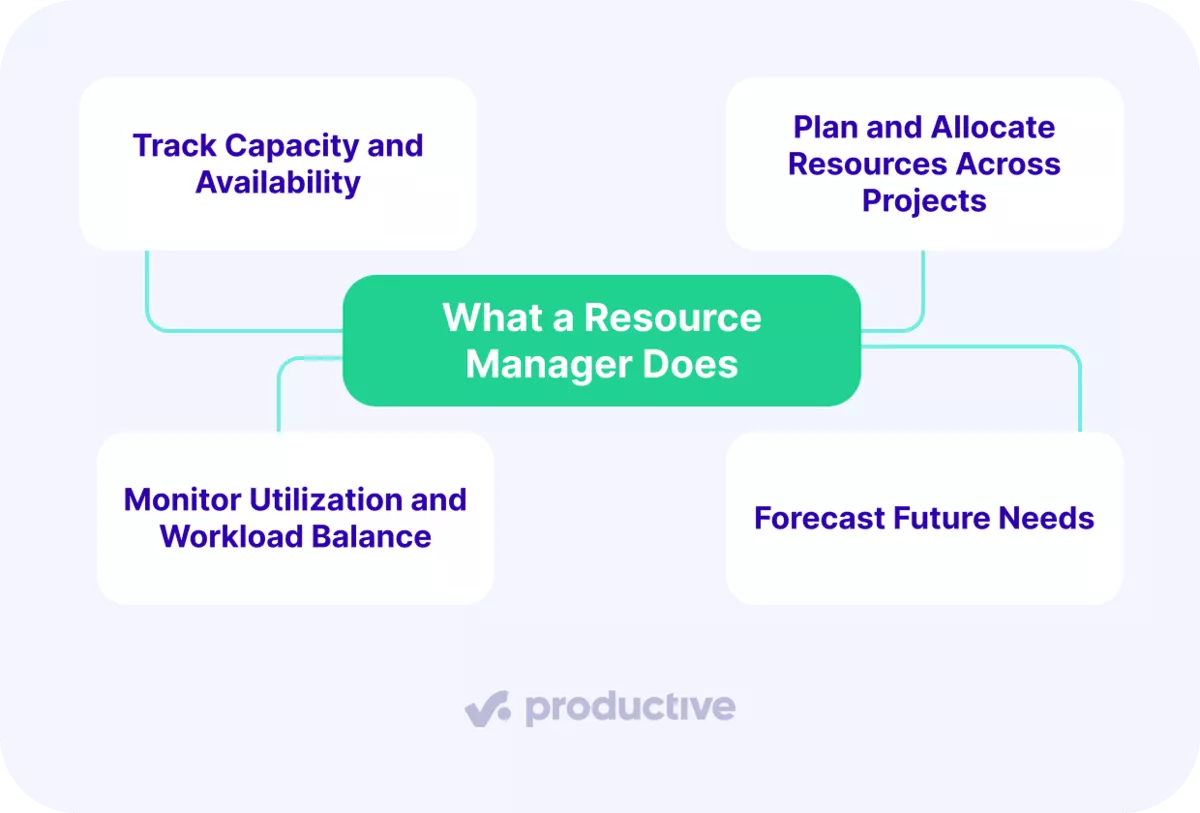
In the sections below, we will look at each of these areas in more depth.
Track Capacity and Availability
Managers track capacity and availability to know how much work each person can take on. Capacity is the total number of hours, while availability is the time someone can actually be scheduled, accounting for time off and holidays.
That difference matters because someone can look free next week and still have much less time available than expected. Spreadsheet-based planning makes this worse. In the Next Generation Resource Management Solutions survey by RMI, 70% of respondents reported using spreadsheets such as Excel or Google Sheets for tracking resources.
This is when resource management tools become crucial. In Productive’s Resource Planner, teams can see availability, bookings, and gaps in one place, with updates flowing through as projects and time off change.
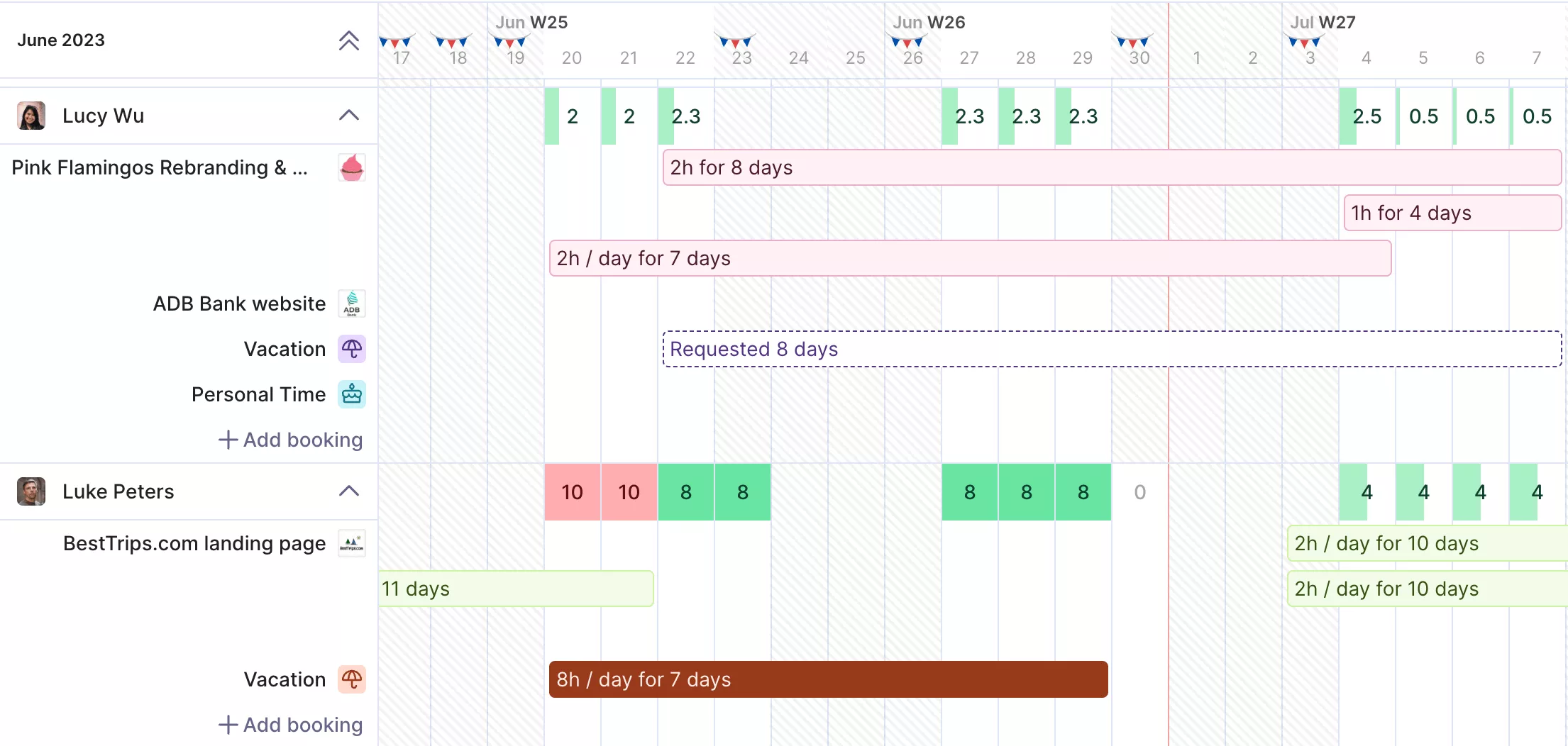
USE PRODUCTIVE TO SEE AVAILABILITY AND BOOKINGS IN ONE PLACE.
Plan resources in Productive
A good resource capacity plan helps managers make better calls before work gets assigned, not after someone is already overloaded. That is the difference between guessing and planning.
Plan and Allocate Resources Across Projects
Once managers know the team’s actual capacity, they can start making resource allocation decisions. This is the point where visibility turns into judgment.
Resource planning and allocation are about deciding where people should be assigned across active work. That usually means weighing:
- project priority
- upcoming deadlines
- skill fit
- current availability
- where someone will have the biggest impact
This matters most when two projects need the same person. In that situation, the manager has to make a trade-off that benefits the business as a whole, not just one project team. Good resource allocation helps prevent bottlenecks, protects specialists from being spread too thin, and keeps delivery more realistic.
If you want a deeper look at that process, our resource planning guide is a good next read.
Monitor Utilization and Workload Balance
Resourcing managers monitor resource utilization to see how much time is actually spent on billable work.
For example, if someone has 40 hours available and 32 are billable, their billable utilization is 80%. The number itself is not the goal. What matters is the signal it gives.
Low resource utilization indicates idle capacity or poor resource allocation. Very high utilization points to overload and delivery risk. The job is to spot this early and rebalance the work. Good performance monitoring is not about pushing harder. It is about maintaining predictable delivery and protecting employee performance.
Forecast Future Needs
Resource planners look ahead so the business can prepare for upcoming work rather than react at the last minute.
In practice, that means watching for patterns like:
- upcoming projects that will need more people
- resource shortages in the same roles
- skill gaps that keep slowing down delivery
- pressure built in certain teams
- staffing plans that no longer match future demand
This is where forecasting supports better workforce planning. A bit of scenario analysis helps too, because it lets managers test what happens if priorities shift, timelines move, or key people become unavailable.
Once that future view is clear, the next question is what skills a resourcing manager needs to make good decisions with it.
What Skills Does a Resource Manager Need?
The skills a resource manager needs are allocation and planning, analytical thinking and awareness, communication and stakeholder coordination, and problem-solving and adaptability.
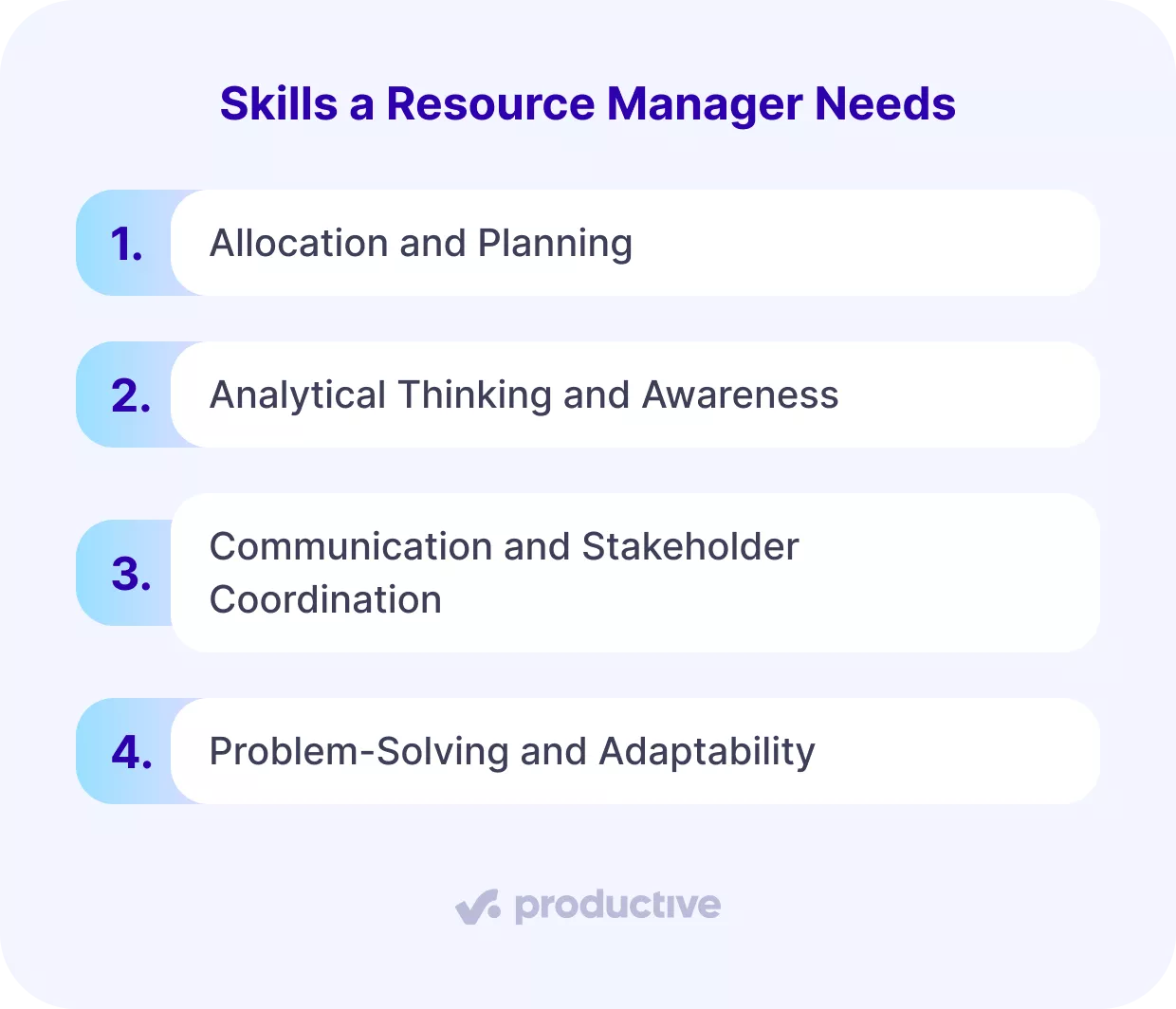
In the sections below, we will explore each skill in more detail.
Allocation and Planning
Allocation and planning are the skills that help a resourcing manager match people to work realistically. When two or three projects need the same specialist, you have to decide where that person is most needed, what can wait, and what needs to be reassigned.
Good operators stay organized and think ahead. They use resource optimization to avoid idle time and resource leveling to smooth out peaks and overload before they hit the team.
Analytical Thinking and Awareness
Strong resource coordinators do more than keep schedules up to date. They look at workload patterns, spot bottlenecks early, and notice when the same people keep getting pulled into too many projects. That kind of awareness helps them catch resource risks before they turn into delivery problems.
It also helps them see the quieter issues. Underused people, emerging skill gaps, and small resource conflicts can sit unnoticed for weeks if no one is paying attention. A good manager reads those signals early and adjusts before the plan starts wobbling.
Communication and Stakeholder Coordination
Communication matters because staffing decisions affect more than one team. Managers have to keep the right people aligned when demand exceeds capacity. That usually means:
- setting clear expectations with project management and delivery leads
- explaining trade-offs when the same person is needed in two places
- working with human resources when staffing gaps start affecting plans
- keeping resource conflict resolution focused on priorities, timing, and real availability
Without that clarity, resourcing quickly turns into noise. Everyone wants the same specialist, nobody likes hearing no, and the loudest voice starts to win.
Problem-Solving and Adaptability
Problem-solving and adaptability matter when the original plan stops working. A deadline can move, project scope can expand, or a key person can suddenly become unavailable. A good manager adjusts the plan, resets expectations, and keeps the work moving without unnecessary disruption.
Strong managers also think through options rather than react blindly. They use risk management plans and risk mitigation plans to protect deadlines and reduce pressure on the team. Those skills matter, but they are only part of the picture.
The next question is what background usually prepares someone for a resource management role.
What Are the Requirements for Resource Management Roles?
The requirements for resource management roles include relevant education and experience that prepare you for the work.
In the sections below, we will explore each in more detail.
Relevant Education
There is no single degree path for this role, but many employers look for a bachelor’s degree in business, operations, project management, or human resource management. Those fields provide people with a strong foundation in planning, staffing, coordination, and how service teams operate.
Certificates can also strengthen a candidate’s profile, especially when they are practical and tied to day-to-day work. Common examples include:
- a resource management certification
- project management certificates
- process-focused credentials like Six Sigma
It also helps to understand the basics, such as labor laws, especially when scheduling work across teams and locations. That matters because resource decisions are not just about who is free, but also about what is realistic, compliant, and sustainable.
Experience That Prepares You for the Role
The experience that prepares someone for this role often comes from jobs that sit close to staffing, delivery, and team planning.
In professional services, which can include roles like:
- project coordinator
- traffic manager
- operations coordinator
- resource scheduler
- project manager
- delivery manager
- project analyst
These roles help people build experience in project coordination, task management, scheduling, and day-to-day project management. Experience in billable teams is especially useful. You start to see how specialist availability affects timelines, margins, and delivery quality, not just whether the schedule looks full.
Resourcing managers often sit close to project and operations roles, which is why the differences are worth making clear.
How Is a Resource Manager Different From a Project Manager and a Human Resource Manager?
A resource manager is different from a project manager (PM) and a human resource manager(HR) because each role owns a different part of the work: the resource manager owns staffing and capacity planning across the business, the PM owns delivery on specific projects, and the HR manager owns hiring processes, policies, and employee development.
The table below shows those ownership boundaries more clearly.
Resource Manager vs. Project Manager vs. HR Manager
| Responsibility | Resource Manager | PM | HR Manager |
|---|---|---|---|
| Assigns people to projects | Yes | Sometimes requests support | No |
| Manages project timelines | No | Yes | No |
| Tracks delivery progress | No | Yes | No |
| Monitors capacity across teams | Yes | No | No |
| Supports hiring decisions | Yes | Sometimes flags needs | Yes |
| Owns hiring process | No | No | Yes |
| Handles employee policies and development | No | No | Yes |
| Flags staffing gaps | Yes | Sometimes at project level | Sometimes in partnership |
In practice, the resource manager decides who should be assigned across all active work, based on capacity, priority, and skill fit. PMs stay focused on one project at a time, while human resource management handles hiring, policies, and employee development.
Those boundaries matter because the problems show up fast when they blur. PMs can compete for the same specialist without seeing the wider team’s capacity, and human resources can receive hiring requests only after delivery pressure is already high. That is usually the point at which a business needs a single clear owner of resourcing.
That is usually the point when a dedicated resource manager starts to make sense. If you want a deeper breakdown of how delivery and client-facing responsibilities differ, see our guide on project manager vs account manager.
When Should You Hire a Resource Manager?
You should hire a resource manager when projects start competing for the same people, you can’t clearly see who is overbooked or underused, and hiring becomes reactive rather than planned.
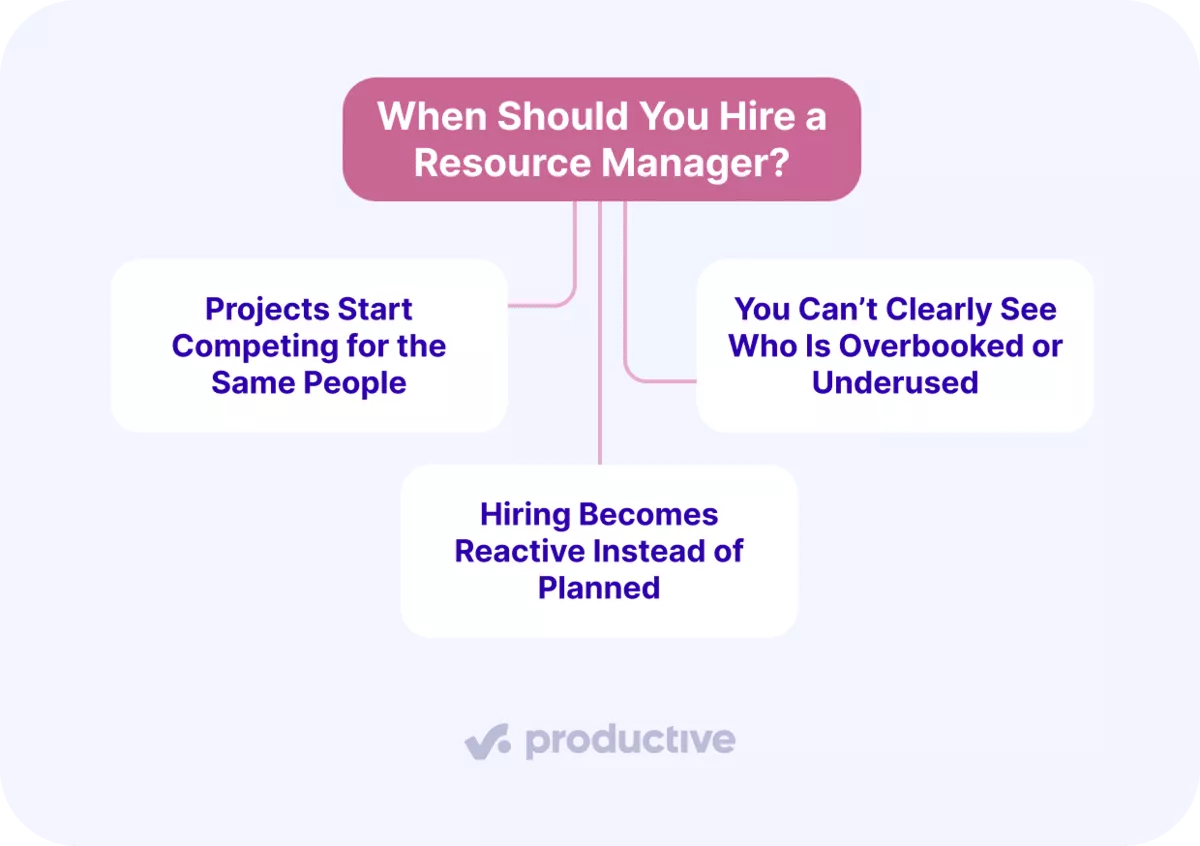
In the sections below, we will look at each situation in more detail.
Projects Start Competing for the Same People
In growing professional services teams, the same specialist often gets pulled into several projects at once. A senior designer may be needed for two client launches in the same week, or a solutions expert may be booked for both pre-sales support and delivery work.
That is where resource managers step in. Instead of letting project managers compete for the same people, the resourcing manager looks across current projects, weighs priority, timing, and skill fit, and decides how to use existing capacity.
That is how they reduce resource conflicts, protect key resources, and make day-to-day allocation less reactive.
You Can’t Clearly See Who Is Overbooked or Underused
In professional services, this problem arises when leaders cannot clearly see who is stretched, who has room, or whether billable utilization is evenly distributed across the team. By the time someone notices the imbalance, one person is overloaded, another is underused, and delivery starts wobbling.
Resource management helps solve that by turning scattered data into a clear view of workload. With Productive, resource managers can review tracked and scheduled hours in one place, review billable utilization and team utilization more easily, and spot imbalances before they start hurting delivery.
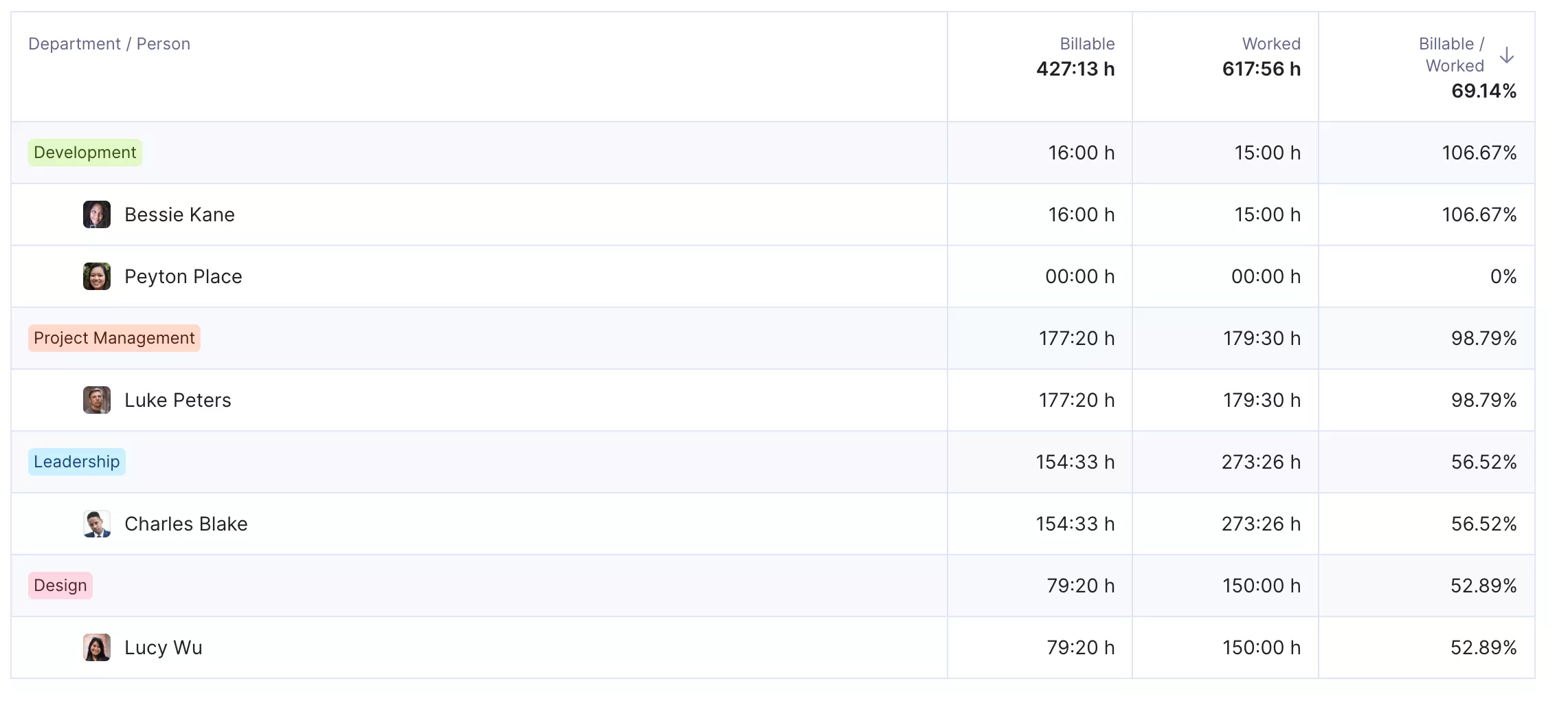
USE PRODUCTIVE TO SEE UTILIZATION ACROSS TEAMS, ROLES, AND INDIVIDUALS.

Now, we can immediately see how each project is performing financially, how utilization looks across teams, and where we need to adjust. The reporting system is especially powerful.

Read the full customer story to see how MONOGRID improved visibility into project performance with Productive.
Hiring Becomes Reactive Instead of Planned
Hiring becomes reactive instead of planned when the business cannot see future capacity gaps early enough.
Common signs include:
- hiring requests appear only after delivery pressure is already high.
- open roles are created after work has already been sold or scheduled.
- staffing plans lag behind pipeline demand and upcoming projects.
- new hires arrive too late to prevent overload.
These issues signal that the business is reacting to problems rather than anticipating them, making it harder to maintain smooth delivery and team morale.
A manager helps solve that by looking ahead, not just at today’s schedule. They spot patterns in demand, flag where future capacity will fall short, and give leadership time to hire before the gap starts hurting delivery.
This is also where resource management tools become more important.
How Does Resource Management Software Support Managers?
Resource management software supports managers by connecting planning with project work, creating a real-time view of capacity, and enabling forecasting. In the sections below, we will look at each of these in more detail.
Connect Planning With Project Work
Resource plans go out of date fast when project work changes, but bookings do not. For example, a project timeline moves by a week, but the team schedule stays the same. One person is now booked too early, another is double-booked, and no one notices until delivery starts slipping.
This usually happens when planning and project work live in different places. Software helps by keeping those changes closer together, so bookings stay aligned with project changes, stale plans and double-bookings are easier to avoid, and staffing decisions are based on real-time data instead of manual updates.
Create a Real-Time View of Capacity
Software helps by showing the details managers need in one place instead of three.
They can answer these questions:
- Who is available this week?
- Who is already booked?
- Where workload pressure is building?
- Where is resource capacity still open?
Without that view, answering a simple question like who has room next week can mean checking spreadsheets, calendars, and project plans one by one. That takes time, and the answer can already be wrong by the time you get it.
A real-time view enables faster, more accurate decisions. Managers can spot tight areas earlier, adjust bookings before someone gets overloaded, and avoid the usual detective work that comes with manual resource loading.
Enables Forecasting
Software helps managers look ahead, rather than planning week by week and hoping for the best. They can compare planned vs. available capacity, see where pressure is building, and spot resource shortages before they cause rushed hiring or missed deadlines.
This matters because many teams still cannot answer a simple question, such as who is free next month, without checking several systems.
With Productive Forecasting, managers can anticipate changes to resource capacity and proactively plan for upcoming needs.
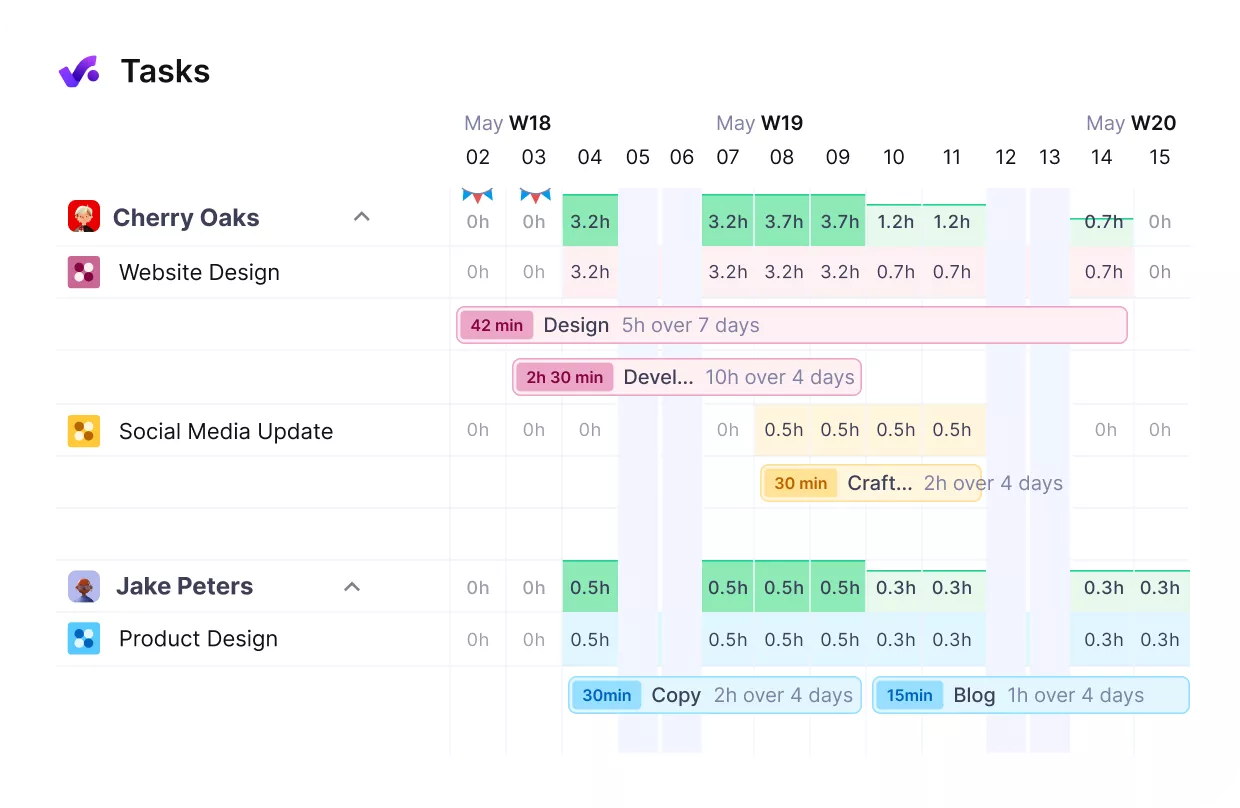
USE PRODUCTIVE TO FORECAST AND SPOT CAPACITY GAPS EARLY.
They can also use real-time data on current and future billable utilization to make more accurate hiring decisions, backed by time tracking, resource plans, and reports.
If you want to explore different tool options, check out our full list of resource management software.
How Resource Management Helps Growing Businesses
Resource management helps growing businesses make better staffing decisions before problems pile up. They provide structure for resource capacity planning, allocation, and forecasting, so teams can see who is available, who is overloaded, and where future gaps are forming.
This is also where software becomes critical. Tools like Productive give managers one place to plan, track, and adjust work using real-time data, which leads to faster decisions and fewer surprises.
If you want to see how this works in practice, book a demo with Productive and explore how better resource management can support your business’s growth.
FAQ
What KPIs Should Resourcing Managers Track?
The KPIs resourcing manager should track are capacity vs. demand, utilization, and planned vs. actual time. Together, these KPIs show whether the team has sufficient capacity, how effectively that time is used, and whether the plan aligns with what actually happens.
They help resource managers spot overload, underuse, and gaps between planned and actual work, which leads to better allocation and more reliable forecasting.
What Makes a Good Resourcing Manager?
A good resourcing manager is someone who can plan clearly, think analytically, communicate trade-offs, and adjust quickly when plans change. The role is not just about filling schedules. It is about making realistic staffing decisions across competing priorities.
What usually sets strong managers apart is judgment. They spot problems early, keep teams aligned, and make decisions that protect both delivery and workload balance.
How Much Do Resource Managers Earn?
Resource managers typically earn salaries in the mid-to-senior operations range, with pay depending on experience, industry, and location. In the US, the average salary in 2026 is around $127,269 per year, with a typical range of $102,442 to $146,398, according to Salary.com data.
Stop juggling spreadsheets and start planning resources in one place.
With Productive, you can track availability, balance workloads, and forecast future capacity in one place. No more chasing updates or fixing plans after they break.
