How to Calculate Overhead Cost: Formula + Worked Example

Knowing how to calculate overhead cost matters, because margins can look healthy until rent and unbilled hours are counted. Overhead cost is what your firm pays to keep running that no single client project carries.
This article will explain what overhead includes, why it matters, and how to calculate overhead cost with a worked example. Then you see why it rises when your team bills less, and how to check it monthly.
Key Takeaways
- Overhead is what keeps your firm running that no project carries: facility costs plus internal time.
- Overhead matters because project margins look too high without it: a project can look profitable on salary alone and still lose money.
- You calculate overhead cost per hour in two parts: facility costs over total hours, plus internal costs over client hours.
- Overhead goes up when your team bills less: unbilled hours become internal costs, and fewer client hours share them.
What Is Overhead Cost?
Overhead cost, also called business overhead, covers the indirect costs of running your firm. These are costs no single client project pays for. Nobody logs rent or an internal meeting to a client job. So a project only carries these costs if you add them.
It helps to split overhead into two groups, because each one is shared out differently:
| Group | What it includes | Examples |
|---|---|---|
| Facility costs | Steady monthly expenses of running the firm | Office rent, software subscriptions, utility costs, insurance |
| Internal costs | Time and money spent on work no client pays for | Internal projects, administrative salaries, sales, training, paid time off |
Internal costs are easy to miss, because they are part of salaries you already pay. An hour your designer spends on an internal pitch still gets paid. It just never shows on a client report.
Overhead is not every cost, though. A freelancer booked to one project, or travel you charge back to a client, is a direct project cost. It goes straight onto that project, so it stays out of overhead.
You may also see overhead sorted as fixed, variable, or semi-variable, by how it changes month to month. That helps with budgeting, but facility and internal costs are the split you need here.
Leaving either group off a project changes the margin you see, which is why these indirect costs matter.
Why Does Overhead Cost Matter?
Overhead cost matters because a project report without it shows a margin that is too high. A cost column that only multiplies hours by salary leaves out overhead expenses like rent and internal time. One firm described the effect plainly: leaving overheads out “makes the costs per hour look quite low.”
Say you quote a fixed-fee study at 400 hours for $80,000, and it takes 700. At a salary cost of $65 per hour, delivery costs $45,500. On salary alone, the study shows a 43% profit margin.
Now add overhead at $48 per hour, the example firm’s rate. The 700 hours carry $33,600 of overhead. The study barely broke even, at about $900 or 1% of the fee.
Without overhead, a project report only shows gross profit. A full project profitability calculation subtracts overhead to get net profit.
Getting to net profit starts with calculating your overhead per hour.
How Do You Calculate Overhead Cost?
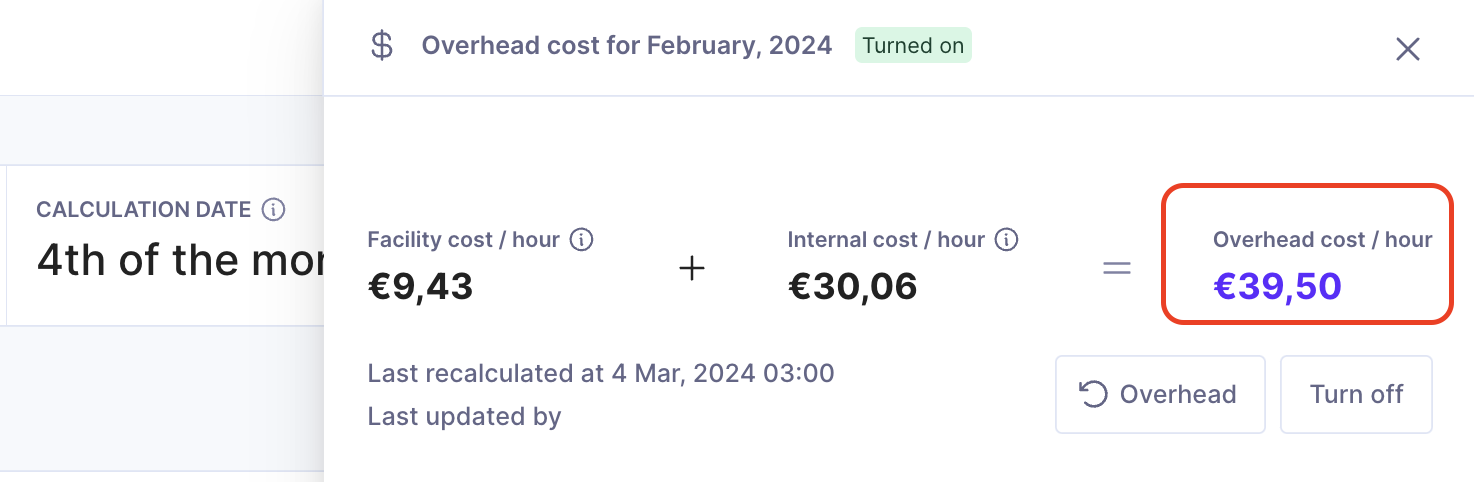
You calculate overhead cost per hour in two parts: facility costs over total hours, internal costs over client hours. Then you add the two together. This is the method Productive’s overhead feature uses, so your numbers follow the same logic as the app.
The parts are: using three formulas to get overhead per hour, collecting one month’s costs and hours, and a worked example. We’ll take a closer look at each.
Use Three Formulas to Get Overhead per Hour
Using three formulas turns one month’s overhead into a cost for every client hour:
- Facility cost per hour = facility costs ÷ total hours
- Internal cost per hour = internal costs ÷ client hours
- Overhead per hour = facility cost per hour + internal cost per hour
Overhead per hour is also called the overhead rate or overhead absorption rate. The third line is your overhead rate formula.
Total hours are every hour tracked on client and internal work, plus paid time off. Client hours are only the hours tracked on client work.
Hours are the allocation base: the number you divide overhead by to share it out. Facility costs use total hours, and internal costs use client hours. Hours fit a services firm because time is what you sell. Each project pays for the time it used.
A cost rate is what you pay someone per hour, such as salary. Internal costs are made up of these lines, each valued at the person’s cost rate:
- Internal time: hours tracked on internal projects, also called indirect labor
- Internal expenses: money spent on internal projects
- Paid time off: time off taken by anyone on the team
- Hours under availability: the cost of hours someone was available but didn’t track
- Hours over availability: hours worked beyond availability, which are subtracted
The two formulas divide by different hours on purpose. Facility costs are spread across all hours, including time off. Internal costs are carried by client hours alone, because only client work brings in fees to cover them.
So the cost depends on the type of hour. A client hour costs the person’s cost rate plus the full overhead per hour. An internal hour costs their cost rate plus the facility cost per hour only.
Productive calculates overhead this way every month. You enter your facility costs, and it takes internal costs and hours from your time tracking.
Track overhead on your projects in Productive.
It averages them over a period you choose, then lets you spread overhead across all your budgets.
Include overhead in your projects with Productive.
Collect One Month’s Costs and Hours
Collecting the inputs means pulling one month’s facility costs and one month’s complete timesheets. Facility costs come from your profit and loss statement. Internal costs and every hour come from time tracking.
The facility lines to pull from the statement include, for example:
- Office rent and building costs
- Software licenses and subscriptions
- Utility costs, phone, and internet
- Office supplies and equipment maintenance
Insurance, accounting, and legal fees
Keep direct project costs out of this list, since each one already belongs to a single client.
Before you run the overhead calculation, make sure everyone has logged the whole month. That includes support staff and time off. Missing timesheets distort both formulas. Clean billable and non-billable time tracking makes this a quick check.
We recommend at least two to three months of consistent time tracking before you turn overhead on.
Worked Example: A 45-Person Consultancy
The worked example follows an illustrative 45-person consultancy: 36 people in delivery and nine in support roles. Delivery cost rates are $65 per hour, and support cost rates are $40. The firm had no internal expenses this month.
The consultancy’s hours and facility costs for the month look like this:
| Input | Amount |
|---|---|
| Facility costs (rent $16,000, software $10,000, utilities and insurance $12,850) | $38,850 |
| Client hours (delivery team) | 4,320 |
| Internal hours (delivery 1,440, support 1,440) | 2,880 |
| Paid time off (delivery 480, support 90) | 570 |
| Total hours | 7,770 |
Its internal costs add up like this:
| Internal cost line | Amount |
|---|---|
| Internal time (delivery 1,440 hours at $65, support 1,440 at $40) | $151,200 |
| Internal expenses | $0 |
| Paid time off (delivery 480 hours at $65, support 90 at $40) | $34,800 |
| Hours over availability (19 support hours at $40, subtracted) | -$760 |
| Total hours | 7,770 |
| Total internal costs | $185,760 |
Facility cost per hour is $38,850 ÷ 7,770, which is $5. Internal cost per hour is $185,760 ÷ 4,320, which is $43. Added together, overhead per hour is $48.
The month’s total overhead cost is $224,610: $38,850 in facility costs plus $185,760 in internal costs. So a delivery person with a $65 cost rate costs $113 for every client hour. The same person costs $70 for an internal hour.
Is $48 a lot? As an overhead percentage, it’s about 74% of the $65 delivery cost rate. Most of it comes from the delivery team’s own unbilled time. At 75% utilization, their internal hours and time off alone add about $29 to every client hour.
To add overhead to a project, multiply its client hours by overhead per hour. At $48 per hour, the fixed-fee study’s 700 hours total $33,600, and a 200-hour project totals $9,600. Other methods share overhead differently. A manufacturing overhead formula divides factory overhead by machine hours or units produced to find a cost per unit.
That $48 holds only while your team bills at the same pace. The next question is what happens when it doesn’t.
Why Does Overhead Go Up When Your Team Bills Less?
Overhead goes up when your team bills less because internal costs are divided by client hours. When client hours drop, the same salaries move into internal costs. Fewer client hours then share a bigger bill, so the rate climbs from both sides.
CPA firm Wiss puts it simply in its guide to optimizing overhead rates: “non-billable hours inflate overhead.”
The parts are: what happens in a slow month, and checking overhead per hour every month. We’ll take a closer look at each.
What Happens in a Slow Month
In a slow month, the example firm’s delivery team logs 3,888 client hours instead of 4,320. The 432 hours they didn’t bill go to internal work, so internal costs rise without new spending. If those hours go untracked, Productive still counts their cost for salaried staff, as hours under availability.
Remember, internal cost per hour = internal costs ÷ client hours. The normal and slow months compare like this:
| Normal month | Slow month | |
|---|---|---|
| Client hours | 4,320 | 3,888 |
| Delivery internal hours | 1,440 | 1,872 |
| Internal costs | $185,760 | $213,840 |
| Internal cost per hour | $43 | $55 |
| Facility cost per hour | $5 | $5 |
| Overhead per hour | $48 | $50 |
Facility cost per hour stays at $5, because total hours didn’t change. Delivery employee utilization by hours worked fell from 75% to 67.5%.
Nothing about the firm’s spending changed, only the mix of hours. Overhead per hour rose by $12, or 25%. A project priced on the old $113 per client hour now costs $125 per hour to deliver.
The same math works in reverse. In a busy month, more client hours share the internal costs, so overhead per hour falls.
Check Overhead per Hour Every Month
Checking overhead per hour every month shows a utilization drop before it affects your next quote. Recalculate once everyone has logged the month’s time. Then compare the new rate with the one your quotes use.
When the gap is large, update the rate you quote from. Our own rule of thumb is to act when it moves more than 5%.
A single slow month shouldn’t rewrite your prices, though. Averaging a few months gives a steadier figure to quote from, and it still moves when utilization keeps falling.
When the rate keeps climbing, you have two levers. Move time from internal work to client work, if there’s client work to fill it. Dropping recurring meetings you could do without frees some. Or raise the rates on new quotes so they clear the higher break-even.
Productive can calculate an overhead cost per hour and add it to people’s costs when they track time on client budgets.

Ask the AI assistant for profitability reports in plain language in Productive.
That way, it’s reflected in budget profitability. You can then ask AI to build a report, such as profitability by client company. Overhead is available on the Ultimate plan, and an admin must enable AI reporting.
If you’re comparing software for this, check out our list of the top reporting tools.
Put Overhead Into Every Rate You Quote
Add overhead per hour to each person’s cost rate to find the lowest hourly rate you can charge. Anything below it loses money, so put your profit margin on top.
Your overhead rate changes as your team’s billable hours change, so check it once a month. Productive calculates overhead per hour every month from your time tracking, so the new rate is ready.
Book a demo with Productive to see your overhead per hour calculated from your own data.
See Project Profit With Overhead Included
Spread your overhead across all your budgets to see actual project profitability.
