Harvest Price Increase 2026 – What Changed + What to Do?

Since the recent Harvest price increase, users on Reddit and review sites have been sharing renewal notices far higher than what they expected.
We dug into their stories and actual numbers so you don’t have to.
This article covers exactly what the new pricing model is, how much it will cost you to stay on Harvest, how to audit your subscription after the pricing model changes, and what your options are if the math stops working.
Stick around to the end for a migration discount on a tool that fills every gap the new rate exposes.
Key Takeaways
- The new pricing has two layers, not one. Harvest charges a per-seat plan fee ($9/month Teams, $14/month Enterprise on annual billing) plus usage-based fees for invoices, projects, clients, and tasks. The starting rate is the floor, not the ceiling.
- Bending Spoons acquired Harvest in mid-2025, and added the usage fees. Most of the companies they acquired saw rate hikes or free-tier cuts after the acquisition.
- No plan covers what growing agencies need most. Project profitability reporting is limited to the Enterprise plan at $14 per seat. If you need additional agency management features, you are paying for separate tools on top of Harvest.
- The real cost can be multiples of the pricing page number. G2 reviewers report increases of 600% after the acquisition, driven by usage fees, checkout defaulting to Enterprise, and freelancer seat fluctuation.
What Is the Harvest Price Increase?
The 2026 Harvest price increase is a restructuring from a flat per-seat model to a plan-fee-plus-usage system, introduced after the platform was acquired by its new parent company in mid-2025.
- The old model charged a flat rate per seat for time tracking and invoicing with no extra fees for account activity.
- The new model splits into three plans and introduces usage-based billing for invoices, projects, clients, and tasks on top of the per-seat base.
The per-seat starting rates are $9/month on Teams annual billing and $14/month on Enterprise annual billing. Those numbers are the starting point, not the total.
Your actual bill scales with how actively your team uses the platform. The more projects you run, clients you manage, and invoices you send, the higher the usage layer climbs.
The 2026 Per-Seat Rate and Plan Changes
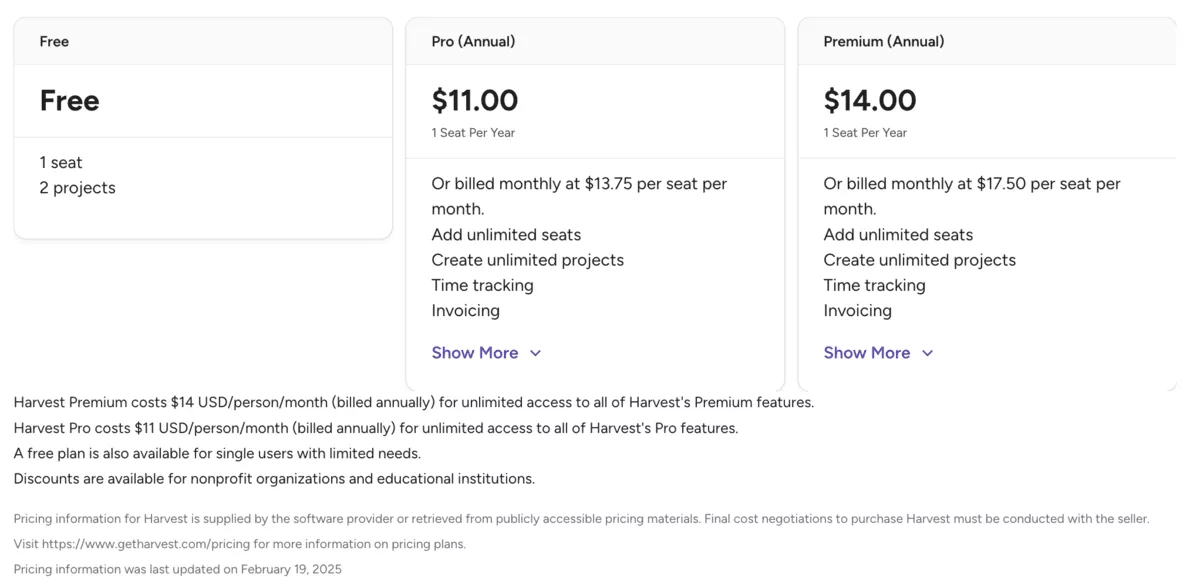
The old structure offered a Free plan (1 seat, 2 projects) and a Pro tier at a flat per-seat rate, as well as a Premium. This rate is not listed on Harvest’s current site and is sourced from the G2 review page.
Source: G2
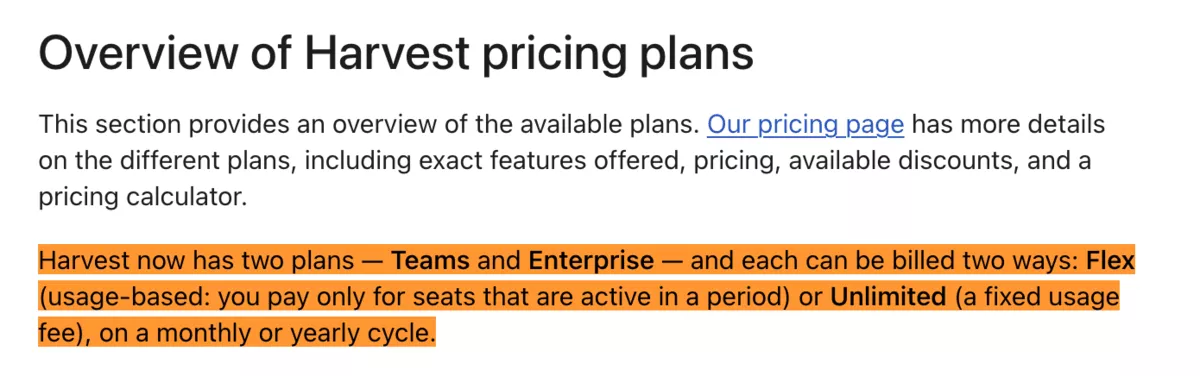
That model is gone. Harvest app now runs two paid plans, Teams and Enterprise, each with two billing modes:
- Flex usage billing (you pay only for seats active in a billing period, but usage fees stack on top)
- Unlimited (a fixed usage fee that covers your account activity regardless of volume).
Source: Official help docs
Note: The Help Center refers to these plans as Teams and Enterprise. The pricing page labels the same plans as Pro and Premium. Premium features match what the Help Center calls Enterprise. They are the same tiers with the same pricing.
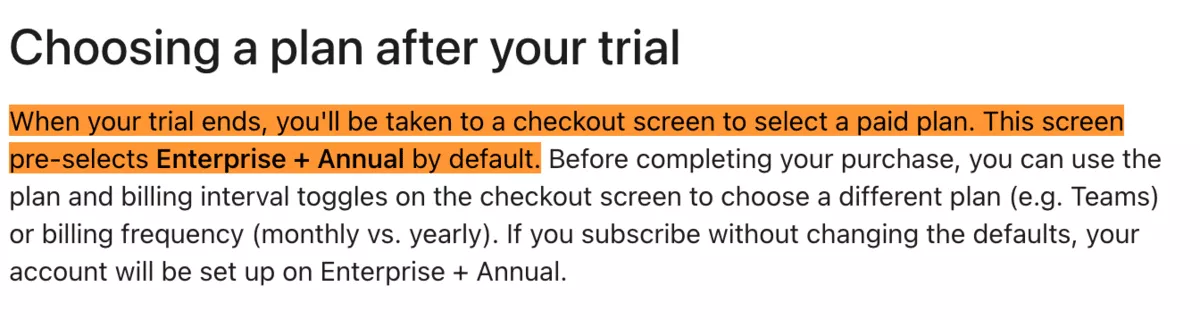
One detail worth checking before you subscribe: the checkout screen after a trial period ends pre-selects Enterprise + Annual by default. If you complete the purchase without switching the toggle, you land on the $14/seat tier, not the $9 Teams plan. The Help Center confirms this default.
Source: Help Docs
When Does the Cost Increase Hit Your Budget?
The increase lands at your next renewal date, not retroactively. If you are on a legacy annual plan, your old rate holds until that contract renews. Some teams absorbed the new pricing in late 2025. Others are seeing it for the first time in mid-2026.
To find your renewal date, go to Settings > Billing inside Harvest.
- If you are on monthly billing, the new billing model may already be active on your account.
- If you are on annual billing, you have a window between now and your renewal date to evaluate whether the new cost makes sense.
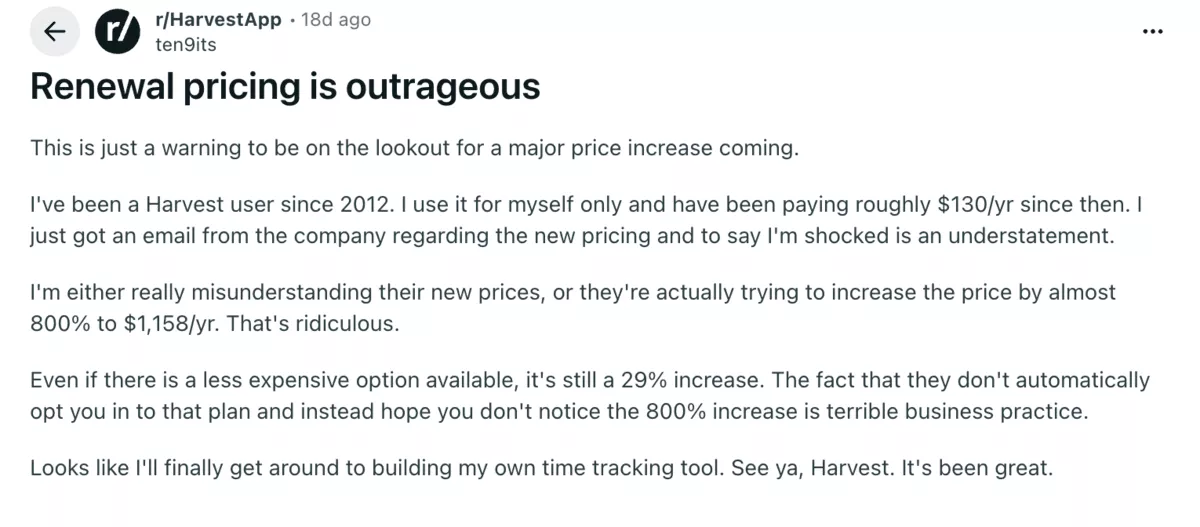
Renewal notices are where the real numbers appear. One r/HarvestApp thread on renewal pricing documents the sticker shock in detail.
source: reddit
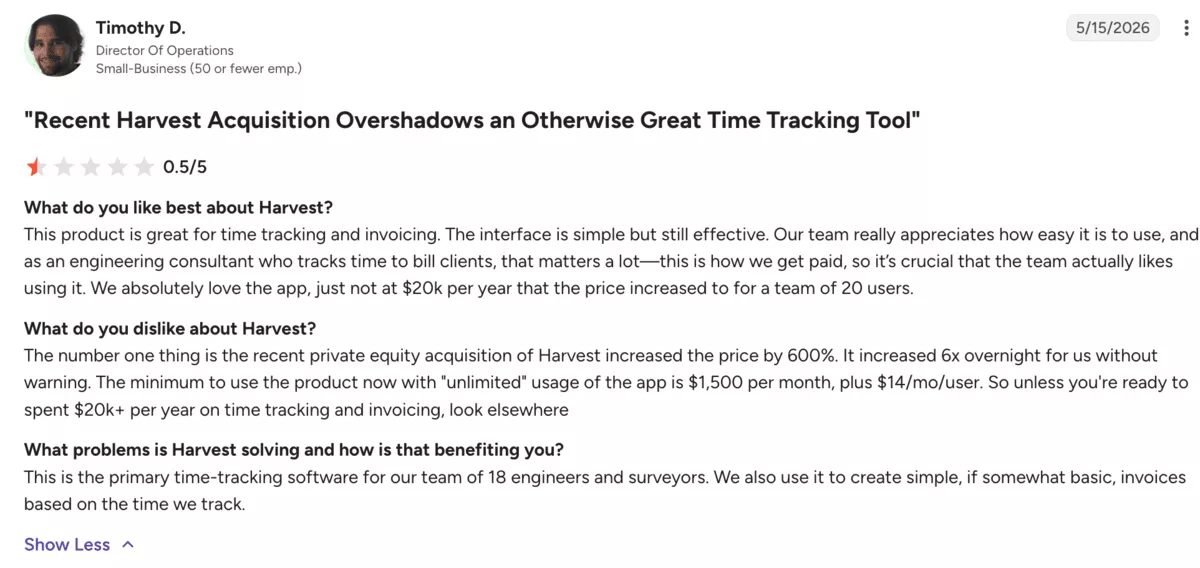
On a verified G2 review, one engineering consultancy with 20 seats reported their annual cost jumping to over $20,000 after the acquisition, a 600% increase from what they were paying before.
source: g2
What Happened to Harvest After the Bending Spoons Acquisition?
Bending Spoons, the Milan-based technology conglomerate, acquired Harvest in mid-2025. Harvest prices were restructured around the same period, with legacy plans cut off for new signups as early as November 2024.
Within the first year of ownership, Harvest moved from a flat per-seat model to a tiered structure with usage fees layered on top. The free tier was restricted to a single seat and two projects. Two paid tiers replaced the legacy plan.
Usage-based fees were layered on top.
How Does the New Harvest Billing Model Actually Work?
Harvest charges a per-seat base rate plus usage-based fees that scale with your account activity. The plan fee covers access to the platform. On top of that, you pay for the volume of invoices you send, projects you create, clients you manage, and tasks you log.
The pricing page shows three plans:
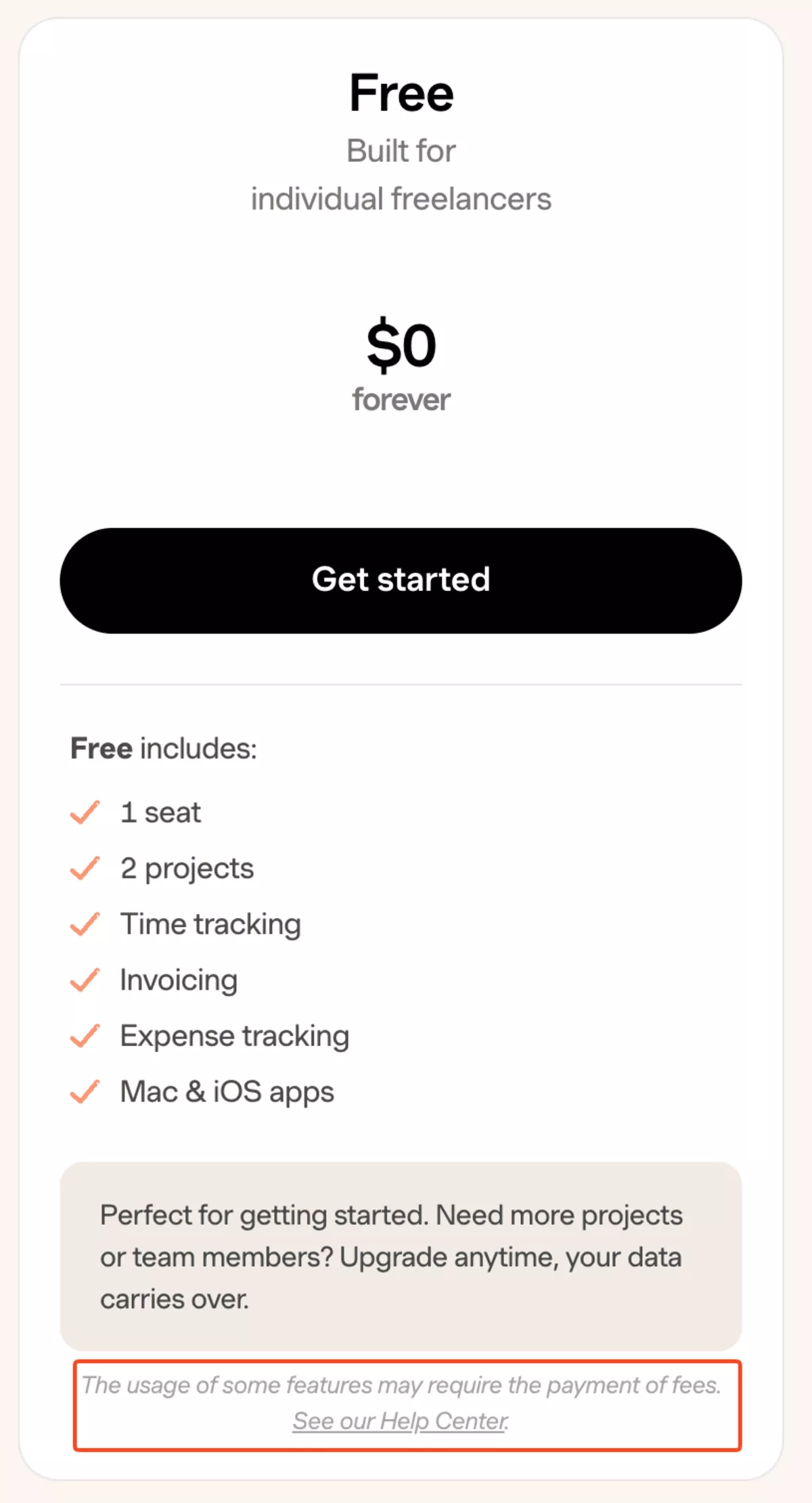
- Free is for solo freelancers: one seat, two projects, no cost.
- Teams starts at $9 per seat per month on annual billing ($11 monthly) and covers unlimited seats, time tracking, team reporting, invoicing, and accounting integrations.
- Enterprise starts at $14 per seat per month on annual billing ($17.50 monthly) and adds profitability reporting, timesheet approvals, an activity log, SAML single sign-on (SSO), custom reports, and the option to require notes on all time entries.
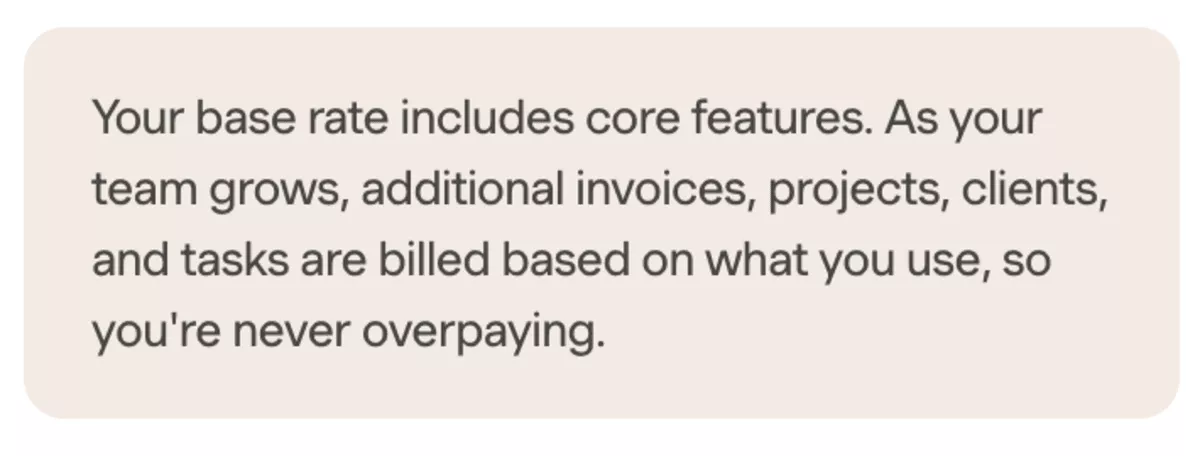
Both Teams and Enterprise carry the same line on the pricing page:
Source: Official pricing page
That line is doing heavy lifting.
It means the per-seat rate is the starting point. The actual bill scales with how actively your team uses the platform. For a small team with 3 projects and 2 clients, the usage layer may add little.
For agencies billing retainers across multiple clients, it adds up fast. For an agency running 20 active projects across 12 clients, managing retainers, and sending 15 invoices a month, usage fees can exceed the plan fee itself.
The pricing page does not publish per-unit usage rates. That means you cannot predict the exact usage portion of your bill until you see it. The gap between your listed plan cost and your actual renewal is driven by this layer.
Even the Free plan includes a similar note.
Source: Official pricing page
What Does Each Plan Actually Include?
Teams covers the core time tracking workflow: log hours, run capacity reporting across your team, send invoices, and connect to accounting tools.
Enterprise adds the features that compliance-heavy or margin-conscious firms need: profitability reporting, approval workflows, audit trails, and single sign-on.
Keep in mind that Harvest time tracker has no AI layer for automating time entries, generating reports, or turning meeting notes into tasks.
Productive’s AI features handle all three:
- AI assistant that builds reports from plain-language prompts
- Automatic and AI time tracking from calendar events
- Built-in notetaker that converts action items into assigned tasks.
Ready to leave Harvest? Get 10% off Productive.
Your renewal went up. Your stack costs keep climbing. Productive replaces Harvest, Forecast, your resourcing tool, and your profitability dashboard in one subscription with zero usage fees. Essential starts at $9/seat with the migration discount.

How Much Do the New Harvest Prices Cost Across Your Portfolio?
The real cost depends on three variables: your team size, your plan tier, and your account activity. Usage fees stack on top of the plan fee, so the tables below show the minimum annual cost, not the total.
Plan Cost Comparison: Legacy vs. 2026 Pricing
The table below models the annual plan cost at four team sizes. Before the restructuring, Harvest offered a Pro plan at $11 per seat per month and a Premium plan at $14 per seat per month on annual billing, according to G2’s pricing data (last updated February 2025). Neither plan carried usage-based fees.
| Seats | Legacy Pro ($11/seat/mo) | Legacy Premium ($14/seat/mo) | New Teams annual ($9/seat/mo) | New Enterprise annual ($14/seat/mo) |
|---|---|---|---|---|
| 10 | $1,320 | $1,680 | $1,080 | $1,680 |
| 30 | $3,960 | $5,040 | $3,240 | $5,040 |
| 50 | $6,600 | $8,400 | $5,400 | $8,400 |
| 100 | $13,200 | $16,800 | $10,800 | $16,800 |
At first glance, the Teams annual plan cost looks lower than the old flat rate. That comparison is misleading:
- Legacy plans had no usage fees. The new Teams plan does.
- The real comparison is plan fee plus usage versus the old flat rate.
- For most active agencies, the total cost on the new structure exceeds what they paid before.
- If your checkout defaulted to Enterprise after a trial (which it does unless you change the toggle), you are already paying $14 per seat before usage fees.
That is above the legacy rate from day one. On monthly billing, the numbers climb further: Teams monthly runs $11 per seat, Enterprise monthly runs $17.50 per seat. A 50-person team on Enterprise monthly billing pays $10,500 per year in base costs alone.
Usage Fees Can Push the Real Cost Well Beyond the Plan Fee
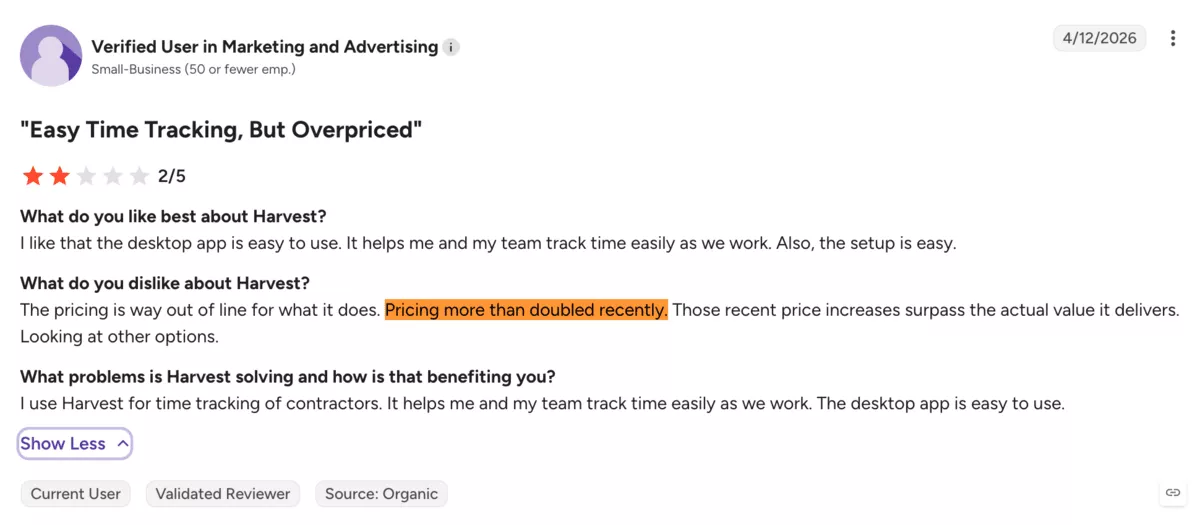
The plan cost table above shows the minimum annual cost. For agencies with active accounts, usage fees can add significantly to the total bill. A separate G2 reviewer wrote that pricing more than doubled after the acquisition and no longer matched the value delivered.
source: G2 REVIEW
The mechanics explain why. Every invoice you send, project you create, client you manage, and task you log adds to the usage layer.
- A solo freelancer with 2 projects and 1 client might see little impact.
- An agency running 20 active projects across 12 clients and generating 15 invoices a month is operating at a scale where usage charges can match or exceed the subscription fee.
Harvest does not publish per-unit usage rates on its pricing page. The pricing calculator returns a total estimate, but not an itemized breakdown.
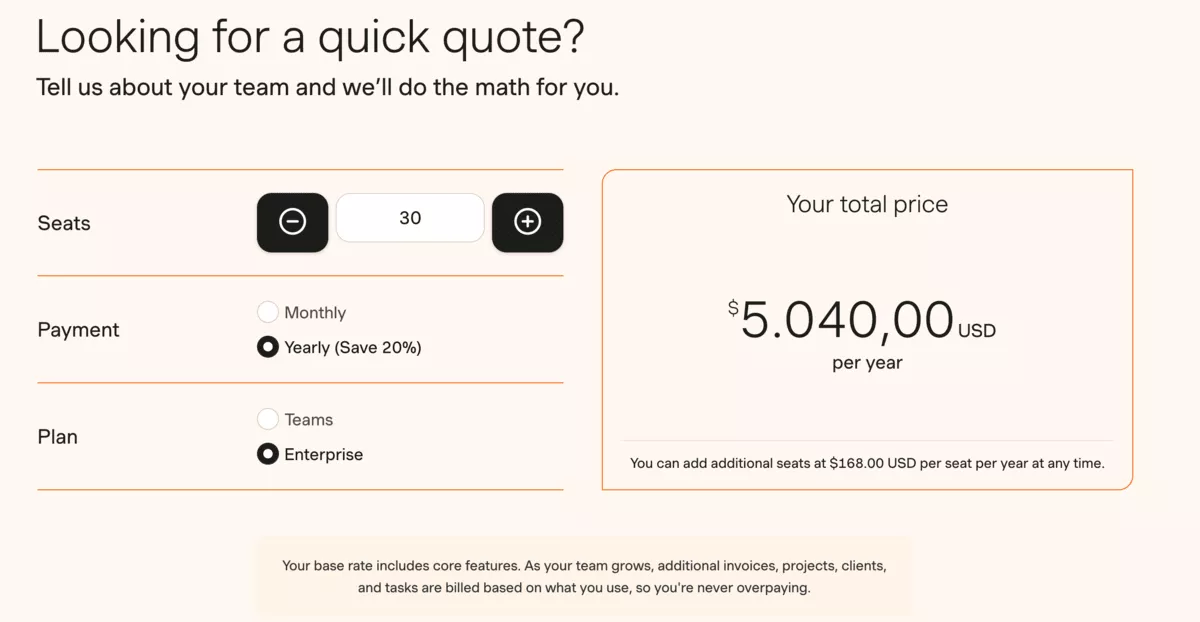
Source: Official pricing calculator
Freelancer Roster Changes Inflate Your Seat Count
The seat math above assumes a stable headcount. Most agencies do not have one. A 40-person core team might expand to 70 or 80 seats during a busy delivery period as freelancers come on for project staffing needs. In a per-seat model, every active freelancer is a billable seat.
Adding 30 freelancers at $14 per month (Enterprise) adds $420 per month, or $5,040 per year, for people who may only log time for six to eight weeks. On Teams billing at $9 per seat, the same 30 freelancers add $270 per month, or $3,240 per year.
Harvest’s pricing FAQ states:
While you can’t remove seats during your current billing cycle, you can indicate inside your account if you’d like your yearly or monthly plan to renew with fewer seats.
In practice, that means if you add 30 freelancers in Q2, you pay for all 30 seats through the end of that billing period even if they stop logging time in week three.
For agencies with dynamic rosters, the effective annual cost is unpredictable and consistently higher than the listed plan cost suggests. Factor in your peak headcount, not just your permanent team, when modeling the real cost of time tracking at scale.
How to Calculate Your Harvest Prices and Subscription Cost Increase?
You can calculate your Harvest subscription cost increase by pulling your seat count, confirming your plan tier and billing cycle, running the subscription math, and estimating your usage fees. Here is how to do each step.
- Count your seats. Log in, go to the Team page, and count every active member. Include freelancers and contractors. That total is your billable seat number.
- Confirm your plan tier and billing cycle. Go to Settings > Billing. Check whether you are on Teams or Enterprise, and whether you pay monthly or annually. If you signed up after a trial without changing the default toggle, you are likely on one of the Enterprise plans billed annually.
- Run the plan cost math. Multiply your seat count by your per-seat rate by 12. That is your annual subscription cost. Teams annual: seats x $9 x 12. Enterprise annual: seats x $14 x 12.
- Estimate usage fees. Go to the pricing calculator, enter your team size, and note the total. Subtract your plan cost figure from step 3. The difference is your estimated usage layer. You can also check your last two or three billing statements in Settings > Billing for line items beyond the per-seat charge. Export your billing history as CSV files if you need to compare months side by side.
- Add Forecast if you use it. Harvest Forecast is a separate add-on at $5 per person per month on annual billing ($6.25 monthly). Multiply your seat count by $5 by 12.
- Model your peak season. Calculate the annual cost at your highest freelancer headcount, not just your stable core. Remember: you cannot remove seats mid-billing cycle.
- Now compare the total (base + usage + Forecast + peak seats) to what you paid last year. The gap is your real increase.
Try the best Harvest alternative
Worked Example: 30-Seat Agency on Enterprise Annual
Here is what the math looks like for a mid-size agency with 30 permanent staff, occasional freelancer expansion, and the Forecast add-on.
| Line item | Calculation | Annual cost |
|---|---|---|
| Base rate | 30 seats x $14/seat x 12 months | $5,040 |
| Forecast add-on | 30 seats x $5/seat x 12 months | $1,800 |
| Freelancer buffer (10 extra seats, 3 months) | 10 x $14 x 3 | $420 |
| Usage fees | Check pricing calculator or past invoices | Varies by activity |
| Annual floor (base + Forecast) | $6,840 | |
| Realistic range (all factors) | $7,260 to $10,000+ |
What Should You Do When Your Renewal Cost Jumps?
If your renewal cost jumps, you should run through six checks before you sign a new contract or switch tools: clean up your seat count, confirm your plan tier, run the cost model, audit your feature usage, total up your stack cost, and compare it against a consolidated alternative.
Here’s what that looks like in practical steps:
1. Pull Your Real Seat Count
Go to Team and count every active user. Include freelancers and contractors, not just permanent staff. Then cross-reference against who actually logged time in the last 30 days. Seats that have not logged time tracking entries in a month are candidates for removal.
Most agencies find 10 to 20 seats they can cut before renewal, which lowers the baseline cost immediately.
2. Confirm Your Renewal Date and Plan Tier
Go to Settings > Billing. Your current plan (Teams or Enterprise), billing cycle (monthly or annual), and next renewal date are all visible there. If you signed up after a trial without changing the default, you may be on Enterprise + Annual without realizing it.
3. Run the Cost Model
Use the calculation from the previous section. Multiply your cleaned-up seat count by your per-seat rate by 12 months. Add your estimated usage fees (from the pricing calculator or your last few billing statements).
Add Forecast if you use it ($5/seat/month annual). Add your peak freelancer buffer. Write down the projected annual total.
4. List What You Actually Use
Most teams rely on two features: time tracking and invoicing. Fewer use reporting, approval workflows, or the accounting integrations.
If you are paying for Enterprise at $14 per seat but only using features available on Teams at $9 per seat, you can downgrade and cut your subscription cost by 36% without losing the features you depend on.
If time tracking is the core of what you use, our guide to agency time tracking software compares the options worth evaluating.
5. List What You Pay for Elsewhere
If you run a separate tool for project staffing, capacity reporting, or profitability tracking, add those subscription costs to your bill.
That combined number is your real stack cost. Many agencies discover their total spend across Harvest, Forecast, a project staffing tool, and a profitability dashboard exceeds what a single platform would charge for all four.
6. Compare
Put your total stack cost (Harvest + Forecast + bolt-on tools) next to what a consolidated platform would charge for the same coverage. If the stack costs more, the renewal is the right moment to consolidate.
If the math works and you use what you pay for, staying makes sense. In case it doesn’t, our review of the top Harvest alternatives covers seven options with key features, user-based pros, cons and migration advice.
What You Save by Consolidating (30-Seat Example)
| Line item | Harvest stack (annual) | Productive Essential (annual) | Productive Professional (annual) |
|---|---|---|---|
| Base rate (30 seats) | $5,040 (Enterprise at $14/seat) | $3,600 ($10/seat) | $9,000 ($25/seat) |
| Usage fees | Varies, not published | $0 | $0 |
| Forecast add-on | $1,800 ($5/seat) | $0 (resource planning built in) | $0 (resource planning built in) |
| Separate resourcing tool | $1,200 to $3,000+ (this is an estimate, add your actual cost) | $0 (built in on all plans) | $0 (built in on all plans) |
| Separate profitability tool | $1,200 to $2,400+ (this is an estimate, add your actual cost) | Basic budget tracking only (full profitability requires Professional) | $0 (full profitability built in) |
| Estimated annual total | $9,240 to $12,240+ | $3,600 | $9,000 |
The 10% Migration Discount
Productive is offering a 10% discount for teams migrating from Harvest. With that discount, Essential drops to $9 per seat per month and Professional drops to $22.50 per seat per month on annual billing.
Should You Move From Harvest After the Price Increase?
The real cost of the Harvest time tracking app is not the per-seat delta. It is the total cost of a fragmented stack: a time tracking tool, a Forecast add-on, resourcing spreadsheet, profitability tool, and the manual exports that stitch them together.
The alternative is a single platform that covers all five. If your renewal is the trigger to consolidate, start with the migration checklist above, and book a Productive demo to compare your actual stack costs side by side.
Connect With Agency Peers
Access agency-related Slack channels, exchange business insights, and join in on members-only live sessions.
