AGENCY GUIDE
The Report on
Agency Valuations

1. Introduction
What’s your agency really worth?
It’s a question more agency owners are asking. Whether you’re thinking about selling, scaling, or just staying competitive, knowing what drives your agency’s value gives you a real edge.
In 2025, 235 agencies completed our Agency Valuation survey, sharing data on revenue, profit, growth, client mix, and leadership. Here’s what we found.
2. The Agency M&A Landscape in 2025
Deal activity picked up in 2025 after a slower 2024 — but it hasn’t returned to the frenzy of 2021. The market is more disciplined now. Buyers are pickier, and they’re looking for quality over volume.
A few things are driving this shift: private equity firms sitting on capital they need to deploy, a growing backlog of agencies coming to market, and AI reshaping what buyers actually want to acquire. They’re not just buying revenue anymore — they’re buying capabilities. Data, automation, integrated services.
That said, economic uncertainty and higher financing costs are still creating friction. Deal volume is uneven, but the intent behind deals is stronger than ever.
2.1 Agency Size & Type
Size matters in valuations — mostly because it tends to correlate with EBITDA. Larger agencies usually have stronger revenue, better margins, and more established processes, which makes them more attractive to buyers.
Here’s how the survey respondents break down by headcount:

And by agency type:

Digital-focused agencies are particularly well-positioned right now — the global digital ad market is projected to hit $1 trillion by 2027.
According to Kelly Molson, an agency advisor with over 20 years of agency management experience, finding your agency’s niche can also be a good strategy for differentiating in saturated markets.

Niching down can increase agency valuations by boosting profitability, improving client retention, and creating a more precise market position. A well-defined niche makes your agency stand out in the market, which can drive demand and justify a higher valuation.
2.2 Revenue & Profitability
Revenue is the starting point for any valuation conversation. But what really moves the needle is how efficiently you turn that revenue into profit.
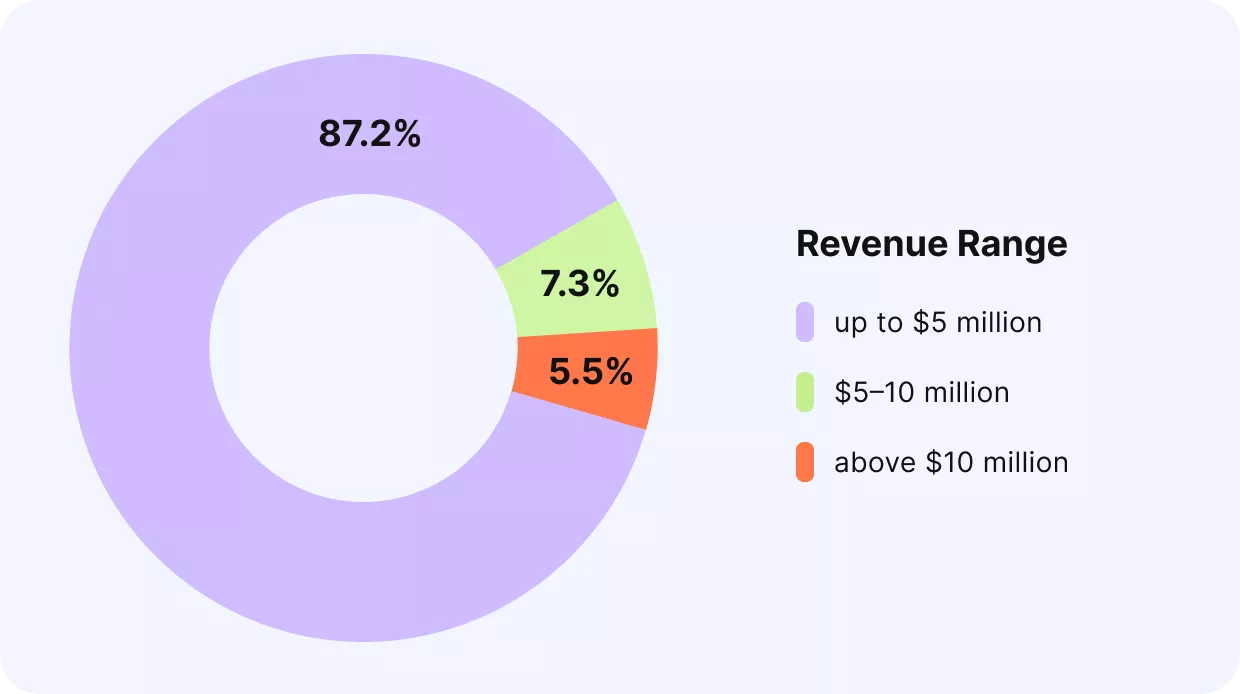
However, revenue alone isn’t enough—what really matters is how efficiently an agency turns that revenue into profit.
Despite their size, many agencies operate with strong margins:

Revenue and EBITDA determine the multiplier used to value your agency. The more efficiently your agency generates profit, the higher your multiplier will be.
2.3 Growth & Risk Factors
Growth signals potential. A growing agency is better placed to win new clients, expand services, and compound profitability over time.
Here’s how agencies performed:

Another key risk factor is client concentration. The more diversified your client base, the lower your risk.

While this is lower than previous years, it still represents a significant valuation risk. Agencies must continue diversifying their client portfolios to ensure financial stability and stronger valuations.
3. What Makes Agencies Attractive for M&A?
3.1 Recurring Revenue & Stability
Recurring revenue is one of the most powerful valuation drivers. It makes your business predictable, protects you from short-term turbulence, and signals long-term health to buyers.

More recurring revenue doesn’t just smooth out your cash flow — it directly lifts your valuation multiple.
3.2 Business Development & Management Maturity
Buyers want to know your agency can grow beyond its current client relationships. A repeatable process for winning new business — whether that’s outbound, inbound, partnerships, or referrals — signals lower risk and more upside. The problem?
Most agencies are still heavily founder-dependent when it comes to sales:

The same dynamic plays out in management structure:

If your agency’s growth, sales, or day-to-day operations depend on you being in the room, that’s a valuation risk. Buyers price in the possibility that you walk out the door and take clients with you.

When asked about transition plans, most owners said they would stay for at least 12 months, which matters to buyers for client retention and team stability.
3.3. Reputation and Brand Image
Brand is one of the most underrated drivers of valuation. A recognizable name in your market isn’t just a marketing asset — it reduces buyer risk and increases perceived value.

3.4 Technology & Operational Efficiency
How you run your operations tells buyers a lot about your scalability and acquisition-readiness

Fragmented systems hurt you in two ways: they reduce your internal visibility, and they make post-acquisition integration harder. Agencies with all their operational data in one place are easier to evaluate and integrate, and more attractive to buyers.
4. Top Performing Agencies: Key Takeaways
Learning from mistakes is a crucial part of growth. Based on the data, clear patterns emerge between agencies that achieve higher valuations and those that struggle.
The following section highlights the most common pitfalls—and what agencies can do to overcome them.

5. Conclusion
In 2025, the agencies commanding the best valuations aren’t just growing — they’re efficient, predictable, and built to run without constant founder involvement.
Buyers have gotten more selective. Revenue alone doesn’t cut it. What they’re paying a premium for is recurring revenue, strong EBITDA margins, diversified client books, and management teams that don’t need the founder in the room to function.
The agencies that struggle most share a few common traits: founder-dependent sales, over-reliance on one or two clients, and operational systems that can’t scale.
Looking ahead, AI, automation, and integrated systems are no longer a differentiator — they’re table stakes. Buyers assume you have them.
For agency owners thinking about the next chapter, whether that’s a sale, a scale-up, or just building something more durable, the priorities are the same. Build a team that can operate without you, create predictable revenue, and protect your margins. That’s what a valuable agency looks like in 2025.
Achieve Your Agency’s
True Potential
Switch from multiple tools and spreadsheets to one scalable agency management system.