12 Agency Roles Explained and How They Collaborate

There are a lot of different agency roles involved in client work. If their responsibilities get mixed up, client management turns into a hot mess. Disconnected tools only make it harder; ownership blurs, and project visibility disappears. If you’d like to avoid this type of friction, invest 14 mins and read this guide.
We will explain what agency roles are, cover the most common ones, outline the steps of a client project in which they collaborate, and explain at which stages team roles shift as the agency scales.
Key Takeaways
- Agency roles clarify ownership: they define who handles each part of client work, so fewer tasks slip between sales, delivery, and reporting.
- Agencies rely on specialized roles to deliver work: positions like account managers, project managers, brand strategists, and other specialists each own a specific part of the delivery.
- Client projects move through defined steps: sales, strategy, production, and reporting, each of which requires different roles working together.
- Agency growth changes how team roles are structured: with expansion, new roles create clearer ownership, and unified software makes work, capacity, and profitability easier to track.
What Are Agency Roles?
Agency roles are the defined functions people hold within an agency to help deliver client work. In practice, roles in an agency clarify who owns each part of the work, even when job titles change.
A simple way to group agency roles is by the part of the work they support:
- Client management: handling relationships, expectations, and updates.
- Planning and delivery: turning goals into a plan and keeping work on track.
- Production: creating the actual deliverables.
- Reporting and analysis: measuring results and deciding what to improve.
You’ll see this across marketing agency roles and advertising agency roles, then refined further as teams group work into agency departments.
Agency teams also deal with constant talent movement. Campaign US reported in its 2025 Agency Performance Review that advertising and marketing agencies have historically seen annual turnover around 30%. That is one reason clearly defined roles matter: they help agencies stay consistent even as people join, leave, or change positions.
Next, we’ll break down the most common roles in an agency and what they do day to day.
What Are the Most Common Roles in an Agency?
The most common roles in an agency include a business development manager, account manager, brand strategist, project manager, creative director, designer, copywriter, SEO specialist, PPC specialist, social media manager, data and operations manager, and analytics specialist.
We’ll now take a look at a role comparison table that provides a quick overview.
| Role | What they own | Day-to-day responsibilities | Works closely with |
|---|---|---|---|
| Business development manager | New client acquisition and pipeline | Running discovery calls, qualifying leads, preparing proposals, aligning scope with delivery teams | Account managers, strategists, leadership |
| Account manager | Client relationship and communication | Client check-ins, managing expectations, coordinating feedback, sharing project updates and reports | Project managers, strategists, clients |
| Brand strategist | Campaign direction and messaging | Audience research, defining positioning, writing briefs, translating business goals into campaign plans | Account managers, creative team, channel specialists |
| Project manager | Project delivery coordination | Building timelines, coordinating tasks, managing dependencies, protecting scope and deadlines | Account managers, creatives |
| Creative director | Creative quality and direction | Reviewing work, setting creative standards, mentoring designers and copywriters | Designers, copywriters, strategists |
| Designer | Visual asset production | Designing campaign assets, websites, and brand materials aligned with strategy | Creative director, project managers |
| Copywriter | Messaging and written content | Writing campaign copy, website content, ads, and messaging aligned with strategy | Designers, strategists, account managers |
| SEO specialist | Organic search performance | Keyword research, optimizing website pages, improving technical SEO and content visibility | Content team, developers, analytics specialists |
| PPC specialist | Paid advertising campaigns | Managing ad platforms, testing creatives and targeting, optimizing budget and performance | Strategists, analytics specialists |
| Social media manager | Organic social presence | Planning content calendars, publishing posts, managing engagement and community interactions | Designers, copywriters |
| Operations manager | Agency systems and internal processes | Managing tools, improving workflows, maintaining reporting systems, supporting utilization tracking | Leadership, project managers |
| Data and analytics specialist | Performance measurement and insights | Tracking campaign results, analyzing data, building reports, identifying optimization opportunities | Account managers, strategists, channel specialists |
Next, we will look at each role more closely to understand what they actually do day to day.
1. Business Development Manager
A business development manager is responsible for generating new client opportunities and turning them into signed projects that the agency can realistically deliver. They qualify prospects, shape the proposal with input from delivery teams, and make sure scope, budget, and expectations are aligned before work begins.
Day to day, this role:
- runs discovery calls and asks the uncomfortable questions early
- qualifies leads based on fit (budget, timeline, scope)
- shapes proposals and defines assumptions
- confirms who is responsible for what before work starts
- aligns with performance goals, so delivery does not begin with guesswork
In some agencies, a Partnerships Manager covers part of this work, often with a stronger focus on partner referrals and existing relationships than on outbound sales.
2. Account Manager
An account manager owns the client relationship and keeps the account moving. They set expectations, collect feedback, and make sure the client knows what is happening and what decision is needed next.
Day to day, they run check-ins, get approvals, and keep the scope clear so extra work does not sneak in.
Account management often gets stuck chasing project managers for updates, then rebuilding the same status report in a spreadsheet.
With Productive’s Permission Builder, managers can easily monitor project progress and budget usage without revealing sensitive internal cost rates. They can also generate client-ready reports directly from the same unified system that contains live client data.
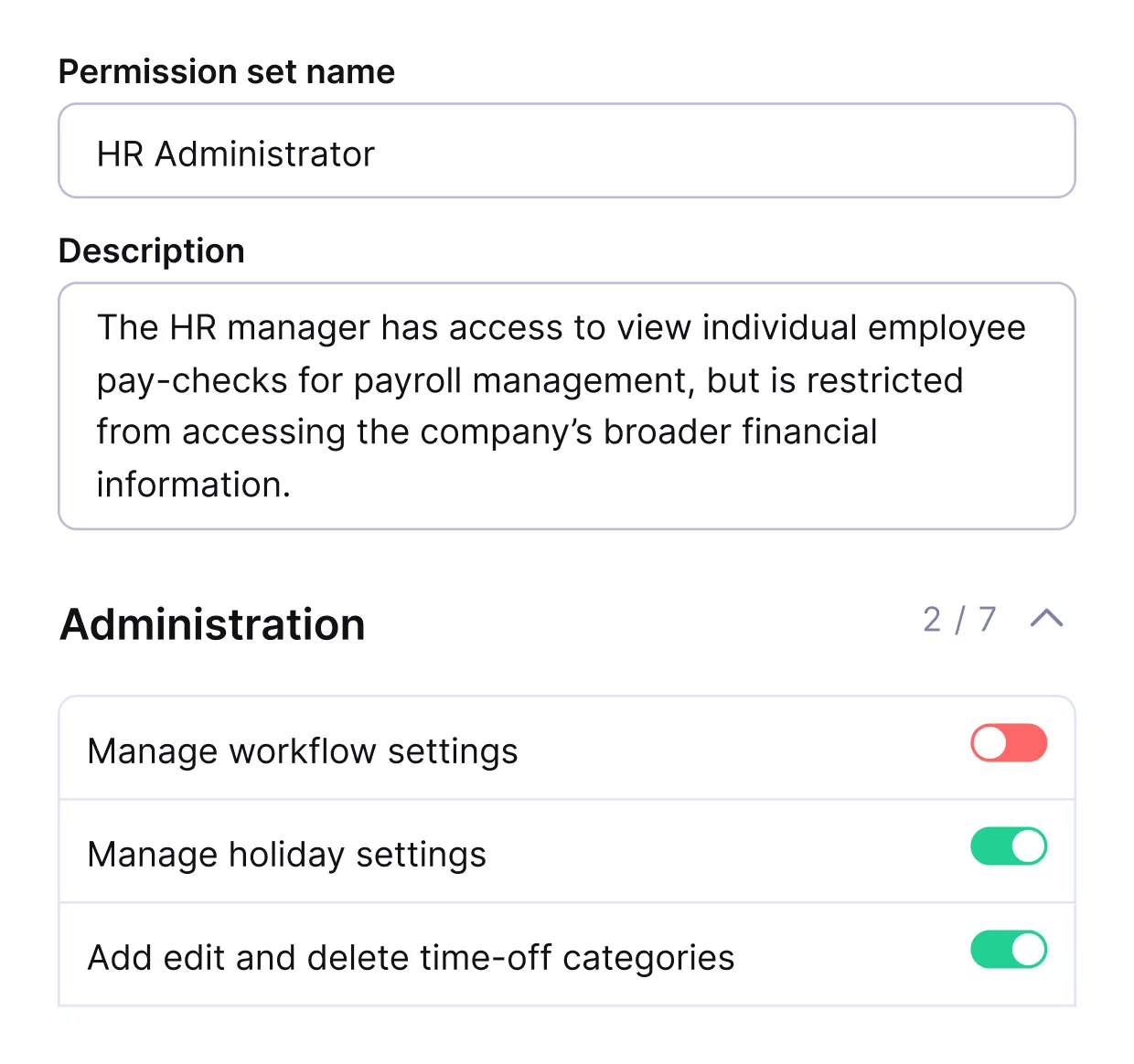
Productive Permission Builder ensures each member sees only the project data they need.
This way, each person sees the layer of data they’re entitled to.
Control your employees’ permissions in Productive
3. Brand Strategist
A brand strategist turns business goals into campaign direction and messaging that the whole team can execute. They make sure the agency does not jump straight into production before the team understands who the campaign is for and why it should work.
Day to day, this role:
- researches the audience and context
- defines positioning and key messages
- builds a messaging framework that the creative and channel teams can use
- writes the campaign brief and aligns stakeholders on it
In some agencies, you will see the title client strategist, especially when the role works closely with account teams and client workshops.
4. Project Manager
A project manager coordinates delivery and keeps scope, timelines, and dependencies under control. They turn a messy mix of tasks, people, and client feedback into a plan the team can actually follow.
A common point of confusion is project manager vs account manager: one keeps the work on track, while the other keeps the client aligned.
Day to day, this role:
- builds a timeline with clear milestones and owners
- coordinates tasks across roles so work does not get blocked
- tracks dependencies, risks, and approvals before they become emergencies
- protects the scope by documenting changes and resetting the plan when needed
This role often overlaps with a project coordinator in smaller teams, especially when there is a lot of scheduling and follow-up work.
5. Creative Director
A creative director owns creative direction and quality, so the work stays consistent before it reaches the client.
Day to day, this role:
- reviews concepts and early drafts before they reach the client
- sets creative standards so the creative team works toward the same bar
- mentors designers and copywriters during production
- gives the final sign-off on major deliverables
In some agencies, art director roles focus on the visual execution, while directors own the overall concept and final sign-off.
6. Designer
Designers create the visual deliverables clients actually see, and they align that work with the strategy and brand guidelines.
Day to day, this role:
- designs campaign and brand assets, from ads and landing pages to full page layouts
- builds and refines user experience flows so people can actually complete the action you want
- collaborates with copywriters and developers during website development to keep the design usable and on spec
7. Copywriter
A copywriter translates strategy into clear messaging that people actually want to read. They give the campaign a voice that stays consistent across channels, from the first ad someone sees to the last follow-up email.
Day to day, this role:
- writes copy for websites, landing pages, ads, emails, and social posts
- adapts one message to different formats without losing the point
- partners with designers to build interactive experiences that feel natural, not forced
8. SEO Specialist
An SEO specialist improves search visibility by making sure your site and content match how people actually search. They focus on the details that drive results: intent, structure, and technical health.
Day to day, this role:
- conducts keyword research and analyzes search intent before content is produced
- optimizes pages so headings, internal links, and structure support rankings
- fix technical issues that hold pages back from being indexed or discovered
- works with writers and designers so that the content reads well and still follows SEO best practices
An SEO specialist uses Google Analytics and basic business analytics to track what brings qualified traffic, what converts, and what needs improvement. They also keep an eye on data quality, because messy tracking leads to messy decisions.
9. PPC Specialist
A PPC specialist manages paid campaigns so ad spend turns into measurable leads or sales, not just clicks. They translate the plan into settings, creatives, and budgets that can actually hit performance goals.
Day to day, this role:
- structures campaigns and chooses targeting based on the audience and offer
- tests ads and landing pages, then scales what works
- manages budgets and bids so spend stays controlled
- tracks results daily and makes small optimizations before problems grow
A good PPC specialist pairs the numbers with context. They use Google Analytics and basic business analytics to see what happens after the click, not only inside the ad platform.
In larger agencies, a media director may oversee the overall paid strategy and budget allocation across channels. The PPC specialist still owns execution and optimization.
10. Social Media Manager
A social media manager owns organic social channels and keeps the community engaged, not just “posted at.” They translate campaign ideas into a consistent social presence that sounds like the brand and fits each platform.
Day to day, this role:
- plans content calendars that match the campaign and the client’s real capacity
- publishes posts, coordinates assets with designers and copywriters, and keeps approvals moving
- responds to comments and messages, spot patterns in feedback, and flag risks early
In some agencies, a digital marketing manager oversees multiple channels, while the social media manager owns organic social execution within the media team.
11. Operations Manager
An operations manager owns the systems and processes that keep agency operations running without chaos. They step in when the team needs three tools and a spreadsheet export to answer the question, “Are we on track?”
Day to day, this role:
- sets up project intake and defines what a kickoff needs
- standardizes workflows and handoffs (who approves what, and when)
- Keeps time tracking and invoicing rules consistent, so reporting stays usable
- maintains templates, permissions, and reporting inside the software system
As agencies grow, tool sprawl is usually the first fire: planning, time, invoicing, and tasks live in separate tools, which creates data lag and duplicated work.
With Productive, teams can replace 4–5 tools with a single software system, eliminate the export-import loop, and connect resource planning to timelines and budgets so forecasting is based on committed work.
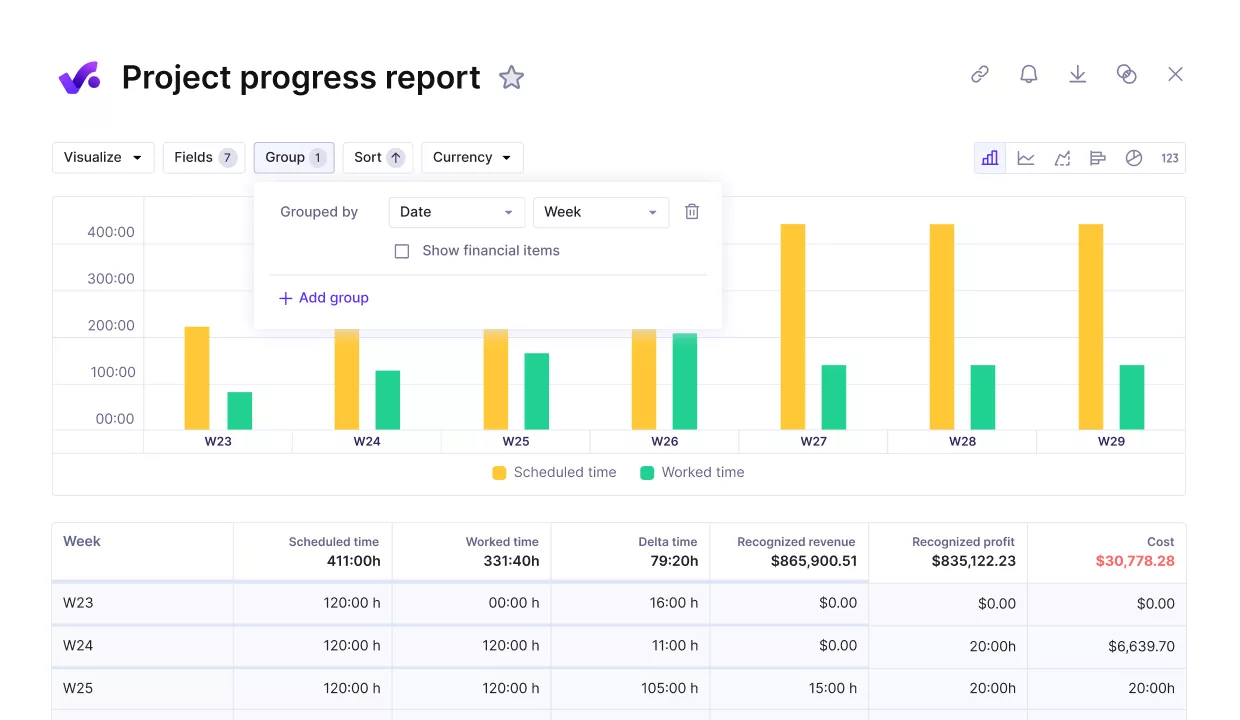
TRACK YOUR PROJECTS END-TO-END WITH PRODUCTIVE.
If you want a clearer view of which tools can reduce this kind of tool sprawl, check out our operations management software list.
12. Data and Analytics Specialist
A data and analytics specialist turns campaign performance data into insights the team can act on. They help the agency answer simple questions with confidence, like what is working, what is not, and what to change next.
Day to day, this role:
- sets up and maintains reporting dashboards and templates
- pulls and cleans data from data analytics tools
- checks tracking and naming so data quality stays consistent
- shares clear takeaways with account management and strategists, not just charts
As agencies grow, this role often becomes the “glue” that binds tools together. They align business analytics metrics and push for systemwide data quality to ensure leadership does not make decisions based on mismatched reports.
Next, let’s look at how these roles connect during a real client project and how work moves from one stage to the next.
Which Steps of a Client Project Do Marketing Agency Roles Collaborate In?
Marketing agency roles collaborate in these steps of a client project: sales and onboarding, strategy and planning, production and execution, and measurement and reporting.
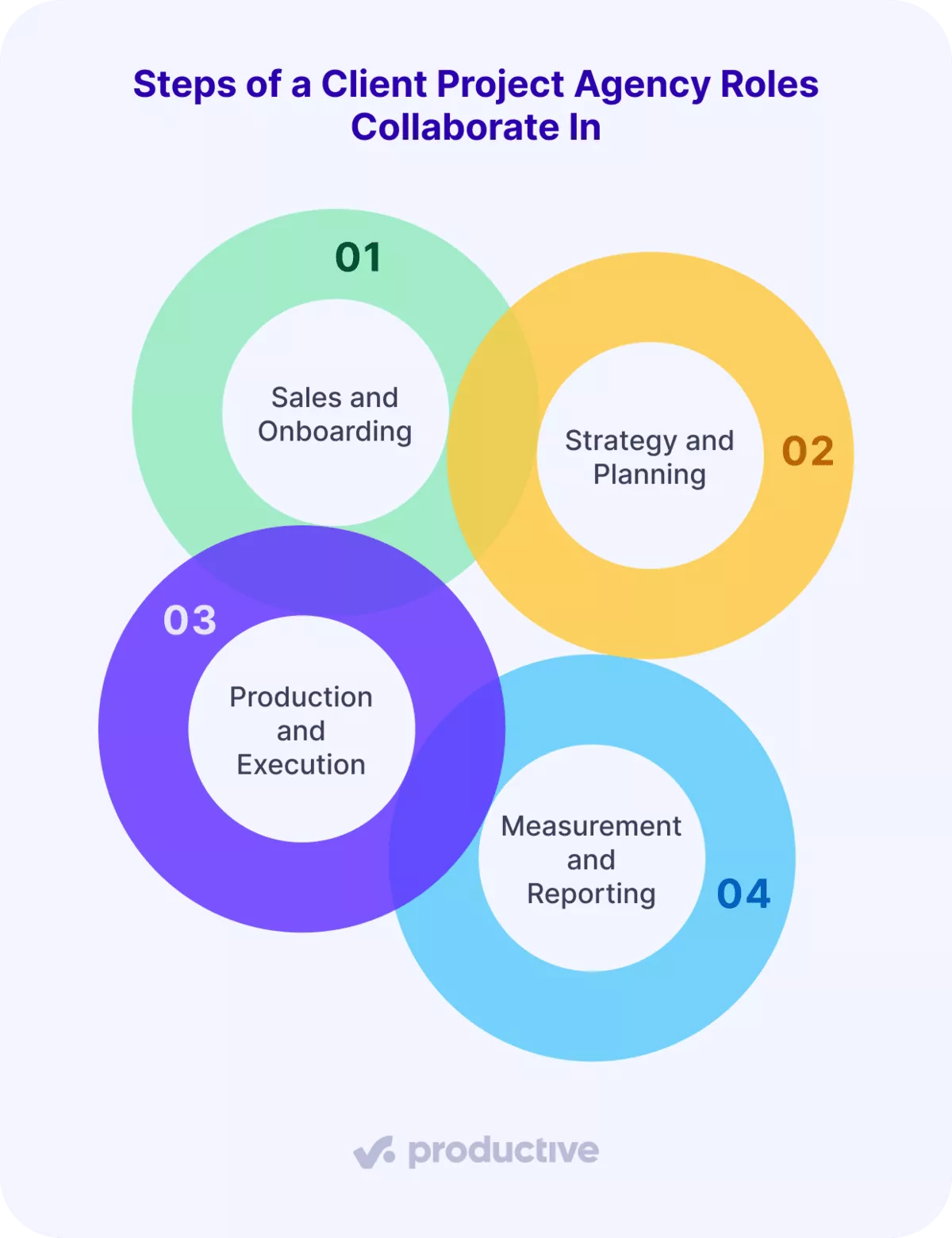
We will take a closer look at each step.
Step 1: Sales and Onboarding
Sales and onboarding are where the agency sets the project up for clean delivery. The business development manager provides context, but the handoff makes it real: the account managers confirm goals, align expectations, and ensure everyone agrees on what is included.
At this stage, a project manager turns the promise into a plan. The operations manager then supports onboarding by ensuring workflows, templates, and permissions are ready before work begins.
Step 2: Strategy and Planning
Strategy and planning are where the team agrees on what you are trying to achieve and how you will get there. The brand strategist leads the thinking, and the project manager turns it into a deliverable plan.
At this stage, the strategist runs the core workshops and research, then distills it into a brief that defines:
- target audience and market context
- key message and positioning
- the channels to prioritize
- success criteria and performance goals
The creative director often pressure-tests the brief here, too, so the team enters production with a clear direction rather than vague ideas.
Once the brief is clear, the project manager builds the execution plan by mapping milestones, dependencies, and approvals, then aligning the timeline with the performance goals and coordinating handoffs between specialists.
Step 3: Production and Execution
Production and execution are where the plan turns into deliverables. The project manager keeps the work moving, and the creative team and channel specialists ship what the client will actually use.
Designers and copywriters produce campaign assets and enhanced content, then adjust quickly as feedback comes in. If the project includes website development, they stay close to the build so the user experience matches the intent, not just the layout.
Channel specialists keep execution grounded in reality:
- SEO checks the structure and on-page basics before pages go live
- PPC aligns ads and landing pages so the promise matches the click
- social flags what will work in the feed
When those inputs happen early, you get stronger interactive experiences and less last-minute rework.
Step 4: Measurement and Reporting
Measurement and reporting are where the team reviews results and decides what to improve next. The data and analytics specialist analyzes performance, while account managers turn those insights into a clear client update.
The team reviews Google Analytics, examines post-click conversion behavior, and confirms data quality to ensure the numbers are reliable. From there, they summarize a small set of client-level data, connect it to business analytics, and recommend the next step: what to scale, adjust, or stop.
Next, let’s look at when team roles start to change as an agency grows.
At Which Stages Do Team Roles Typically Change as an Agency Grows?
As an agency grows, team roles typically change at these stages: 1–25 employees, 25–50 employees, and 50+ employees.
We will look in more detail at how they change in each phase.
1–25 Employees
At 1–25 employees, agency roles are still relatively flexible. In the earliest stage, the founder often acts as the project lead, and the same person may handle sales, client communication, and day-to-day delivery.
As the team grows, project management becomes a real function rather than something handled by whoever is free.
Specialists exist, but they still handle a wide range of tasks. A designer may also handle basic web work, while a copywriter may cover ads, emails, and landing pages. Early capacity planning also matters because work now flows through a few asset pools, and the agency needs to know who is actually available before promising new work.
25–50 Employees
At 25–50 employees, the agency’s structure changes again. Teams become more specialized, leading to more handoffs between roles and more projects running at the same time.
At this stage, several managerial roles typically become more defined:
- project managers focus on delivery coordination instead of juggling client communication
- account managers take clearer ownership of client relationships and expectations
- operations managers maintain workflows, reporting rules, and the main software system
This is also the point where many owners hit the same nightmare: they can no longer answer basic questions quickly. Are we making money on this client? Do we have the capacity to take on more work? Who is over-allocated?
With Productive’s Budgeting, leadership can see budget health, utilization targets, and profitability by client or department in one place.
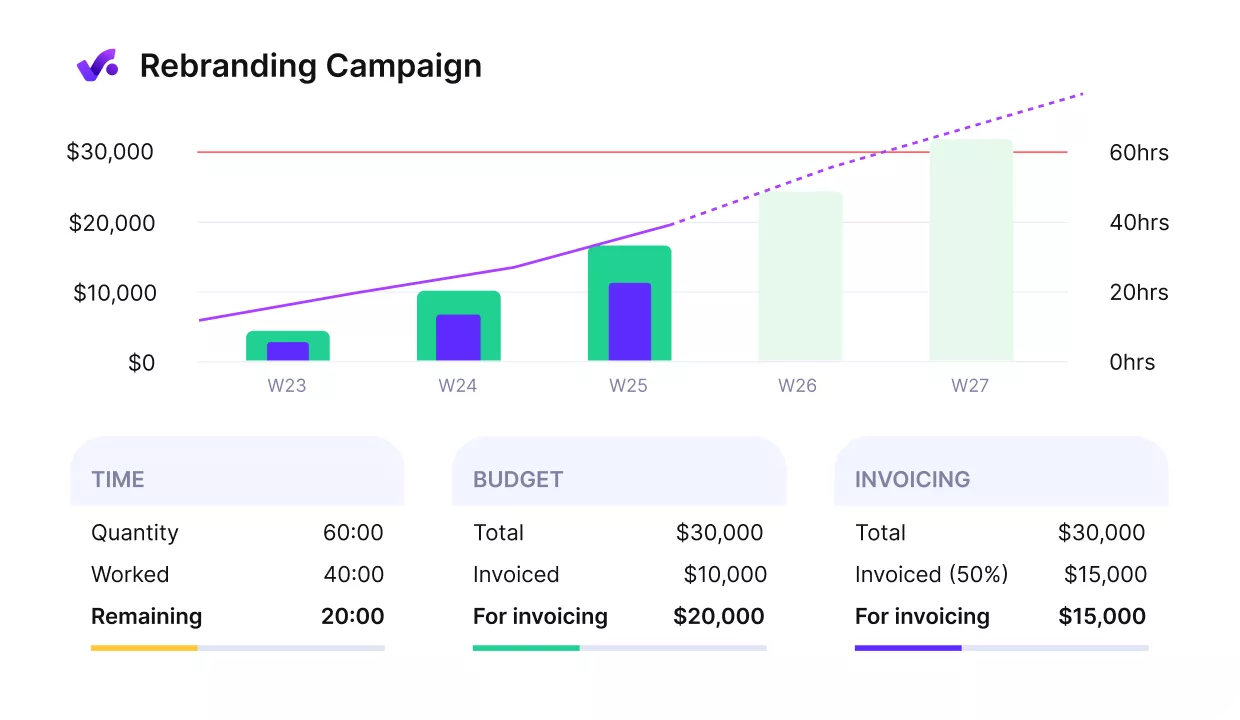
GAIN FINANCIAL CLARITY WITH PRODUCTIVE.
That means fewer spreadsheets, less “asking around,” and faster decisions because the numbers stay live.

It’s great to be able to see until what point some projects will be profitable and when they won’t be anymore.
Read the full customer story to learn how Globaldatanet gained financial clarity with Productive.
50+ Employees
With 50+ employees, departments are solidifying, and the agency needs consistent reporting across teams.This is where clean measurement becomes non-negotiable.
Agencies invest in data analytics tools and basic data warehousing. Hence, client-level data is consistent, data quality is maintained, and systemwide data quality is not dependent on who last exported the latest spreadsheet.
What Agencies Need As Teams and Projects Scale
As an agency expands, more roles, projects, and handoffs happen at once. What felt easy with five people gets messy with thirty if information is split across tools, chats, and memory. Clear agency roles and shared visibility keep work moving, because everyone knows who owns what and where to find the real project status.
That is why having the right software matters. Productive brings project management, timetracking, reporting, and resource planning into one place so that the team can work from the same source of truth instead of scattered tools and updates.
If you want clearer visibility across your agency, book a demo with Productive and see how it helps you manage everything in one system.
Run your agency operations from a single platform.
Productive connects project delivery, resource planning, and financial data in a single platform. See who owns what, track project progress, and keep your entire agency aligned without spreadsheets or scattered tools.
